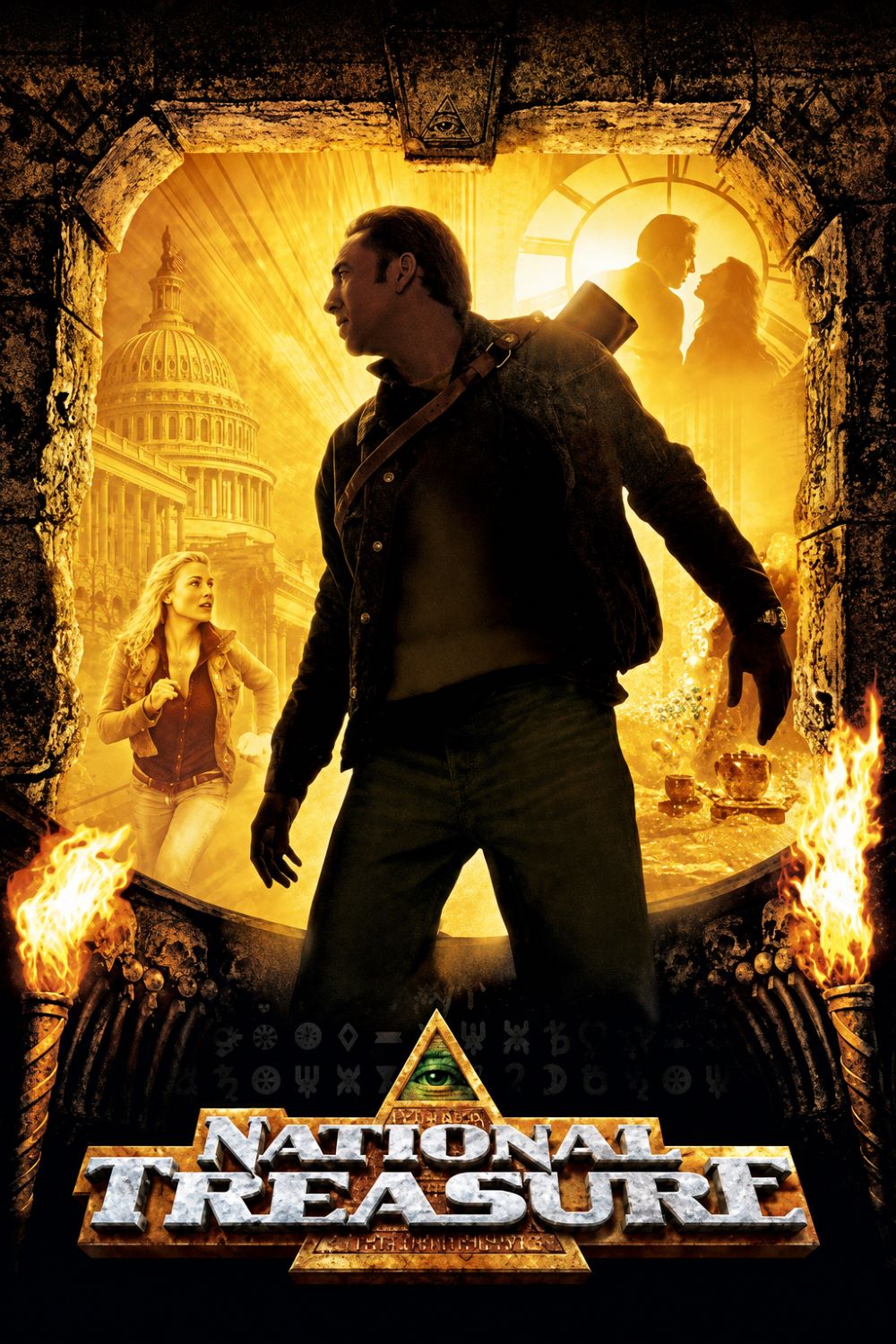
Review: National Treasure (dir. by John Turteltaub)


“If there’s something wrong, those who have the ability to take action have the responsibility to take action.” — Benjamin Gates

National Treasure directed by John Turteltaub is one of those movies that feels like a love letter to adventure, history, and a bit of old-fashioned treasure hunting. It’s the kind of film that doesn’t take itself too seriously but still manages to pull you in with its charm, puzzles, and non-stop action. At its heart, it’s a story about obsession, legacy, and the idea that history isn’t just something you read about in books—it’s something you can touch, chase, and maybe even uncover if you’re clever enough.

The movie kicks off with Benjamin Franklin Gates, played by Nicolas Cage in one of his most Nicolas Cage roles, as a historian and amateur treasure hunter convinced that a massive treasure hidden by the Freemasons and the Founding Fathers is real. The idea is wild: a secret stash of gold, artifacts, and historical riches hidden away to keep them out of the wrong hands. Most people, including his own father, think he’s nuts. But Ben’s got a lead, and when a rival treasure hunter, Ian Howe (played by Sean Bean), starts closing in on the same clues, the race is on. The stakes get higher when Ben realizes that if Howe finds the treasure first, it could mean disaster—not just for Ben’s reputation, but for history itself.

What makes National Treasure so much fun is how it blends history with a modern-day adventure. The film takes real historical figures and events—like the Declaration of Independence, the Liberty Bell, and the National Archives—and weaves them into a fictional but plausible treasure hunt. It’s the kind of movie that makes you want to dust off your old history textbooks or visit a museum the next day. The puzzles and clues are clever, even if they’re a little far-fetched. From invisible ink on the back of the Declaration to a series of riddles leading to the next location, the film keeps you guessing and engaged. And let’s be honest, who hasn’t daydreamed about finding a hidden message in a famous document or stumbling upon a secret that changes everything?

You really cannot talk about National Treasure without talking about Nicolas Cage. By 2004, Cage had already firmly established his reputation as an actor who brings a very specific, slightly unhinged energy to every role, and Benjamin Franklin Gates might be the perfect vessel for that energy. Ben is a nerd, but he is a nerd who somehow knows how to do parkour and execute complex heists. Cage plays him with this weird, endearing earnestness that anchors the movie. He delivers ridiculous lines about the Illuminati and secret tunnels with the gravity of a Shakespearean monologue, and it is hilarious, but it also makes you genuinely root for him. He never winks at the audience; he truly believes in the treasure, and that conviction pulls the whole thing together.

Of course, Cage cannot carry the entire movie on his own, and the supporting cast is surprisingly well-calibrated for this kind of ridiculous adventure. Justin Bartha plays Riley Poole, Ben’s tech-savvy sidekick who provides a running commentary of sarcastic quips. Bartha is essentially the audience surrogate, constantly pointing out how insane everything is, but he never gets annoying, which is a tough balancing act for a comic relief character in an action movie. Then there is Diane Kruger as Abigail Chase, an archivist at the National Archives who gets dragged into the chaos. Kruger does a great job of playing the exasperated straight woman to Cage’s eccentric history buff, and their chemistry is surprisingly charming, even if her character arc basically boils down to realizing that stealing national monuments is actually kind of fun.

On the villain side of things, we have Sean Bean as Ian Howe, and honestly, casting Sean Bean as a treasure-hunting bad guy is just a cheat code for making your movie better. Howe is a classic blockbuster villain—polished, ruthless, and driven entirely by greed—but Bean gives him just enough suave charm that he feels like a genuine threat rather than a cartoonish punching bag. Rounding out the main cast is Jon Voight as Ben’s estranged father, Patrick, and Christopher Plummer as his grandfather, John. Their inclusion adds a nice generational family drama to the story. The Gates family has been mocked for centuries for chasing this mythical treasure, and seeing Ben finally prove his father wrong adds a surprising amount of emotional weight to a movie that is otherwise about stealing the Declaration of Independence with a bunch of plastic ciphers.

John Turteltaub’s direction keeps the movie moving at a brisk pace. There’s never a dull moment, and the film balances its action sequences with quieter moments of discovery and problem-solving. The chase scenes, whether it’s through the streets of Washington D.C. or the tunnels beneath Philadelphia, are exciting without being over-the-top. The film also does a great job of making the historical elements feel tangible. When Ben and his team are examining a clue or piecing together a puzzle, you feel like you’re right there with them, trying to figure it out alongside them. It’s a testament to Turteltaub’s ability to make the implausible feel plausible, at least for the two hours you’re watching the movie.

Of course, National Treasure isn’t without its flaws. The plot does require a fair amount of suspension of disbelief. The idea that a treasure of this magnitude could stay hidden for centuries, or that Ben could outsmart everyone from the FBI to a team of professional thieves, is a stretch. And some of the historical liberties the film takes might make purists cringe. But that’s part of the fun. This isn’t a documentary—it’s a popcorn movie, and it embraces that wholeheartedly. The film also leans heavily on its twists and turns, some of which you might see coming a mile away. But even when you can predict what’s going to happen next, it’s still entertaining to watch it unfold.

What really stands out about National Treasure is its sense of wonder. It’s a movie that reminds you of the joy of discovery, whether it’s uncovering a hidden clue or simply learning something new about the world. The film’s climax, set in a secret underground chamber, is a perfect example of this. Without giving too much away, it’s a moment that feels both epic and intimate, a payoff for all the hard work and dedication Ben has put into his quest. And while the treasure itself might not be what you expect, the journey to find it is what makes the movie so satisfying.

In the end, National Treasure is a film that’s easy to enjoy. It’s got action, humor, history, and heart, all wrapped up in a package that’s as entertaining as it is lighthearted. It’s the kind of movie you can watch on a lazy Sunday afternoon and come away from feeling like you’ve been on an adventure yourself. Sure, it might not be high art, but it doesn’t need to be. Sometimes, a great story, a little bit of mystery, and a lot of fun are all you need. And National Treasure delivers on all three. If you’re a fan of adventure films, history buffs, or just love a good treasure hunt, this one’s for you. Just don’t be surprised if you find yourself Googling Freemason symbols or the history of the Declaration of Independence afterward.
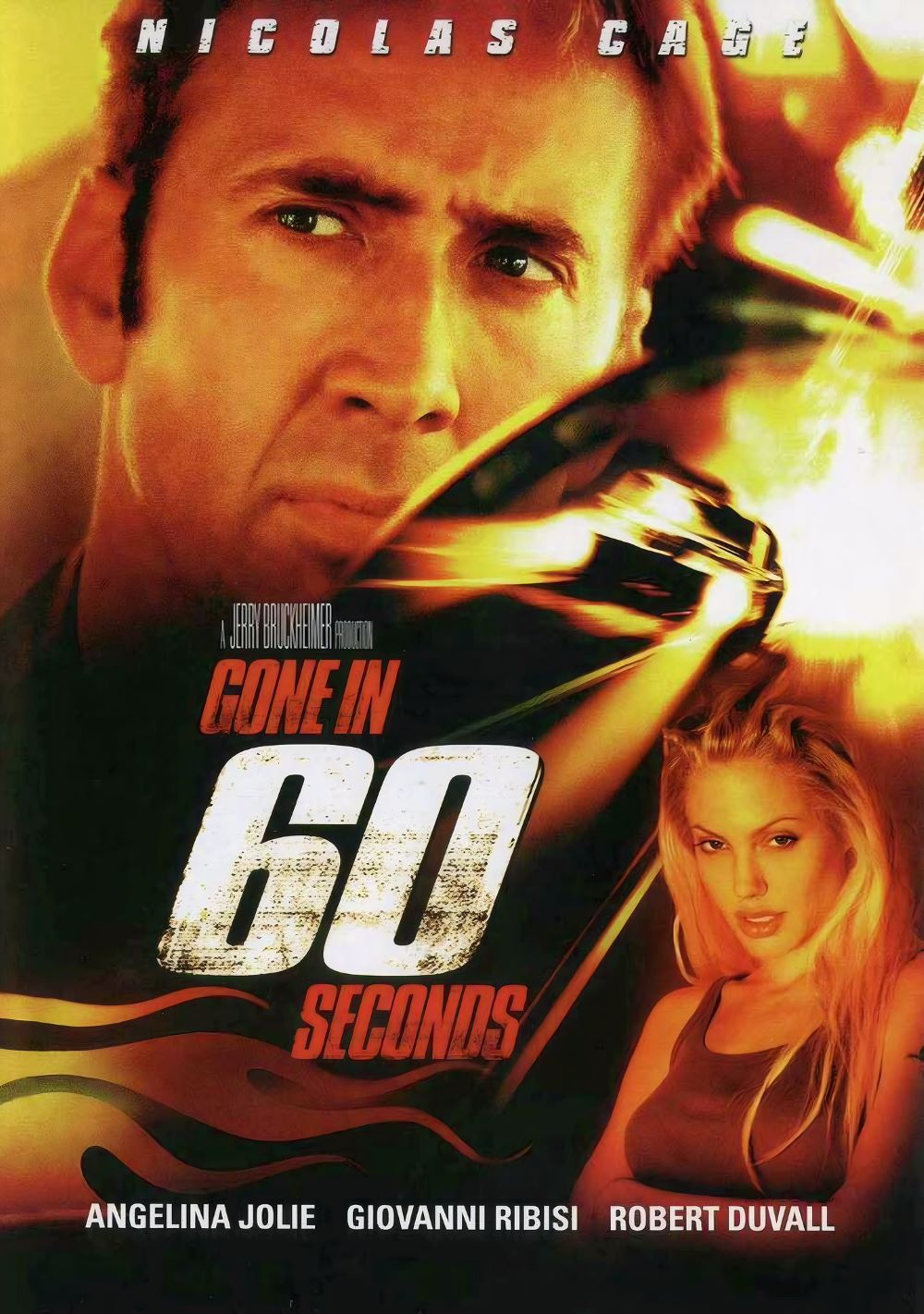
Guilty Pleasure No. 117: Gone in 60 Seconds (dir. by Dominic Sena)


There is a specific, almost alchemical quality to the late 1990s and early 2000s era of Nicolas Cage as an action star. Before the internet turned every one of his performances into a meme and before his financial troubles led him down the rabbit hole of direct-to-video oddities, Cage was genuinely one of the most exciting and weirdly compelling action heroes on the planet. From The Rock in 1996 to Con Air in 1997 and Face/Off in 1997, he delivered a holy trinity of high-octane insanity that no other actor could have pulled off. By the time the calendar flipped to 2000, Cage was at the peak of his powers, and director Dominic Sena’s Gone in 60 Seconds arrived as both a victory lap and a slight exhale. It is not as unhinged as Face/Off nor as tightly wound as The Rock, but it is a perfect snapshot of its moment: a glossy, MTV-infused car heist flick that smells like gasoline, leather, and late-90s hubris. And while it has plenty of shortcomings, Gone in 60 Seconds has earned its place not in the pantheon of great action cinema, but in that more beloved hall of fame: the Guilty Pleasure.

The plot is as simple as a carburetor. Cage plays Randall “Memphis” Raines, a legendary car thief who has supposedly gone straight, now living a quiet life designing hybrid engines. But when his reckless younger brother Kip, played with sweaty desperation by Giovanni Ribisi, botches a job for a ruthless British gangster named Raymond Calitri (Christopher Eccleston at his sleaziest), Memphis is forced back into the life he left behind. The task is absurdly impossible: steal 50 specific luxury cars in a single weekend, or Calitri will kill Kip. That’s right, fifty cars. In three days. The film never really bothers to explain the logistics of storing or delivering that many vehicles, but that’s not the point. The point is the ride, the revving engines, and the way Cage stares at a 1967 Shelby GT500 named Eleanor like she’s the ghost of a lost lover. That car is the real star, and the film knows it.

Dominic Sena, who previously directed Cage in the underrated road thriller Kalifornia, brings a music video sensibility to the proceedings. Gone in 60 Seconds is drenched in late-90s visual tics: slow-motion shots of hubcaps spinning, golden sunsets glaring off polished chrome, and a soundtrack that alternates between nu-metal grooves and bluesy rock. The editing is fast but not confusing, and the heist sequences have a rhythmic, almost choreographed feel. You never believe for a second that Memphis and his crew—a motley collection of oddballs played by Robert Duvall, Vinnie Jones, and a very underutilized Angelina Jolie—can actually pull off fifty thefts without the entire LAPD catching on. But the film operates on movie logic. Cars are hotwired in seconds, police radio chatter is effortlessly avoided, and every chase defies the laws of physics. It is pure fantasy, and that is exactly why it works as a guilty pleasure.

Now, let’s talk about Cage. In 2000, he was still riding the high of that legendary late-90s run, and Gone in 60 Seconds fits neatly into his brand of action star as tortured romantic. Memphis Raines is not the coked-up lunatic Castor Troy or the shouty Stanley Goodspeed. He is weary, melancholic, and trying to be honorable in a dishonorable profession. Cage plays him with a hangdog sincerity that is surprisingly effective. When he talks to Eleanor, stroking her steering wheel and whispering about how she tests her drivers, he is utterly committed. There is no irony, no winking at the camera. That is the secret to Cage’s enduring appeal in this era: he treats absurd material with the same intensity he would bring to a Shakespeare soliloquy. The action sequences—especially the climactic chase where Eleanor leaps over a drawbridge—showcase Cage’s physicality and willingness to do real stunt work. He sells the danger and the desperation. You believe that this man would risk everything for a car, and that belief makes the film’s silliness palatable.

But let’s be honest about the shortcomings, because Gone in 60 Seconds has plenty. The middle act drags considerably. For a movie about stealing fifty cars, there is a surprising amount of standing around in warehouses and having conversations about “respecting the machine.” Angelina Jolie’s character, Sara, is Memphis’s ex-girlfriend and a fellow thief, but she is given almost nothing to do except look cool in leather and exchange tepid romantic banter with Cage. The chemistry between them is nonexistent. Christopher Eccleston’s Calitri is a one-note villain who likes opera and cruelty, and his final defeat is laughably abrupt. Delroy Lindo plays a dogged detective, but he is so incompetent that he never generates real tension. The film’s central gimmick—the ticking clock of fifty cars in three days—is inconsistently tracked, and by the final act, you have no idea how many cars are left or why it still matters. The dialogue is also gloriously corny. Lines like “Ride or die” and “Respect the car, man” are delivered with such straight faces that they circle back around to being endearing.

And yet, Gone in 60 Seconds earns its status as a guilty pleasure because it understands exactly what it is. This is not a sophisticated heist thriller like Heat or a gritty crime drama. It is a shiny, high-budget B-movie about a man and his car, and it leans into that identity without apology. The final twenty-minute chase sequence is genuinely thrilling, with real cars being destroyed and practical stunts that modern CGI could never replicate. Eleanor getting airborne, landing hard, and somehow still running is a moment of pure cinematic joy. The sound design—the roar of that V8 engine, the screech of tires on asphalt—is visceral and satisfying. And Cage’s performance, even when the script lets him down, holds the whole thing together. He is the anchor that keeps the film from floating away into utter nonsense.

Looking back from today’s perspective, Gone in 60 Seconds is a time capsule of a very specific moment. It captures the tail end of the late-90s obsession with extreme sports, tuner culture, and the idea that cars had souls. It also captures Nicolas Cage at a fascinating crossroads: still an A-list action star, still capable of opening a blockbuster, but already showing the signs of the wonderful weirdness that would later define his career. This film is not his best, not by a long shot, but it is one of his most rewatchable. You put it on when you want to turn your brain off, hear some great engine noises, and watch a sweaty, sincere Nic Cage talk to a Shelby like she is his long-lost sweetheart. That is the definition of a guilty pleasure. It is not good in the traditional sense, but it is fun. And sometimes, fun is enough.

Previous Guilty Pleasures

  1. Half-Baked
  2. Save The Last Dance
  3. Every Rose Has Its Thorns
  4. The Jeremy Kyle Show
  5. Invasion USA
  6. The Golden Child
  7. Final Destination 2
  8. Paparazzi
  9. The Principal
  10. The Substitute
  11. Terror In The Family
  12. Pandorum
  13. Lambada
  14. Fear
  15. Cocktail
  16. Keep Off The Grass
  17. Girls, Girls, Girls
  18. Class
  19. Tart
  20. King Kong vs. Godzilla
  21. Hawk the Slayer
  22. Battle Beyond the Stars
  23. Meridian
  24. Walk of Shame
  25. From Justin To Kelly
  26. Project Greenlight
  27. Sex Decoy: Love Stings
  28. Swimfan
  29. On the Line
  30. Wolfen
  31. Hail Caesar!
  32. It’s So Cold In The D
  33. In the Mix
  34. Healed By Grace
  35. Valley of the Dolls
  36. The Legend of Billie Jean
  37. Death Wish
  38. Shipping Wars
  39. Ghost Whisperer
  40. Parking Wars
  41. The Dead Are After Me
  42. Harper’s Island
  43. The Resurrection of Gavin Stone
  44. Paranormal State
  45. Utopia
  46. Bar Rescue
  47. The Powers of Matthew Star
  48. Spiker
  49. Heavenly Bodies
  50. Maid in Manhattan
  51. Rage and Honor
  52. Saved By The Bell 3. 21 “No Hope With Dope”
  53. Happy Gilmore
  54. Solarbabies
  55. The Dawn of Correction
  56. Once You Understand
  57. The Voyeurs 
  58. Robot Jox
  59. Teen Wolf
  60. The Running Man
  61. Double Dragon
  62. Backtrack
  63. Julie and Jack
  64. Karate Warrior
  65. Invaders From Mars
  66. Cloverfield
  67. Aerobicide 
  68. Blood Harvest
  69. Shocking Dark
  70. Face The Truth
  71. Submerged
  72. The Canyons
  73. Days of Thunder
  74. Van Helsing
  75. The Night Comes for Us
  76. Code of Silence
  77. Captain Ron
  78. Armageddon
  79. Kate’s Secret
  80. Point Break
  81. The Replacements
  82. The Shadow
  83. Meteor
  84. Last Action Hero
  85. Attack of the Killer Tomatoes
  86. The Horror at 37,000 Feet
  87. The ‘Burbs
  88. Lifeforce
  89. Highschool of the Dead
  90. Ice Station Zebra
  91. No One Lives
  92. Brewster’s Millions
  93. Porky’s
  94. Revenge of the Nerds
  95. The Delta Force
  96. The Hidden
  97. Roller Boogie
  98. Raw Deal
  99. Death Merchant Series
  100. Ski Patrol
  101. The Executioner Series
  102. The Destroyer Series
  103. Private Teacher
  104. The Parker Series
  105. Ramba
  106. The Troubles of Janice
  107. Ironwood
  108. Interspecies Reviewers
  109. SST — Death Flight
  110. Undercover Brother
  111. Out for Justice
  112. Food Wars!
  113. Cherry
  114. Death Race
  115. The Beast Within
  116. Girl Series