I watched it so you don’t have to: “My Boyfriend’s Back” (1993)
“He died for me, He came back from the dead for me, He ate somebody for me.”
I’ll get back to that, but let’s get the technicalities out of the way first!
Stars:
Andrew Lowery as Johnny Dingle (Buffy The Vampire Slayer, Nothing, Clerks)
Traci Lind as Missy McCloud (Voyager, Fame, 21 Jump Street)
Minor roles by:
Philip Seymour Hoffman, Cloris Leachman,Matthew McConaughey, Renée Zellweger (You might have heard of them.)
Directed by:
Bob Balaban (Nurse Jackie, The Twilight Zone, plus much more)
Written by:
Dean Lorey (Arrested Development, ‘Til Death)
Plot:
To impress his wanna be girlfriend (Lind), Johnny (Lowery) decides to stage a convenience store robbery. In that staging he is killed and comes back as a zombie. Just before dying, Johnny asked Missy to the prom and she accepts.
As Johnny comes back as a zombie, he tries to integrate back into society. Facing anti-zombie discrimination. Missy finally agrees to got to prom with him in his zombie state. Going to the prom, Johnny finally disitergrates into his un-dead form.
While he made it to Heaven, he was let known that his original death was a mistake and he is given another chance. Put back in the point of the robbery, and knowing he was never meant to die, Johnny dives infront of the bullet. The bullet, caught by a locket he made of Missy and himself in the first grade, he is saved. Missy and Johnny go to the prom and (presumably) live happily ever after.
Review:
Honestly, going in, I really wanted to hate this movie. It has all the cheesy plot lines. Boy loves girl, boy dies for girl, boy comes back for girl, she ends up loving him. But if I am going to be honest, this movie was really cute. And to get back to my original quote, yeah, that worked!
Since “My Boyfriend’s Back” is not in public domain, I can’t give you a link to the entire movie, but here is a trailer if you like! 🙂
Gerard Depardieu is naked a lot in Welcome to New York and I know you’re probably being snarky and sarcastically thinking, “Well, then I’m definitely going to track down this film…” but actually, the frequent display of Depardieu’s body gets to the heart of what makes his performance so memorable. Playing an extremely unsympathetic role, Depardieu doesn’t hide the character’s depravity from the audience. He reveals every inch of the character, from his flabby body to his empty soul. It takes courage to bring such an unsympathetic character to life and talent to keep the audience watching and fortunately, Depardieu has both of those.
Welcome to New York opens with Depardieu (as himself) talking to a group of reporters and explaining why he’s decided to play a character based on Dominique Strauss-Kahn in Abel Ferrara’s upcoming movie. It’s an interesting way to start, both because it features Depardieu’s scornful opinion of politicians and because it leaves no doubt that, even if Depardieu’s character has been renamed Devereaux, Welcome to New York is directly based on the Dominique Strauss-Kahn case.
(Dominique Strauss-Kahn, of course, was the wealthy French socialist who many thought was going to be the next President of France until he was arrested after raping a hotel maid in New York City. As a wealthy and well-connected white man, he was acquitted of raping the maid, who neither wealthy, well-connected, or white. Throughout the trial, the usual collection of elitists complained about how Americans just didn’t understand French culture but, ultimately, Strauss-Kahn’s political career was ended by the scandal.)
Welcome to New York closely follows the facts of the Strauss-Kahn case. Wealthy banker and politician Devereaux is in New York on business. When he meets his daughter and her boyfriend, he spends the entire lunch asking them about their sex life. When he returns to his hotel, he and his business associates hire a group of prostitutes and have one of the most depressing orgies ever captured on film.
I have to admit that during these first part of the film, I was often tempted to turn off Welcome To New York. No, it wasn’t that the film was too explicit. Instead, my problem was that Devereaux was such a dull character. Devereaux has a lot of sex during the first third of the film but, at no point, does he seem to enjoy it. Instead, he is detached from everything happening around him and it doesn’t exactly make for compelling viewing.
But, as the film played out, I realized that we weren’t supposed to find Devereaux in any way compelling. Instead, Devereaux is portrayed as a hollow and empty shell. For him, sex is all about entitlement and power. After his is arrested for raping the hotel maid, Devereaux appears to be more surprised than anything else. Rather than feeling regret at being caught or even fear that he might be convicted, Devereaux seems to be shocked that a man of his wealth would be held responsible for his actions.
After Devereaux is arrested, the film’s pace picks up a bit. Devereaux’s wife, Simone (Jacqueline Bisset), flies to New York and takes over her husband’s defense. It’s not that Simone feels that Devereaux has been wrongly accused. In fact, Simone really doesn’t seem to care much for her husband in general. However, Simone is determined that Devereaux is going to be the next president of France and she certainly has no intention of allowing some American criminal case to stand in his way. Bisset gives a chilling performance as the almost fanatically driven Simone.
Soon, Devereaux is under house arrest and staying at a rented house. (For these scenes, Welcome to New York filmed in the same house that Strauss-Kahn stayed at during his trial.) It’s while locked away in the house that Devereaux finally starts to realize that he has gone too far. It’s in the house that Devereaux remembers the man he was once was and is forced to confront the man that he has become.
Welcome to New York is not always an easy film to watch but, thanks to Depardieu and Bisset’s ferocious performances, it’s a film that will reward patient viewers.
Today was the first day of a new year so, of course, I had to go down to the Alamo Drafthouse and see a movie. What was the title of the first movie that I saw in a theater in 2016?
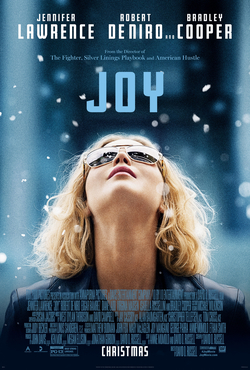
Joy.
Despite the fact that Joy has gotten some seriously mixed reviews, I had high hopes when I sat down in the Alamo. After all, Joy represents the third collaboration between director David O. Russell and one of my favorite actresses, Jennifer Lawrence. (Their previous collaborations — Silver Linings Playbook and American Hustle — happen to be two of my favorite films of the past 5 years.) Add to that, Joy has been advertised as being a tribute to a real-life, strong-willed woman and I figured that, at the very least, it would provide a nice alternative to the testosterone-crazed movies that I’ve recently sat through. And finally, Joy had a great trailer!
Sure, there were a few less than positive signs about Joy. As I mentioned before, the majority of the reviews had been mixed and the word of mouth was even worse. (My friend, the sportswriter Jason Tarwater, used one word to describe the film to me: “Meh.”) But what truly worried me was that Sasha Stone of AwardsDaily absolutely raved about the film on her site and that’s usually a bad sign. Let’s not forget that this is the same Sasha Stone who claimed that Maps To The Stars was one of the best films ever made about Hollywood.
And, to be honest, I had much the same reaction to Joy that I had to Map To The Stars. I really wanted to love Joy and, occasionally, there would be a clever bit of dialogue or an unexpected directorial choice and I would briefly perk up in my seat and think to myself, “Okay, this is the film that I wanted to see!” But, for the most part, Joy is a disappointment. It’s not so much that it’s bad as it’s just not particularly great. For the most part, it’s just meh.
But let’s talk about what worked. Overall, this may be one of Jennifer Lawrence’s lesser films but she gives a great performance, one that reminds us that she truly is one of the best actresses working today. I’ve read some complaints that Lawrence was too young for the title role and, to be absolutely honest, she probably is. She looks like she could easily go undercover at a high school and help Jonah Hill and Channing Tatum bust drug dealers. But, at the same time, she projects the inner weariness of a survivor. For lack of a better term, she has an old soul and it comes across in her films.
In Joy, she plays Joy Mangano, a divorced mother of two who lives in upstate New York. Her mother (Virginia Madsen) lives with Joy and spends all of her time watching soap operas. Joy ex-husband, a lounge singer named Tony (Edgar Ramirez), lives in the basement. Meanwhile, her grandmother (Diane Ladd, who narrates the film) is always hovering in the background, offering Joy encouragement and optimism. At the start of the film, Joy’s cantankerous father (Robert De Niro) has also moved into the house. Joy, who was the valedictorian of her high school, has got a demeaning job working as a flight booker at the airport.
(“What’s your name?” one rude customer asks, “Joy? You don’t seem very joyful to me…”)
How stressful is Joy’s life? It’s so stressful that she has a reoccurring nightmare in which she’s trapped in her mother’s favorite soap opera and Susan Lucci (cleverly playing herself) tells her that she should just give up.
However, as difficult as life may get, Joy refuses to take Susan Lucci’s advise. She invents a miraculous mop known as the miracle mop and eventually becomes a highly successful businesswoman. Along the way, she makes her television debut on QVC and becomes a minor celebrity herself…
The film’s best scenes are the ones that deal with Joy and QVC. These scenes, in which the inexperienced Joy proves herself to be a natural saleswoman, are the best in the film. These scenes are filled with the spark that I was hoping would be present throughout the entire film. Of course, it helps that these scenes also feature Bradley Cooper as a sympathetic television executive. This is the third time that Bradley Cooper and Jennifer Lawrence have acted opposite each other and there’s an immediate chemistry between them. In this case, it’s not a romantic chemistry (and one of the things that I did appreciate about Joy was that it didn’t try to force a predictable romance on the title character). Instead, it’s the type of mutual respect that you rarely see between male and female characters in the movies. It’s a lot of fun to watch, precisely because it is so real and unexpected.
But sadly, the QVC scenes only make up a relatively small part of Joy. The rest of the film is something of a mess, with David O. Russell never settling on a consistent tone. At times, Joy feels like a disorganized collection of themes from his previous films. Just as in The Fighter and Silver Linings Playbook, we get the quirky and dysfunctional family. Just as in American Hustle, we get the period detail, the Scorsese-lite soundtrack, and the moments of cynical humor. There’s a lot going on in Joy and, at time, it doesn’t seem that Russell really knows what to do with all the theme and characters that he’s mixed into the movie. I found myself wondering if he truly understood the story that he was trying to tell.
Finally, at the end of the film, Joy visits a business rival in Dallas, Texas. Let’s just say that the film’s version of Dallas looks nothing like the city that I know. (The minute that the scene cut from her ex-husband discovering that Joy had left to a close-up of a Bar-B-Q sign, I let out an exasperated, “Oh, come on!”) I suppose I should be happy that Russell didn’t have huge mountains in the background of the Dallas scenes but seriously, would it have killed anyone to do a little research or maybe hop on a plane and spend a day or two filming on location?
(After all, if Richard Linklater or Wes Anderson decided to set a movie in David O. Russell’s home state of Massachusetts, I doubt that they would film the Boston scenes in El Paso….)
Joy features great work from Jennifer Lawrence and Bradley Cooper and it tells a story that has the potential to be very empowering. But, when it comes to the overall film … meh.
What’s an Insomnia File? You know how some times you just can’t get any sleep and, at about three in the morning, you’ll find yourself watching whatever you can find on cable? This feature is all about those insomnia-inspired discoveries!
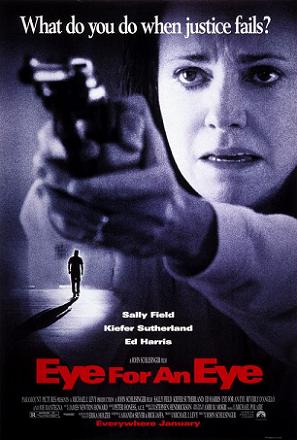
If you were awake at midnight and trying to get some sleep, you could have turned over to ThillerMax and watched the 1996 revenge thriller, Eye For An Eye. However, the film wouldn’t have helped you get to sleep. Eye For An Eye is not a film that you sleep through.
Eye For An Eye opens with Karen McCann (Sally Field) comforting her youngest daughter, Megan (Alexandra Kyle). Megan is terrified of a moth that has flown into her bedroom. “Kill it, mommy, kill it!” Megan shouts. Instead, Karen gently takes the moth in her hand and allows it to escape through an open window. In those first few minutes, the film tells us everything that it feels to be important about Karen. She’s a mother. She lives in a big house in the suburbs. And she wouldn’t kill a moth…
But — the name of the title is Eye For An Eye and that would seem to promise killing so we know that something terrible is going to happen to change Karen’s outlook on life.
And it does! The next afternoon, Karen is stuck in traffic and calls her oldest daughter, 17 year-old Julie (Olivia Burnette). In an extremely harrowing sequence that is pure nightmare fuel, Karen helplessly listens as Julie is raped and murdered.
A white trash deliveryman named Robert Doob is arrested for the crime and we immediately know that he’s guilty. First off, his name is Robert Doob and that’s a serial killer name if I’ve ever heard one. Secondly, he smirks at Karen and her husband (Ed Harris) and, in a particularly cruel moment that was especially upsetting to this former stutterer, he imitates Julie’s stammer. Third, Robert has tattoos and Satanic facial hair. And finally, Robert Doob is played by Keifer Sutherland. And usually, I find Keifer and his growl of a voice to be kinda sexy in a dangerous sorta way but in Eye For An Eye, he was so icky that he just made my skin crawl.
Robert Doob is obviously guilty but an evil liberal judge throws the case out on a technicality. After Karen gets over the shock of seeing justice perverted, she decides to take the law into her own hands. After meeting a professional vigilante (Philip Baker Hall, looking slightly amused no matter how grim he tries to act), Karen decides to learn how to use a gun so that she can get her revenge…
There’s not a single subtle moment in Eye For An Eye but that’s actually the main reason I enjoyed the film. Everything — from the performances to the script to the direction to the music to … well, everything — is completely and totally over-the-top. The symbolism is so heavy-handed and the film is so heavily stacked in favor of vigilante justice that the whole thing becomes oddly fascinating. It may not be a great film but it’s always watchable. It may not be subtle and it may even be borderline irresponsible in its portrayal of the American justice system but who cares? By the end of the movie, I was over whatever real world concerns I may have had about the film’s premise and I was totally cheering Karen on in her quest for vengeance. I imagine I’m not alone in that. Eye For An Eye is the type of film that elitist movie snobs tend to dismiss, even while secretly knowing that it’s actually kinda awesome.
Last night, I watched the second-to-last original Lifetime film of 2015, Stalked By My Doctor!
Why Was I Watching It?
After a month of nonstop holiday cheeriness, Lifetime returned to doing what it does best. With the premiere of Stalked By My Doctor, Lifetime announced that the melodrama was back! There was no way that I was going to miss it. (Of course, it also helped that the film was directed by Doug Campbell, who previously directed such classic Lifetime films as Sugar Daddies, Stalked By My Neighbor, Betrayed at 17, and The Cheating Pact.)
What Was It About?
Teenager Sophie Green (Brianna Joy Chomer) is nearly killed in a car accidents that occurred because her dumbass boyfriend was texting while driving. Fortunately, her life is saved by the brilliant Dr. Beck (Eric Roberts).
Unfortunately, as brilliant as he may be as a doctor, Beck has some issues. He’s a sociopath with an obsessive streak and he quickly decides that he’s in love with Sophie. Soon, Sophie is being stalked by her doctor…
What Worked?
Oh my God, Eric Roberts was so creepy in this movie! And I mean that in the best possible way. Whether flashing a smile that was a bit too quick or leaning in a bit too close while having a conversation or throwing a sudden and childish fit, Eric Roberts turned Dr. Beck into the creepiest stalker in the history of creepy Lifetime stalkers. But what made Roberts’s performance even better was that, no matter how crazy he went, you still believed that he could be a brilliant surgeon.
The film also did a good job of revealing the double standard when it comes to how society views stalkers and their victims. No matter how insane Dr. Beck revealed himself to be, Sophie’s father was quick to 1) make an excuse for him and 2) accuse his own daughter of leading him on.
What Did Not Work?
It all worked! This was exactly what viewers like me are looking for when we watch a Lifetime film.
“Oh my God! Just like me!” Moments
When I was 19 years old, I was in a serious accident much like Sophie’s. By all logic, I shouldn’t have survived. It was raining, I wasn’t wearing my seat belt, I was driving too fast, and I was in a convertible. When I hit the car in front of me, I turned the wheel too sharply and my car flipped over and skidded, upside down, across the street. By the time the car came to a stop, both the windshield and the door windows had shattered, showering me with broken glass. Thankfully, since it was raining, I had the top up on the car. Otherwise, I would have ended up with a broken neck and more. However, somehow, I only ended up with a few scrapes on my legs, a small cut on my hand, and a gash on my neck that bled a lot but didn’t sever any major veins or arteries. I didn’t have any broken bones or anything else and, my injuries meant that I’d only have to deal with some stitches and I wouldn’t be able to show off my legs for a few days. I don’t know how I survived but I do know I was a very lucky girl!
And though my injuries were not as bad as Sophie’s (I didn’t nearly die, for instance), I did feel like the doctor at the hospital was hitting on me but who was I to complain? He was a medical professional and I was in shock and bleeding. He could flirt as much as he wanted as long as he made sure I didn’t end up with any disfiguring scars.
Lessons Learned
Melodramatic Lifetime is a lot more than Holiday Lifetime (though I did enjoy The Spirit Of Christmas!)
Here are 6 more reviews of 6 other films that I watched this year. Why six? Because Lisa doesn’t do odd numbers, that’s why.
The Big Game (dir by Jalmari Helander)
In The Big Game, Samuel L. Jackson plays the President of the United States and you would think that fact alone would make this film an instant classic. Unfortunately, this film never really takes advantage of the inherent coolness of Samuel L. Jackson playing the leader of the free world. When Air Force One is sabotaged and crashes in the wilderness of Finland, President Jackson has to rely on a young hunter (Onni Tommila) from a group of CIA agents disguised as terrorists. Tommila does a pretty good job and the scenery looks great but at no point does Samuel L. Jackson says, “Check out this executive action, motherfucker,” and that’s a huge missed opportunity. As for the rest of the film, it takes itself a bit too seriously and if you can’t figure out the big twist from the minute the movie starts, you obviously haven’t seen enough movies.
The Connection (dir by Cedric Jiminez)
Taking place over the 1970s, the French crime thriller tells the largely true story of the efforts of a French judge (played by Jean Dujardin) to take down a ruthless gangster (Gilles Lellouche) who is the head of one of the biggest drug cartels in the world. The Connection run for a bit too long but, ultimately, it’s a stylish thriller that does a very good job of creating a world where literally no one can be trusted. Dujardin, best known here in the States for his Oscar-winning role in The Artist, does a great job playing an honest man who is nearly driven to the point of insanity by the corruption all around him.
Graduation Day (dir by Chris Stokes)
Hey, it’s another found footage horror film! Bleh! Now, I should admit that this horror film — which is NOT a remake of that classic 1980s slasher — does have a fairly clever twist towards the end, that goes a long way towards explaining a lot of the inconsistencies that, up until that point, had pretty much dominated the film. But, even with that in mind and admitting that Unfriended and Devil’s Due worked wonders with the concept, it’s still hard to feel any enthusiasm about yet another found footage horror film.
McFarland USA (dir by Niki Caro)
McFarland USA is an extremely predictable but likable movie. Kevin Costner plays a former football coach who, while teaching at a mostly Latino high school, organizes a cross country team that goes on to win the state championship. It’s based on a true story and, at the end of the film, all of the real people appear alongside the actors who played them. There’s nothing about this film that will surprise you but it’s still fairly well-done. Even Kevin Costner, who usually gets on my last nerve, gives a good performance.
Taken 3 (dir by Olivier Megaton)
Bryan Mills (Liam Neeson) is back and he’s killing even more people! Fortunately, they’re all bad people but you really do have to wonder what type of dreams Bryan has whenever he goes to sleep. In Taken 3, Bryan’s wife (Famke Janssen) has been murdered and Bryan has been framed. He has to solve the case and kill the bad guys while staying one step ahead of the police (represented by a bored-looking Forest Whitaker). Neeson does all of his usual Taken stuff — the intense phone conversation, the steely glare, and all the rest — but at this point, it has literally been parodied to death. If you’re into watching Liam Neeson kill ugly people, Taken 3 will provide you with adequate entertainment but, for the most part, it’s but a shadow of the first Taken.
War Room (dir by Alex Kendrick)
I saw the War Room in Oklahoma. It was being shown as part of a double feature with The Martian, of all things! Anyway, this film is about an upper middle class family that hits rock bottom but they’re saved by the power of prayer! Lots and lots of prayer! Seriously, this film almost qualifies as “prayer porn.” Anyway, the film was badly acted, badly written, incredibly heavy-handed, and ran on way too long but, on the plus side, it did eventually end.
Here are reviews of 6 documentaries that I saw in 2015:
Packed In A Trunk: The Lost Art of Edith Lake Wilkinson (dir by Michelle Boyaner)
In 1924, painter Edith Lake Wilkinson was committed to an insane asylum and lived the rest of her life in sad obscurity. As a result of Edith’s commitment, her artwork never received the recognition it deserved. That’s the idea behind this documentary, which follows Edith’s great-great niece as she researches Edith’s life and tries to get the art world to acknowledge Edith’s talent. As an art history major, I really wanted to like this documentary but, unfortunately, it focused more on the self-important niece than on the artwork. Matters were not helped by a lengthy visit with a psychic who claimed to have “contacted” Edith’s spirit. For the most part, this was a missed opportunity.
Requiem for the Dead: American Spring 2014
This film takes a look at the hundreds of people who were murdered by someone using a gun during the Spring of 2014. Some of the cases are examined in detail while other victims only appear for a second or two, quickly replaced by another tragedy. The cases are recreated through 911 calls, news reports, and occasionally interviews. It makes for sobering and sad viewing though, at the same time, it works better an indictment of our sick culture than as a call for greater gun control.
Southern Rites (dir by Gillian Laub)
Photographer Gillian Laub comes down to Montgomery County, Georgia, in order to take pictures of the town’s first integrated prom. She sticks around to film the trial of an old white man who shot and killed a young black man. The film has good intentions and it’s obvious that Laub is convinced that she has something important to say that hasn’t been said before but, especially when compared to the superior and thematically similar 3 1/2 Minutes, it quickly becomes obvious that neither she nor the film can offer up any new insight as far as racism in America is concerned.
A Symphony of Summits: The Alps From Above (dir by Peter Bardehle and Sebastian Lindemann)
A Symphony of Summits, which is currently available on Netflix, is basically 94 minutes of aerial footage of the Alps. A Symphony of Summits was originally made for German television and the English-language narration track has a blandly cheerful, touristy feel to it that often doesn’t go along with the imposing images and the occasionally bloody events being discussed. (The history of the Alps is not necessarily a peaceful one.) My advise would be to turn down the sound, put on your favorite music, and just enjoy the beauty of the images.
Thought Crimes: The Case of the Cannibal Cop (dir by Erin Lee Carr)
Thought Crimes tells the story of Gilberto Valle, a New York Cop who, in 2013, was convicted, on the basis of comments that he made online about plotting to kidnap and eat a woman. Valle claimed that he was just sharing a fantasy and that he had no intention of following through. Eventually, a judge agreed with him and his conviction was overturned. This disturbing and creepy documentary features extensive interviews with Vallee (who literally made my skin crawl) and examines some of the darkest corners of the internet. Many times in the documentary, Vallee claimed that he would never actually hurt anyone and I didn’t believe him for a second. (As a cop, Vallee accessed the police database to look up info on a woman he was fantasizing about abducting and cannibalizing.) That said, Thought Crimes still raised some interesting issues about the internet as an outlet for fantasy and how seriously we should take it as an indicator for real world actions. There are no easy answers.
The Thread (dir by Greg Barker)
The Thread is a 61 minute documentary about the Boston Marathon Bombing and how a group of wannabe detectives used Reddit and twitter to wrongly accuse a missing graduate student of being one of the bombers. It’s interesting and occasionally cringe-inducing viewing experience, even if it really doesn’t offer up much original insight. (Documentarians are always quicker to bemoan the rise of new media than to seriously investigate why old media collapsed in the first place.) Among those interviewed about the rush to find a suspect is Sasha Stone, the founder and editor of AwardsDaily and yes, she is just as annoying and smugly self-important as you would expect. (Thankfully, they did not interview Ryan Adams.)
There’s an early scene in Jenny’s Wedding in which Jenny (Katherine Heigl) is talking to her roommate, Kitty (Alexis Biedel) about how difficult it is to spend time with her family. They all want to know when Jenny is going to get married. After all, her younger sister, Anne (Grace Gummer), is married. Jenny tells Kitty that she does want to get married and start a family and she wants to do it soon.
Kitty replies with something like: “I guess you’re going to have to tell them about us.”
And WOW! THAT WOULD BE SUCH A MIND-BLOWING MOMENT … if not for the fact that it’s 2015. Jenny’s Wedding seems to take place in an alternative universe where Glee was never a hit TV show, thousands of people never changed their Facebook avatar to a rainbow flag, Milk was never a box office hit, nobody’s ever watched a program on Bravo or seen that Ikea commercial, and the majority of Americans continue to believe that gays are some exotic group of people who exclusively live in New York, San Francisco, and Oak Lawn. Maybe in 2002, Jenny’s Wedding‘s approach to LGBT issues would have felt brave and groundbreaking but in 2015, it just feels heavy-handed and trite.
“Nothing will ever be the same again!” Jenny’s mom (Linda Emond) wails when Jenny comes out of the closet.
“I mean, we’re ordinary people…” Jenny’s dad (Tom Wilkinson) laments when Jenny tells him that she’s a lesbian and she’s going to marry Kitty.
“They must’ve done something wrong,” one of the neighbors is overhead gossiping after it becomes common knowledge that Jenny is getting married to a *GASP* woman.
Especially when compared to the many truly groundbreaking, touching, and thought-provoking LGBT-films that have been released over the past few years, Jenny’s Wedding is heavy-handed and utterly lacking in either nuance or insight. Watching it, I wondered who could be responsible for making such an old-fashioned film that seemed to be so totally out-of-touch with the modern world. Then I checked with Wikipedia and discovered that the film’s director is 72 years old and straight and that explained a lot.
I think the idea was for the viewers to be stunned that Katherine Heigl was playing a lesbian and I guess the viewers are all supposed to think, “If Katherine Heigl can be a lesbian, then anyone can be a lesbian!” And I guess that could have happened in 2002, though it still seems to be based on a massive misreading of the popularity of a performer who has, several times, literally been described as being “box office poison.” But this is 2015 and anyone who still believes that a character played by Katherine Heigl could never be a lesbian probably is not going to be watching a movie about a lesbian wedding.
As well, it doesn’t help that Katherine Heigl gives a performance that is brittle even by the standards of Katherine Heigl. Watching Jenny’s Wedding, I couldn’t help but feel that Kitty could do so much better.
Well, Christmas is over and soon 2015 will be over as well! And our long time readers know what that means — its time for Lisa to desperately try to get caught up on reviewing all of the films that she’s seen this year! After all, it will soon be time for me to post my “Best of” and “Worst of” lists and who knows? Some of these films might make a list!
Anyway, with all that in mind, let’s take a quick look at Aloha!
Say what you will about Aloha as a movie, I would have loved to have been a part of the production. Not only is the cast full of performers that I absolutely adore (Bradley Cooper, Emma Stone, John Krasinski, Bill Murray, Rachel McAdams, and Danny McBride, just to name a few) but the film itself was shot in Hawaii, which is one of the most beautiful places on Earth. And let’s give director Cameron Crowe some credit for capturing some truly beautiful images of Hawaii.
As for the film itself, it’s a bit of a self-indulgent chore to sit through. Aloha feels like a dozen different films, all mashed together and the end result is something of a mess. Bradley Cooper is Brian Gilchrest, a defense contractor who is haunted by a mistake that he made while in Afghanistan. (It’s the equivalent of Jerry Maguire writing that memo and Orlando Bloom making those shoes in Elizabethtown.) Disillusioned and cynical, Brian is now working for a billionaire Carson Welch (Bill Murray), who wants to build his own private space center in Hawaii. Brian’s job is to get the support of the native Hawaiians.
Brian’s Air Force liaison is Alison Ng (Emma Stone) and she’s as idealistic as Brian is cynical. Brian and Alison are soon falling love but, at the same time, Brian has also reconnected with his ex-girlfriend, Tracy (Rachel McAdams). Tracy is now married to Woody (John Krasinski), an Air Force captain who has difficulty expressing his feelings. Tracy also has a 12 year-old daughter and Brian might be the father.
That may sound like enough for any movie to deal with but Aloha also wants to be a political satire as well as a relationship dramedy. So, of course, there’s all sorts of ethical questions about the satellite that Carson wants to launch and, as a character, Carson is so incredibly inconsistent that you’re just happy that he’s being played by Bill Murray, one of the few actors who can make inconsistency charming.
Aloha is such a frustrating film, largely because of all the talent involved. With that cast and all the beautiful scenery, it should have at least been an enjoyable lark. Instead, it’s a huge and self-indulgent mess.
And, naturally enough, it features Alec Baldwin. Baldwin always seems to show up in films like this and, as I watched him bellow his way through Aloha, I found myself wondering how Alec Baldwin can be so good in some films and so amazingly awful in others. Baldwin’s a talented actor but, when a director allows him to go overboard, he can be difficult to watch. In Aloha, Cameron Crowe lets Alec Baldwin go totally overboard.
When Aloha was first released, there was a lot of controversy over Emma Stone playing a character who supposed to be a quarter Chinese and a quarter Hawaiian. At the time, Cameron Crowe stated that: “As far back as 2007, Captain Allison Ng was written to be a super-proud one-quarter Hawaiian who was frustrated that, by all outward appearances, she looked nothing like one. A half-Chinese father was meant to show the surprising mix of cultures often prevalent in Hawaii. Extremely proud of her unlikely heritage, she feels personally compelled to over-explain every chance she gets. The character was based on a real-life, red-headed local who did just that.” That’s something that I — as a pale redhead who happens to be very proud of being a fourth Spanish — could relate to so it didn’t particularly bother me that Emma Stone was playing a character named Alison Ng.
Instead, what bothered me was that Alison Ng was never really allowed to emerge as an individual character with her own hopes, dreams, and ambitions. Her character pretty much only existed to give Brian a reason to believe in life again. Emma Stone’s a good actress but, as a film, Aloha lets her down.
Still, at least she got to spend sometime in Hawaii!
I got a screener of this years Doctor Who Christmas special, all I am going to say is, “Spoilers Sweetie” And Whovians will know what I mean!
And as much as ‘Melody Pond‘ says that…. I won’t spoil the episode for anybody with my preview!
Ok, let me first get this out of the way: watching, writing and reviewing at the same time….
I despise Steven Moffats’ writing of Doctor Who, and I am not the only one, but his Christmas episodes do bring something to the table.
Alex Kingston is back as ‘River Song‘; complete with ‘sonic trowel‘ and all! But, there is a catch, She is now married to the HUGE cyborg King Hydroflax.
River, trying to pull off another hoax, gets caught by The Doctor. She doesn’t recognize him and he gets to play around with that, reversing their roles before.
The Doctor going back into the TARDIS was a beautiful scene! Alex and Peter manage to pull off a heart felt and kindred feeling. Literally, this was the best scene between The Doctor and a “companion” since Rory and Amy.
Got to give props to Greg Davies and Matt Lucas, their performance was enthralling as well.
I have never warmed up to Peter Capaldi as “The Doctor“, just do not like the way he portrays him. But I will admit, this is one of the best Doctor Who Christmas specials ever! Give me a season with Peter Capaldi and Alex Kingston and I will take it forever!
I felt this season of Doctor Who was one of the worst of the modern version; but this Christmas episode might be one of the best episodes ever! Heart-warming, laughable and engaging. I actually loved it!
Definitely Christmas night viewing with the family worthy. I laughed and got teary-eyed all at the same time!
Here is the trailer and you can watch the Doctor Who Christmas Special, The Husbands of River Song, Christmas night on BBC America at 9pm.