Film Review: The Crucible (dir by Nicholas Hytner)


In 1692 and 1693, over 200 people were accused witchcraft in colonial Massachusetts.  Thirty people were found guilty.  19 were executed, fourteen women and five men.  One man died while being tortured in an effort to get a confession out of him.  At least five more people died in their jail cells, awaiting their trial.

There’s a lot of debate about how the witch trials actually began but it’s generally agreed that the initial accusations were made by four girls in the village of Salem.  The oldest was 17 while the youngest was just nine.  (One of the girls, 12 year-old Abigail Williams, was related to the village’s pastor, Samuel Parris.  Traditionally, she has been portrayed as being the ringleader of the accusers.)  The girls claimed that the women of the village had caused them physical pain through witchcraft.  Soon, other girls in nearby villages were making similar accusations.  Some of the accused confessed to being witches to avoid execution.  Others claimed to be innocent but also said they knew who the real witches were.  And, of course, many refused to confess and were executed as a result.

Today, it’s easy to see that the Salem Witch Trials were an early “moral panic.”  What is often forgotten is that, even at the time the trials were taking place, there were many prominent thinkers who condemned them as being a case of mass hysteria.  In the years immediately following the trials, the majority of its victims were posthumously exonerated.  The Reverend Samuel Parris wrote an official apology letter for his role in the trials.  One of the legacies of the Salem Witch Trials was that the First Amendment of the United States Constitution made clear that “Congress shall make no law respecting an establishment of religion.”

Arthur Miller’s 1953 play, The Crucible, was set during the Salem Witch Trials and, for many people, it’s the defining work about the trials, despite the fact that Miller acknowledged to taking dramatic liberties with some of the characters and events.  Miller, who had recently been questioned by the House Unamerican Activities Committee, meant for the play to be both a commentary on McCarthyism and a rebuke towards people like his former friend, Elia Kazan, who “named names” to protect themselves.   Of course, one could argue that the main difference between the Salem Witch Trials and the Red Scare is that communists were real while the Salem witches were not.  But, no matter.  It’s one of Miller’s better plays.  If Elia Kazan could justify his testimony by imagining himself as a punch-drunk boxer standing up to a corrupt union, I suppose Arthur Miller could pretend to be a man accused of witchcraft.  The play was initially not as acclaimed as some of Miller’s other works but, over the years, it has come to be widely acknowledged as one of the classic works of American theater.

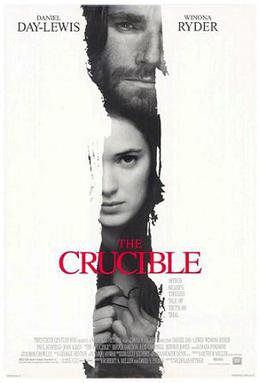
In the 90s, Miller wrote the screenplay for a film adaptation of the The Crucible.  First released in 1996, this adaptation starred Daniel-Day Lewis as the wrongly accused John Proctor, Joan Allen as Proctor’s wife, Elizabeth, and Winona Ryder as Abigail Williams.  For the purposes of Miller’s dramatization, Abigail was reimagined as being a teenage girl who had a brief affair with John Proctor and who was still obsessed with him.  When the Reverend Parris (Bruce Davison) catches Abigail and some of her friends trying to cast a “love spell” on John, the girls try to avoid punishment by accusing Parris’s slave, Tituba (Charlayne Woodard), of being a witch.  Tituba gives a false confession to avoid being hanged.  The girls are soon accusing numerous other women, including Elizabeth Proctor, of witchcraft.

As a film, The Crucible is a fine adaptation of Miller’s play and it’s always a little bit surprising to me that the movie itself isn’t better-known.  Daniel Day-Lewis, Winona Ryder, Joan Allen, and Bruce Davison all give excellent performances, as does Rob Campbell as a reverend who comes to doubt the accusations of witchcraft.  The great Paul Scofield also does a good job as Danforth, the stern judge who attempts to be fair but ultimately is not willing to admit that the law itself is in error.  The film recreates Salem is such detail that you feel as if you’re walking its streets.  The film also recreates the horrible conditions that a colonial prisoner would have to deal with while imprisoned.  Watching Daniel Day-Lewis go from being handsome and rugged to being an emaciated man with rotten teeth really drives home the story’s portrayal of casual, state-sanctioned cruelty.  By the end of the movie, Day-Lewis is a testament to what authoritarians will do to someone who insists on thinking for himself.

The film is at its strongest when showing how a moral panic begins.  The unstable Abigail is looking for revenge against John Proctor.  The other girls, immature and trying to be avoid being punished, make their accusations without giving much thought to the consequences.  Soon, the adults of Salem — all of whom have no excuse for not knowing better — are making accusations because it’s better to be an accuser than to be one of accused.  The film presents a disturbing portrait of how quickly a community can turn on itself.

The film ends on a note of devastating sadness.  Though the witch trials were eventually seen for being the farce that they were, it was too late for the twenty-five people who died as a result of the hysteria.  (Today, with a clear mind, it’s easy to see that the Salem Witch Trials had more in common with Stalin’s show trials and China’s Cultural Revolution than anything else.)  The Crucible is a powerful film adaptation that deserves to be better-known.

Icarus File No. 3: Glass (dir by M. Night Shyamalan)


Oh, Glass.  We all had such hopes for you.

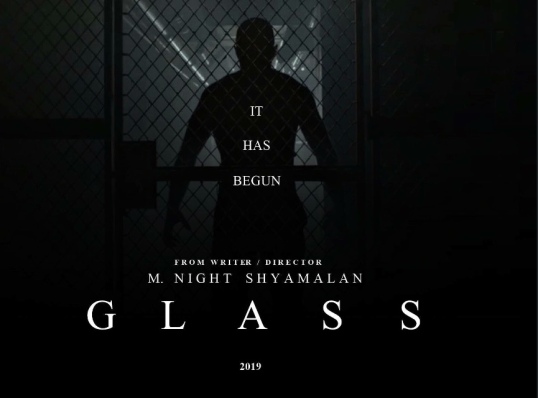
Glass, as you may remember, came out in January and was one of the first big cinematic disappointments of the 2019.  People were certainly excited about it before the film was released.  Glass was a sequel to not only Split but also Unbreakable.  James McAvoy, Samuel L. Jackson, and Bruce Willis would all be returning to the roles that they played in those original films.  Glass was viewed as being the film that would establish whether director M. Night Shyamalan was truly back after the critical and commercial success of Split or if he was going to return to being the kinda hacky director who we all remembered from the mid to late-aughts.

Actually, it can probably be argued that, as a director, M. Night Shyamalan managed to go from being slightly overrated to being wildly underrated.  Even his worse films aren’t exactly terrible.  Even the incredibly silly The Happening had a few effective scenes.  Shyamalan wasn’t a bad director as much as he was a director who, at times, seemed to be way too convinced of his own cleverness.  The Shyamalan twist became both his trademark and his curse.  I can still remember an entire theater audibly groaning during The Village, not because the twist was necessarily bad as much as just because it was so expected.  Was Shyamalan capable of making a film that didn’t end with a gimmicky twist?  Interestingly, for most of its running time, Split seemed like a straight forward story about a psychotic man with multiple personalities.  It was only at the last minute, when Bruce Willis showed up in that bar, the people realized that Split had a Shyamalan twist.

Glass has a few twists of its own, most of them dealing with how Kevin Wendell Crumb (James McAvoy) became the killer known as The Beast.  It’s all connected to Elijah Price (Samuel L. Jackson), who is also the supervillain named Mr. Glass.  Kevin, Elijah, and David Dunn (Bruce Willis) all end up in a mental asylum together.  Dr. Ellie Staple (Sarah Paulson) insists that the three of them do not have any super powers and instead, they’re all suffering from a shared delusion.  Of course, Dr. Staple has an agenda of her own.  It’s not a particularly interesting agenda but then again, who cares, right?  I mean, the main reason people are going to watch this movie is so they can watch James McAvoy and Bruce Willis square off against each other, right?

Well, those people are out of luck.  The audience may not care about Dr. Staple’s agenda but Shyamalan certainly does and, as a result, McAvoy, Jackson, and Willis often seem to be bystanders in their own film.  When the long-promised confrontations between our three main characters finally do occur, it all leads to a finale that leaves a rather sour aftertaste.  You can’t help but feel that the characters (and their actors) deserved better.  What ultimately happens to David Dunn in Glass feels almost like an extended middle finger to anyone who has ever defended Unbreakable.  One gets the feeling that Shyamalan was so eager to work in one of his trademark surprises that he never stopped to consider whether the film’s storyline was strong enough to support his ambition.

The other problem is that Bruce Willis’s David Dunn and James McAvoy’s The Beast really don’t belong in the same movie together.  Willis gives an understated and rather haunted performance as David but McAvoy is so flamboyantly evil as the Beast that it destroys whatever gritty reality Willis had managed to develop.  Both McAvoy and Willis give good performances but they appear to be performing in different films.  As for Jackson, nobody glowers with the power of Samuel L. Jackson.  But, oddly, he never seems to have much to do.  Glass may be named after his character but Mr. Glass often feels superfluous to the overall plot.

Glass is ultimately a rather forgettable movie.  One gets the feeling that Shyamalan was truly trying to say something profound about heroism and pulp mythology in the final part of the trilogy that began with Unbreakable.  But, ultimately, Glass‘s message is too muddled to have much of an effect.  In the end, Glass leaves Shyamalan’s ambitions unfulfilled.

Previous Icarus Files:

  1. Cloud Atlas
  2. Maximum Overdrive

Horror Trailer: Glass


Glass

Yes, I think next year’s film from M. Night Shyamalan is a horror to a certain degree. It’s what one may call a horror-thriller with superhero aspects. It helps that one of the returning characters for the film is The Beast played by James McAvoy from M. Night Shyamalan’s 2016 psychological horror film Split.

With Glass still set for a January 19, 2019 release it’s time we got a new trailer that gives a bit of a look at the basic premise of the film’s story. From this trailer it looks like Mr. Glass will not just team-up with The Beast but do so in order to prove to the rest of the world that superheroes and supervillains do exist and that they’re not just a mental disorder.

There’s definitely some creepy beats in this trailer that hopefully will lend itself for some disturbing sequences in the film. It’s the horror aspect of Split that made it quite popular with audiences. Now time to see whether it’ll combine well with the superhero journey narrative of David Dunn (played by Bruce Willis).

Insomnia File #10: Eye For An Eye (dir by John Schlesinger)


What’s an Insomnia File? You know how some times you just can’t get any sleep and, at about three in the morning, you’ll find yourself watching whatever you can find on cable? This feature is all about those insomnia-inspired discoveries!

Eye_for_an_Eye_(1996_film)_poster

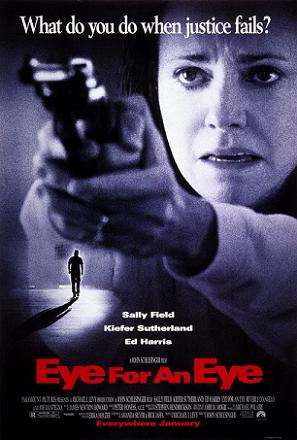
If you were awake at midnight and trying to get some sleep, you could have turned over to ThillerMax and watched the 1996 revenge thriller, Eye For An Eye.  However, the film wouldn’t have helped you get to sleep.  Eye For An Eye is not a film that you sleep through.

Eye For An Eye opens with Karen McCann (Sally Field) comforting her youngest daughter, Megan (Alexandra Kyle).  Megan is terrified of a moth that has flown into her bedroom.  “Kill it, mommy, kill it!” Megan shouts.  Instead, Karen gently takes the moth in her hand and allows it to escape through an open window.  In those first few minutes, the film tells us everything that it feels to be important about Karen.  She’s a mother.  She lives in a big house in the suburbs.  And she wouldn’t kill a moth…

But — the name of the title is Eye For An Eye and that would seem to promise killing so we know that something terrible is going to happen to change Karen’s outlook on life.

And it does!  The next afternoon, Karen is stuck in traffic and calls her oldest daughter, 17 year-old Julie (Olivia Burnette).  In an extremely harrowing sequence that is pure nightmare fuel, Karen helplessly listens as Julie is raped and murdered.

A white trash deliveryman named Robert Doob is arrested for the crime and we immediately know that he’s guilty.  First off, his name is Robert Doob and that’s a serial killer name if I’ve ever heard one.  Secondly, he smirks at Karen and her husband (Ed Harris) and, in a particularly cruel moment that was especially upsetting to this former stutterer, he imitates Julie’s stammer.  Third, Robert has tattoos and Satanic facial hair.  And finally, Robert Doob is played by Keifer Sutherland.  And usually, I find Keifer and his growl of a voice to be kinda sexy in a dangerous sorta way but in Eye For An Eye, he was so icky that he just made my skin crawl.

Robert Doob is obviously guilty but an evil liberal judge throws the case out on a technicality.  After Karen gets over the shock of seeing justice perverted, she decides to take the law into her own hands.  After meeting a professional vigilante (Philip Baker Hall, looking slightly amused no matter how grim he tries to act), Karen decides to learn how to use a gun so that she can get her revenge…

There’s not a single subtle moment in Eye For An Eye but that’s actually the main reason I enjoyed the film.  Everything — from the performances to the script to the direction to the music to … well, everything — is completely and totally over-the-top.  The symbolism is so heavy-handed and the film is so heavily stacked in favor of vigilante justice that the whole thing becomes oddly fascinating.  It may not be a great film but it’s always watchable.  It may not be subtle and it may even be borderline irresponsible in its portrayal of the American justice system but who cares?  By the end of the movie, I was over whatever real world concerns I may have had about the film’s premise and I was totally  cheering Karen on in her quest for vengeance.  I imagine I’m not alone in that.  Eye For An Eye is the type of film that elitist movie snobs tend to dismiss, even while secretly knowing that it’s actually kinda awesome.

Previous Insomnia Files:

  1. Story of Mankind
  2. Stag
  3. Love Is A Gun
  4. Nina Takes A Lover
  5. Black Ice
  6. Frogs For Snakes
  7. Fair Game
  8. From The Hip
  9. Born Killers