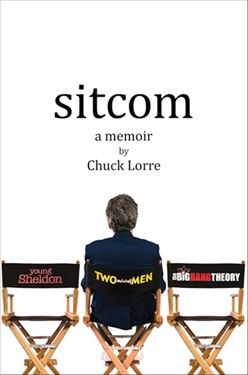
 What happens when a successful but somewhat self-important television producer gets it into his head that he’s the modern-day equivalent of Robert Evans?
He ends up writing a memoir like Sitcom.
Now, don’t get me wrong. Chuck Lorre has both produced and written for a number of shows that were very successful. In his book, he admits that old-style network sitcom is pretty much a dying breed, so one should be prepared to give him some credit for being one of the few people around still finding consistent success with the format. As I read his book, I was amazed to be reminded of just how many shows he was involved with, one way or another. Of course, he was also involved in quite a few shows that were not successful. (As of right now, the true secret of his success seems to be doing nostalgic period spin-offs based on The Big Bang Theory.) Lorre’s habit of posting “vanity cards” at the end of his shows is either brilliant or annoying, depending on how you look at it. He includes a few of his favorite vanity cards in his memoir, and none of them are particularly profound. But, as long as I’m posting random Thoughts on the Culture, who am I to judge? Part of being a successful writer is truly believing that people really want to know your thoughts and opinions on every little thing.
That said, his book is kind of a strange read. He discusses each of his shows but doesn’t really go into much detail beyond complaining about the people he worked with. On Twitter, everyone’s already discussed his bizarrely dismissive (and frustratingly vague) comments about Anna Faris. Throughout the book, he promises to tell us the story of his widely publicized feud with Charlie Sheen, but he really doesn’t. He gives us some details, but he doesn’t really dig too much into any of it, and what he does share isn’t anything that isn’t already well-known. (Wow, did you know that Charlie Sheen has addiction issues?) He also promises to tell us how he and Charlie Sheen reconciled, but again, he really doesn’t. Instead, one gets the feeling that they just magically stopped being mad at each other. Maybe that’s what happened; I don’t know. I’ve noticed that guys have a strange ability to just get over things. Reading the book, it becomes apparent that it’s not just actors who Lorre has issues with. Almost everyone who has ever worked with him—from producers to other writers—is portrayed as being duplicitous. He criticizes his father for being a Republican. He criticizes his mother for even existing. There’s an old saying: If everyone you meet is a jerk, then you’re the jerk. Lorre’s even a bit rude to the few people he does like. Melissa McCarthy may be a good actress, but did you know that she owes her entire career to Chuck Lorre?
This is the sort of thing that Robert Evans was able to pull off while he was alive. That’s because, deep down, Robert Evans seemed to understand that he was playing the role of Mr. Hollywood. Reading Lorre’s book, one gets the feeling that he takes himself way too seriously. Yes, he’s the guy behind the goofy shows like Two and a Half Men and The Big Bang Theory. He’s also the guy who helped to produce The United States of Al and Mom, two of the most depressing sitcoms ever made. (Mom had its moments, but, speaking as someone with ADHD, I’ve never quite gotten over Allison Janney’s character having to see a therapist just because she got diagnosed with something that I’ve successfully navigated my entire life.)
That said, I am a history nerd, and Sitcom does provide a reminder of some of the shows that, for better or worse, shaped our current culture. If nothing else, Chuck Lorre will probably be remembered as the last network sitcom impresario. His book shows how much things have changed over just the past twenty years. Today, multi-camera sitcoms with live audiences and laugh tracks feel like an artifact from a soon-to-be-forgotten age.

