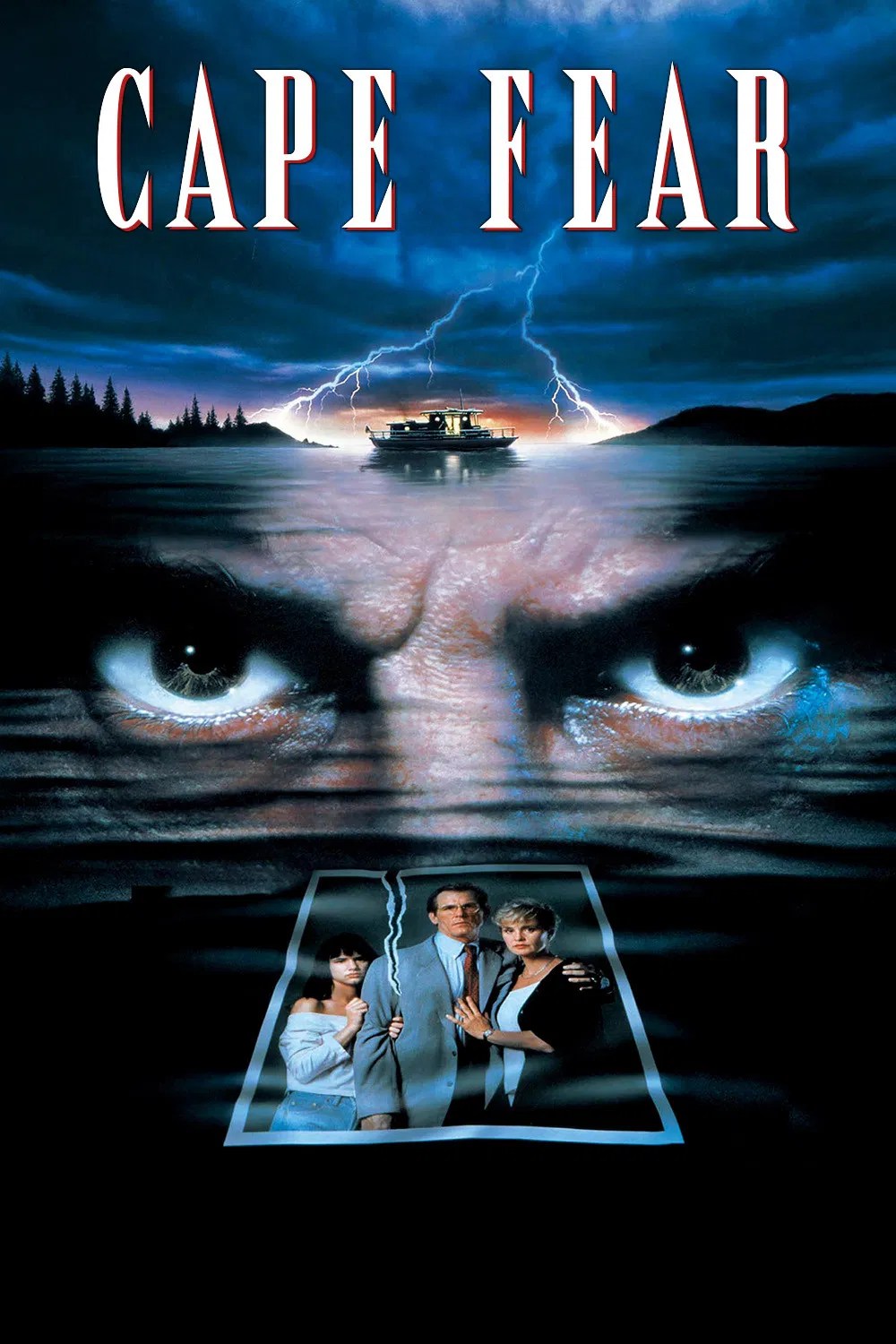
“Every man… every man has to go through hell to reach paradise.” — Max Cady
There’s nothing subtle about the way Martin Scorsese’s Cape Fear gets under your skin. The music announces an approaching apocalypse, the camera seems unable to sit still, and Robert De Niro looks ready to chew through the scenery before anyone can stop him. Yet beneath all that noise is a nasty question: what happens when someone discovers the secret that makes your respectable life possible? This 1991 horror-thriller builds its terror around that vulnerability, turning a revenge story into a nightmare about being exposed. It’s wildly entertaining, even when its determination to overwhelm you becomes a little much.
A remake of J. Lee Thompson’s 1962 film of the same name, itself adapted from John D. MacDonald’s novel The Executioners, Cape Fear follows convicted rapist Max Cady after his release from prison. Cady, played by De Niro, has spent fourteen years nursing a grudge against his former defense attorney, Sam Bowden. Nick Nolte’s Sam withheld evidence that might have helped his client’s case, deciding that his disgust justified compromising Cady’s defense. Now Cady has come looking for him, and he isn’t satisfied with an apology. He wants to dismantle Sam’s life slowly enough that Sam understands exactly who is doing it.
Making Sam morally compromised is the remake’s smartest move. Rather than simply asking us to root for an innocent family against an evil outsider, Scorsese gives us a man whose professional betrayal has returned to haunt him. That doesn’t make Cady’s campaign remotely justified, but it complicates Sam’s position. He wants the protection of rules he previously decided didn’t apply to him. Every attempt to present himself as the reasonable, law-abiding party becomes harder to accept without qualification. The suspense comes partly from wondering what Cady will do next and partly from watching Sam struggle to maintain his version of himself.
Casting Nolte in the role previously played by Gregory Peck makes that shift especially convincing. Where Peck’s authoritative presence suited the original’s more upright protector, Nolte brings a battered, irritable quality that makes Sam’s respectability feel less secure. You believe this man may regret living in the law’s moral gray areas without having learned to stay out of them. When protecting his family means employing criminal methods, including arranging an assault on Cady, the decision feels like an extension of his character rather than a sudden reversal. Nolte makes the contradiction work: Sam wants to be decent, but he’ll use dirty resources when he decides the circumstances demand it.
De Niro makes those circumstances as uncomfortable as possible. His Cady is all tattoos, muscle, exaggerated politeness, and a Southern drawl that turns ordinary conversation into a threat. It’s a performance built around excess, and you can practically feel De Niro enjoying how far he can push it. That might sound like a criticism, but Cady is performing, too. He wants Sam to notice him, fear him, and recognize his control over the situation. Every appearance becomes a demonstration of power, with each smile suggesting he knows something everyone else would rather leave unspoken.
The character becomes more interesting, and less believable, as the film continues. Initially, Cady is a dangerous convict with a personal grudge and a talent for exploiting legal boundaries. Eventually, he resembles a boogeyman: impossibly resilient, seemingly everywhere, and almost impossible to keep out. Here the remake embraces more recent slasher-film tropes, moving beyond intimidation toward an unstoppable-killer nightmare. Practically speaking, that transformation gets ridiculous. Psychologically, though, it fits. Cady becomes a manifestation of Sam’s guilt, something that can be denied, attacked, or temporarily escaped, but never comfortably buried again. His persistence makes emotional sense even when his physical endurance strains credibility.
That idea connects the horror to the story’s Southern Gothic roots, which Scorsese emphasizes even more heavily than the original. Religious obsession, sexual menace, family dysfunction, and corruption beneath respectable surfaces create an overheated atmosphere. Cady treats revenge as a sacred mission, dressing cruelty in scripture and self-righteous declarations. Sam has his own history of deciding that moral certainty excuses misconduct. The men aren’t equivalent, but the echoes matter. Cady doesn’t introduce darkness into an innocent household so much as drag existing darkness into the open, where nobody can politely ignore it.
The Bowdens are already miserable enough to make that process convincing. Nolte gives Sam a prickly defensiveness, while Jessica Lange, as his wife Leigh, conveys the exhaustion of someone living with unresolved resentment. Their marriage feels strained before Cady applies pressure, making his interference more destructive. Occasionally, their hostility becomes so relentless that the family scenes feel almost as punishing as the stalking. Still, the performances ground the tension. These aren’t symbolic victims waiting to be threatened; they’re people whose existing problems make the threat harder to manage.
Juliette Lewis is especially good as their teenage daughter, Danielle, whose uncertainty makes her vulnerable to Cady’s attention. Their encounter at her school is the most unsettling sequence because it trades spectacle for something horribly intimate. Cady listens, flatters, and presents himself as someone who understands her better than her parents do. Lewis captures the mixture of curiosity, discomfort, and a teenager’s desire to appear older. The scene exposes the predatory calculation beneath Cady’s theatrical behavior. He doesn’t need physical force to gain control, which makes him scarier than his muscles ever could.
Scorsese surrounds these performances with filmmaking that rarely lets anyone breathe. Working with cinematographer Freddie Francis, he uses distorted perspectives, oppressive close-ups, lurid lighting, and restless camera movements to make ordinary surroundings threatening. Bernard Herrmann’s original score, adapted by Elmer Bernstein, adds an operatic sense of disaster. Sometimes the style shouts over an already effective scene, and restraint might have made certain moments sharper. But the commitment is impressive. By the storm-battered houseboat climax, everyday realism has disappeared, and the setting feels like an extension of the characters’ psychological collapse.
What makes Cape Fear stick isn’t simply whether the Bowdens can survive Cady. It’s the uglier possibility that survival won’t restore the comfortable story they once told about themselves. Scorsese pushes that idea through a thriller so outrageous that its moral complications occasionally get swallowed by spectacle. Nevertheless, Nolte keeps Sam’s contradictions recognizable beneath the chaos: a man who regrets crossing lines but remains willing to cross them again. Cady may become too indestructible to believe in as a person, yet he’s persuasive as the reckoning Sam cannot shut out. The locks were never going to be enough.

