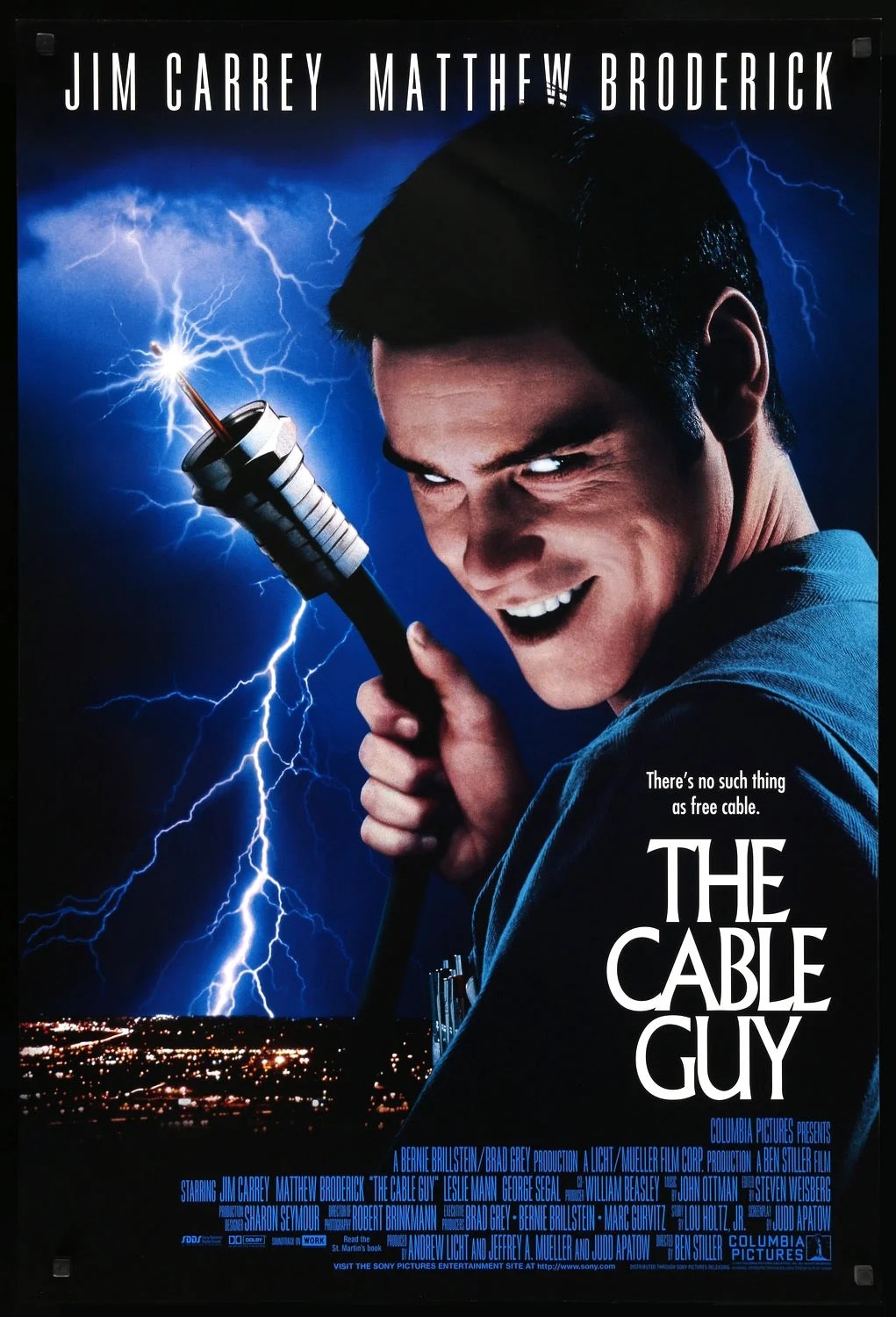
Icarus File No. 32: The Cable Guy (dir. by Ben Stiller)


“You were never there for me, were you, Mother? You expected Mike and Carol Brady to raise me! I’m the bastard son of Claire Huxtable! I am a lost Cunningham! I learned the facts of life from watching The Facts of Life!” — Chip

Few 1990s studio comedies are as awkwardly fascinating—or as misunderstood on arrival—as The Cable Guy. Directed by Ben Stiller and built around one of Jim Carrey’s most deliberately uncomfortable performances, it arrived at a strange point in Carrey’s career: he had become a massive box-office draw through films such as Ace Ventura: Pet Detective, The Mask, Dumb and Dumber, Batman Forever, and Ace Ventura: When Nature Calls. Audiences associated him with rubber-faced chaos, exuberant catchphrases, and a kind of manic but fundamentally likable comic energy. The Cable Guy offers something much colder. Carrey is still loud, physical, and wildly committed, but the movie twists those familiar traits into a portrait of loneliness, obsession, and emotional menace. It is a dark comedy about a man who has absorbed television culture so completely that he cannot form a normal human relationship without treating it like an episode of a sitcom.

That basic idea remains clever and surprisingly ahead of its time. Carrey plays Chip Douglas, a cable installer who enters the life of Steven Kovacs, played by Matthew Broderick, after Steven moves into a new apartment following a breakup with his girlfriend Robin, played by Leslie Mann. Steven wants cable television installed; Chip wants a best friend. What begins as awkward friendliness becomes invasive dependence, as Chip worms his way into Steven’s social circle, his professional life, and eventually his relationship with Robin. Chip is not simply a pest or an eccentric service worker. He is a lonely, emotionally stunted man whose references to television, movies, commercials, and game shows have become his entire vocabulary for intimacy.

The most interesting thing about The Cable Guy is that it understands television as both comfort and damage. Chip’s childhood was clearly shaped by neglect, with television functioning as his guardian, teacher, and surrogate parent. The movie makes this point broadly, sometimes too broadly, but it also gives the character a sad logic. Chip does not understand friendship as mutual connection; he understands it as a package deal. You meet someone, quote the same shows, hang out constantly, become inseparable, and live out the happy ending promised by popular entertainment. When Steven resists that fantasy, Chip does not know how to process rejection. His behavior turns increasingly controlling and vindictive because, in his mind, Steven has violated the rules of the relationship genre they are supposed to be playing.

In that respect, the film was well ahead of its time. In 1996, the idea of television becoming an all-encompassing babysitter for a generation of children was recognizable, but it still played largely as exaggerated satire. Chip represents the extreme result of a childhood where adults failed to provide stability, affection, supervision, and basic emotional guidance, leaving television to fill every role instead. He learned how to talk, how to joke, how to flirt, how to fight, and how to imagine friendship from whatever appeared on the screen. The tragedy is that media gave him endless information and endless imitation, but no real understanding of boundaries, empathy, or reciprocity.

That concern feels much less hypothetical today. Television did not disappear; it expanded into streaming libraries, on-demand movies, YouTube, social media feeds, online games, short-form video, and the constantly available internet. More children now grow up surrounded by screens that are not confined to a living-room television set or a few scheduled hours of programming. The old guardrails of limited channels, parental supervision around a shared TV, and the simple fact that a show ended at a certain time have weakened or, in many homes, disappeared altogether. The Cable Guy obviously does not predict every aspect of the internet age, but it does anticipate the emotional danger of allowing media to become a substitute for parenting, companionship, and healthy social development.

The film is careful enough to suggest that media alone did not create Chip. He is the product of abandonment first and television second. That distinction matters, because the movie is not arguing that children who watch too much television will inevitably become unstable stalkers. Rather, it suggests that screens can become especially powerful when they are used to fill an emotional void that should be addressed by family, community, and genuine relationships. Chip’s many references are funny at first because they are recognizable, but they become sadder as the movie reveals that he is not simply quoting pop culture for fun. He is quoting it because he has little else to draw from.

That makes the film more ambitious than its reputation as “the weird Jim Carrey movie” might suggest. The screenplay, by Lou Holtz Jr., has fun with media saturation, consumer culture, male insecurity, and the way people use technology to avoid direct emotional communication. The title itself now feels almost quaint, because cable installation hardly seems threatening in an age of smartphones, streaming services, social media surveillance, and algorithmic recommendation systems. Yet Chip’s obsession has only become more recognizable. He is essentially a proto-internet stalker, a man who treats access as entitlement. Because he can enter Steven’s home to connect his television service, he assumes he deserves access to Steven’s private life. The film exaggerates that premise for comic effect, but the underlying discomfort has aged well.

At the same time, The Cable Guy has a major problem, and it is inseparable from the reason the film exists: Jim Carrey. Casting Carrey was a commercial gamble meant to make a very dark premise accessible to a mainstream audience. In theory, it is an inspired decision. His brand of elastic, outsized comedy gives Chip a strange unpredictability; you never know whether he is going to make a ridiculous movie reference, belt out a sentimental song, physically humiliate himself, or suddenly become frightening. Carrey’s comic instincts make Chip memorable in a way that a more restrained actor likely would not have been. His version of the character is like an abandoned cartoon character who has somehow wandered into a real person’s life.

But the same performance often works against the movie. Carrey’s penchant for excessive facial expressions, exaggerated voices, and physical escalation overwhelms the subtler and more unsettling possibilities in the script. The film wants to be a satirical dark comedy, but it repeatedly gives itself over to big Jim Carrey bits. Some are undeniably funny, especially because Carrey commits to them with fearless energy, but they can make Chip feel less like a damaged human being and more like a delivery system for gags. The movie keeps shifting between “this man is dangerously unstable” and “look at Jim Carrey doing something weird,” and that unevenness prevents it from fully landing as either a truly disturbing character piece or a consistently hilarious farce.

The medieval-themed restaurant sequence is probably the clearest example of both the movie’s strengths and weaknesses. When Chip and Steven engage in an extended jousting and sword-fighting routine at Medieval Times, it is funny because it transforms a casual social outing into a ridiculous, testosterone-heavy spectacle. It also exposes the warped nature of their friendship: Chip is trying to force Steven into a grand, cinematic bonding ritual. Yet the scene is so broad and so committed to the escalating stunt comedy that it can feel detached from the film’s more interesting emotional undercurrents. It is memorable, certainly, but it is also the kind of scene that makes it easy to see why contemporary audiences may have expected another straightforward Carrey comedy rather than a satire with genuine bitterness beneath the jokes.

Broderick is important here because he provides the film’s necessary straight-man perspective. Steven is not a particularly dynamic protagonist, and that is partly the point. He is an ordinary, mildly selfish guy trying to rebuild his life after a breakup, which makes Chip’s intrusion feel even more invasive. Still, Broderick’s deliberately subdued performance can make Steven seem passive compared with the hurricane of Carrey’s performance. The movie needs Steven to be bland enough for Chip to project his fantasies onto him, but that choice also leaves the film with an imbalance: Chip is by far the most vivid person on screen, even when the story is asking us to see him as a nightmare.

Leslie Mann brings warmth and patience to Robin, while Jack Black, in an early supporting role as Steven’s friend Rick, adds a welcome jolt of weird energy without taking over the movie. The supporting cast understands the heightened tone, but Stiller’s direction occasionally pushes the material toward sketch-comedy exaggeration. That is not always a flaw; The Cable Guy is frequently inventive in its visual jokes, its television parodies, and its depictions of Chip turning every situation into a warped pop-culture performance. Still, the film is at its best when Stiller lets the strangeness breathe rather than constantly underlining it.

The movie’s lackluster initial reception makes sense in context. Audiences had been trained to see Carrey as a wildly energetic hero of broad studio comedies, not as a creepy, needy antagonist whose jokes often curdle into discomfort. The promotional challenge was enormous: sell The Cable Guy as a Jim Carrey movie, and viewers might expect another crowd-pleasing laugh machine; sell it honestly as a dark satire about loneliness and media dependency, and it becomes a much harder commercial proposition. Many viewers at the time seemed to reject it not because it lacked ideas, but because it did not give them the version of Jim Carrey they thought they were buying a ticket to see.

In the years since, however, the film has developed a deservedly large cult following. Distance has helped. Modern audiences are more accustomed to comedians making darker career turns, and the themes of mediated identity, parasocial attachment, isolation, and invasive access now feel much more relevant than they did in the mid-1990s. Carrey’s performance, once seen by many as abrasive or miscalculated, can now be appreciated as a risky attempt to weaponize his own comic persona. Chip is funny precisely because he is desperate to be liked, but he is also disturbing because his idea of being liked involves total possession.

The Cable Guy is not a perfect dark comedy. Its tone wobbles, its protagonist can feel underwritten, and Carrey’s larger-than-life antics sometimes obscure the sharper satire hiding underneath. Yet those flaws are also part of what makes it fascinating. It is a studio movie willing to be unpleasant, odd, and commercially confusing at the height of a superstar’s popularity. Rather than simply giving Jim Carrey another vehicle for his most familiar tricks, it turns those tricks into symptoms of a damaged man’s inability to connect. The result is uneven, but it is far more interesting than a safer 1996 Jim Carrey comedy would have been—and its cult status feels earned.

Previous Icarus Files:

  1. Cloud Atlas
  2. Maximum Overdrive
  3. Glass
  4. Captive State
  5. Mother!
  6. The Man Who Killed Don Quixote
  7. Last Days
  8. Plan 9 From Outer Space
  9. The Last Movie
  10. 88
  11. The Bonfire of the Vanities
  12. Birdemic
  13. Birdemic 2: The Resurrection 
  14. Last Exit To Brooklyn
  15. Glen or Glenda
  16. The Assassination of Trotsky
  17. Che!
  18. Brewster McCloud
  19. American Traitor: The Trial of Axis Sally
  20. Tough Guys Don’t Dance
  21. Reach Me
  22. Revolution
  23. The Last Tycoon
  24. Express to Terror 
  25. 1941
  26. The Teheran Incident
  27. Con Man
  28. Looker
  29. 1776
  30. Here
  31. The Adventures of Brisco County, Jr.
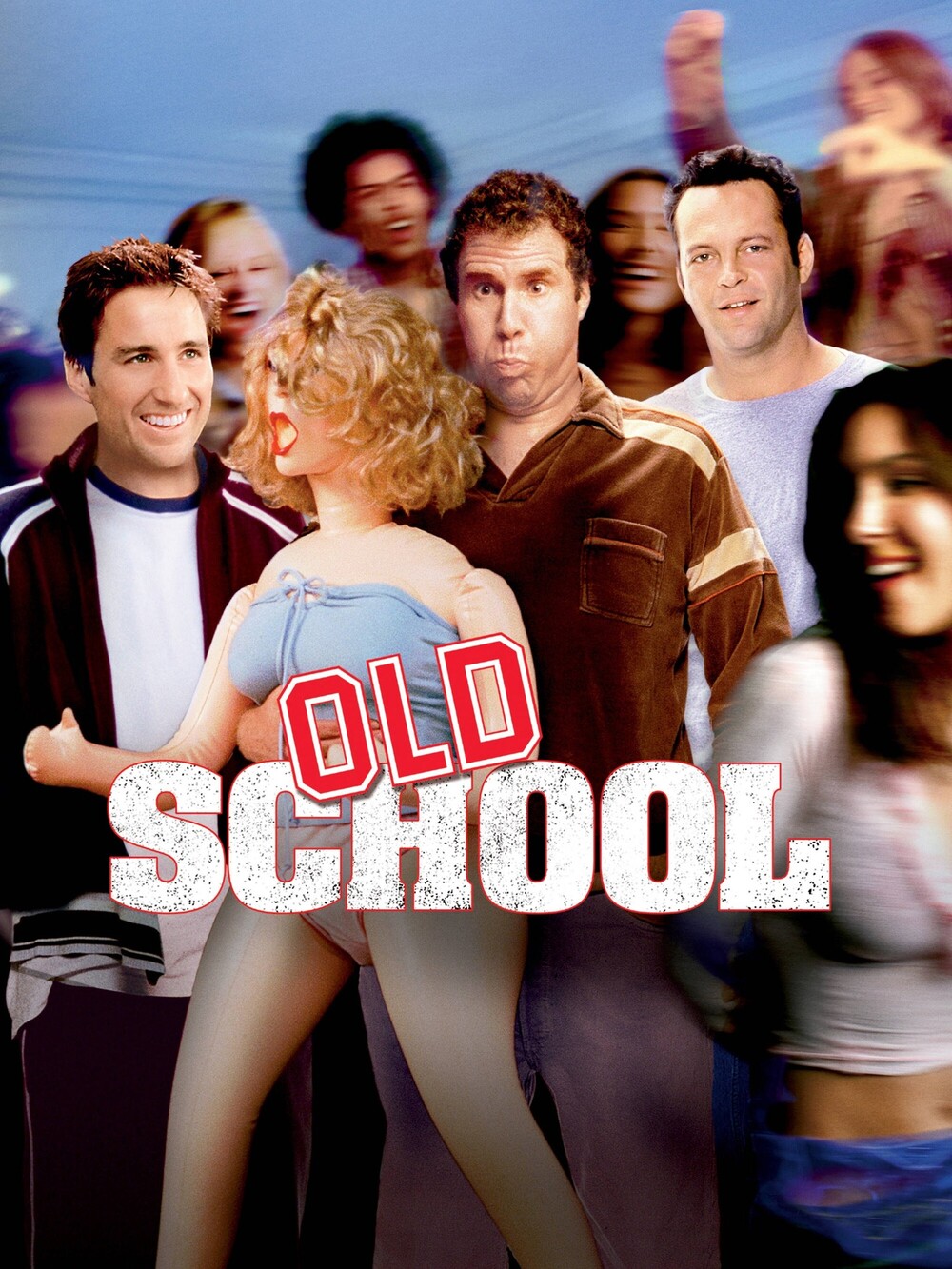
Guilty Pleasure No. 123: Old School (dir. by Todd Phillips)


Old School is one of those comedies that feels like it was made in a lab to be the perfect guilty pleasure, a film that knows exactly what it is and doesn’t apologize for a second of it. Directed by Todd Phillips in 2003, it’s a raucous, often ridiculous ode to arrested development, where three thirtysomething men decide the solution to their midlife crises is to start a fraternity and relive their college glory days. On paper, it sounds like the kind of premise that could either be hilariously relatable or painfully cringe-inducing. In execution, it somehow manages to be both, which is exactly why it works as well as it does.

The story centers around Mitch, Frank, and Beanie, played by Luke Wilson, Will Ferrell, and Vince Vaughn, respectively. Mitch is a mild-mannered attorney whose world implodes when he walks in on his girlfriend, Heidi (Juliette Lewis), mid-orgy in his own bathroom. Frank, a former legendary party animal known as “Frank the Tank,” is about to get married but can’t seem to let go of his wild past. Beanie, the most level-headed of the trio, is a family man who still feels the pull of his youth. When Mitch impulsively buys a house near a college campus, Beanie suggests they turn it into a fraternity, and thus, the most chaotic midlife crisis in cinematic history begins. The premise is thin, but the film doesn’t need much more than an excuse to string together a series of increasingly absurd set pieces.

What makes Old School so much fun is the chemistry between its three leads. Wilson plays the straight man to Ferrell and Vaughn’s antics, grounding the film with a relatable everyman quality. Vaughn, with his rapid-fire delivery and sharp wit, is the glue that holds the trio together, while Ferrell steals every scene he’s in as the unhinged, beer-chugging, streaking force of nature that is Frank the Tank. Ferrell’s performance is a masterclass in commitment to the bit, whether he’s chugging beers in his underwear, delivering a motivational speech about the importance of “earning” respect, or streaking through a neighborhood in one of the most iconic comedy scenes of the 2000s. His energy is infectious, and it’s hard not to laugh at the sheer audacity of his character, even when the humor leans into the absurd or the juvenile.

The supporting cast is packed with familiar faces who add texture to the film’s world. Jeremy Piven is delightfully slimy as Dean Pritchard, the smug, power-tripping dean of students who holds a grudge against the trio from their own college days. Ellen Pompeo, pre-Grey’s Anatomy, plays Nicole, Mitch’s high school crush, who re-enters his life at Frank’s wedding and becomes a romantic subplot that feels both sweet and slightly out of place in a movie this committed to chaos. Leah Remini, Juliette Lewis, and Elisha Cuthbert round out the cast, each bringing their own flavor to the proceedings. The film also features a slew of cameos, from Snoop Dogg as himself to James Carville, which adds to its anything-goes vibe.

Todd Phillips’ direction leans heavily into the film’s frat-house aesthetic, with a loose, improvisational feel that mirrors the energy of its characters. The movie doesn’t bother with subtlety or nuance; it’s a series of escalating gags and set pieces designed to elicit laughs, and for the most part, it succeeds. The humor is often crude, sometimes dumb, but always delivered with a sense of enthusiasm that’s hard to resist. The film’s pacing is brisk, jumping from one ridiculous scenario to the next without much time to breathe, which works in its favor. There’s no pretension here—Old School isn’t trying to be a smart comedy or a biting satire. It’s a beer-soaked, testosterone-fueled romp, and it owns that identity with pride.

One of the film’s most memorable sequences is the “Mitch-A-Palooza” party, a rager that cements the trio’s status as campus legends. The party is a microcosm of everything Old School does well: it’s loud, it’s messy, and it’s filled with the kind of over-the-top antics that make you laugh even as you shake your head in disbelief. The scene where Frank the Tank rallies the troops with a speech about the importance of “earning your letters” before chugging a beer in his underwear is a perfect example of the film’s brand of humor. It’s stupid, it’s juvenile, but it’s also undeniably funny, thanks in large part to Ferrell’s commitment to the bit.

That said, Old School isn’t without its flaws. The film’s humor often relies on shock value and crude jokes, which won’t land for everyone. Some of the gags feel dated, and the film’s treatment of women is, at times, simplistic. The female characters are often relegated to the roles of either love interests or obstacles, and the movie’s worldview is unapologetically male-centric. It’s a product of its time, and while that doesn’t excuse some of its more problematic elements, it does explain them. The film also suffers from a lack of depth in its storytelling. The plot is thin, and the character arcs are minimal, but that’s almost beside the point. Old School isn’t trying to be a deep or meaningful film—it’s trying to be a fun, raucous comedy, and on that front, it largely delivers.

What makes Old School such a great guilty pleasure is its sheer unapologetic joy in its own ridiculousness. The film doesn’t pretend to be anything other than what it is: a celebration of immaturity, friendship, and the kind of chaos that can only come from a group of grown men trying to relive their youth. There’s something oddly endearing about the way Mitch, Frank, and Beanie cling to their college days, as if they’re afraid of what comes next. It’s a theme that resonates with anyone who’s ever felt a pang of nostalgia for a time when life felt simpler, even if that time was also filled with questionable decisions and questionable haircuts.

The film’s soundtrack is another standout element, packed with a mix of classic rock, hip-hop, and pop hits that perfectly complement its vibe. From Whitesnake’s “Here I Go Again” to Metallica’s “Master of Puppets,” the music adds an extra layer of energy to the film’s already high-octane proceedings. The soundtrack isn’t just background noise—it’s a character in its own right, helping to set the tone for each scene and amplifying the film’s sense of fun.

In the years since its release, Old School has only grown in stature as a cult classic, a film that’s frequently quoted, referenced, and revisited by fans. Lines like “You’re my boy, Blue!” and “Frank the Tank” have entered the comedic lexicon, and the film’s influence can be seen in the wave of bro comedies that followed in its wake. It’s a testament to the film’s enduring appeal that it still feels fresh and funny, even as some of its jokes and sensibilities have aged less gracefully.

At its core, Old School is a movie about friendship and the lengths we’ll go to hold onto the past. Mitch, Frank, and Beanie may be thirtysomethings, but their hearts are still stuck in their college days, and their journey is as much about reconnecting with each other as it is about reliving their youth. The film’s message isn’t exactly profound—sometimes, you just need to let loose and have fun—but it’s delivered with such enthusiasm and charm that it’s hard not to get swept up in it. And if that message comes wrapped in a package of crude jokes, ridiculous antics, and a healthy dose of nostalgia, well, that’s just part of the charm.

Ultimately, Old School is the kind of movie that you don’t so much watch as you experience. It’s a film that demands to be seen with friends, preferably with a few beers in hand and a willingness to embrace the chaos. It’s not perfect, and it’s certainly not for everyone, but for those who are willing to go along for the ride, it’s a wildly entertaining, laugh-out-loud romp that never fails to deliver on its promise of fun. It’s a guilty pleasure, sure, but sometimes, the best kind of movies are the ones that don’t take themselves too seriously. Old School is a reminder that it’s okay to be a little immature, to embrace the chaos, and to never stop chasing the things that make you happy—even if those things involve starting a fraternity in your 30s.

Previous Guilty Pleasures

  1. Half-Baked
  2. Save The Last Dance
  3. Every Rose Has Its Thorns
  4. The Jeremy Kyle Show
  5. Invasion USA
  6. The Golden Child
  7. Final Destination 2
  8. Paparazzi
  9. The Principal
  10. The Substitute
  11. Terror In The Family
  12. Pandorum
  13. Lambada
  14. Fear
  15. Cocktail
  16. Keep Off The Grass
  17. Girls, Girls, Girls
  18. Class
  19. Tart
  20. King Kong vs. Godzilla
  21. Hawk the Slayer
  22. Battle Beyond the Stars
  23. Meridian
  24. Walk of Shame
  25. From Justin To Kelly
  26. Project Greenlight
  27. Sex Decoy: Love Stings
  28. Swimfan
  29. On the Line
  30. Wolfen
  31. Hail Caesar!
  32. It’s So Cold In The D
  33. In the Mix
  34. Healed By Grace
  35. Valley of the Dolls
  36. The Legend of Billie Jean
  37. Death Wish
  38. Shipping Wars
  39. Ghost Whisperer
  40. Parking Wars
  41. The Dead Are After Me
  42. Harper’s Island
  43. The Resurrection of Gavin Stone
  44. Paranormal State
  45. Utopia
  46. Bar Rescue
  47. The Powers of Matthew Star
  48. Spiker
  49. Heavenly Bodies
  50. Maid in Manhattan
  51. Rage and Honor
  52. Saved By The Bell 3. 21 “No Hope With Dope”
  53. Happy Gilmore
  54. Solarbabies
  55. The Dawn of Correction
  56. Once You Understand
  57. The Voyeurs 
  58. Robot Jox
  59. Teen Wolf
  60. The Running Man
  61. Double Dragon
  62. Backtrack
  63. Julie and Jack
  64. Karate Warrior
  65. Invaders From Mars
  66. Cloverfield
  67. Aerobicide 
  68. Blood Harvest
  69. Shocking Dark
  70. Face The Truth
  71. Submerged
  72. The Canyons
  73. Days of Thunder
  74. Van Helsing
  75. The Night Comes for Us
  76. Code of Silence
  77. Captain Ron
  78. Armageddon
  79. Kate’s Secret
  80. Point Break
  81. The Replacements
  82. The Shadow
  83. Meteor
  84. Last Action Hero
  85. Attack of the Killer Tomatoes
  86. The Horror at 37,000 Feet
  87. The ‘Burbs
  88. Lifeforce
  89. Highschool of the Dead
  90. Ice Station Zebra
  91. No One Lives
  92. Brewster’s Millions
  93. Porky’s
  94. Revenge of the Nerds
  95. The Delta Force
  96. The Hidden
  97. Roller Boogie
  98. Raw Deal
  99. Death Merchant Series
  100. Ski Patrol
  101. The Executioner Series
  102. The Destroyer Series
  103. Private Teacher
  104. The Parker Series
  105. Ramba
  106. The Troubles of Janice
  107. Ironwood
  108. Interspecies Reviewers
  109. SST — Death Flight
  110. Undercover Brother
  111. Out for Justice
  112. Food Wars!
  113. Cherry
  114. Death Race
  115. The Beast Within
  116. Girl Series
  117. Gone in 60 Seconds
  118. Swordfish
  119. Marked For Death
  120. The Internship
  121. The Angry Red Planet
  122. 2012

October Hacks: L.A. Slasher (dir by Martin Owen)


In 2016’s L.A. Slasher, an androgynous killer wearing a white suit and a mask decides that reality stars are the worst people in the world so he starts kidnapping them and torturing them and live-streaming their murders.  Even worse, he talks to them and talks to us about how he feels about them.  I say “even worse” because the voice of the Slasher is provided by Andy Dick.  Andy Dick’s nasal voice is even more whiny than usual in this film and it left me wondering what if perhaps death would preferable to listening to Dick speak.

L.A. Slasher is meant to be a satire and I will give it some credit.  It hits its targets and there’s even some bite to the scenes in which people on social media start talking about how much they love the slasher.  In many ways, this film predicted the Cult of Luigi.  Unfortunately, the film itself is so overdirected and cartoonishly-staged that it’s never quite as effective as it wants to be.  It’s essentially a live action cartoon and a fairly exhausting one of that.  The flashing lights, the constantly prowling camera, the jump cuts, the neon, it’s meant to be overwhelming but instead it’s just annoying.

There are a lot of familiar faces in the cast.  Dave Bautista and Danny Trejo shows up as drug dealers.  Mischa Barton is the Actress.  Drake Bell is the Popstar.  Brooke Hogan is the Reality Star.  And, of course, Eric Roberts shows up very briefly as The Mayor.  Personally, I think the film would have worked better if Andy Dick had played the Mayor and if Roberts had been the voice of the Slasher.  Roberts has a much better voice and, with Dick playing the Mayor, it would be easy to just leave his scenes on the cutting room floor.

In the end, I think the main problem is that L.A. Slasher is a film from 2016 that acts as if it’s the first film to ever criticize reality television and the people who populate it.  Even in 2016, that argument was hardly new or original.  It certainly didn’t need to be made in the voice of Andy Dick.

Previous Eric Roberts Films That We Have Reviewed:

  1. Paul’s Case (1980)
  2. Star 80 (1983)
  3. Runaway Train (1985)
  4. To Heal A Nation (1988)
  5. Best of the Best (1989)
  6. Blood Red (1989)
  7. The Ambulance (1990)
  8. The Lost Capone (1990)
  9. Best of the Best II (1993)
  10. Love, Cheat, & Steal (1993)
  11. Voyage (1993)
  12. Love Is A Gun (1994)
  13. Sensation (1994)
  14. Dark Angel (1996)
  15. Doctor Who (1996)
  16. Most Wanted (1997)
  17. Mercy Streets (2000)
  18. Raptor (2001)
  19. Rough Air: Danger on Flight 534 (2001)
  20. Strange Frequency (2001)
  21. Wolves of Wall Street (2002)
  22. Border Blues (2004)
  23. Mr. Brightside (2004)
  24. Six: The Mark Unleased (2004)
  25. We Belong Together (2005)
  26. Hey You (2006)
  27. Depth Charge (2008)
  28. Amazing Racer (2009)
  29. The Chaos Experiment (2009)
  30. In The Blink of an Eye (2009)
  31. Bed & Breakfast (2010)
  32. Enemies Among Us (2010)
  33. The Expendables (2010) 
  34. Sharktopus (2010)
  35. Beyond The Trophy (2012)
  36. The Dead Want Women (2012)
  37. Deadline (2012)
  38. The Mark (2012)
  39. Miss Atomic Bomb (2012)
  40. Assault on Wall Street (2013)
  41. Bonnie And Clyde: Justified (2013)
  42. Lovelace (2013)
  43. The Mark: Redemption (2013)
  44. The Perfect Summer (2013)
  45. Self-Storage (2013)
  46. Sink Hole (2013)
  47. A Talking Cat!?! (2013)
  48. This Is Our Time (2013)
  49. Bigfoot vs DB Cooper (2014)
  50. Doc Holliday’s Revenge (2014)
  51. Inherent Vice (2014)
  52. Road to the Open (2014)
  53. Rumors of War (2014)
  54. Amityville Death House (2015)
  55. Deadly Sanctuary (2015)
  56. A Fatal Obsession (2015)
  57. Las Vegas Story (2015)
  58. Sorority Slaughterhouse (2015)
  59. Stalked By My Doctor (2015)
  60. Enemy Within (2016)
  61. Hunting Season (2016)
  62. Joker’s Poltergeist (2016)
  63. Prayer Never Fails (2016)
  64. Stalked By My Doctor: The Return (2016)
  65. The Wrong Roommate (2016)
  66. Dark Image (2017)
  67. The Demonic Dead (2017)
  68. Black Wake (2018)
  69. Frank and Ava (2018)
  70. Stalked By My Doctor: Patient’s Revenge (2018)
  71. Clinton Island (2019)
  72. Monster Island (2019)
  73. The Reliant (2019)
  74. The Savant (2019)
  75. Seven Deadly Sins (2019)
  76. Stalked By My Doctor: A Sleepwalker’s Nightmare (2019)
  77. The Wrong Mommy (2019)
  78. Exodus of a Prodigal Son (2020)
  79. Free Lunch Express (2020)
  80. Her Deadly Groom (2020)
  81. Top Gunner (2020)
  82. Deadly Nightshade (2021)
  83. The Elevator (2021)
  84. Just What The Doctor Ordered (2021)
  85. Killer Advice (2021)
  86. Megaboa (2021)
  87. Night Night (2021)
  88. The Poltergeist Diaries (2021)
  89. The Rebels of PT-218 (2021)
  90. Red Prophecies (2021)
  91. A Town Called Parable (2021)
  92. Bleach (2022)
  93. Dawn (2022)
  94. My Dinner With Eric (2022)
  95. 69 Parts (2022)
  96. The Rideshare Killer (2022)
  97. D.C. Down (2023)
  98. Aftermath (2024)
  99. Bad Substitute (2024)
  100. Devil’s Knight (2024)
  101. Insane Like Me? (2024)
  102. The Wrong Life Coach (2024)
  103. Broken Church (2025)
  104. When It Rains In L.A. (2025

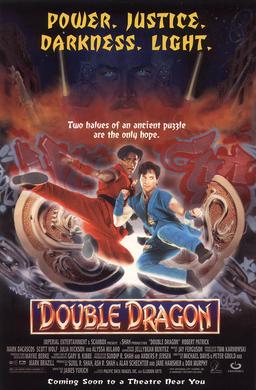
Guilty Pleasure No. 61: Double Dragon (dir by James Yukich)


The time is …. the future!

The future looks a lot like a cheap music video.  Due to repeated earthquakes, California is now an island and Los Angeles has been left in ruins.  The city has been renamed New Angeles, even though the correct name would have been Nuevos Angeles but whatever.  The important thing is that city is now a mess.  The police allow the gangs to run rampant at night in return for not running rampant during the day.  The nightly news, which is anchored by George Hamilton and Vanna White, is full of stories about the federal government refusing to send any more aid to California, despite the fact that Jerry Brown is the Vice President.  For some reason, Andy Dick plays the weatherman and gives continual updates on the smog and rain.

Despite the fact that the city is the most dangerous place on Earth, Satori Imada (Julia Nickson) still makes the time to drive her teenage sons, Billy (Scott Wolf) and and Jimmy Lee (Mark Dacascos, who was clearly not a teenager when this film was shot) to and from their karate tournaments.  However, that might all end because Sartori possesses half of a magic medallion and the evil Koga Shuko (Robert Patrick, looking oddly like Sugar Ray’s Mark McGrath) has the other half.  Satori gives her half of the medallion to Billy and tells him that he and his brother must keep it out of the hands of Shuko.

That’s not going to be easy because Shuko not only has control of the local gangs but also the police.  Fortunately, rebel leader Marian Delario (Alyssa Milano) is willing to help out the Lee brothers.  It all leads to a lot of fights, a lot of running, some campy humor, and stiffly delivered dialogue.  For whatever reason, the filmmakers decided that the way to make this marital arts film a success would be to push accomplished martial artist Mark Dacascos into the background and instead focus on Scott Wolf, who spends most of the movie looking like he’s either confused by the plot or terrified as to what Double Dragon might do to his career.

Yeah, this movie is pretty stupid and the plot is pretty much impossible to follow.  And yet, it is oddly entertaining in its own weird way.  If you ignore the story and just focus on the visuals, it can actually be kind of fun.  Look at all the bright colors.  Look at Robert Patrick, with his goat-tee and his 90s pop star hair.  Look at Alyssa Milano, who, surprisingly, seems to actually be in on the joke.  Look at all of the Mad Max-inspired fashion choices.  From a purely visual point of view, New Angeles is a huge improvement on Los Angeles.  Along with the film visuals, the film is also worth watching just so one can witness just how over-the-top Robert Patrick goes in his performance.  I don’t normally think of Patrick as being someone who chews the scenery but, in this film, he gives into every cartoonish impulse that he has and it’s actually a lot of fun to watch.  There’s not a moment of subtlety to be found in either his performance or Alyssa Milano’s and thank the Angels for that.  Finally, I have to appreciate the fact that the film’s main message appears to be that the government and all other forms of civil authority are basically useless.  Not even Vice President Jerry Brown can be bothered to help out the people of New Angeles.  That pretty much tells you all that you need to know.

In the end, Double Dragon is not a particularly good film but it’s fun in its own deeply dumb way.

Previous Guilty Pleasures

  1. Half-Baked
  2. Save The Last Dance
  3. Every Rose Has Its Thorns
  4. The Jeremy Kyle Show
  5. Invasion USA
  6. The Golden Child
  7. Final Destination 2
  8. Paparazzi
  9. The Principal
  10. The Substitute
  11. Terror In The Family
  12. Pandorum
  13. Lambada
  14. Fear
  15. Cocktail
  16. Keep Off The Grass
  17. Girls, Girls, Girls
  18. Class
  19. Tart
  20. King Kong vs. Godzilla
  21. Hawk the Slayer
  22. Battle Beyond the Stars
  23. Meridian
  24. Walk of Shame
  25. From Justin To Kelly
  26. Project Greenlight
  27. Sex Decoy: Love Stings
  28. Swimfan
  29. On the Line
  30. Wolfen
  31. Hail Caesar!
  32. It’s So Cold In The D
  33. In the Mix
  34. Healed By Grace
  35. Valley of the Dolls
  36. The Legend of Billie Jean
  37. Death Wish
  38. Shipping Wars
  39. Ghost Whisperer
  40. Parking Wars
  41. The Dead Are After Me
  42. Harper’s Island
  43. The Resurrection of Gavin Stone
  44. Paranormal State
  45. Utopia
  46. Bar Rescue
  47. The Powers of Matthew Star
  48. Spiker
  49. Heavenly Bodies
  50. Maid in Manhattan
  51. Rage and Honor
  52. Saved By The Bell 3. 21 “No Hope With Dope”
  53. Happy Gilmore
  54. Solarbabies
  55. The Dawn of Correction
  56. Once You Understand
  57. The Voyeurs 
  58. Robot Jox
  59. Teen Wolf
  60. The Running Man

Film Review: Permanent Midnight (dir by David Veloz)


Meh.  Who cares?

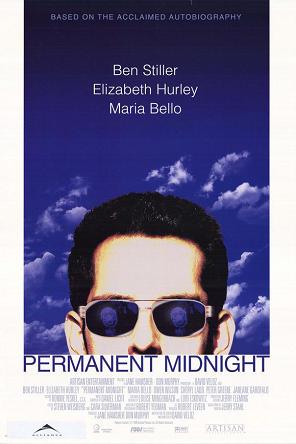
That was largely my reaction to watching the 1998 film, Permanent Midnight.  In this film, Ben Stiller plays Jerry Stahl, a real-life screenwriter who had a fairly successful career going in the 80s and early 90s.  He came out to Los Angeles looking to be a serious writer but, instead, he ended up writing for silly puppet show and getting addicted to heroin.  He also married a British television executive named Sandra (Elizabeth Hurley), so that Sandra could get her green card.  When the star of a show that he writes for tells him to kick his habit or lose his job, Jerry ends up smoking crack cocaine with a new dealer (Peter Greene).  When Sandra tells him that she’s pregnant, Jerry responds by shooting up in the bedroom.  When he’s trusted to spend the day taking care of his baby daughter, he drives her around the seediest sections of Los Angeles while he searches for his drug dealer.  As the baby cries beside him, Jerry shoots heroin into his jugular.  Jerry ends up unemployable and abandoned by every friend that he had.  He works at a fast food restaurant, or at least he does until he meets another recovering addict (Maria Bello).  She’s the one to whom he tells his story, in between sex and bouts of impotence.  In the end, what’s left for Jerry Stahl to do but write a book and then a movie about his life as a junkie?

It’s a harrowing story and I guess Stahl deserves some credit for writing the screenplay for a movie that doesn’t exactly make him look good.  However, Permanent Midnight runs into the same problem that afflicts most movies about drug addiction.  With very few exceptions, drug addicts are just not that interesting.  The only thing more boring than watching someone shoot up is then having to listen to that person explain why he shoots up.  (Trainspotting is the obvious exception but Trainspotting benefits from Danny Boyle’s frenetic direction, Ewan McGregor’s explosively charismatic lead performance, a witty script, and a killer soundtrack.  These are things that Permanent Midnight lacks.)  The film attempts to build up some sympathy for Stahl by telling us about his difficult childhood, his father’s suicide, and his mother’s instability but, in the end, Jerry is a junkie who shoots up in front of his baby.  Regardless of how crappy his childhood was, it’s hard to care about whether or not he ever gets his shit together.  Mostly, you just want someone to step in and make sure he never gets near that baby again.

Permanent Midnight makes another mistake, one that is all too common when it comes to films about troubled artists.  It continually tells us that Jerry is a talented and important writer without ever showing us any evidence of that fact.  We’re supposed to feel bad that Jerry is stuck working on a sitcom called Mr. Chompers but, at no point, does the film really convince us that he deserves anything better.  Everyone says that Jerry is talented but we don’t really get to see any evidence of that fact.  It’s hard not to feel that maybe Jerry should just be happy that, unlike the majority of writers in Los Angeles, he actually has a steady job.

(Jerry does get one good line, when he appears on The Maury Povich Show to promote his book and says, “People always ask, ‘What’s the worst thing heroin drove you to do?’  I always answer, ‘showing up on Maury.'”)

Of course, for most people, the main appeal of seeing Permanent Midnight will be the chance to see Ben Stiller shooting up heroin while soaked in withdrawal sweat.  Stiller gives a serious performance, good enough that you regret that his acting career now seems to mostly consist of starring in bad movies and making cameos in even worse ones.  There’s actually a lot of familiar faces in Permanent Midnight: Elizabeth Hurley, Maria Bello, Fred Willard, Owen Wilson, Sandra Oh, Janeane Garofalo, Andy Dick, and others.  They all give good enough performance but ultimately, this is aimless and ultimately rather frustrating movie.

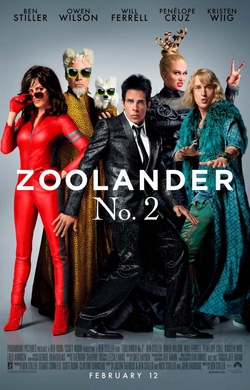
Cleaning Out The DVR Yet Again #16: Zoolander 2 (dir by Ben Stiller)


(Lisa recently discovered that she only has about 8 hours of space left on her DVR!  It turns out that she’s been recording movies from July and she just hasn’t gotten around to watching and reviewing them yet.  So, once again, Lisa is cleaning out her DVR!  She is going to try to watch and review 52 movies by Wednesday, November 30th!  Will she make it?  Keep checking the site to find out!)

zoolander_2_poster

On October 14th, I recorded Zoolander 2 off of Epix.

A sequel to the 2001 cult hit, Zoolander 2 came out earlier this year and got absolutely terrible reviews and quickly vanished from theaters.  Watching the film last night, I could understand why it got such terrible reviews.  Zoolander 2 is not only a terrible movie but it’s also a rather bland one.  Somehow, the blandness is even more offensive than the badness.

Zoolander 2 opens with Justin Bieber getting assassinated and Derek Zoolander (Ben Stiller) being forced to come out of retirement and discover why pop stars are being targeted.  And, of course, Zoolander can’t do it without the help of Hansel (Owen Wilson)!  Penelope Cruz is in the film as well, playing  Zoolander’s handler and essentially being wasted in a role that could have been played by anyone.

Oh!  And Will Ferrell returns as well.  Ferrell gives a performance that essentially shouts out to the world, “Fuck you, I’m Will Ferrell and no one is going to tell Will Ferrell to tone his shit down!”

Actually, I think everyone in the world is in Zoolander 2.  This is one of those films that is full of cameos from people who probably thought a silly comedy would be good for their image.  For instance, there’s a huge number of journalists who show up playing themselves.  Matt Lauer shows up and I get the feeling that we’re supposed to be happy about that.  There was a reason why people cheered when the sharks ate him in Sharknado 3.

You know who else shows up as himself?  Billy Zane!  And Billy Zane has exactly the right type of attitude for a film like this.  He shows up and he mocks the whole enterprise by giving the Billy Zaniest performance of Billy Zane’s career.  For that matter, Kiefer Sutherland also shows up as himself.  I’m not really sure what Kiefer was doing in the film but he makes sure to deliver all of his lines in that sexy growl of his.  Kiefer knows what we want to hear.

You may notice that I’m not talking about the plot of Zoolander 2.  That’s largely because I couldn’t follow the plot.  This is an incredibly complicated film but it’s not complicated in a funny way.  Instead, it’s complicated in a way that suggests that the film was made up on the spot.  It’s as if the cast said, “We’re all funny!  Just turn on the camera and we’ll make it work!”

The problem with Zoolander 2 is obvious.  The first film pretty much exhausted the comic possibilities of making a spy film about shallow and stupid models.  Don’t get me wrong — the first film did a good job but it’s not like it left any material untapped.  But I would ask you to indulge me as I imagine an alternate reality.

Consider this: Terrence Malick was reportedly a huge fun of Zoolander.

Let’s take just a minute to imagine a world in which Ben Stiller asked Terrence Malick to write and direct Zoolander 2.  And let’s say, just for the sake of argument, that Malick agreed!

Just think about it — 4 hours of Zoolander and Hansel staring up at the sky and thinking about nature.  “What is this thing that causes the heart of man to beat?” Zoolander asks.  “Are we nature or has nature become us?” Hansel replies.

That would have been a fun film!

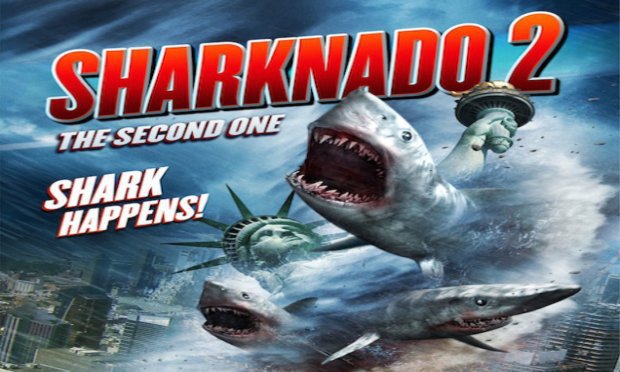
10 Reasons Why Sharknado 2 Was Sharktastic!


sharknado-2-poster

Unless you’ve been living in total and complete isolation, you know that Sharknado 2 premiered on SyFy last night.  And of course, I watched and live tweeted it.  Now, when it comes Sharknado 2, it seems like everyone has one question: Was it better than Sharknado?

The answer?

Yes.  Yes, it was.

Here are 10 reasons why Sharknado 2 was sharktastic!

1) Action!  Action!  Action!

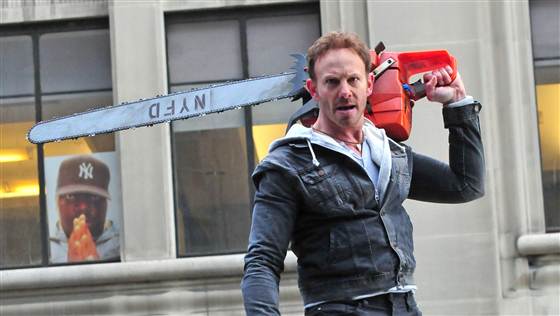
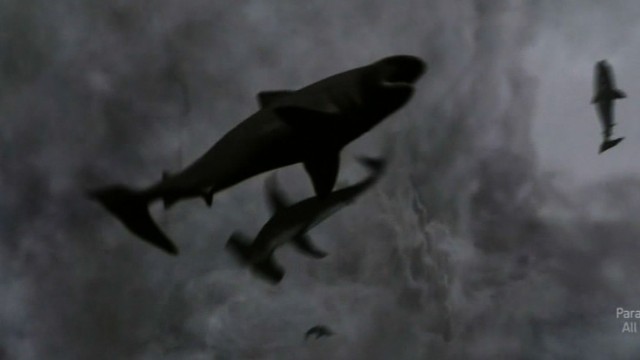
Sharknado 2 didn’t waste any time getting to the point.  From the minute the film started with Ian Ziering and Tara Reid sitting in an airplane that’s hit some sharknado-related turbulence, Sharknado 2 was all about sharks falling from the sky.  The film didn’t waste any time revisiting the events of the previous film or trying to explain, for a second time, how a bunch of sharks ended up in a tornado.  And you know what?  If you were worry about the logic of the situation then you really weren’t the right audience for this film.  Sharknado 2 was a movie for those of us seeking nonstop shark mayhem and it delivered!

2) Plenty of New York Attitude

When the first sharknado hit Los Angeles, we were presented with a portrait of a town that deserved to be destroyed.  I mean — really, Los Angeles?  A little bad weather and a few sharks and your entire population is screaming and fleeing?  New York, however, knows how to handle a sharknado.  It didn’t matter how many sharks fell from the sky — the citizens of New York refused to allow it to stop them from enjoying baseball games, visiting the Statue of Liberty, and seeking out a good slice of pizza.  New York, you’re the tops!

3) Tara Reid Showed Us How To Handle Losing A Hand

I don’t know about you but if a shark fell out of the sky and bit off my hand, I would probably freak out.  Having watched Sharknado 2, I can say that I am definitely not as strong as Tara Reid.  Though she may have lost her hand early on in this movie, she never let it slow her down.  Not only did she defiantly walk out of the hospital but she also managed to drive a fire truck with only one hand!  I’ve got two hands and I don’t think I could do that.  Finally, as a perfect example of how to make lemonade out of lemons, she even replaced her missing hand with a radial saw that, as it turns out, was perfect for fighting sharks.  You go, girl!

4) Ian Ziering Gave It All He Could

In the first Sharknado, Ian seemed almost annoyed to be there.  You got the feeling that he felt that somehow, by appearing in a movie about flying sharks, he was somehow damaging his career.  In Sharknado 2, however, Ian brought a lot of conviction to his role.  Though it may be hard to understand if you haven’t seen the actual film, I’ll just say that you looked at and listened to Ian and you believed that this man had indeed been inside of a shark.

IZ in Sharknado 2


5) The Statue Of Liberty Lost Her Head

And you better believe that head went rolling down the streets of New York.  I am a little bit disappointed that Ian never found a moment to stare up at headless Lady Liberty and shout, “You blew it up!  Damn you to Hell!” but oh well.

6) Cameos Galore!

Seeing as how the first Sharknado became a bit of a pop cultural phenomena, we should probably not be surprised that a lot of celebrities agreed to do cameos in the sequel.  What should surprise, however, is just how well the cameos were integrated into the film.  Whether it was Kelly Osbourne getting eaten by a shark or Matt Lauer and Al Roker arguing over the proper name for the storm (eventually, Matt did call it a sharknado and you can see just how happy Al was; it was a touching moment), all of the cameos worked brilliantly and, even more importantly, they didn’t distract from all of the shark mayhem.

7) The Live Tweeters Were On Fire Last Night!

Especially me!  Seriously, Sharknado 2 brought out the best in me.

8) Ian Wasn’t The Only Actor Giving It His All

To be honest, the entire cast brought their A game to Sharknado 2.  Everyone from Vivica A. Fox to Mark McGrath to Kari Wuhrer to Tara Reid to Judd Hirsch to well, everyone seemed to understand that for this material to work, they had to be willing to say some of the most ludicrous lines imaginable with a straight face.  If a single member of the cast had tried to wink at the audience or play up the film’s inherent campiness, the entire film would have fallen apart.  Instead, everyone brought a lot of conviction to their roles.  Instead of mocking the film and their dialogue, you could tell that they were instead having fun with it and, as a result, the audience had a lot of fun as well.

9) Kelly Ripa Stamped On The Head Of A Hammerhead Shark

Proof positive that high heels can be a girl’s best friend.

10) Everyone Watched it!

And you know what that means:  SHARKNADO 3!

Sharknado 2