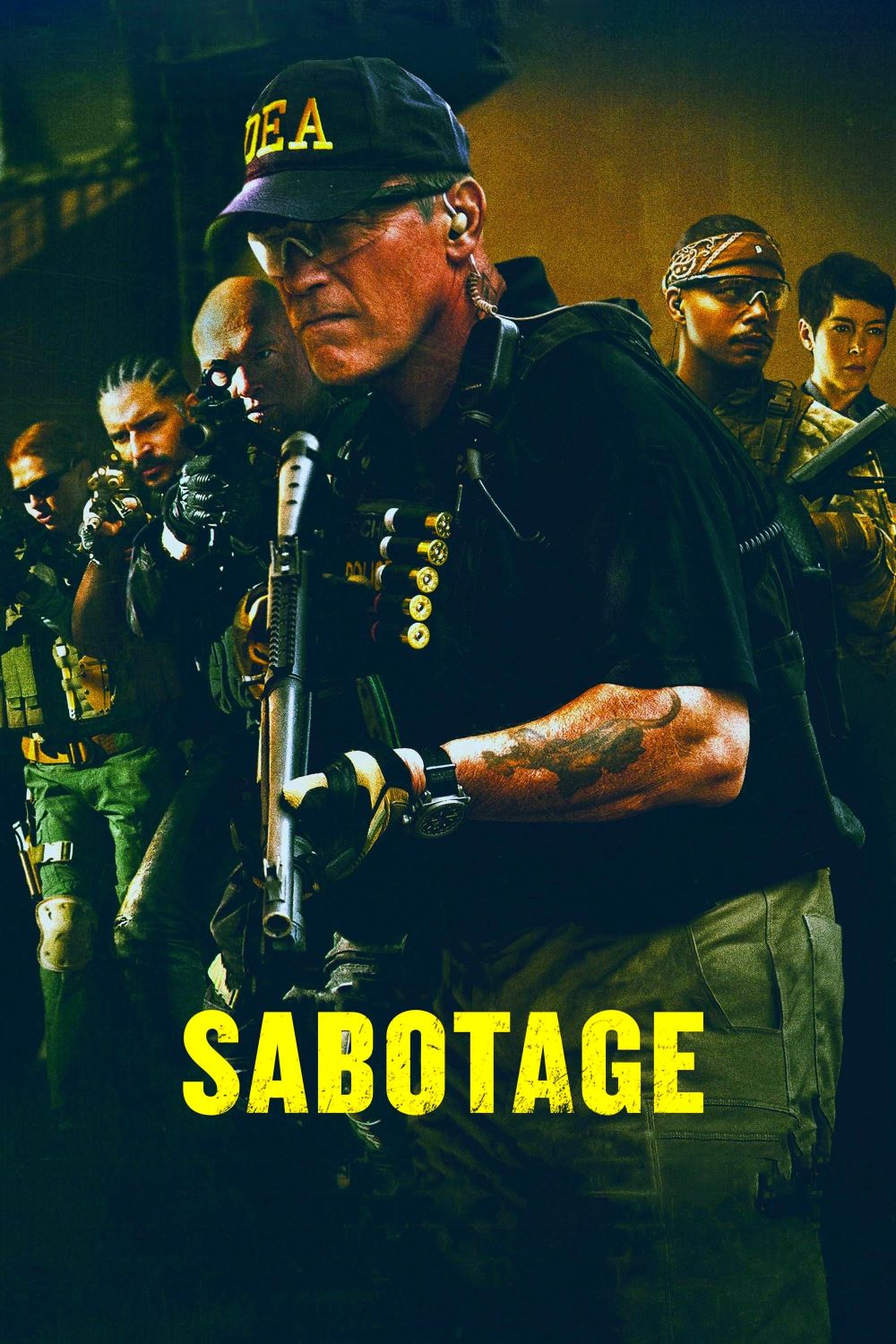
Review: Sabotage (dir. by David Ayer)


“Ammo’s cheap, my life ain’t.” — Joe “Grinder” Phillips

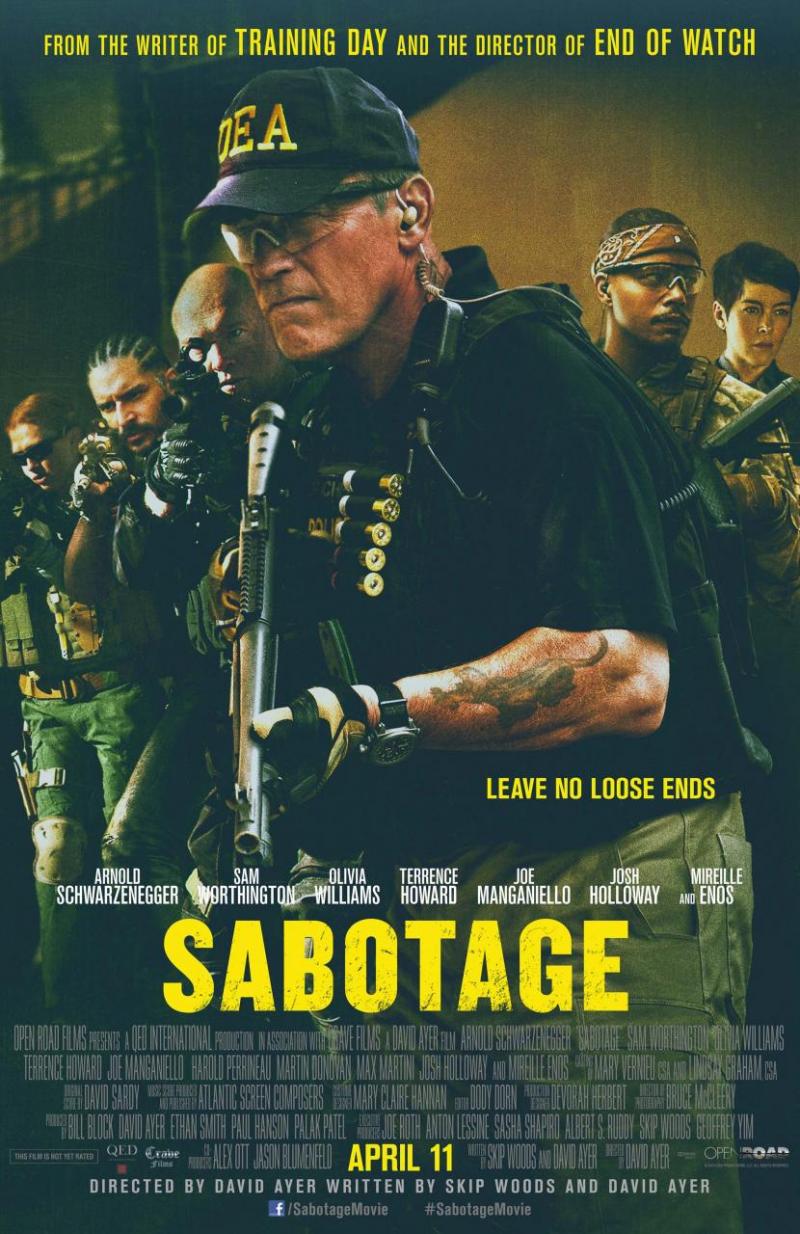
Watching Sabotage, the 2014 David Ayer action-thriller, is a bit like finding a beautiful, high-performance sports car that’s been stripped for parts. It’s got a shiny exterior in Arnold Schwarzenegger, a director known for gritty cop dramas, and a promising cast, but under the hood, the engine is sputtering and the chassis is held together with duct tape and questionable intentions. The film is a strange, often unpleasant beast that seems unsure if it wants to be a complex whodunit, a grim torture-porn horror flick, or a simple action vehicle for its aging star. In trying to be all of them, it mostly succeeds at being a confusing, albeit fascinating, mess.

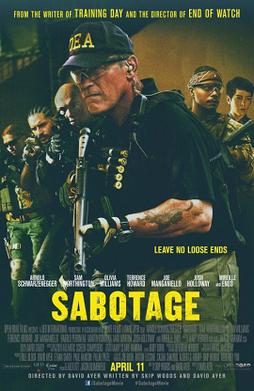
The film starts with a classic set-up that reeks of potential. Schwarzenegger plays John “Breacher” Wharton, the leader of an elite and ruthless DEA task force. During a cartel raid, the team decides to skim $10 million in cash from the seizure for themselves. Their plan backfires when they go to retrieve the hidden money and find it gone. This creates a perfect powder keg of suspicion and paranoia. While they’re all investigated, no one is charged, and they are put back into action. The plot kicks into high gear when members of the team start getting picked off one by one in increasingly gruesome and inventive ways. Now, Breacher has to find out who is hunting his team, while simultaneously being haunted by a dark secret from his past.

The mystery is clearly meant to be a bloody, modern interpretation of a classic “stranded and hunted” thriller formula. The problem is, the “whodunit” aspect falls flat because the story is just too messy to build any real suspense. The characters are an indistinguishable mass of nicknames like “Monster” (Sam Worthington), “Grinder” (Joe Manganiello), and “Sugar” (Terrence Howard), making it difficult to keep track of who is who, let alone care when they meet their grisly end. The film gives you little reason to invest in them, as they are an intentionally unlikable bunch of thugs who treat civilians with contempt, break the law without a second thought, and generally act like cartoon villains with badges. When a character is killed off, it’s often not a shocking, gut-wrenching twist, but more of a shrug: “Oh, that guy’s gone now.” The plot becomes less about solving a puzzle and more about waiting for the next spectacularly bloody demise.

And those demises are where David Ayer’s direction makes its most “memorable” impact. The violence in Sabotage is not your typical Schwarzenegger shoot-’em-up. It is unflinchingly brutal and hyper-realistic, leaning heavily into the kind of gruesome, elaborate set-pieces that feel borrowed from the horror genre. We’re not talking about clean, one-shot kills; we’re talking about brutal, drawn-out murders involving trains, industrial equipment, and a staggering amount of viscera. The camera lingers on open wounds, bodies nailed to ceilings, and the general gory aftermath of each death with a kind of morbid fascination. The film’s obsession with gore is relentless. It even opens with a scene of Breacher watching a video of his family being tortured, setting a grim, nasty tone that never quite lets up. It feels like Ayer is trying to show the brutal, unglamorous reality of violence, but it quickly crosses the line into exploitation, making the film a punishing watch for anyone not specifically seeking out that level of graphic brutality.

The cast is a mixed bag, and it’s one of the more interesting paradoxes of the film. Schwarzenegger, despite being the star, is a strange fit for this material. Critics noted that he seems to be trying to give a more “dark and complex performance,” mining reserves of darkness he rarely accesses. However, the movie around him doesn’t quite support that ambition. He’s still “Arnold,” and his innate charisma and larger-than-life persona often clash with the grim, nasty world Ayer has created. His presence is too big for the bleak mundanity the movie is striving for, creating a constant tension between the action hero audiences expect and the broken, haunted man the script demands. In stark contrast, it was the supporting female cast that often stole the show. Mireille Enos delivers a truly fearless and unhinged performance as Lizzy, the team’s drug-addicted female member, bringing a level of manic energy that is genuinely engaging. Olivia Williams, as the no-nonsense homicide detective Caroline Brentwood, is also a standout. She plays the “only sane person in the room” with an air of world-weary professionalism that feels like it belongs in a better movie. But even her character is dragged into the muck, with a strange and unnecessary romance that feels forced and out of place.

It’s almost impossible to discuss Sabotage without talking about the tone. The film is relentlessly cynical, presenting a world where the line between law enforcement and the cartels is practically non-existent. Ayer, who has explored the dark side of law enforcement in previous work, seems to be asking a bold question here: what happens when cops are worse than the criminals? The answer, according to the film, is a lot of violence and a total lack of moral compass. This cynical view is further dragged down by a barrage of cheap, sophomoric humor. The script is peppered with scatological jokes, crude sexual banter, and homophobic slurs that feel less like “gritty realism” and more like the writers are trying to be edgy just for the sake of it. This creates a bizarre, off-putting atmosphere where the dark, philosophical musings about corruption are undercut by a high-school-level obsession with bodily functions, making the whole experience feel awkward and juvenile.

In the end, Sabotage is a textbook example of a movie that is sabotaged by its own ambitions. It boasts a director with a distinctive style for crime stories, a legendary action star trying something different, and a cast full of talented actors. Yet, it’s ultimately sunk by a script that can’t balance its whodunit premise with its over-the-top gore, and a tone that can’t decide if it’s a serious crime drama or a nasty, nihilistic joke. It’s not boring, and you can’t say Ayer didn’t try something different with the action genre, but the result is an ugly, mean-spirited, and often just plain unpleasant film. For a fascinating look at what happens when a good idea goes horribly off the rails, Sabotage is a case study in wasted potential. But for a good movie? You’ll want to look elsewhere.
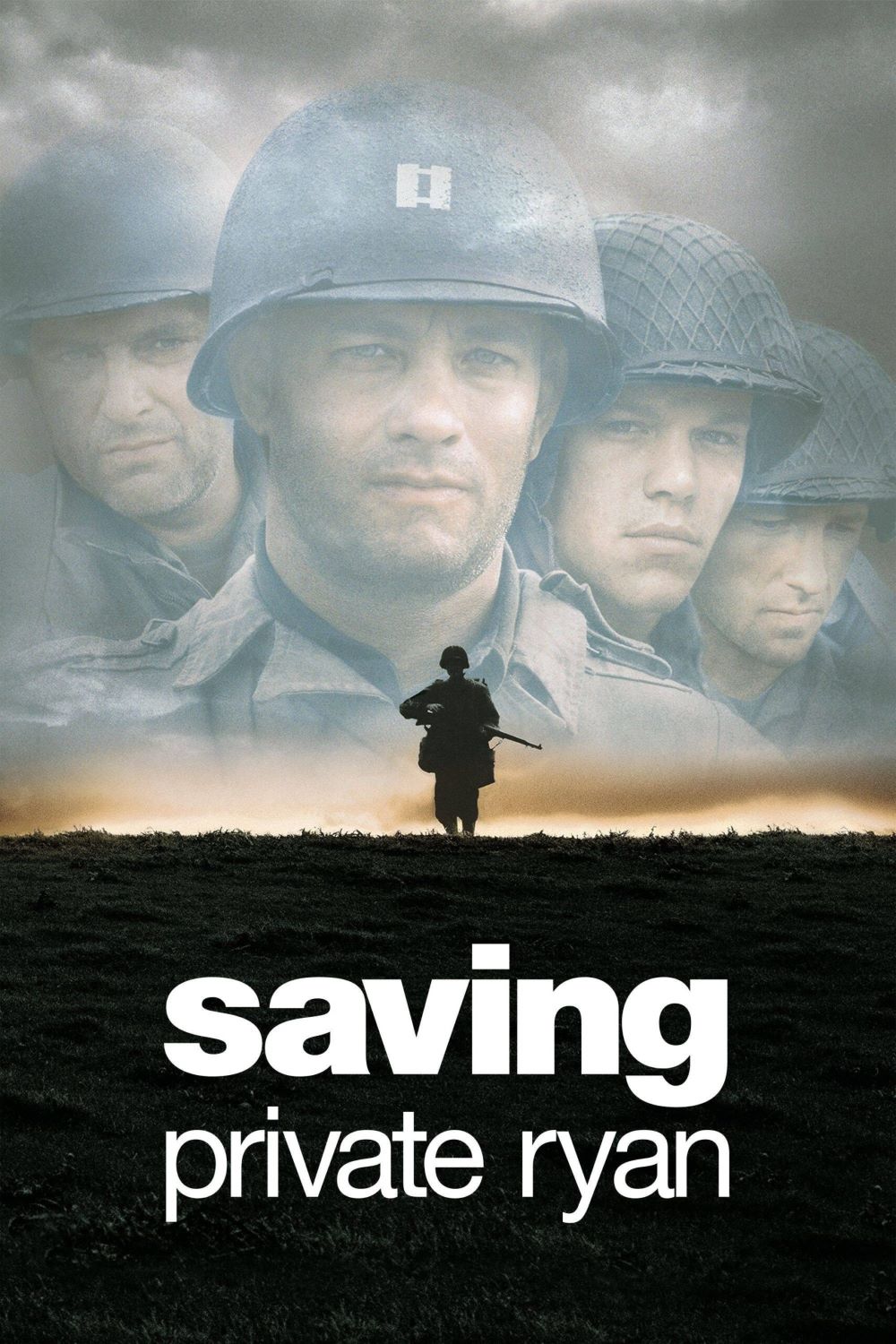
Review: Saving Private Ryan (dir. by Steven Spielberg)


“Someday we might look back on this and decide that Saving Private Ryan was the one decent thing we were able to pull out of this whole godawful, shitty mess.” — Sergeant Horvath

Saving Private Ryan stands as a landmark achievement in war cinema, intricately weaving immersive battle scenes, rich character dynamics, and profound moral themes into a nearly three-hour exploration of World War II’s human cost. One of its most remarkable features is the opening Omaha Beach landing sequence, a meticulously crafted, over 24-minute depiction of warfare’s brutal reality. Spielberg deploys a cinema verité style with handheld cameras capturing disorientation and chaos through the soldiers’ eyes. The sound design envelops the viewer in a sensory onslaught—gunfire, shouting, explosions—creating a visceral experience that immerses audiences directly in the terror and confusion of D-Day.

The filming process drew heavily on historical accuracy, with the production shot on the coast of County Wexford, Ireland, employing amputee actors and practical effects over computer graphics to simulate violent injuries and battlefield horrors. Muted tones evoke wartime photographs, and rapid, shaky editing conveys the disorganized, frantic environment soldiers endured. Consulting WWII veterans and historians, Spielberg created a sequence that reshaped cinematic portrayals of war, influencing how future films would approach the genre’s raw immediacy and emotional weight.

The film’s narrative follows a squad led by Captain Miller on a mission to locate and bring home Private James Ryan, whose three brothers have been killed in combat. The mission is steeped in the real-life tragedy of the five Sullivan brothers who died together aboard the USS Juneau in the Pacific, prompting military policies to prevent similar familial devastation. This historical context frames the story’s ethical heart: risking several men’s lives to save one, raising enduring questions about the value of individual sacrifice within the broader war.

In Saving Private Ryan, sacrifice is portrayed ambiguously—not as the sacrifice of a single hero but as the collective cost borne by the men tasked with rescuing one individual under perilous conditions. As the squad journeys through the war-torn French countryside, the deaths, injuries, and tensions they face underscore war’s randomness and the difficulty of weighing one life against many. The narrative refuses to romanticize or simplify, instead confronting the audience with the tragic truth that countless soldiers lose their lives without recognition or purpose, while some survive against staggering odds.

Duty and camaraderie thread throughout the film, portrayed through the soldiers’ evolving relationships and personal struggles. Each grapples with loyalty not only to their mission but to their fellow men and their own moral codes.

Integral to the film’s power is Tom Hanks’s layered performance as Captain John Miller. Hanks breathes life and emotional depth into Miller, portraying him as a man shaped by civilian life—revealed poignantly when he discloses his pre-war profession as a schoolteacher—now transformed by the relentless demands of war. He embodies an officer who is both composed and vulnerable, carrying the heavy burden of leadership with quiet dignity. Hanks’s portrayal reveals the internal struggles beneath Miller’s stoic exterior: moments of doubt, moral conflict, and fatigue subtly expressed through a trembling hand or a weary gaze. This humanity makes Miller relatable, as a man trying to maintain order and purpose amid chaos.

Hanks skillfully balances Miller’s authoritative presence with warmth and empathy, particularly evident in his paternal interactions with younger soldiers, reinforcing Miller’s role as both a leader and protector. His nuanced acting delivers the complexity of a man constantly negotiating duty and compassion. In scenes of high tension or moral quandaries, Hanks conveys the weight of command while allowing glimpses into Miller’s psychological strain, deepening the film’s emotional resonance.

Following Hanks’s Miller, a standout amongst the supporting cast is Tom Sizemore’s portrayal of Technical Sergeant Mike Horvath, Miller’s steady second-in-command. Sizemore embodies the pragmatic, battle-hardened soldier whose loyalty and experience provide emotional grounding for the squad. Sizemore portrays Horvath’s weariness and quiet commitment, adding layers of realism that deepen the exploration of how war reshapes individuals. The chemistry and shared history between Miller and Horvath are palpable, illustrating the bonds that sustain soldiers through hardship and lending emotional weight to the narrative.

The film wrestles with intense moral ambiguity throughout. The mission’s premise—to risk many lives to save one—compels both characters and viewers to confront complex questions about justice, value, and the cost of war. Scenes presenting difficult choices, such as the decision to spare or execute prisoners, dramatize these ethical dilemmas and highlight the emotional burdens borne by soldiers.

Technically, the film excels, with Janusz Kaminski’s dynamic cinematography capturing both the chaos of battle and intimate moments with evocative clarity. The immersive sound design reinforces the brutal reality, stripping warfare of glamor and confronting audiences with its daunting human costs.

Despite the overwhelming destruction and loss, Saving Private Ryan offers moments of humanity and hope. The rescue mission serves as a fragile symbol of compassion in the midst of devastation, while the film’s closing reflections on memory and legacy emphasize the lasting significance of sacrifice and survival.

Saving Private Ryan stands as a monumental achievement in the war genre, combining visceral combat realism, compelling characters, and moral complexity. Through Hanks’s deeply human Captain Miller and the nuanced supporting performances, especially Sizemore’s grounded Horvath, the film explores themes of sacrifice, duty, and brotherhood with unflinching honesty. Its enduring legacy lies in its unvarnished yet empathetic portrayal of war’s cost and the profound sacrifices made by those who lived it.

Sabotage (2014, directed by David Ayer)


Atlanta Homicide detective Caroline Brentwood (Olivia Williams) and her partner, Darius Jackson (Harold Perrineau), are the primaries on the murder of a former DEA agent.  Their investigation leads them to an elite special operations team led by “Breacher” Wharton (Arnold Schwarzenegger).  Wharton and his crew were previously suspended for six months while the FBI investigates their last raid and why there was a $10 million dollar discrepancy between the amount of money the team reporter and the amount of money the FBI was expecting to be recovered.  Someone is murdering the members of Breacher’s team one-by-one.  Breacher and Brentwood investigate the murder and what happened to the money but they both discover that they can’t trust anyone.

Sabotage has got a cast that is full of talent and familiar faces, including Sam Worthington, Mireille Enos, Terrence Howard, Joe Manganiello, Martin Donavon, and Josh Holloway.  It also has one truly great action scene, a violent chase down a busy Atlanta street that comes to sudden and very bloody conclusion.  The film’s final scene takes Sabotage into western territory, with Schwarzenegger dominating the screen like a larger-than-life Sergio Leone hero.  It’s just too bad that the rest of the movie isn’t as a good as its final shot or that one chase scene.  Unfortunately, most of the film feels repetitive and half-baked, with way too much time being wasted on supporting characters who tend to blend together.

Arnold Schwarzenegger gives one of his better performances.  When he made Sabotage, he was no longer a governor and he was also no longer an automatic box office draw and there’s a tired weariness to his performance.  Unfortunately, the rest of the cast is either miscast (Olivia Williams) or stuck playing one-dimensional characters (everyone else).  There’s enough good action sequences to keep Sabotage watchable and Schwarzenegger shows that he can actually be a very good actor but it’s also easy to see why this film didn’t reignite his his career.

The Things You Find On Netflix: Eli (dir by Ciaran Foy)


Eli (Charlie Shotwell) is a young boy who is allergic to everything outside.  As a result, he can’t venture out of the house unless he’s covered, head-to-toe, in protective gear.  Eli wasn’t always allergic, of course.  It’s just something that suddenly started.  Eli’s mother, Rose (Kelly Reilly) and her husband, Paul (Max Martini), are taking him to a special clinic run by Dr. Isabella Horn (Lili Taylor).  Because the clinic is sealed off from the outside, Eli can leave his plastic bubble.  Because the clinic is in a dark old building, we know that it’s either going to be haunted or run by some sort of cult.  In fact, it doesn’t take long before Eli is doubting not only Dr. Horn but his parents as well!  He keeps hearing voices that hiss, “Lie.”  And the only other patient at the clinic, a young girl named Haley (Sadie Sink), repeatedly tells him to be careful….

Eli is 98 minutes long and I lost interest after the first ten.  Basically, I was willing to give the film a chance but then a bunch of rednecks started to taunt Eli while he was walking around outside in his protective gear and I was like, “Yeah, okay.” Then they started throwing stuff at him and I was like, “Getting a little bit heavy-handed now.”  Then the suit got torn and Eli started screaming like he was about to die and the rednecks just stood there laughing and that’s when I said, “Okay, this is going to suck.”  There’s heavy-handed and then there’s just attacking your audience with a sledgehammer.  Sledgehammers give you a migraine.

Once Eli reaches the clinic, the film slows down to a glacial pace.  In theory, the slow pace should have helped to maintain an ominous atmosphere but …. eh.  To be honest, I’ve seen a lot of creepy clinics in a lot of creepy movies and there was nothing that special about this one.  It all leads to a big twist but, again, it wasn’t a particularly original twist and even the film’s attempt to blow my mind with a subversive ending just left me shrugging.  “Really?” I thought, “That’s what’s going to happen, huh?  Well, what can you do?”

Like a lot of bad movies, the script for Eli was included on the infamous Hollywood Black List.  The Black List is an annual list of the “best” unproduced screenplays in Hollywood.  A few good films have been made out of scripts on the Black List but, for whatever, the majority of Black List films always seem to turn out to be somewhat disappointing.  Broken City, for instance, was a Black List film.  So was The Beaver.  You can add Eli to the pile of mediocre Black List films.

Catching Up With The Films of 2018: Fifty Shades Freed (dir by James Foley)


“Mrs. Grey will see you now.”  (Insert your own eye roll GIF here.)

Occasionally, you see a film and, even though you know you should, you just never get around to reviewing it.  For instance, I saw Fifty Shades Freed when it was originally released in February and then I watched it again when it was released on DVD.  Both times, I thought to myself that I should write down my thoughts on the film, if for no other reason than the fact that I previously reviewed both Fifty Shades of Grey and Fifty Shades Darker for this site.  And yet, I never did.  To be honest, it was difficult to really think of anything to say about this movie that I hadn’t said about the previous two films.

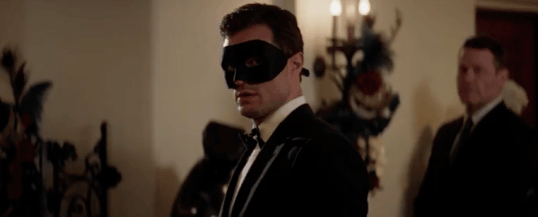
Fifty Shades Freed opens with Christian (Jamie Dornan) and Ana (Dakota Johnson) getting married and going on their honeymoon.  It’s fun!  It’s sexy!  And it’s kinda creepy because, as always, Christian has control issues and he has to have his security team following them all over the place.  Christian freaks out with Ana removes her top on the beach.  Ana gasps at the sights of handcuffs.  There’s one hot sex scene that will temporarily make you forget about the fact that Jamie Dornan doesn’t seem to be that good of an actor.  It’s everything that you’d expect from a Fifty Shades honeymoon.

Unfortunately, the honeymoon ends way too quickly and then we have to deal with the marriage.  On the plus side, marrying Christian Grey means that you get to live in a really nice house and fly around in a private jet.  On the negative side, Christian is still basically an immature douchebag and, now that’s she rich, Ana has become a lot less likable.

Christian freaks out when he discovers that Ana is still using the name “Ana Steele” in her email address.  Ana explains that she’s Ana Steele at work but then, when she meets an architect named Gia Matteo (Arielle Kebbell), Ana tells her to stop flirting with her husband and announces, “You can call me Mrs. Grey!” with all the intensity of Kelly Kapowski announcing that she’s going to prom with Zach Morris on Saved By The Bell.

The marriage continues to play out like a perfume commercial written by Sartre’s bastard child.  Fortunately, there’s a few more sex scenes that are designed to again remind us that a good body can make up for a lack of everything else.  Unfortunately, Ana gets upset when Christian tries to humiliate her for real and a pouty Christian walks out of a shower as soon as Ana steps into it.  Ana is told that she’s pregnant and Christian totally freaks out because he still has all sorts of things that he wants to do with his money.  Christian’s a douchebag but he’s got a good body and he’s like super rich.  Have I already mentioned that?

Anyway, it turns out that Ana is being stalked by her former boss, Jack Hyde (Eric Johnson).  Fortunately, all of the stalking allows Ana and Christian to rediscover their love for each other.  There’s a kidnapping.  There’s a car chase.  There’s a lot of music and a lot of scenes of Dakota Johnson looking confused and Jamie Dornan looking blank.  It’s a Fifty Shades movie.  What else were you expecting?

The usual argument that critics tend to make with the Fifty Shades trilogy is that the movies are terrible but Dakota Johnson does the best that she can with the material.  Actually, both Dakota Johnson and Jamie Dornan are pretty lousy in all three of these films but Ana was at least kind of a sympathetic character in the previous two films.  Unfortunately, Fifty Shades Freed sees Ana and Christian becoming a boring married couple and what little chemistry Dornan and Johnson had in the previous films completely vanishes.  As a result, Ana doesn’t seem like someone lucky enough to have fallen in love with a man who just happens to be super wealthy.  Instead, she just comes across like someone who sold her soul for a private jet.

Fifty Shades Freed is the weakest of the trilogy, done in by the fact that there’s really not much of a story to tell.  Ana and Christian get to live blissfully ever after and it’s always good to see happy mannequins.  I saw this movie with my best friend and we talked through the entire movie and I imagine that’s what we’ll do every time we rewatch it.

Film Review: Fifty Shades Darker (dir by James Foley)


The Fifty Shades of Grey trilogy is shaping up to be the cinematic equivalent of a twitter parody account.

That’s the conclusion that I reached today after my BFF Evelyn and I watched the second part of the trilogy, Fifty Shades Darker.  Since we had both read the book, we weren’t shocked when Fifty Shades Darker turned out to be a bad movie.  Hell, we weren’t surprised when Fifty Shades of Grey turned out to be bad, either.  Each subsequent book was worst than the one that came before it so, when the film version of Fifty Shades Freer is released next year, it should be the worst of all.

Still, nothing could have prepared us for the amount of laugh-out-loud moments and odd details that were offered up in Fifty Shades Darker.  Consider just a few:

Having broken up with Christian “I’m fifty shades of fucked up” Grey at the end of the previous film, Ana Steele (Dakota Johnson, doing penance in the hope of being sprung from Purgatory) is now working for a hip and trendy Seattle publishing company!  How do we know that it’s hip and trendy?  Well, it’s in Seattle and it’s called Seattle Independent Publishing!  (As opposed to Seattle Corporate Press.)  Her boss, Jack (Eric Hyde) leers at her in a style that basically screams, “Lifetime movie villain!”  There’s a scene in which Ana tells her editors that they should be making more of an attempt to reach readers in the “18-24 demographic” and everyone reacts as if this is the first time that they’ve ever heard about this concept.  You half expect someone to say, “18 to 24 year olds!  WHY DIDN’T WE THINK OF THAT!?”  Seriously, after seeing this, I’m going to send my resume to the Dallas Observer, along with a note that says, “18-24.  Hire me for more info.”

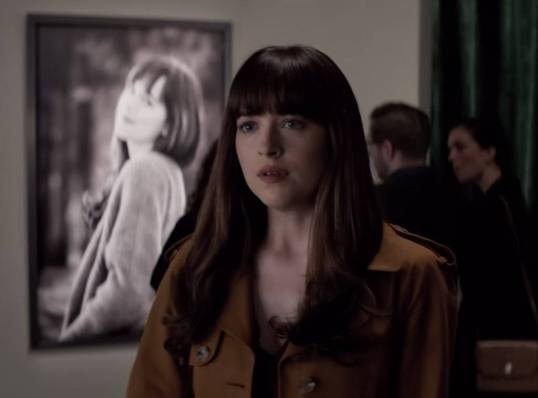
When Christian (poor Jamie Dornan, who I’m pretty sure was trying to blink out an S.O.S. signal at certain points in the film) and Ana first reunite, it’s to attend an art show.  Ana’s artist friend has filled an entire gallery with photos of Ana, the majority of which resemble the “sexy” photos that Darcy posted to her MyRoom page in that very special episode of Degrassi.  Christian buys all the pictures because he can’t handle the idea of anyone else having Ana on their wall.  This obsessive and controlling act is just enough to apparently make Ana reconsider her decision to dump Christian because he was being too obsessive and controlling.

50

Christian eventually confesses to Ana that he’s only attracted to women who look like his mother and he punishes them because he’s angry with her.  “Oh, Christian, your Oedipal complex is so sexy,” Ana coos.  Okay, she doesn’t say that.  I said that and then Evelyn said something that I can’t repeat.  And then we laughed and laughed.  Don’t get me wrong.  I know that everyone has their issues and God knows, I’ve got a few myself.  But the minute a guy tells me that he’s only dating me because I look like his mother, that’s the minute I leave.

When Christian tells Ana about his messed up childhood, Ana responds by drawing on his chest with lipstick.  And I swear, that lipstick remains on his chest — without a smudge — for at least a few days.  Every time we would catch a glimpse of those perfect lipstick markings on Christian’s chest, Evelyn and I would start laughing.  I mean, drawing on your partner (or having your partner draw on you) can be fun but most people wash it off after a while.

(Incidentally, when the Scary Movie people get around to parodying this movie, you know that the lipstick scene is going to be recreated.)

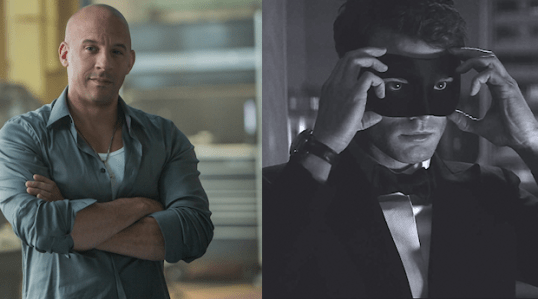
Christian’s childhood bedroom is decorated with a poster of Vin Diesel.  When Christian is pouring out his heart, Vin Diesel is glowering in the background.  It would have been neat if the poster had suddenly come to life.  Perhaps Vin could have suddenly appeared in the bedroom and said, “Someday … BUT NOT TODAY!”

And I’m not even going to talk about the Ben Wa balls.

fifty-shades-darker-teaser-intrigued

Anyway, there’s really not much of a plot in Fifty Shades Darker.  Ana gets back together with Christian but says that she wants to have a “vanilla” relationship.  Christian agrees but he still keeps doing controlling stuff, like buying Ana’s company and freezing her bank account.  Ana gets mad.  Ana breaks up with him.  They get back together.  This happens a few times.  Christian tells Ana to stay away from a man.  Ana gets upset but then the man tries to rape her which feels like the film’s way of putting her in her place for doubting Christian’s instincts when it comes to men.  Kim Basinger pops up as the woman who introduced Christian to BDSM and tells Ana that Christian will never be happy in a vanilla relationship.  Ana says that vanilla is her favorite ice cream.  Here’s my thing: why can’t Ana come up with a more complimentary term than “vanilla” to describe her relationship goals?  I mean, Ana’s clever.  She came up with that whole 18-24 thing, after all.

There’s also a crazy woman (Bella Heathcote) who shows up occasionally.  We know she’s crazy because she’s dressed like someone who lives in an abandoned subway tunnel.  She occasionally grabs Ana and says, “I’m nobody!”  Hmmm….I wonder what that’s about…

(Well, don’t wonder too much.  There’s not a single mystery or question in Fifty Shades Darker that isn’t solved a scene or two after it’s raised.)

One of the redeeming things about Fifty Shades of Grey is that neither Dakota Johnson nor director Sam Taylor-Johnson seemed to be taking it all that seriously.  Dakota would pause meaningfully before delivering the worst of her dialogue, a sign that even she couldn’t believe what she was about to say.  Meanwhile, Sam Taylor-Johnson’s direction suggested that she found the story to be just as ludicrous and stupid as everyone else.  However, Fifty Shades Darker is directed by James Foley.  Foley is a veteran director, one who has been making films since before I was born.  He does a workmanlike job and you can almost hear him shouting, “Now, where’s my paycheck!?” during certain scenes.  Under Foley’s direction, there’s no winking at the audience.  There’s no hints of subversion.  Foley’s direction is very literal and more than a little dull.  He was hired to direct a big-budget version of a Chanel No. 5 commercial and that’s exactly what he does.

50

The other big issue with Fifty Shades Darker is that Dakota Johnson and Jamie Dornan have very little romantic chemistry.  They both look good naked but that’s about it.  Jamie looks miserable to be there and Dakota seems to be trying to keep herself amused.  The lack of chemistry was less of a problem in Fifty Shades of Grey.  In that film, all that mattered was that Christian was rich and hot and Ana didn’t really haven’t anything better to do.  But, in Fifty Shades Darker, we’re asked to believe that they’re actually deeply in love and … no, it just doesn’t work.

Evelyn and I laughed through the entire movie.  In the past, we’ve gotten in trouble for doing this because we do have a tendency to get a little bit loud.  However, nobody in the audience seemed to mind.

Anyway, Fifty Shades Freer will be coming out next year.  Hopefully, someone will read this review and work my idea about the Vin Diesel cameo into the film.

Seriously, it would be great!

vin-diesel-jamie-dornan

Lisa Reviews An Oscar Nominee: Captain Phillips (dir by Paul Greengrass)


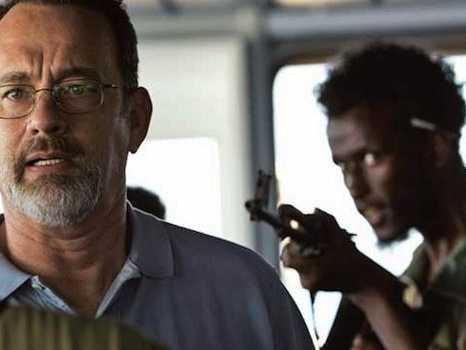
tom-hanks-barkhad-abdi-captain-phillips

Here’s an interesting and often overlooked fact:

It has been 17 years since Tom Hanks was last nominated for Best Actor.

When I discovered this fact, I was shocked because Tom Hanks is one of those actors who has a reputation for always getting nominated.  We tend to think of him as almost being a male Meryl Streep, an actor who will be nominated simply for showing up.  But, actually, the Academy last nominated Tom Hanks, for his performance in Cast Away, in the year 2000.

Hanks has given plenty of strong performances since then and he’s continued to appear in acclaimed and Oscar-nominated films.  And you would think, considering his apparent popularity in Hollywood, Tom Hanks would have been nominated for everything from Charlie Wilson’s War to Bridge of Spies.  But no.

Personally, I think Hanks should have been nominated this year for Sully.  But you know what Hanks performance truly deserved some Oscar recognition?

Captain Phillips.

Playing the title role in this 2013 Best Picture nominee, Hanks gave perhaps the best performance of his career.  That he was snubbed by the Academy is not only shocking but it’s actually a bit unforgivable.  Perhaps Hanks was so good that the Academy took him for granted.  Perhaps they thought that since both Hanks and Richard Phillips are decent, down-to-Earth guys, that Hanks was just playing himself.  For whatever reason, Tom Hanks deserved, at the very least, a nomination.

Captain Phillips was based on a true story.  This is another docudrama from director Paul Greengrass, filmed in his signature (and potentially nausea-inducing) handheld style.  (Actually, if any aspiring director wants to understand how to effectively use the handheld style, Greengrass is the filmmaker to study.)  In 2009, a four Somali pirates hijacked the Maersk Alabama and took its captain, Richard Phillips, hostage.  Captain Phillips was eventually rescued by a group of Navy SEALS.  Three of the pirates were killed while their leader, Muse (Barkhad Abdi), was captured and is currently serving a 33 year sentence in a federal penitentiary.

This was a huge news story in 2009 with the rescue being described as being the first major foreign policy victory for the new presidential administration.  When Phillips was rescued, people took to the streets and the “USA!  USA!” chant was heard.  “That’s right,” the media and the government and the chanters seemed to be exclaiming in unison, “America’s back!  We were abused and it’s never going to happen again!”

A lot of that jubilation was because, at the time, the term “Somali pirates” conjured up visions of cinematic villains who would be more at home in Mad Max: Fury Road than in the real world.  The reality of the situation, of course, was that the “pirates,” whose deaths were celebrated as some sort of political victory for the government, were actually poverty-stricken Somali teenagers, the majority of which worked for warlords who remained (and still remain) safely hidden away.

One of the more interesting things about Captain Phillips is that it devotes almost as much time to the Somali pirates as it does to Phillips and his crew.  Rather than presenting them as a nameless and personalityless threat, the film allows Muse and his men to emerge as individuals.  Much as Phillips spends the movie trying to keep both himself and his crew safe, Muse spends much of the movie trying to keep an increasingly out-of-control situation stable.  Both Phillips and Muse are in over their heads.  Barkhad Abdi gives a smart and intimidating performance as Muse.  The film never makes the mistake of excusing the actions of Muse or the other pirates but, at the same time, it does provide a more nuanced view of them than one would normally expect.

But really, this film totally belongs to Tom Hanks.  Captain Phillips works because of Tom Hanks.  It earned its best picture nomination on the strength of Hanks’s performance.  As an actor, Hanks could have easily coasted on the good will that the audience would have already had for him but instead, he fully commits himself to playing not Tom Hanks but instead Captain Richard Phillips.  The film’s final scene — in which Phillips goes into a state of shock and can’t stop talking — is a masterclass in great acting.  How the Academy ignored it, I will never understand.

Captain Phillips was nominated for best picture of 2013.  However, it lost to 12 Years a Slave.


Cleaning Out The DVR Yet Again #17: 13 Hours (dir by Michael Bay)


(Lisa recently discovered that she only has about 8 hours of space left on her DVR!  It turns out that she’s been recording movies from July and she just hasn’t gotten around to watching and reviewing them yet.  So, once again, Lisa is cleaning out her DVR!  She is going to try to watch and review 52 movies by Wednesday, November 30th!  Will she make it?  Keep checking the site to find out!)

13_hours_poster

I recorded 13 Hours off of Epix on October 14th.

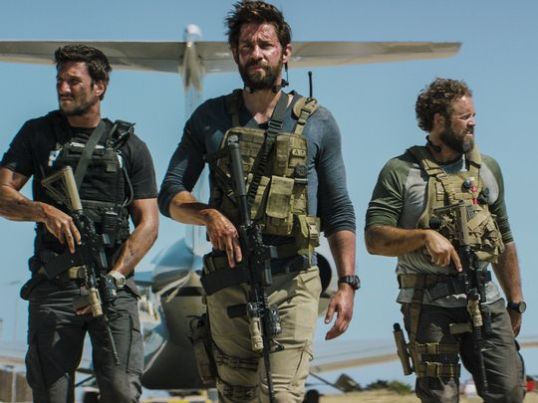
Before I say anything else about 13 Hours, I would like to be point out something that I haven’t seen mentioned in any of the other reviews of this film.  13 Hours is not just a recreation of the September 11th, 2012 attack on the American diplomatic compound in Benghazi, Libya.  (This attack led to death of Ambassador Chris Stevens, Tyone Woods, Sean Smith, and Glenn Doherty, all of whom are portrayed in the film.)  13 Hours is also a very unexpected The Office reunion.  On The Office, John Krasinski played Jim Halpert while David Denman played Roy Anderson, the ex-fiance of Jim’s wife, Pam.  In 13 Hours, they both play members of the American security detail who spend 13 terrifying hours trying to protect the compound from a violent and heavily armed mob.

They’re both surprisingly well-cast.  As someone who absolutely loved The Office, I had my doubts as to whether or not I’d be able to believe John Krasinski — he of the iconic smirk and the adorable eye roll — as a battle-hardened, former Navy SEAL.  Jim Halpert with a gun!?  I wondered.  But Krasinski brings an unexpected gravity to his role, as does David Denman.  For that matter, the entire cast — and this is truly an ensemble film, even if it is dominated by Krasinski and James Badge Dale (in the role of Tyrone Woods) — does surprisingly well.  If I sound surprised, that’s because 13 Hours was directed by Michael Bay, a director who is not exactly known for his skill with actors.

It says something about how messed up 2016 has been that, for a few weeks in January, 13 Hours was the most controversial film in America.  When the film was first released, many commentators and critics were convinced that it was all part of a grand conspiracy to keep Hillary Clinton from being elected President.  Now, 11 months later, we can look back and — well, hmmm.  Hillary Clinton wasn’t elected President but that probably has nothing to do with 13 Hours.  If I remember correctly, 13 Hours didn’t exactly set the box office on fire.  It was pretty much forgotten by February.  Unless 13 Hours somehow convinced Hillary Clinton to not campaign in Wisconsin or Michigan, I imagine that it had little influence on the actual election.

Neither Hillary Clinton nor, for that matter, Barack Obama are ever mentioned in 13 Hours.  (Then again, the film also never tries to convince us that the attack was solely the result of a YouTube video, either.)  That’s not to say that there isn’t a political subtext to 13 Hours.  (It’s impossible to make a movie about Americans with guns in the Middle East without there being some sort of political subtext.)  However, that subtext has less to do with what happened during the attack and more about whether or not the U.S. should have even gotten involved in the Libyan Civil War in the first place.  If anything, 13 Hours seems to be suggesting that any sort of American military intervention in the Middle East is doomed to failure.

Make no mistake about it.  Thematically, 13 Hours is Michael Bay’s darkest film.  It starts with disturbing footage of the Libyan revolution and it ends with shots that linger over the ruins of the compound that several men were either killed or wounded attempting to defend.  Even those who manage to survive the 13-hour battle are left scarred, both physically and emotionally.  For perhaps the first time in a Bay film, no attempt is made to make war look heroic or inviting.  There’s none of the over the top sentimentality that typifies so many of Bay’s other films.  Instead, there’s just John Krasinski sobbing as he realizes that his friends are dead.

That said, Bay has to be Bay.  In some ways, 13 Hours is his most mature film to date but that doesn’t mean that it doesn’t showcase a lot of Bay’s flaws as a filmmaker.  At 2 and a half hours, the film is at least 50 minutes too long and the scenes of Krasinski talking to his pregnant wife feel like they were lifted from an unpolished second draft of American Sniper and, as a result, they’re never as powerful as they were obviously meant to be.  As usual, Bay does better with the action sequences than with the human element.

In the end, 13 Hours is a frequently harrowing, if rather uneven, film.  If nothing else, it may be remembered for heralding the unlikely emergence of John Krasinski, action star.

635881144692964630-ap-film-review-13-hours-the-secret-soldiers-of-be-78723528

Film Review: Fifty Shades of Grey (dir by Sam Taylor-Johnson)


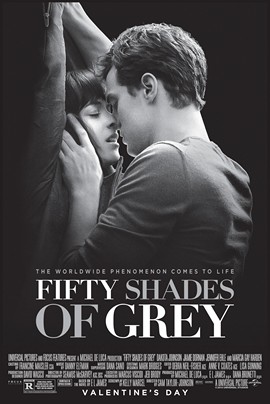
FSG_31_5_Promo_BW_3F.indd

If there’s anything that’s obvious from looking over some of the reviews of Fifty Shades of Grey, it’s that only after you’ve read the book can you properly appreciate the film.

If you haven’t read the book, you’ll probably watch the film and dismiss it as being a draggy film that has some truly terrible dialogue and which features two actors who look good naked but who have absolutely no chemistry.  You might appreciate that fact that Dakota Jonson, at the very least, appears to be trying to give a good performance.  You might even acknowledge that director Sam Taylor-Johnson manages to capture a few pretty images.  You might even be happy that she resisted the temptation to cast her husband, Aaron Taylor-Johnson (a.k.a., the least interesting bankable actor working today), in the role of Christian Grey.  But, even with all of that, you’ll probably still probably watch the film and, even with its artfully composed and shot sex scenes, think to yourself, “That was two hours of my life that I’ll never get back.”

However, if you have read the book, then you will be capable of watching the film and understanding that, as flawed as it may be, 50 Shades of Grey probably should have been a thousand times worse.  It may seem weird to praise Sam Taylor-Johnson for managing to create a below average film but, considering her source material, below average is probably the best that could be hoped for.

Both the film and the book tell the same basic story.  Anastasia Steele (Dakota Johnson) is a 21 year-old English lit major.  We know that she’s intelligent because she knows the difference between Thomas Hardy the writer and Tom Hardy the actor.  We know that she’s innocent because, the first time that she interviews Christian Grey, she wears a sweater.

As for Christian Grey (Jamie Dornan), he’s a 28 year-old multibillionaire.  We are constantly assured that he’s the most interesting man in the world, despite the fact that he actually seems to be rather dull.  He likes Ana.  She likes him.  But Christian doesn’t do the relationship thing.  Instead, he explains, “I fuck.  Hard.”  (As opposed to doing so limp…)  He’s not interested in having a “vanilla” relationship with Ana.  Instead, he wants her to sign a contract in which she’ll agree to be his submissive.

That’s right — Christian claims to be into BDSM.  And, in order to prove that point, he has a red dungeon that’s full of stuff that he apparently picked up at a BDSM yard sale.  The dungeon’s red, of course.  In both the book and the film, a good deal of time is spent attempting to explain BDSM and, in both cases, you’re left with the feeling that Christian got most of his knowledge from reading Wikipedia.  In many ways, Christian comes across like someone who has never had a drink pretending to be drunk.  He tries really hard but … no.

Anyway, a lot of the film comes down to Christian trying to get Ana to sign a contract.  Ana agrees to give up her freedom.  When she asks what she gets in return, Christian replies, “Me.”  Which, if Christian was being played by Ryan Gosling or Michael Fassbender, might be an incentive.  But instead, he’s being played by Jamie Dornan who, quite frankly, looks embarrassed to be there.

Those who have read the book will be pleased to discover that Christian’s immortal line of “I’m fifty shades of fucked up!” has been included in the film.  Dornan delivers it like an actor who has given up and who can blame him?  To her credit, Dakota Johnson manages to keep a straight face.

Here’s the main problem.  Christian Grey is a stalker asshole.  He’s an obsessive control freak who is basically using the BDSM lifestyle as a way to cover up the fact that he’s a sociopath.  Though that was not author E.L. James’s intention when she wrote the book, that’s who Christian Grey ultimately turns out to be.  And that’s the way that Jamie Dornan plays the character.  It’s not that Dornan is a bad actor.  Just watch him in The Fall and you’ll see that Dornan is capable of giving a very good performance.  Instead, you just get the feeling that he looked at the 50 Shades script, saw that Christian was an impossible character to play sympathetically, and decided to give the most literal performance possible.  When you were reading the book, you could always imagine some redeeming features for Christian.  But, when you watch the movie, you’re forced to accept this very literal interpretation of the character and it quickly becomes apparent that the only reason why anyone would possible love Christian is because he’s rich.

Meanwhile, in the role of Ana, Dakota Johnson actually does a pretty good job.  Fortunately, the film jettisons Ana’s narration and we don’t have to hear any details about what her inner goddess is doing while being ordered around by Christian.  As a result, Johnson’s interpretation of Ana is far different from how the character was portrayed in the book.  Whereas the book’s Ana seems to be desperate to be loved by Christian, Johnson’s Ana often seems to be struggling to keep a straight face.  Whereas the book’s Ana took the whole contract thing very seriously, Johnson’s Ana always seems to be on the verge of rolling her eyes.  It gives the film an interesting subtext in that you never quite believe that Johnson’s Ana could be as intrigued by Christian Grey as both the book and the film insist that she is. Instead, she mostly seems to put up with him and his kinks because he buys her expensive gifts.

And, since Christian is such a jerk, you really don’t mind the possibility that Ana’s main motivation might be materialistic.

(Another great thing about Dakota Johnson is that she seems to be sincerely embarrassed whenever she has to tell anyone that her name is “Anastasia Steele.”)

Finally, a word about Sam Taylor-Johnson.  On the basis of Nowhere Boy, she’s a talented director and, as far as 50 Shades of Grey goes, I think she does the best that she could possibly do.  At the very least, she seems to realize that the film is a bit ludicrous and she wisely plays some of the book’s worst moments for subversive laughter.  Considering that 50 Shades of Grey is one of the worst books ever written (and, by that, I mean that the book’s prose is so clunky and overdone that it’s damn near unreadable), Sam Taylor-Johnson probably does deserve some credit for making a movie that’s only below average as opposed to disastrous.  At the very least, I hope that 50 Shades of Grey will not damage her career in the way that Twilight damaged the equally talented Catherine Hardwicke’s.

I forced my boyfriend to see it with my on Valentine’s and there were a lot of couples in the theater.  But, for all the talk of how 50 Shades of Grey launched a thousand fantasies, it’s not a particularly erotic film.  The sex scenes are well shot but, since Jamie and Dakota have no chemistry, they also feel very clinical and detached.  (Add to that, for a film that’s being identified as being a chick flick, the camera spent a lot more time lingering on Dakota’s naked body than on Jamie’s.)  All the sex that followed couples viewing 50 Shades on Saturday night had more to do with the romance of Valentine’s Day and the glory of being in love than with the film itself.

(That, of course, is one of the huge differences between 50 Shades of Grey and Magic Mike.)

50 Shades of Grey apparently made a lot of money this weekend and, if you’re reading this review, chances are that you’ve already seen the film.  So, I’ll just conclude by saying that the film is not as bad as most people were expecting.  It’s just not particularly any good either.  I’ll be looking forward to seeing what Dakota and Sam Taylor-Johnson do in the future but Christian Grey can just stay in his red room for all I care.

(And now that you’ve read the review, why not have some real fun and check out the Fifty Shades of Grey text generator!?  Click on refresh a few times and you’ll have an erotic best seller of your own, ready to be published and to make you rich!)

Trailer: Sabotage (Red Band)


Sabotage

Since Arnold Schwarzenneger left the California governor’s office and politics he’s gone back to doing what he was good at (or at least good at during the 80’s and 90’s). His first couple of films since getting back in front of the camera has been average at best (though I must say that Last Stand was pretty fun).

Now, we have him back in another film, but this time around one that’s a very hard, gritty R-rating that he hasn’t done since ever. He’s always had rated-R films, but they had a certain fun tone to them. With David Ayer’s Sabotage it looks like Schwarzenneger is trying to flex his hardcore bones. It’s definitely a surprise to hear him curse like a sailor during the red band trailer.

Sabotage is set for a March 28, 2014, release date.