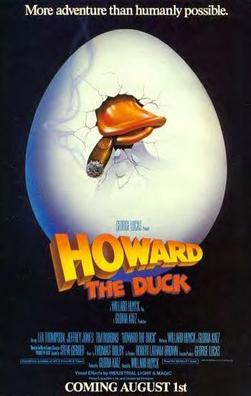
 There’s a scene in Howard the Duck where Tim Robbins looks like he briefly wants to strangle the title character, and I don’t blame him. Howard the Duck (voiced by Chip Zien) is not a very likable character in this movie. Due to an experiment with a laser spectroscope, he’s been transported from his planet to Earth. He’s in a world he didn’t make, and he doesn’t stop complaining for one moment. As for Tim Robbins, he plays Phil Blumburtt, a laboratory assistant who is a friend of Beverly Switzler (Lea Thompson), the aspiring singer who is also Howard’s girlfriend. Beverly ends up getting abducted by Dr. Jennings (Jeffrey Jones), Phil’s boss, who has been possessed by a space monster that was brought to Earth by the same spectroscope that caught Howard. Howard wants to return to his planet, but he also wants to manage Beverly’s band; first, though, he has to defeat the space monsters.
Produced by George Lucas and based on the character created by Steve Gerber, Howard the Duck was a notorious box office bomb when it was first released in 1986, and it’s actually one of the reasons why it took so long for Marvel to start regularly producing films. I watched it recently to see if it had gotten any better with age, but no, it’s still pretty bad. Lea Thompson is cute, likable, and probably a little bit too sexy for a film about a talking duck, but otherwise, it’s a typical ’80s mix of action, comedy, and science fiction that gets too buried under its special effects to really be effective.
The main problem with the movie is its version of Howard himself. According to Steve Gerber, Howard the Duck was originally envisioned as being an animated film, but Lucas decided to do the film live-action, which meant creating a duck suit for Ed Gale to walk around in. Unfortunately, the suit doesn’t look like a duck, animated or real. It made Howard look like a puppet. The scenes of an underwear-clad Beverly rolling around with a duck were already strange enough without making the duck look like a ventriloquist dummy. The movie also didn’t capture the personality that made Howard so memorable in the comic books. In the comic books, Howard is cynical, easily irritated, and frustrated with the madness of everyday life. He’s an intellectual duck who wants to be left alone. In the movie, he tells a lot of bad jokes and is only once seen smoking his famous cigar. The satire that was at the heart of Gerber’s creation is lost as Howard instead tries to save Earth from being conquered by another group of aliens.
The movie never really decides if it wants to be a comedy or a big-budget action film. The movie not only damaged George Lucas’s reputation as a producer, but it also ended Willard Huyck’s career as a director. Howard the Duck is still a beloved character amongst readers. I remember the entire theater applauding when he showed up in Guardians of the Galaxy, looking like a real talking duck and voiced by Seth Green. He was featured in several episodes of What If…?. There might be a movie future for this duck yet.

 To quote Geoffrey Chaucer, “All good things must come to an end.”

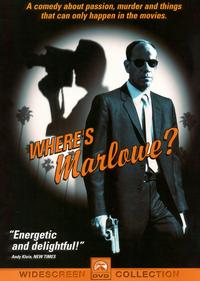 Two documentarians (Mos Def and John Livingston) decided to make a film about two real-life private detectives, Joe Boone (Miguel Ferrer) and Kevin Murphy (John Slattery). At first, Boone is skeptical of the two filmmakers. He watched their last documentary, a three-hour epic about New York’s water supply, and was disappointed by the lack of sex. However, as the two filmmakers follow him around, he warms up to them and they discover that the tough and sarcastic Boone is actually a soft-hearted idealist who can barely pay the bills. When Boone discovers that Murphy is sleeping with the wife of one of their clients, their partnership dissolves. It looks like Boone is going to have to shut down his agency, unless the two filmmakers can help him solve his latest case.