Retro Television Review: Crime Story 1.5 “The War”


Welcome to Retro Television Reviews, a feature where we review some of our favorite and least favorite shows of the past!  On Mondays, I will be reviewing Crime Story, which ran on NBC from 1986 to 1988.  The entire show can be found on Tubi!
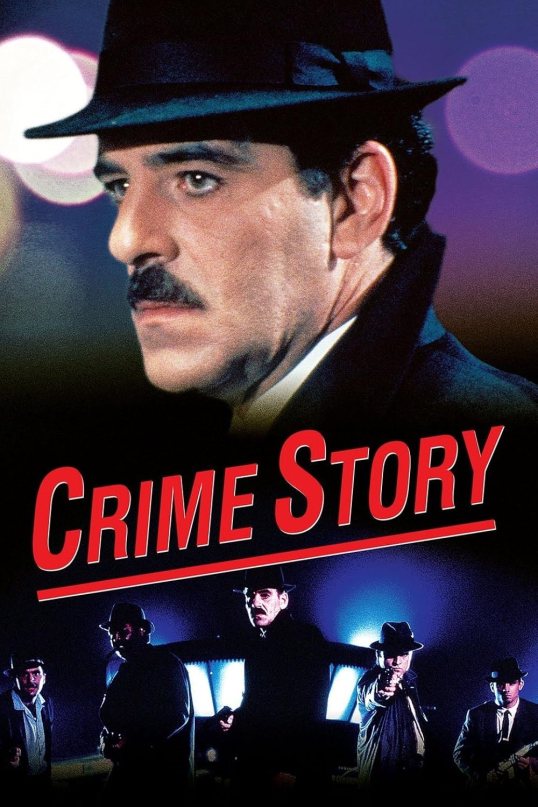
This week, Luca has to prove himself.

Episode 1.5 “The War”

(Dir by Leon Ichaso, originally aired on October 7th, 1986)

Luca is in trouble.

Last week’s episode ended with Max Goldman on the receiving end of a beating from Noah Ganz’s goons.  Goldman survives and returns with a message.  Ganz is not happy that Luca tried to steal his book.  Bartoli, Weisbord, and Fosse all inform Luca will have to resolve the Ganz situation on his own.

Luca tries to get public defender David Abrams (Stephen Lang) to act as a negotiator for him but David doesn’t want to get involved in the mobster lifestyle that made his father rich.  David just wants to defend the poor and play sax in a jazz club.  When Luca is attacked while driving in Chicago, he realizes that negotiating with Ganz is a dead end.

Instead, he just kills Ganz.  In a bravura sequence, Luca shows up at a hotel and, with the help of sniper, takes down Ganz’s bodyguards.  Then he uses a bomb to take out Ganz while the latter is holding court in an elevator.  A plume of white smoke puffs out of the hotel’s exhaust vent.

Having taken care of the issue, Luca is welcomed back into the family.  Weisbord says, “Call me Mac.”  Fosse (played by Michael Madsen) nods and slowly smokes a cigarette.

Meanwhile, Torello’s wife miscarries.  This is the episode that features the clip of Torello walking down a lonely Chicago street on a rainy night.  (The clip is prominently featured during the show’s opening credits.)  In fact, both Torello and Luca end up spending a good deal of time walking around at night while David Abrams plays his saxophone.  It’s a scene that is so overstylized that it shouldn’t work but somehow, it does.  If nothing else, it reminds us that Crime Story of two dangerously obsessed men on a collision course.

This was a good episode, if just because it showed that Luca can be a clever criminal when he needs to be.  Before this episode, Luca seemed to be clearly outmatched by Torello.  With this episode, Luca proved himself to be Torello’s equal.
Retro Television Review: Crime Story 1.4 “St. Louis Book of Blues”


Welcome to Retro Television Reviews, a feature where we review some of our favorite and least favorite shows of the past!  On Mondays, I will be reviewing Crime Story, which ran on NBC from 1986 to 1988.  The entire show can be found on Tubi!

This week, everyone’s going to Missouri.  Can you blame them?

Episode 1,4 “St. Louis Book of Blues”

(Dir by Leon Ichaso, originally aired on September 30th, 1986)

After Ray Luca discovers that his henchman, Frank Holman (Ted Levine), has been compromised by Torello, he decides to deal with the situation by sending Holman down to St. Louis.  A gangster named Ganz (Raymond Serra) has a home in St. Louis and, according to Ganz’s associate Johnny Fosse (Michael Madsen, doing his slow-talking, cigarette-smoking Madsen thing), there is a book in Ganz’s shelf that contains the name of every bookie, coach, and sports-fixer in America.  Ray, who is hoping to start up his own nationwide gambling syndicate, wants that book.

Far be it for me to question Ray Luca’s strategy but it does seem strange that his response to one of his people screwing up is to give that person an even more important job to do.  I get that Ray is trying to be a manager now and, as a result, he no longer personally robs anyone but Frank really does seem like the last person he should trust to pull this off.

And, to no one’s surprise, Frank doesn’t pull it off.  Torello and his men follow him all the way to St. Louis.  They not only arrest him but they also get their hands on Ganz’s book.  They do this despite the operation nearly being ruined by an ambitious and publicity-hungry sheriff named Hartman (Allen Swfit).

Unfortunately, when Frank offers to inform on the entire “St. Louis mob,” Hartman releases him from jail.  Frank promptly flees town.  When he calls Ray, Ray orders him to stay out of Chicago and instead to go to Cleveland.  Frank replies that if he has to choose between Hell or Cleveland …. he’ll go to Cleveland.  Good thinking, Frank!

(Actually, I’ve never been to Cleveland so I don’t know if it’s really good thinking.  Wasn’t Dennis Kucinich from Cleveland?)

As this episode ends, Ganz is ready to declare war on Luca and it appears that Max Goldman might be the first victim.  The funny thing about Max is that he’s played by a young Andrew Dice Clay and, in every scene in which he appears, Clay’s facial expressions are totally and completely over-the-top, as if Clay was determined to make sure that no one forgot he was in the scene.  I hope that Max survives, just for the sake of entertainment,

This episode returned to the idea of Torelllo being dangerously and tightly wound.  Before he followed Frank to St. Louis, he nearly firebombed a furniture store because the owner hadn’t delivered the table that he had ordered.  Torello was talked out of doing so by his fellow cops but the store owner still got the message.  The table arrived at Torello’s apartment.  Of course, it was the wrong table.  That made me laugh.  People have no idea how close Torello is to snapping and killing everyone around him.

This was a good episode.  It was interesting to see a young Ted Levine, not to mention a young Michael Madsen as well.  The corrupt and incompetent sheriff was identified as being a Democrat. I appreciated that.  I’m looking forward to seeing where this show is going.


Alone In The Neon Jungle (1988, directed by Georg Stanford Brown)


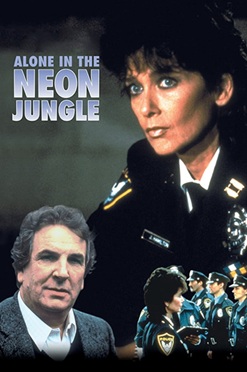
Alone In The Neon Jungle takes place in a Pittsburgh police precinct that is supposedly so crime-ridden that it is called The Sewer.  After two cops are arrested while committing a burglary, the Chief of Police (Danny Aiello) sends tough Captain Jane Hamilton (Suzanne Pleshette) to take over the precinct.  Her mission?  To enforce discipline and root out police corruption!

There’s a lot of corruption to root out.  Crime boss Nahid (Tony Shalhoub) has half the precinct on his payroll and corrupt cops like Brad Stafowski (Jon Polito) are quick to to drag new transfers, like Todd Hansen (Jon Tennery), into the rackets.  Along with enforcing the dress code and cleaning up the streets, Jane also has to figure out who is responsible for the murder of one of her sergeants.

This made for TV movie was probably meant to be a pilot for a weekly television series.  It just has the sort of feel to it.  It features just about every cop cliche imaginable, from the weary detective who comes to respect the new boss to the crime lord who claims to be a respectable businessman.  The main problem is that the precinct never seems as bad as its described.  For a place called The Sewer, the streets are surprisingly clean.  The majority of the crimes committed seem to be burglary and prostitution.  If you’re a cop and that’s all you have to deal with in a big city like Pittsburgh, count yourself lucky.  The precinct never lives up to the title “Neon Jungle” and no one’s ever alone in it.

Suzanne Pleshette does a good enough job in the lead role.  By this point in her career, Pleshette’s voice was as deep as the voice of the toughest patrolman around.  It worked for her.

Lisa Reviews An Oscar Nominee: Prizzi’s Honor (dir by John Huston)


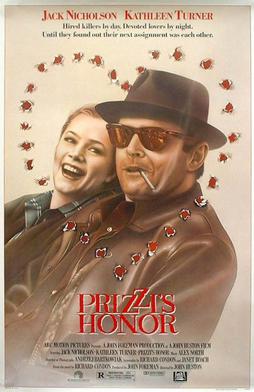
First released in 1985, Prizzi’s Honor tells the story of Charley Partanna (Jack Nicholson), a blue collar guy who lives in Brooklyn and who is a hard-working hit man for the Prizzi crime family.  Charley is the son of Angelo (John Randolph), who is the right-hand man to the family’s elderly but still ruthless Don (William Hickey).  In the past, Charley came close to marrying the Don’s daughter, Maerose Prizzi (Anjelica Huston), and he is almost as much a member of the family as the Don’s two sons, Eduardo (Robert Loggia) and Dominic (Lee Richardson).

While attending a family wedding, Charley meets and is immediately infatuated with a woman named Irene Walker (Kathleen Turner).  Later, when Charley is sent to California to kill a man who robbed one of the family’s Vegas casinos, he is shocked to discover that the man is Irene’s husband.  Irene swears that she didn’t have anything to do with the casino theft and, after a whirlwind courtship, Charley and Irene get married in Mexico.  What Charley doesn’t know (but eventually discovers) is that Irene is herself a professional killer.  While Charley and Irene try to balance work and love, Maerose conspires to turn the family against Irene and win Charley back.

Directed by the legendary John Huston, Prizzi’s Honor is pitch black comedy about two hard-working people who kill for a living.  (The film’s big set piece is an extended sequence in which Charley and Irene’s attempt to pull a job together goes wrong in every way and they end up arguing about their relationship while dragging dead bodies from one room to another.)  Though Prizzi’s Honor was released long before the series premiered on HBO, the film feels almost like a companion piece to The Sopranos, full of mobsters who are not as clever as they think they are and who struggle to uphold the old ways in an increasingly complicated world.  Particularly when compared to the gangster who populate a film like The Godfather, the Prizzis are defined by their pettiness.  If Don Corleone epitomized wisdom and honor, Don Prizzi epitomizes someone who holds onto power solely for power’s sake.

Prizzi’s Honor is one of those films that probably seemed a bit more revolutionary when it was first released than it does today.  At this point, we’ve seen so many films about hired killers who have quirky conversations while carrying out their work that the mix of violence and dark humor can feel almost like a cliché.  As well, there are certain parts of the film, like the opening wedding sequence, that feel as if they go on for just a few minutes too long, as if John Huston himself was not always comfortable with the balance between the dark drama and the comedy of mob manners.  That said, Jack Nicholson, Kathleen Turner (who gives a performance worthy of the great femme fatales of film noir), Anjelica Huston, John Randolph, and especially William Hickey all give strong enough performances to hold the audience’s attention and the film’s finale cuts to the point in such a way that it leaves you reconsidering everything that you’ve previously seen.  Prizzi’s Honor has its flaws but Nicholson and Turner have such chemistry that the film’s ending sticks with you.

Prizzi’s Honor was nominated for 8 Oscars, including Best Picture, Best Director, Best Actor, and Best Supporting Actor for William Hickey.  (Oddly, Kathleen Turner was not nominated for playing Irene.)  In the end, it only won one Oscar that year, for supporting actress Anjelica Huston.  The Oscars that year were dominated by a far more convention love story, Out of Africa.