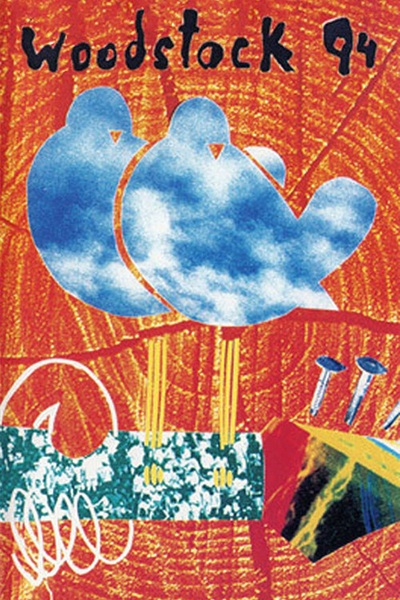
Woodstock ’94 is the forgotten Woodstock.
Taking place in a field in Saugerties, New York, Woodstock ’94 opened on August 12 and it ended two days later. Officially, it was held to celebrate the 25th anniversary of the original Woodstock and it was produced and promoted largely by the same people who were behind the original festival. They were hoping to actually make some money this time but that plan failed when the fence surrounding the concert area was torn down by people who wanted to see the bands and hear the music without having to pay an exorbitant amount of money for tickets. In all, 164,000 tickets were sold for Woodstock ’94 but it’s estimated that 350,000 attended. To be honest, that sounds like a good example of the Woodstock spirit to me. The people in charge of the festival disagreed, which is what led to the disaster that was Woodstock ’99.
Woodstock ’94 tends to be overlooked, precisely because it was neither the spontaneous celebration of the first Woodstock nor the epic trainwreck of the third Woodstock. Instead, the second Woodstock was a largely peaceful festival that featured a good mix of older and, at the time, newer acts. The original Woodstock featured open love and the third Woodstock featured random acts of arson. The second Woodstock, on the other hand, featured a lot of rain. Apparently, Green Day got pelted with mud. Maybe a time traveler went back to 1994 and told everyone about American Idiot before the band started playing. It makes sense if you think about it.
The first Woodstock lives forever as an epic documentary. The third Woodstock has inspired at least two docuseries, both of which examine the festival with the grim weariness of a true crime recreation. Earlier today, I discovered that the second Woodstock actually was filmed as well, though apparently Bruce Gowers’s Woodstock ’94 was never released in theaters and instead went straight to video. It’s a sign of how forgotten Woodstock ’94 is that the film has never even been released on DVD or Blu-ray. That said, after I learned of the film’s existence, I really did want to see it. (I’m a completist at heart.) I discovered that, fortunately, it’s been uploaded to YouTube.
From the start, Woodstock ’94 sets out to duplicate the style of the first Woodstock. There’s plenty of split screens. We open with people working hard to get the festival grounds ready. There are interviews with concert goers. There’s an interview with a guy selling food. We get a few random announcements from the stage. There’s a hint of nudity, though nowhere near as much as in the first film. Probably the funniest moment in the documentary is when we see a sign telling us that a certain area has been reserved for those wanting to watch the concert nude. During the first Woodstock, the nudity was spontaneous. For the second one, it was prepared for. The main thing that I noticed was how pleasant everyone seemed to be. There was none of the anger that defined Woodstock ’99. There was none of the bad brown acid that inspired so many warnings at the first Woodstock. Instead, everyone appeared to be having a good time. Even with Green Day getting pelted with mud, the Woodstock ’94 audience appeared to be rather mild-mannered. Most of them seemed like they probably play golf now.
The majority of the documentary is devoted to the music. We see tightly edited performances from, amongst others, Bob Dylan, Sheryl Crow, Aerosmith, Crosby Still Nash & Young, Nine Inch Nails, Metallica, The Cranberries, Green Day (though we don’t really get to see the incident with the mud, which is a shame), and Primus. The festival had a good lineup. Crosby, Stills, Nash & Young are a bit on the dull side but Primus more than makes up for it. My only real complaint is that we only get to hear one song from each featured group.
Woodstock ’94 was surprisingly pleasant. It’s too bad that, five years later, the whole idea of Woodstock fell apart.


Yes Woodstock 94 was peace & love my jam! Funny not so funny Crosby, Stills & Nash couldn’t hold A note or carry A tune live. Easily the worst live set of my lifetime. I didn’t know strictly A studio band big disappointment they could of been like The Archies .Bill board number one hit of 1969 “Sugar,Sugar” but they never toured totally a studio group. Dispite CS&N my Woodstock94 rocked peace & love brothers & sisters!
LikeLike
Pingback: Lisa’s Week In Review: 6/1/26 — 6/7/26 | Through the Shattered Lens
Pingback: Song of the Day: Those Damn Blue Collar Tweekers by Primus | Through the Shattered Lens