
by Rafael De Soto
Watch those hands!
by Rafael De Soto
Watch those hands!
The music video for Kim Carnes’s Voyeur is another music video that was initially banned from MTV and other music shows because it was considered to be too suggestive. The video features Kim Carnes watching and being watched in a red light district.
This video was directed by Russell Mulcahy, who perhaps did more than anyone to perfect the early music video aesthetic.
Enjoy!
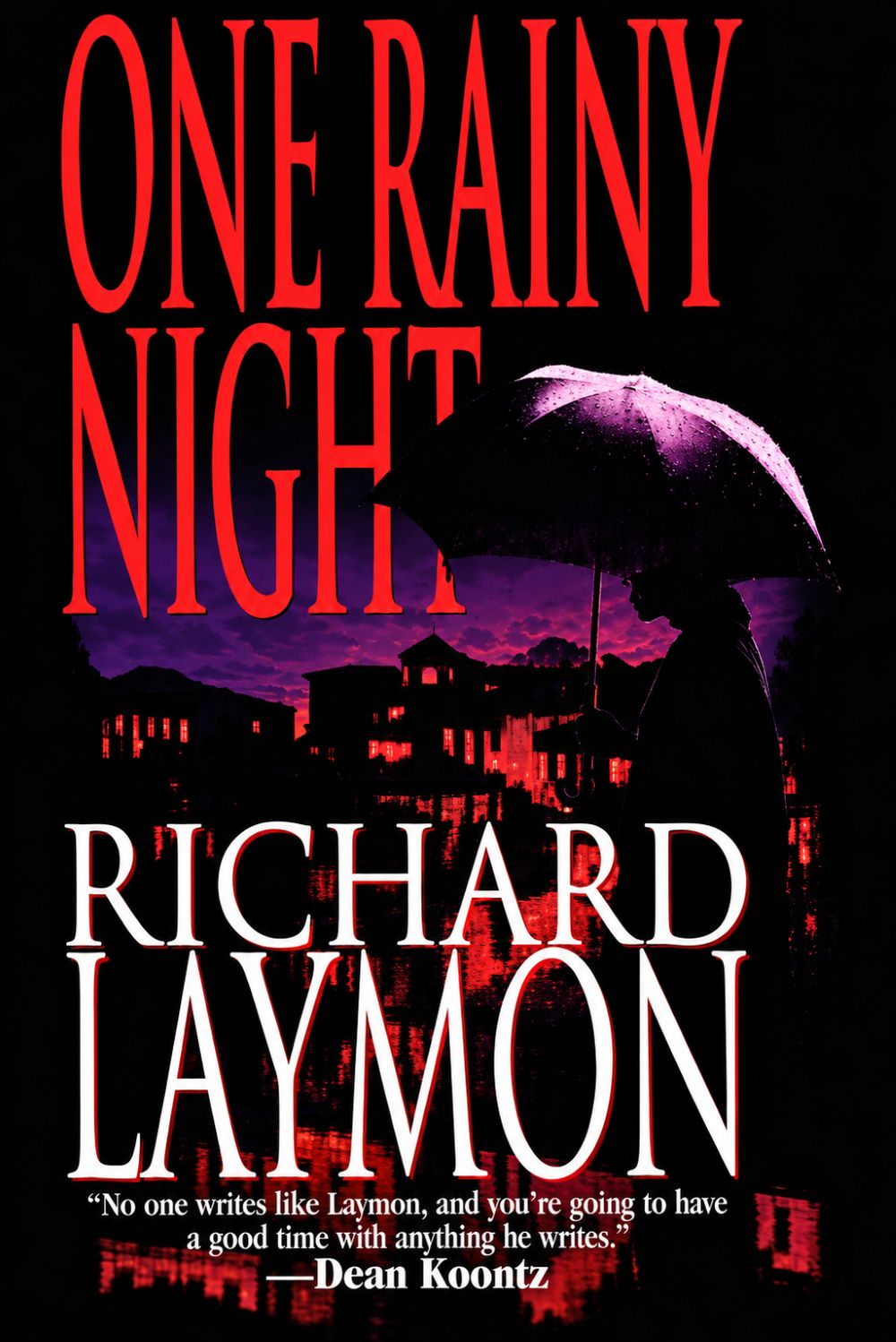
“A dark, warm and continuous rain falls on the town of Bixby…” — One Rainy Night, Richard Laymon
Richard Laymon’s One Rainy Night turns a town-wide downpour into a bloodbath, then spends the evening making sure nowhere feels safe. There’s no elaborate setup required to make that frightening. You just need people indoors, people outside, and enough distance between them to make staying dry a serious problem. Laymon understands the appeal immediately, delivering a fast, vicious survival story that rarely stops moving. It’s also messy, sleazy, and occasionally frustrating, with a stronger sense of how to escalate a nightmare than how to wrap one up. Whether that sounds entertaining or exhausting probably tells you something about how you’ll respond to this book.
The story takes place in Bixby, a town already shaken by the racist murder of a young Black student. Then an unnatural black rain begins falling, and anyone it touches becomes violently unhinged. Ordinary neighbors become attackers, familiar streets become death traps, and the distinction between safety and disaster suddenly comes down to a roof, a locked door, or an exposed patch of skin. Laymon follows several groups through the unfolding catastrophe, including a police officer, a babysitter and her boyfriend, people sheltering in a restaurant, and a group of young thugs whose cruelty predates the storm. That last detail gives the setup an extra sting: the rain isn’t introducing evil to an innocent community. It’s finding plenty already there.
The novel bears some basic similarities to Jack Ketchum’s Ladies’ Night, particularly in how an outside force turns ordinary people into vicious attackers and sends everyone else scrambling to survive. The big difference is the trigger. Ketchum uses a chemical spill to unleash the violence, with women becoming murderous predators, while Laymon goes the supernatural route with his black rain. Both books build their horror around the sudden collapse of familiar relationships and everyday safety, but Laymon’s approach gives the mayhem the feeling of a curse rather than a toxic disaster. His storm makes the whole town feel subject to something malicious, not merely caught in the aftermath of an accident.
What works best is the way Laymon turns the weather into a practical problem. Rain is usually background atmosphere in horror, something rattling against windows while the real threat approaches. Here, the weather is what makes almost every possible escape dangerous. Staying inside might protect you from the downpour, but it also leaves you trapped when the people outside decide they want in. Going somewhere else means risking the very thing you’re trying to avoid. It’s an effective little trap because the rules are easy to grasp, yet the situations they produce keep changing. You don’t need pages of explanation to understand why crossing an open stretch of ground could be terrifying.
The shifting viewpoints help keep that premise from wearing itself out too quickly. Rather than sticking with one group until its predicament becomes repetitive, Laymon cuts between different pockets of trouble. The babysitting storyline brings the vulnerability of a home invasion, while the restaurant scenes expand that anxiety into a larger siege. Trevor Hudson’s efforts to protect others give the night a more mobile perspective. These threads offer variations on the same basic nightmare without requiring the book to reinvent itself every few chapters. The transitions can feel calculated, especially when one strand becomes particularly tense, but that calculation generally works. There’s nearly always another problem waiting around the corner.
Laymon’s prose suits this kind of material. The emphasis is on action, physical danger, and the immediate question of what someone can do next. This isn’t a novel that asks you to linger over beautiful sentences or untangle layers of symbolism before anything happens. Its pleasures are more direct: an unsafe hiding place, a desperate decision, a confrontation that becomes uglier than expected. That straightforwardness gives the violence an uncomfortable closeness. Survival feels awkward and difficult rather than elegantly choreographed. The characters aren’t all equipped to handle what’s happening, and the gap between wanting to fight back and actually managing it provides some of the book’s strongest tension.
The characterization is more uneven. Laymon gives the central groups enough personal connections and immediate concerns to make their separation matter, but several people remain recognizable types rather than especially complicated individuals. Trevor supplies the protective police presence; Denise and Tom bring youthful intimacy into a situation that makes privacy and security impossible. The book is generally better at showing what people do under pressure than making their inner lives surprising. Still, that isn’t fatal to a story built around surviving a single night. You don’t necessarily need an elaborate biography to care whether someone gets a door shut in time. You do need some human investment, though, and the novel supplies it inconsistently.
The bigger sticking point is the sexual violence and the persistent overlap between lust, cruelty, and spectacle. The rain doesn’t simply make people aggressive; it strips away inhibitions in ways that repeatedly turn sexual menace into part of the threat. That makes the book genuinely unpleasant at times, but unpleasantness isn’t automatically the same thing as effective horror. Some of this material reinforces the sense of a community collapsing into predation. Elsewhere, it risks feeling like another excuse to push the exploitation angle harder. Readers comfortable with gore may still find this aspect much more difficult to take. It’s central enough to the novel that it deserves more than a vague warning about “mature content.”
The racist killing behind the story also creates expectations the book doesn’t fully satisfy. There’s a potentially powerful idea here about communal violence returning to consume the community that produced it. The presence of vicious characters who require no supernatural encouragement makes that reading especially tempting. But the novel’s main interest remains the rampage itself, not a sustained examination of racism, responsibility, or grief. That imbalance can leave the initiating crime feeling more like a mechanism for unleashing the horror than an experience given equivalent emotional attention. The premise has moral weight; the storytelling is usually in too much of a hurry to sit with it.
The ending is another limitation. After so much frantic movement, the resolution feels abrupt rather than fully satisfying. A book this relentless doesn’t necessarily need a lengthy aftermath, but it does need a landing that feels proportionate to the chaos. Here, the momentum that makes the middle so entertaining becomes a weakness: reaching the explanation and stopping the action aren’t quite the same as delivering a strong payoff.
Even with those reservations, One Rainy Night succeeds as a nasty, tightly focused piece of survival horror. Its strongest asset is the simplicity of its central danger and Laymon’s willingness to keep finding fresh trouble inside it. The result is an energetic, frequently gripping read held back by thin characterization, exploitative excess, and an underwhelming finish. It isn’t subtle, and it isn’t particularly interested in being tasteful. When it works, though, it makes the ordinary comfort of being indoors feel wonderfully fragile.

In 2007’s Welcome to Paradise, Crystal Bernard stars as Debbie Laramie. Debbie is a preacher who belongs to one of those weird Protestant churches where it’s apparently appropriate to heckle someone while they’re giving a sermon. After Debbie scandalizes her parish by removing her jacket while preaching, she is reassigned to a church in the small town of Paradise. Apparently, this is not the first time that Debbie has been reassigned. She’s a rebellious preacher who does things her own way or, at least, that’s what we’re told. (She doesn’t ever seem that rebellious to me, but then again, I’m used to the Jesuits.) Debbie’s teenage son certainly isn’t happy about having to move again.
In Paradise, Debbie makes a name for herself by reaching out to the town’s surprisingly large homeless population. She invites a street performer named Trevor (Lou Beatty, Jr.) to play his guitar at the church. She holds a potluck dinner to help feed the residents of the local shelter. When a sudden storm approaches, she allows Frances (Beth Grant) to spend the night on the church’s back porch. (Debbie tries to convince Frances to come home with her, but Frances doesn’t want to impose.) Unfortunately, Frances gets cold and tries to build a small fire for warmth. The next thing anyone knows, the church is burning down.
A snooty bishop tells Debbie that the decision has been made to revoke the church’s charter and that all the members will be assigned to the new megachurch. Debbie, however, has already found an abandoned barn that she thinks she can turn into a church, and a local businessman named Bobby Brown (Brian Dennehy—wait, BRIAN DENNEHY!?) has agreed to help fund the new church. Debbie is told that if she can have everything ready to go in a week, the church will keep its charter. Otherwise, Debbie will have to find yet another new job, her son will have to move again, and the residents of the shelter won’t have anywhere to go.
This film wasn’t actually that bad. I liked the fact that it not only took place in small-town Texas but also captured the feeling of living in a small town. Paradise is the type of town where the richest man in town owns a used car lot and where everyone lends a helping hand to those in need. If this were a horror movie, of course, the town would have turned out to be a haven for vampires. Since this was a religious movie, it just turned out to be a nice place to live. Crystal Bernard gave a likable performance as Debbie, and Brian Dennehy, of course, was perfectly cast as the gruff but good-natured businessman. There were actually quite a few familiar faces in the film. William Shockley, Beth Grant, Ken Jenkins, and Jim O’Heir all made appearances. Even comedian Timothy Stack showed up in a small role.
In the end, Welcome to Paradise is a sweet-natured and likable movie. If it had been set during a December snowstorm, it could have easily been mistaken for a Hallmark film.
Welcome to Late Night Retro Television Reviews, a feature where we review some of our favorite and least favorite shows of the past! On Wednesdays, I will be reviewing 1st and Ten, which aired in syndication from 1984 to 1991. The entire series is streaming on Tubi.

This week, some of the players get trapped in the woods.
Episode 5.8 “Vindication”
(Dir by Stan Lathan, originally aired on December 6th, 1989)
It’s time for the Barbara Ann Awards.
The Barbara Ann Awards are a never-before mentioned annual tradition in which Dr. Death, Jethro, Bubba, and Zagreb go to a cabin in the woods with a bunch of women and the women compete to be the new Barbara Ann. Yep, it’s just as sleazy as it sounds. Fortunately, this year sees the players being stalked by two mask-wearing, chainsaw-carrying psychoes. While the women hide in the cabin, the players go out to battle their stalkers and, instead, they end up getting caught in a net. Oh no! Is this the end of the California Bulls? (Well, four of them, at least….)
Fortunately, no. It turns out that it was all a practical joke that was set up by the women. Yay! Put those men in their place! The players are so impressed that they give the title of Barbara Ann to the woman who came up with the joke. This whole thing was pretty silly but at least it felt appropriate for October viewing.
The episode’s other storyline featured Johnny Gunn being interviewed by reporter Susan McDermitt (Catherine MacNeal). With protestors constantly picketing the games and calling Johnny a murderer, TD Parker (OJ Simpson) figures that it’s time for some damage control. TD understands just how damaging it is to the reputation of the game to have a player who is routinely accused of being a murderer.
So, Susan and Johnny go to Johnny’s hometown in Pennsylvania. We learn about Johnny’s past as a foster kid and a high school football star. In a somewhat implausible scene, Johnny’s ex-girlfriend (Tally Chanel) admits on camera that she lied about what happened the night that Johnny killed a man. It turns out that Johnny was actually acting in self-defense.
“I’m glad that’s taken care of!” OJ says as he watches the news report.
This is another episode of 1st & Ten that’s impossible to watch without thinking about OJ Simpson’s later life. Every time OJ started to talk about how unfair it was that Johnny was being judged for being a murderer, I cringed just a little bit. The episode’s contention that one positive news story was all Johnny needed to get on with his life was almost charming in its naiveté.
Next week …. well, who knows? Hopefully, it won’t involve any more murders.
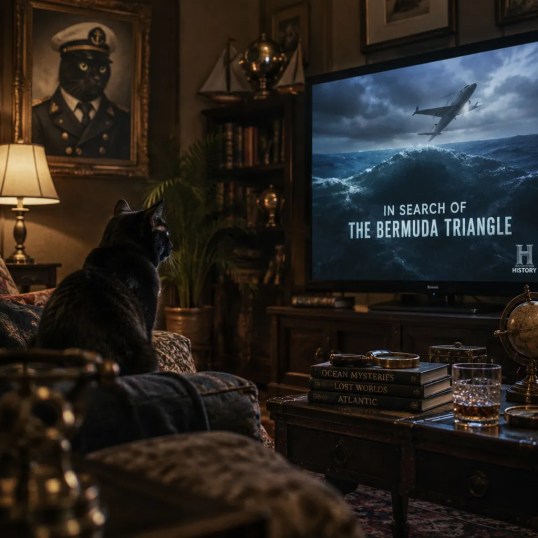
Tonight, on In Search Of…., Leonard Nimoy guides us through an investigation of the Bermuda Triangle!
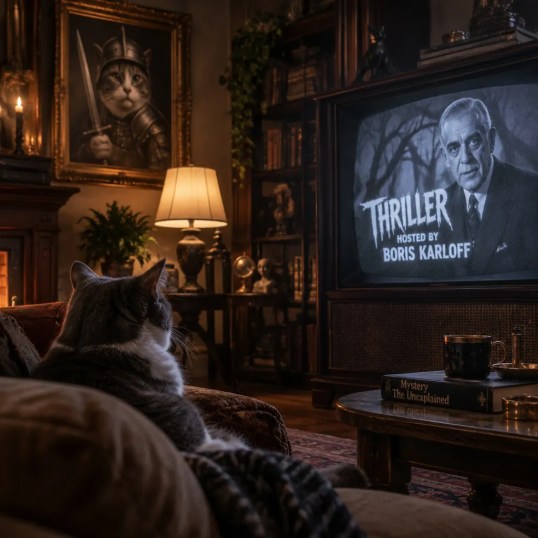
For tonight’s televised horror, we have another episode of the Boris Karloff-hosted anthology series, Thriller!
In this episode, a religious fanatic in a named Freitag (Martin Gabel) lives in a resort community and targets young people who he believes have failed to live up to his standards. His latest targets are played by Olive Sturgess and Richard Chamberlain. This is actually a rather grisly little episode. With its theme of religious hypocrisy, I can only imagine how people reacted when it was first aired on November 1st, 1960.
 Having left the X-Men after the death of Jean Grey (Famke Janssen), Logan (Hugh Jackman) is now living as a hermit in the Canadian wilderness. He is haunted by dreams of his past and visions of Jean. (In the X-Men comic books, Scott Summers was the one who went off to live as a hermit and was haunted by memories of Jean, but since Scott was killed off in X-Men: The Last Stand, Logan was the one who got this story and the visions of lingerie-clad Jean, despite never having been in a truly romantic relationship with her.) Logan is drawn out of hiding by Yukio (Rila Fukushima), a mutant who can predict when people are going to die. Yukio works for Ichiro Yashida (Haruhiko Yamanouchi), a Japanese industrialist who first met Logan during World War II. Logan saved Yashida’s life when Nagasaki was bombed.
Logan and Yukio return to Japan, where Logan discovers that Yashida is on the verge of death. Yashida and Dr. Green (Svetlana Khodchenkova) have apparently developed a way to transfer Logan’s self-healing powers to Yashida, but Logan refuses to cooperate, explaining that immortality is a curse. When Yashida dies, Logan finds himself at war with the Yakuza and also without his power of self-regeneration.
The Wolverine isn’t bad. Even though Logan is no longer as interesting a character as he was when he made his first film appearance in X-Men, the film features some of the best action sequences to be found in the entire X-Men franchise. The extended fight sequence that takes place on top of a bullet train is especially exciting, and it holds up even when you watch it a second time. Unlike the previous X-Men film, The Wolverine makes good use of its characters. The Silver Samurai may be a lesser villain in the comic books, but in this movie, he was one of the few opponents who seem able to match Logan’s combat skills. For the most part, the movie respects the lore of the comic books without getting bogged down in mythology.
Wolverine finally makes peace with himself at the end of this movie. Of course, as soon as he does, Ian McKellen and Patrick Stewart show up with a new mission for him. A hero’s work is never done.
 Ryan and Emily Fleege (played by Chris J. Murray and Brit Shaw) have just moved into a new home with their six-year-old daughter, Leila (Ivy George). They are being visited by both Ryan’s brother, Mike (Dan Gill), and Emily’s best friend, Skyler (Olivia Dudley). While cleaning out the garage, Mike and Ryan come across an old video camera and several VHS tapes featuring young Katie and Kristi from the previous Paranormal Activity films. It turns out that their house has been built over the remains of Katie and Kristi’s old house and that the old video camera can pick up and record traces of ghosts and evil spirits.
That last bit is exactly why this installment of Paranormal Activity doesn’t work. The previous films were scary because the characters could hear and sometimes feel the spirits but they couldn’t actually see them. That always left open the possibility that they were just imagining things. In this one, everyone can actually see the evidence of the house being haunted but they still don’t leave! This is the first Paranormal Activity to make heavy use of CGI, which goes against the whole idea of the films being found footage.
The other problem is that, six films in, the Paranormal Activity series finally fell victim to its own increasingly complex mythology. The first two films worked because they kept things simple. Things started to get more complicated during the third film. By the time Paranormal Activity: The Ghost Dimension was released, the story had grown to include a coven of witches, a family curse, a demon named Toby, and now a camera that can film otherwise invisible spirits. The more elements that are added, the harder it is to ignore the holes in the plot and illogical actions of the characters.
I would have ended things with the second film, but I also would have lost out on all the money made by the third, fourth, and fifth films. Even this installment, which was the weakest box office performer of all of the films, still made a profit. That shows how much I know.
Welcome to Retro Television Reviews, a feature where we review some of our favorite and least favorite shows of the past! On Wednesdays, I will be reviewing the original Love Boat, which aired on ABC from 1977 to 1986! The series can be streamed on Paramount Plus!

This week, it’s love and fraud all aroud.
Episode 8.17 “Ace Takes the Test/The Counterfeit Couple/The Odd Triple”
(Dir by Nell Cox, originally aired on January 12th, 1985)
Ace’s friend Donna (Teresa Ganzel) boards the ship with her macho husband, Gus (Christopher Mayer). Gus owns a moving company. The first thing he does is crush Ace’s hand while shaking it. Gus then beats Ace in an arm-wrestling contest. He then asks Ace to solve a riddle, requests that Ace read the bottom line on a menu, and he asks about Ace’s hearing. Is Gus jealous?
Actually, Gus is testing Ace because he and Donna want to have a baby but Gus appears to be shooting blanks. Gus explains that all of his brothers have at least six kids. Gus just wants to have one. Would Ace consider donating his sperm?
Ace does consider it but ultimately, he decides that he can’t. Fortunately, Donna later faints and, when Doc Bricker examines her, he discovers that she’s pregnant. Gus’s boys can swim after all!
Meanwhile, Susie Epshaw (Crystal Bernard) has a crush on Gopher but Gopher falls in love with Susie’s mom, Annette (Mary Ann Mobley). Susie is okay with it and good for her. Gopher was a little bit old for her. That said, Gopher falls in love several times a season so neither Susie nor her mother should get too excited.
Two strangers (Richard Gilliand and Erin Moran) both buy tickets from scalpers, just to find themselves booked in the Honeymoon Suite together. (Apparently, the couple that originally bought the tickets broke up before the marriage.) “Barbara” and “Lyle” pretend to be married and then they fall in love for real. They admit the truth to the crew and everyone is just fine with the fraud. As long as the tickets were paid for, the Captain doesn’t really care who stays in the Honeymoon Suite. That’s a good attitude. I was a little surprised to discover that the Honeymoon Suite was just a normal cabin.
This cruise was another example of the eighth season’s tendency to be, in general, pleasant but predictable. I laughed a few times at Ace being tested by Donna and Gus, just because of the contrast between super smooth Ted McGinley and the rough-hewn Christopher Mayer. Otherwise, this was a cruise that wasn’t bad but also wasn’t particularly memorable.

