“But Captain, to obey—just like that—for obedience’s sake… without questioning… That’s something only people like you do.” — Doctor Ferreiro
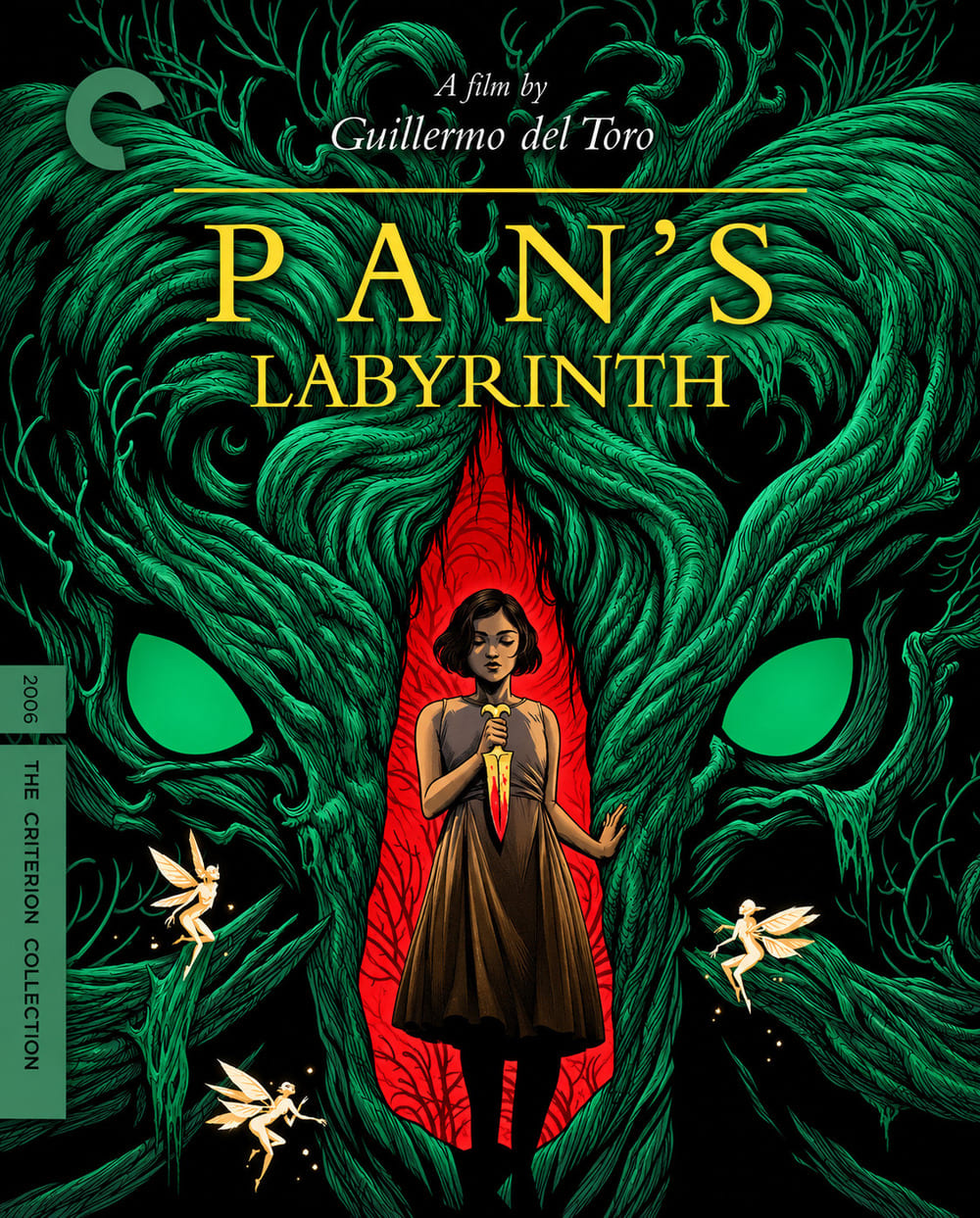
Guillermo del Toro’s Pan’s Labyrinth (2006) is the kind of fairy tale that reminds you these stories were never supposed to be completely comforting. Beneath the princesses, magical doorways, and mysterious creatures, there have always been warnings about cruelty, temptation, and adults who cannot be trusted. Del Toro brings those darker instincts to the surface, creating a film that is beautiful without being reassuring and frightening without feeling empty. Its greatest achievement is weaving together the horror of Francoist Spain, the dark fantasy of Ofelia’s childhood imagination, and the reality of everyone caught in between. These worlds do not compete for attention; they make each other more disturbing.
Set in Spain in 1944, the story follows Ofelia, played by Ivana Baquero, as she arrives at a remote military outpost with her pregnant mother, Carmen. Her new stepfather, Captain Vidal, is hunting Republican resistance fighters, and his household operates with the same cold discipline as his military command. Nearby, Ofelia discovers an ancient labyrinth and meets a faun who tells her she may be a lost princess. To reclaim her place in an underground kingdom, she must complete three tasks. That setup sounds like an adventure, but del Toro quickly establishes that neither world offers reliable safety.
What makes the historical setting so effective is that fascism is not just background scenery. It shapes the smallest interactions: who gets to speak, whose pain matters, and who must obey without asking questions. Vidal treats his authority as something natural and unquestionable, whether he is dealing with soldiers, servants, or his own family. The violence can be shocking, especially when it arrives abruptly during otherwise ordinary encounters. Still, the brutality has a purpose. Del Toro refuses to let the audience treat political oppression as an abstract idea when its consequences are written directly onto people’s bodies.
Sergi López makes Vidal terrifying because he rarely seems to think of himself as a monster. He behaves like a man convinced that order excuses anything. His immaculate appearance and controlled manner make his cruelty feel deliberate rather than impulsive. There is something especially ugly about watching someone approach violence with the patience another person might bring to a household chore. Compared with the creatures lurking in Ofelia’s magical world, Vidal is painfully recognizable. He needs no supernatural powers, just the expectation that everyone around him will submit.
Some viewers may find Vidal’s near-total viciousness limiting, but his lack of moral ambiguity feels like the point. He does not need a sympathetic backstory to become convincing. Read against the experience of Francoist repression, his entitlement, obsession with obedience, and casual dehumanization make him a chilling representation of someone who has completely bought into fascism. Rather than assuming that everyone who survived or studied the period would judge him identically, the stronger argument is that his apparent exaggeration serves a purpose. What looks like uncomplicated villainy can reveal the terrifying consistency of someone who treats brutality as a duty.
Against that certainty, Baquero gives Ofelia a wonderfully unforced mixture of curiosity, stubbornness, and fear. She is not a miniature action hero, and the film is stronger for it. Sometimes she makes mistakes; sometimes she follows a rule before understanding it. Her imagination gives her a language for experiences the adults dismiss or refuse to explain. Yet calling the fantasy mere escapism misses what makes it interesting. The tasks confront her with danger and moral choices rather than simply offering somewhere pleasant to hide. Her imagined identity becomes a way of discovering who she wants to be.
The creatures are a huge part of the appeal, but their beauty is always slightly wrong. The faun looks ancient, earthy, and difficult to read, more like something uncovered beneath a forest than a friendly guide. His presence makes every promise feel conditional. Then there is the Pale Man, whose banquet scene turns a familiar fairy-tale warning into an almost unbearable exercise in suspense. Del Toro understands that a monster becomes more frightening when its surroundings tell a story before it moves. The feast, the stillness, and the suggestion of previous victims make the room feel contaminated by appetite.
Crucially, those fantasy sequences do not interrupt the political story. They echo it. Both worlds contain powerful figures who issue commands, establish punishments, and expect a child to accept their rules. That connection gives the film its bite: learning to behave well is not necessarily the same as learning to obey. Ofelia must develop judgment, not just discipline. Meanwhile, Mercedes, the housekeeper, and the doctor face versions of that same dilemma. Their resistance depends on concealment, nerve, and helping others when discovery could mean death. Through them, the film makes ordinary care feel dangerous and morally urgent.
The film also makes a wonderful bookend to del Toro’s earlier The Devil’s Backbone (2001). Set during the final year of the Spanish Civil War, that film approaches violence and abandonment through children living in a haunted orphanage; Pan’s Labyrinth moves into the dictatorship’s aftermath. Del Toro himself described the later film as a companion, or sister, to the earlier one. Together, they trace childhood vulnerability across the war and its consequences, using supernatural encounters to expose wounds that adults cannot—or will not—address. One gives us a ghost story, the other a dark fairy tale, but both make human cruelty more frightening than the creatures.
Visually, Pan’s Labyrinth balances richness and decay. The forest and underground spaces feel textured, damp, and old, while Vidal’s surroundings suggest rigid arrangements and suffocating control. Even when the fantasy offers warmer colors or inviting shapes, something unsettling remains underneath. That consistency matters: the magical world never looks as though it belongs to a different movie. Wonder and dread occupy the same space, allowing a doorway, a root, or a shadow to seem beautiful and threatening at once. The shifts between graphic injury and childhood wonder can be punishing, but softening that contrast would weaken the reason Ofelia needs another world.
By the end, Pan’s Labyrinth has made its magic inseparable from grief. Its closing images allow consolation and devastation to coexist without letting either cancel the other out. How literally to understand Ofelia’s experiences remains compelling, but the emotional stakes are clear: imagination can preserve possibility when the surrounding world demands surrender. This is dark fantasy with something urgent beneath its exquisite surfaces. It understands that monsters can inhabit fairy tales, military uniforms, and systems of obedience—and that choosing compassion may be the most meaningful refusal available.

