4 Or More Shots From 4 Or More Films is just what it says it is, 4 shots from 4 of our favorite films. As opposed to the reviews and recaps that we usually post, 4 Shots From 4 Films lets the visuals do the talking!
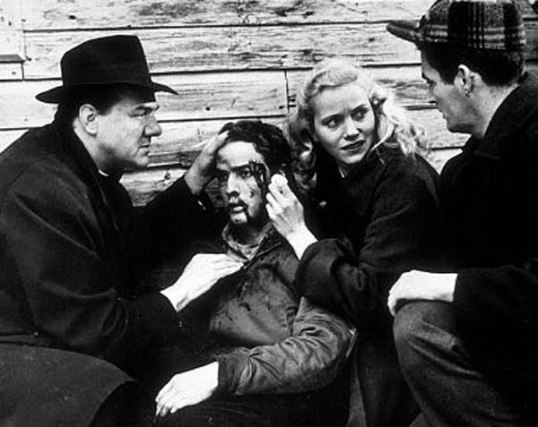
102 years ago, on this date, Marlon Brando was born in Omaha, Nebraska. One of the greatest of American actors and one of the main reasons why so many young actors became enamored with the Method, Marlon Brando played many roles in our culture. When he was young, he was a Broadway bad boy. When he went out to Hollywood, he became a legitimate movie star. In the 60s, he was a cautionary tale as his career suffered a series of notorious flops. In the 70s, he made a comeback and, in during the final years of his career, he was as known for his eccentricities as for his talent. It’s a shame that those eccentricities overshadowed Brando as an actor. When he wanted to be, he was one of the best to ever appear on stage or in the movies.
In honor of the wonderful, tragic, and talented Marlon Brando, it’s time for….
4 Shots From 4 Marlon Brando Films
A Streetcar Named Desire (1951, dir by Elia Kazan, DP: Harry Stradling)
On The Waterfront (1954, dir by Elia Kazan, DP: Boris Kaufman)
The Godfather (1972, dir by Francis Ford Coppola, DP: Gordon Willis)
Apocalypse Now (1979, dir by Francis Ford Coppola, DP: Vittorio Storaro)
“This is some Lord of the Rings bullshit!” — Grace
Ready or Not is a sharp, nasty, and often very funny horror-comedy that turns a nightmare wedding into a vicious class satire. It works best when it embraces its wild premise with full confidence, even if some of its deeper ideas are only lightly explored.
Directed by Tyler Gillett and Matt Bettinelli-Olpin, the film follows Grace, played by Samara Weaving, on what should be the happiest night of her life, only for her new in-laws to force her into a lethal game of hide-and-seek. That setup is simple, but it gives the movie a strong engine: one part survival thriller, one part dark comedy, and one part social commentary about money, power, and inherited privilege. The elegance of the concept is that it does not need much explanation to be effective, because the rules are clear, the stakes are immediate, and the movie wastes little time before letting the chaos begin.
The biggest strength of Ready or Not is Samara Weaving’s performance. Grace is written as someone who feels believable under pressure, which matters because the film asks her to go through absurd, increasingly brutal scenarios while still retaining her humanity. Weaving handles the tonal balancing act extremely well, moving between fear, frustration, disbelief, and darkly comic determination without losing the character’s core. She gives the film an emotional anchor, and without that, the movie would risk becoming just another splatter-heavy genre exercise.
The supporting cast also deserves credit because the Le Domas family is not just rich, but memorably awful in different ways. Adam Brody, Andie MacDowell, Henry Czerny, and the rest of the ensemble help create a household that feels polished on the surface and rotten underneath. Their performances are broadly heightened, but that fits the movie’s tone. The family’s panic, incompetence, and stubborn devotion to tradition become part of the joke, and the film gets a lot of mileage out of watching these people unravel while trying to appear dignified.
Tonally, the movie is strongest when it leans into the tension between horror and comedy. The violence is graphic, but the film rarely treats gore as the whole point; instead, it uses bloodshed as part of a larger joke about entitlement and ritual. That gives the movie a mischievous energy. It wants you to laugh at the absurdity of the situation while still feeling the danger, and for the most part it succeeds. The pacing is also a real asset, since the film avoids spending too long on setup and gets to the conflict quickly. Once the game begins, it keeps finding new ways to escalate the mayhem.
Thematically, Ready or Not is clearly aiming at class resentment and inherited wealth, and that angle gives the film bite. The Le Domas family represent old money, secrecy, and self-preserving tradition, and the movie uses their ridiculous customs to expose how fragile that world really is. There is a satirical edge to how the film portrays privilege as both absurd and dangerous, especially when the family’s traditions are treated with near-religious seriousness. At the same time, the movie is not especially subtle about this, and that can be either a strength or a limitation depending on what you want from it.
That lack of subtlety is one of the film’s few weaknesses. The “eat the rich” angle is easy to understand, but it is not always developed with much nuance, and some viewers may wish the script pushed its social ideas further. The mythology behind the family’s tradition is also deliberately loose, which helps the movie stay nimble but can make the lore feel less important than the film suggests it should be. In addition, the third act gets increasingly outrageous, and while that is part of the fun, not every twist lands with the same force. A few viewers may find the ending more satisfying than the logic that gets it there.
Even so, the film’s swagger largely carries it through those rough spots. Ready or Not understands that tone is everything in a movie like this, and it keeps its balance surprisingly well for something so gleefully chaotic. It is gory without becoming tedious, funny without undercutting the danger, and mean-spirited without losing sympathy for its lead. That is not an easy combination to pull off, and the filmmakers deserve credit for making the material feel brisk and controlled rather than sloppy or overextended.
What makes Ready or Not memorable is that it knows exactly what kind of movie it is. It is not trying to be profound in the heavy, prestige-drama sense, but it is smarter than a simple bloodbath and more disciplined than a pure shock machine. Its pleasures come from its energy, its attitude, and its willingness to let a ridiculous premise keep escalating without apology. The result is a horror-comedy with enough style, bite, and performance power to remain entertaining even when its thematic ambitions are a little broader than deep.
In the end, Ready or Not is a highly watchable genre piece with a terrific lead performance, a savage sense of humor, and a premise that stays potent from beginning to end. It is not perfect, and its satire can feel a little blunt, but it delivers exactly what it promises: a tense, bloody, darkly funny ride through a family dinner from hell.
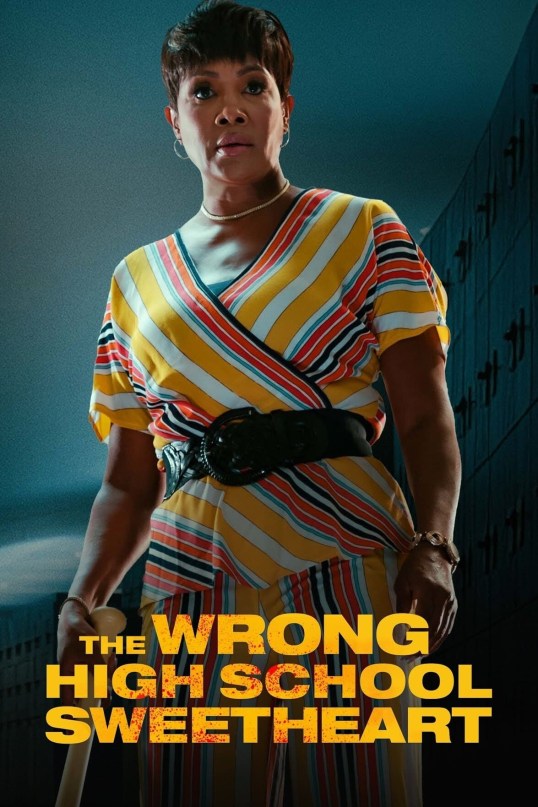
In 2022’s The Wrong High School Sweetheart, Mea Wilkerson plays Danielle, a real estate agent who dated Danny (Alex Trumble) in high school. (Dani and Danny! How cute!) Danielle and Danny broke up when Danny went off to college on a baseball scholarship. Now, Danny has returned home and he’s eager to start things up again with Danielle. Danielle’s wimpy fiancé, Tod (Doug Rogers), isn’t happy about that.
“You just had the wrong high school sweetheart,” Vivica A. Fox says once it’s become obvious that Danny is psychotic. Vivica plays the high school principal. For some reason, she is best friends with her former student, Danielle. Vivica A. Fox appears in all of the “Wrong” films and she’s usually cast as an authority figure. It almost always falls on her to say the film’s title. Sometimes, she’s a bit judgmental. If she says you “picked,” the wrong person, you know everything is your fault. In this once, she makes it clear that Danielle is not to blame because she “just had” the wrong person in her life. It’s always a fun to see Vivica in these films.
The “Wrong” films are almost always entertaining. The Wrong High School Sweetheart certainly is. David DeCoteau’s campy sensibility is uniquely suited to these films. The Wrong High School Sweetheart features Danny chanting, “Stronger than steel/Hotter than the sun/Danny Brooks won’t stop/Til he gets the job done!” while exercising in his underwear. Alex Trumble throws himself into the role of Danny and good for him.
As always with the “Wrong” films, some familiar faces show up in small roles. Tracy Nelson plays a therapist. And, of course, Eric Roberts shows up as a detective. Hopefully, we’ll get a sequel called The Wrong Detective.
Previous Eric Roberts Films That We Have Reviewed:
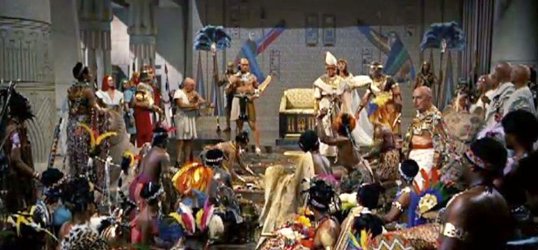
Cecil B. DeMille is often unfairly dismissed as a director, just as Charlton Heston is often underrated as an actor. To me, this is one of the most powerful scenes in DeMille’s filmography. The sound of the screams is haunting. However, one must remember that, as with all the plagues that afflicted Egypt, the Pharoah was given fair warning.
4 Shots from 4 Films is just what it says it is, 4 shots from 4 of our favorite films. As opposed to the reviews and recaps that we usually post, 4 Shots from 4 Films lets the visuals do the talking!
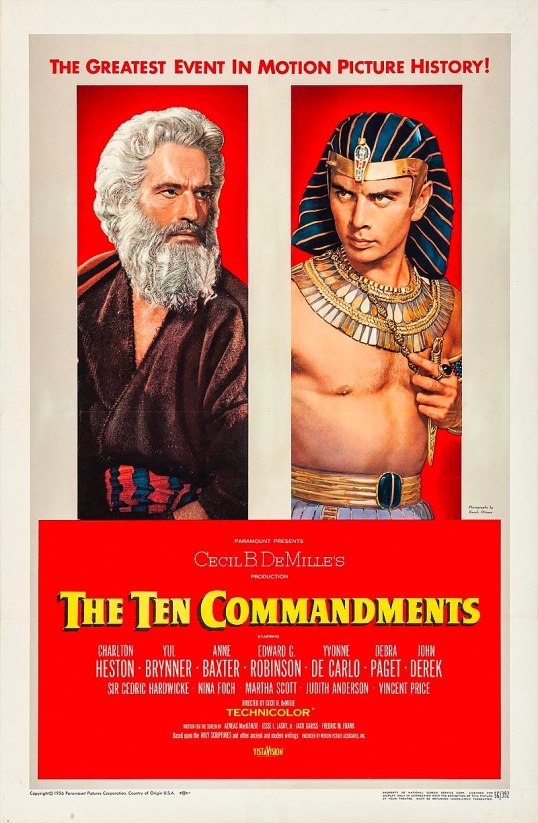
4 Shots From 4 Biblical Epics
Samson and Delilah (1949, dir by Cecil B. DeMille, DP: George Barnes)
The Ten Commandments (1956, dir by Cecil B. DeMille, DP: Lloyd Griggs)
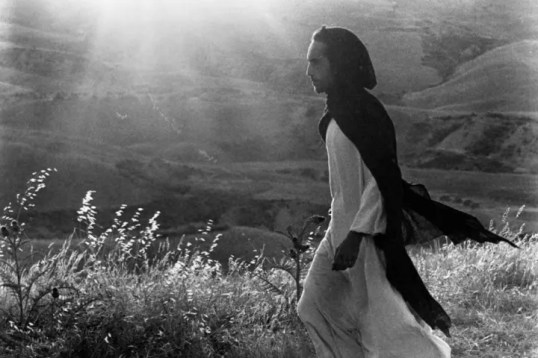
The Gospel According To St. Matthew (1964, dir by Pier Paolo Pasolini, DP: Tonino Delli Colli)
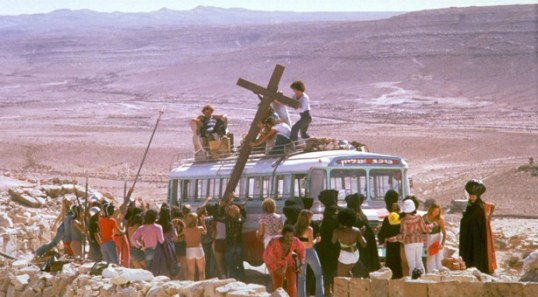
Jesus Christ Superstar (1973, dir by Norman Jewison, DP; Douglas Slocombe)
What’s an Insomnia File? You know how some times you just can’t get any sleep and, at about three in the morning, you’ll find yourself watching whatever you can find on cable or streaming? This feature is all about those insomnia-inspired discoveries!
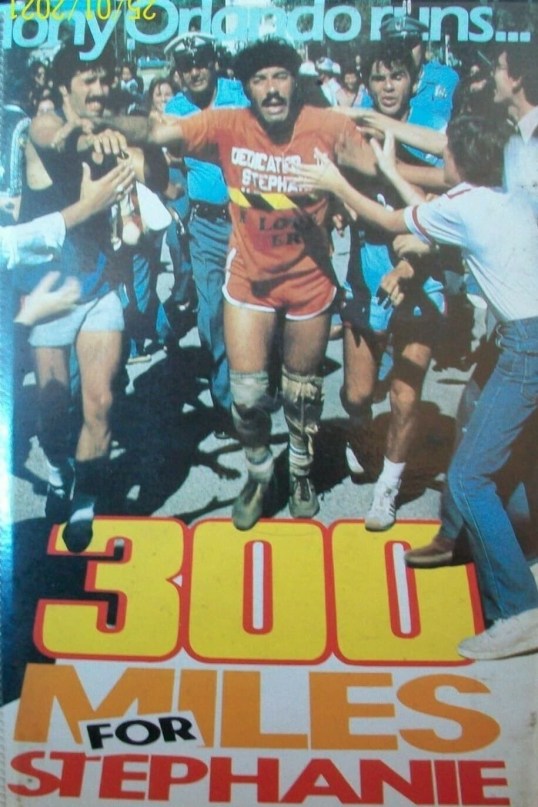
If you were having trouble getting to sleep last night, you could have watched 1981’s 300 Miles For Stephanie.
Tony Orlando — yes, the singer — plays Alberto Rodriguez. When the movie begins, Alberto is a rambunctious military veteran who is notorious for drinking too much and getting into fights. After his latest arrest, he is ordered to turn his life around. With the help of his cousin (Edward James Olmos), he gets a job as a cop in San Antonio. Eventually, he gets married and he becomes a father to Stephanie.
When Stephanie is born, Alberto is told that his daughter probably won’t make it to her fifth birthday. The struggle of raising a handicapped daughter becomes too much for Alberto’s wife and soon, Alberto is a single father. When Stephanie makes it to her fifth birthday, Alberto rides a bicycle 300 miles to a chapel so he can give thanks to God. Later, after his story is picked up the San Antonio media, Alberto resolves to run to the chapel, covering 300 miles on foot in just five days.
300 Miles For Stephanie is clearly a made-for-TV movie from the early 80s. It’s the type of movie where every dramatic beat leads to the inevitable fade-out for commercials. The budget is low and there’s not a single subtle moment to be found in the film but the story itself is so touching that it doesn’t matter. Maybe it’s because it’s Holy Week. Maybe it’s because I’ve recently had to say goodbye to people that I loved. Maybe I’m just as sucker for these type of stories. It doesn’t matter. I cried.
As an actor, Tony Orlando was a little stiff but he still brought a likable earnestness to the role and he got good support from Edward James Olmos, Pepe Serna, Gregory Sierra, and Peter Graves. Graves’s role is small but, as Alberto’s captain, he’s exactly the type of fair-minded authority figure who we could use more of nowadays.
It’s a touching film. In real life, Stephanie, who no one expected to see her second birthday, lived to be 26 years old.
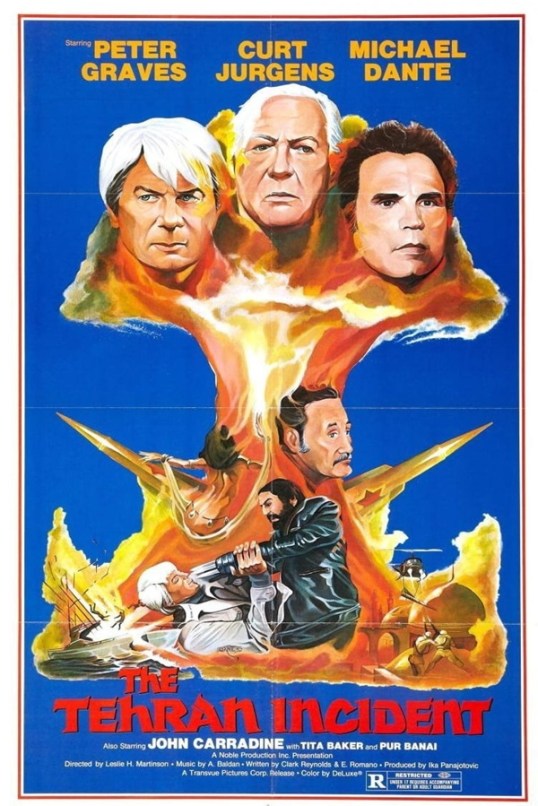
1979’s The Teheran Incident opens with a daring theft. A cruise missile with a nuclear warhead is stolen from a Russian military demonstration and somehow transported to pre-Islamic Revolution Iran. (I say somehow because I’m not really sure how one moves a cruise missile from one country to another without anyone noticing.) The plot was masterminded by the Baron (Curd Jurgens), an international criminal who lives on a yacht. With the help of Professor Nikolaeff (John Carradine, making no effort to sound Russian), the Baron plans to use the missile to blow up a conference that’s being held in Iran.
When an American diplomat is murdered after discovering the Baron’s plan, American spy Alec Franklin (Peter Graves) is sent to Teheran to investigate. Alec teams up with KGB agent Konstantine Senyonov (Michael Dante, who makes even less effort than John Carradine to sound or even come remotely across as being Russian). Together, they investigate the Baron’s operations, which means spending a lot of time wandering around Tehran while a “wacka wacka” beat plays in the background. They also spend a lot of time in a casino because all international criminals own a casino. The Baron, I might add, is such a diabolical villain that he actually hides a cruise missile underneath his casino.
The Teheran Incident is an example of what I like to call “James Bond On A Budget.” In the 60s, 70s, and 80s, the Bond films were a big deal and they inspired a slew of imitators. Most of these imitation Bond films were made by people who really couldn’t afford to spend the millions of dollars that went into the Bond films. What’s important though is that they still tried. It’s hard not to appreciate the effort that goes into trying to recreate a luxurious casino without going bankrupt. The film has the ambitions of Las Vegas and the look of Reno and it’s hard not to look at it and say, “Well, at least they tried. They didn’t give up, even if maybe they should have.” Also, as was the case with many of the budget Bonds, the producers were able to get at least Bond veteran to appear in the film. In The Spy Who Loved Me, Curd Jurgens stole a nuclear missile and got shot in the crotch for his trouble. In The Teheran Incident, Curd Jurgens steals a nuclear missile and gets to hang out on a yacht with his mistress and collection of pinch-faced henchmen. Along with both films featuring Jurgens as their main villain, both films also feature a villainous plot that doesn’t really make much sense. But only The Teheran Incident has John Carradine!
As for our heroes, Peter Graves does his job with his usual stoic professionalism while Michael Dante comes across like he’s never even picked up War and Peace, much lest read it. The true star of the film is the disco soundtrack, which is entertainingly out-of-place and impossible to get out of our head.. This is a bad film that you can dance to!
Apparently, the pre-Mullah Iranian government enthusiastically helped with the production of The Teheran Incident, hoping for a popular film that would bring tourists to Iran. Unfortunately, before the film was released, the Iranian government fell to the Islamic Revolution. (I guess it’s a good thing we took care of that cruise missile.) Needless to say, when it was finally released, The Teheran Incident did not do much to help Iranian tourism.
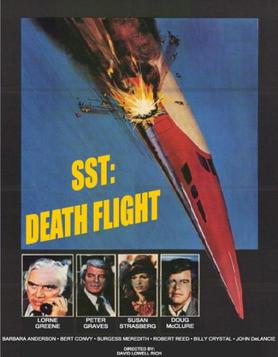
In 1977’s SST: Death Flight, we follow a supersonic jet as it makes it’s maiden flight, going from New York to Paris in just three hours. Not surprisingly, there’s an “all-star” cast waiting for the plane to take off.
Regis Philbin appears as the reporter who breathlessly covers the excitement at the airport. Lorne Greene plays the owner of the jet who is staying behind in New York. Burgess Meredith is the plane’s designer. Robert Reed is the hard-driving pilot. Peter Graves is a businessman who is surprised to see that his former secretary (Season Hubley) has boarded the plane with her stick-in-the-mud fiancé (John De Lancie). Doug McClure is a disgraced pilot who will also be on the flight. Billy Crystal is a bowtie-wearing flight attendant. Bert Convy is the PR man who is traveling with his pregnant mistress (Misty Rowe). Martin Milner, Tina Louise, Susan Strasberg, they’re all on the flight! Finally, there’s a epidemiologist (Brock Peters) who is transporting a box that contains a sample of the Senegal Flu. Now, you might question why anyone would transfer a sample of a highly infectious disease that has a 30% fatality rate on a commercial flight and that’s a good question.
Unfortunately, a disgruntled executive (George Maharis) tries to sabotage the plane, which leads to an explosive decompression that causes the Flu box to burst open. Uh-oh, people are getting sick! And now, Paris refuses to let the plane land in their city because they don’t have time to set up a quarantine. London, however, is willing to let the plane land at one of their airports. However, London hasn’t finalized their quarantine plans so there’s a chance that landing there could lead to British people getting sick.
Brock Peters suggests that they land in Senegal, which already has a quarantine going on. When it is reasonably pointed out that the plane might not have enough fuel to make it to Senegal and that everyone, including those who are not sick, might die in the resulting crash, Martin Milner gives a speech about morality and demands that all of the passengers agree to further risk their lives by going to Senegal. John de Lancie argues for London.
And you know what?
Watching the film, I agreed with John de Lancie. De Lancie points out, quite correctly, the no one on the airplane knew that they were going to be traveling with a deadly disease, that London is preparing a quarantine even while the plane is in flight, and that it’s unfair to demand that everyone on the plane agree to possibly die in a horrific crash. We’re supposed to really hate de Lancie’s character but he makes sense!
The passengers and crew vote 3 to 1 to go to Senegal.
And, of course, the plane crashes.
“Did we do the right thing?” Susan Strasberg asks.
Well, the plane crashed. I think that kind of answers your question.
Some survive and some don’t. The epidemiologist survives without a scratch on him and somehow, no one in the film ever gets mad at him. Seriously, though, what was he thinking bringing his deadly disease samples on a commercial fight!?
Why is this a guilty pleasure? Well, first off, it’s a terrible movie but the cast is full of so many familiar faces that it’s hard to look away. Just the casting of Peter Graves in a “serious” disaster film about an airplane makes this a guilty pleasure. Secondly, the film is the epitome of both the 70s and the disaster genre. The supersonic jet can break the sound barrier but it still looks incredibly tacky. I’m surprised it didn’t have shag carpeting.
Finally, there’s a moment where Bert Convy tells his pregnant girlfriend, “Don’t worry.”
She replies, “That’s what you said last time and look what happened!”
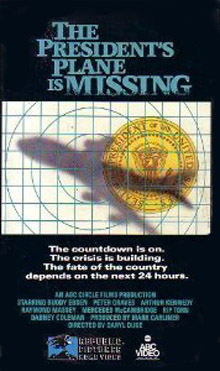
President Jeremy Harris (Tod Andrews) has a lot on his plate. With America and China inching closer and closer to war, Secretary of State Freeman Sharkey (Raymond Massey) is advocating for diplomacy while National Security Advisor George Oldenburg (Rip Torn) feels that America must be more aggressive and ready to launch the first nuclear missile. Of course, no one pays much attention to Vice President Kermit Madigan (Buddy Ebsen). Kermit is viewed with such contempt that he’s never even been given a briefing on what’s going on with China. However, when Air Force One crashes in the California desert and the President cannot be definitively identified as one of the bodies found in the wreckage, Vice President Madigan finds himself with a very difficult decision to make.
That’s quite a crisis. Personally, though, I’m more interested in how the United States ended up with Secretary of State named Freeman Sharkey. I mean, that’s just an amazing name for a diplomat. Why didn’t they elect that guy President? No one messes with Sharkey!
The majority of 1973’s The President’s Plane Is Missing follows a reporter named Mark Jones (Peter Graves) as he tries to get to the bottom of what has happened to President Harris. As usual, Graves is likably stoic. Mark Jones doesn’t show much emotion but, at the very least, he does seem to be trying to do a good job as an old school journalist. What’s interesting is that Mark has an editor (played by Arthur Kennedy) who is constantly yelling at him and threatening to fire him. There’s something very odd about seeing Peter Graves taking order from someone who isn’t intimidated by him.
Mark Jones does learn the truth about why the President has gone missing and he also learns why he, as the reporter assigned to follow the President, wasn’t allowed to board Air Force One when it initially took off. Unfortunately, the solution is a bit anti-climatic. In fact, it’s so anti-climatic that it’s actually kind of annoying. All of the drama ultimately feels rather unnecessary and pointless.
By today’s standards, The President’s Plane Is Missing is a bit on the dull side. There are so many obvious plot holes that I get the feeling that it was probably a bit boring when it originally aired in 1973 as well. The most interesting thing about the film is that it was directed by Daryl Duke, who also directed Payday, a harrowing film about a self-destructive country-western singer. Rip Torn, the star of Payday, appears here as a calm and collected intellectual who advocates for nuclear war without a hint of ambivalence. Torn is a bit miscast as a man without emotions but it’s still always nice to see him in a film.
Who gives the best performance in The President’s Plane Is Missing? Believe it or not, Buddy Ebsen. Ebsen is totally believable as the vice president who, after years of being ignored, is suddenly thrust into a position of power. I’d vote for Kermit Madigan but only if he wasn’t running against Freeman Sharkey.
2020’s Hard Luck Love Story tells the tale of a man named Jesse (Michael Dorman).
Jesse is a drifter, heading from town to town and staying in cheap motels. He plays the guitar and sings to himself. He goes to pool halls and hustles people out of their money, earing him the enmity of a heavily tattooed redneck named Rollo (Dermot Mulroney). He drinks when he’s alone. He drinks when he’s with other people. On the one hand, he’s a pool hustler who makes his living by cheating other people. On the other hand, he’s the type who will hug strangers and give them all of his money. Jesse’s not really a bad guy but he’s someone who, as fate would have it, seems to live in a world that’s dominated by frequently bad people. When Jesse has enough money to afford some beer and some cocaine, he calls his ex-girlfriend, Carly (Sophia Bush), to his hotel. Over the course of a night, we get to know them. Neither one is quite who we originally assumed. Jesse makes a lot of mistakes and he has a talent for angering even the people who try to help him but it’s impossible not to like him. Some of that is due to Michael Dorman’s charismatic performance. Even more of it is because everyone has known someone like Jesse, the well-meaning guy who just has a talent for screwing up.
Hard Luck Love Story is a piece of Americana, one that captures the atmosphere of small towns struggling to survive, dive bars full of broken dreams, and rain-slicked nights when it seems like just about anything can happen. It captures life on the fringes with empathy and a sense of humor. Jesse and Carly may be the heart of the story but the film is full of interesting characters, the types who you could only find in the small cities of Middle America. I particularly liked Zach (Brian Sacca), the bearded cop who goes from being intimidating to being likable in his own dorky way.
Eric Roberts has a small role in this film. He plays Skip, an associate of Carly’s. Roberts doesn’t have a lot of screentime but he makes the most of it. There’s a tendency to be dismissive of the roles that Roberts does nowadays. In his autobiography, Roberts is himself fairly dismissive of a lot of them. But, in Hard Luck Love Song, he gets a chance to create an actual character and he definitely makes an impression. He’s not just Eric Roberts doing a cameo. Instead, he’s very much a part of the film’s world.
Hard Luck Love Song is an engrossing trip through the parts of America that tend to get overlooked by other films. The film is based on an alt-country song and it hits all the right notes.
Previous Eric Roberts Films That We Have Reviewed:






 Through the Shattered Lens