The TSL Grindhouse: The Student Nurses (dir by Stephanie Rothman)


When my mom was dying in 2008 and then when my Dad was in hospice care in 2024, I learned just how important nurses were.

While the doctors that I dealt with were often brusque and overworked, the nurses were the ones who always took the time to answer my questions.  While the doctors took an attitude of, “Death happens,” the nurses were the ones who were willing to show compassion.  They were the ones who seemed to understand the pain that both myself and my sisters were going through.  The nurses were the ones who seemed to care.  Even when it comes to something simple like getting my ADHD prescription renewed, I always feel more relaxed when I’m dealing with a nurse than dealing with a doctor.

(Don’t get me wrong.  I understand why doctors so often avoid a personal connection with their patients.  As Doctor Warshaw (Richard Stahl) puts it in 1970’s The Young Doctors, “mourning is reserved for loved ones.”  It may sound cold but it’s the truth.)

When my Dad was in home hospice, we had a nurse the came by the house every day.  She was cool and professional but still always seemed to care.  She was also a chain-smoker and there were more than a few days that I stepped outside with her.  She always had an extra cigarette for me.  Usually, I don’t smoke because I have asthma but, at that time, I was so stressed that the calming effect of smoking made the risk worth it.  Knowing that the nurse would always arrive early in the morning helped me deal with a very difficult time.  At a time when everything felt like it was spinning out of control, the nurse was someone upon whom I could depend.  After my father died, I struggled to adjust to a lot of things, including the absence of the nurse.  I discovered I missed the nurse’s professional presence.  I missed talking about my feelings while burning a cigarette down to its filter.

In short, I have a lot of respect for nurses.  They have a difficult job, one that I certainly could not do.  But I’m thankful for all that they’ve done for me, my family, and other people’s families.

With all that in mind, I watched 1970’s The Student Nurses earlier today.

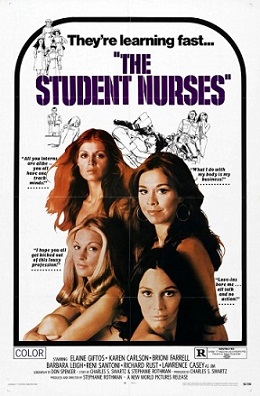
The Student Nurses tells the story of four women who are studying to be nurses while working at the local hospital.  Phred (Karen Carlson) is introduced when she’s attacked by a crazed patient.  Later, she falls for a doctor named Jim (Lawrence P. Casey).  Sharon (Elaine Giftos) grows close to a terminally ill patient (Darrell Larson) and discovers the wisdom of Dr. Warshaw’s admonition about mourning.  Priscilla (Barbara Leigh), who is regularly admonished for the length of her skirt and for never wearing a bra, meets a charismatic drug dealer named Les (Richard Rust).  Les is all about dropping the acid on the beach but he’s not about sticking around when his girlfriend gets pregnant.  And finally, Lynn (Brioni Farrell) meets a Latino political activist named Victor Charlie (Reni Santoni) and discovers that some people just aren’t rich enough to go to the hospital.  When Victor shoots a cop during a raid on his headquarters, Lynn is forced to make a difficult decision.

The Young Nurses is almost legendary because of its status as a politically-themed exploitation film.  It’s a Roger Corman production so there’s a lot of nudity.  But director Stephanie Rothman used the genre to explore themes of class conflict and feminism.  All four of the nurses are portrayed as being strong and independent women who have sex because they want to and who feel no shame about their decisions.  For a 1970 film, that was a big deal.  Interestingly, considering the film’s reputation, it’s actually fairly even-handed when it comes to the differing worldviews of the nurses.  One of the nurses decides that she wants to serve in the Army Nurse Corps, even if that means going to Vietnam.  Another ends up bragging about the gun that she’s carrying in her glove compartment, just in case anyone tries to stand in the way of the revolution.  The film treats both of their decisions with respect.  The important thing, the film seems to be saying, is that all of them are in control of their own future.

It’s an exploitation film, make no doubt about it.  Today, we might talk about the film’s politics and its feminist subtext but I kind of doubt that’s what made the film a box office success in 1970.  That said, Stephen Rothman brings some imagination to even the film’s most exploitive scenes.  When Priscilla drops acid on the beach, Rothman slowly introduces more and more people to the scene, leaving us to wonder, just as Priscilla does, whether they’re real or their just a part of her trip.  All four of the lead actresses are well-cast and fans of great character actors will probably enjoy seeing Reni Santoni playing someone other than a cop or a doctor.

Finally, like so many exploitation films, The Student Nurses is a true time capsule.  The music, the clothes, the groovy slang, this is a film that proudly announces that it was made in 1970.  We may not have time machines but at least we have the movies.

I have no idea if The Student Nurses is a realistic portrayal of what it was like to be a student nurse in 1970.  That said, it’s an entertaining film and, in its grindhouse way, a tribute to the nurses who do so much.
 

Made-For-TV Movie Review: The President’s Plane Is Missing (dir by Daryl Duke)


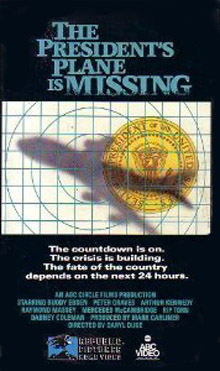
President Jeremy Harris (Tod Andrews) has a lot on his plate.  With America and China inching closer and closer to war, Secretary of State Freeman Sharkey (Raymond Massey) is advocating for diplomacy while National Security Advisor George Oldenburg (Rip Torn) feels that America must be more aggressive and ready to launch the first nuclear missile.  Of course, no one pays much attention to Vice President Kermit Madigan (Buddy Ebsen).  Kermit is viewed with such contempt that he’s never even been given a briefing on what’s going on with China.  However, when Air Force One crashes in the California desert and the President cannot be definitively identified as one of the bodies found in the wreckage, Vice President Madigan finds himself with a very difficult decision to make.

That’s quite a crisis.  Personally, though, I’m more interested in how the United States ended up with Secretary of State named Freeman Sharkey.  I mean, that’s just an amazing name for a diplomat.  Why didn’t they elect that guy President?  No one messes with Sharkey!

The majority of 1973’s The President’s Plane Is Missing follows a reporter named Mark Jones (Peter Graves) as he tries to get to the bottom of what has happened to President Harris.  As usual, Graves is likably stoic.  Mark Jones doesn’t show much emotion but, at the very least, he does seem to be trying to do a good job as an old school journalist.  What’s interesting is that Mark has an editor (played by Arthur Kennedy) who is constantly yelling at him and threatening to fire him.  There’s something very odd about seeing Peter Graves taking order from someone who isn’t intimidated by him.

Mark Jones does learn the truth about why the President has gone missing and he also learns why he, as the reporter assigned to follow the President, wasn’t allowed to board Air Force One when it initially took off.  Unfortunately, the solution is a bit anti-climatic.  In fact, it’s so anti-climatic that it’s actually kind of annoying.  All of the drama ultimately feels rather unnecessary and pointless.

By today’s standards, The President’s Plane Is Missing is a bit on the dull side.  There are so many obvious plot holes that I get the feeling that it was probably a bit boring when it originally aired in 1973 as well.  The most interesting thing about the film is that it was directed by Daryl Duke, who also directed Payday, a harrowing film about a self-destructive country-western singer.  Rip Torn, the star of Payday, appears here as a calm and collected intellectual who advocates for nuclear war without a hint of ambivalence.  Torn is a bit miscast as a man without emotions but it’s still always nice to see him in a film.

Who gives the best performance in The President’s Plane Is Missing?  Believe it or not, Buddy Ebsen.  Ebsen is totally believable as the vice president who, after years of being ignored, is suddenly thrust into a position of power.  I’d vote for Kermit Madigan but only if he wasn’t running against Freeman Sharkey.

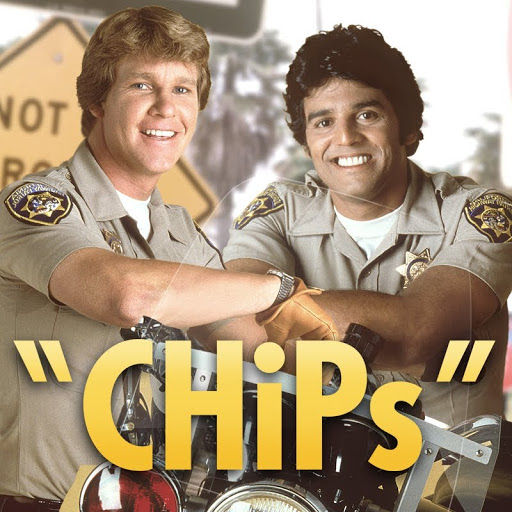
Late Night Retro Television Review: CHiPs 2.6 “Trick or Treat”


Welcome to Late Night Retro Television Reviews, a feature where we review some of our favorite and least favorite shows of the past!  On Mondays, I will be reviewing CHiPs, which ran on NBC from 1977 to 1983.  The entire show is currently streaming on Freevee!

It’s a Halloween episode!

Episode 2.6 “Trick or Treat”

(Dir by Phil Bondelli, originally aired on October 21st, 1978)

It’s Halloween in Los Angeles!  That means that people will be asking for treats and playing tricks and getting into all sorts of trouble.  But, for the California Highway Patrol, it’s just another day and night of trying to keep everyone safe.

Ponch’s day gets off to a bad start when he and Baker chase a van onto a movie lot.  The van’s driver, it turns out, was speeding because he was transporting thirteen black cats to a film set.  When Ponch and Baker finally pull over the van, the cats get loose and all 13 of them march past Ponch.  Later, at headquarters, Ponch is forced by a narrow hallway to walk under a ladder.  *GASP*  Ponch insists that he’s not superstitious but he also won’t stop talking about his encounter with the black cats.

Ponch is in for some bad luck and it shows up in the form of an 8 year-old named Tommy who squirts Ponch with perfume while Ponch is patrolling the neighborhood.  Ponch tells Tommy that playing tricks like that could lead to him getting arrested and hauled off to jail.  Tommy panics and runs away from home.  Guess who gets the blame for that?

That’s not all that’s going on this Halloween night.  (Since this episode aired in 1978, it’s also the night that He came home.)  Eddie (Bobby Van) and his girlfriend, Susan (Elaine Joyce), are holding up convenience stores.  (Susan distracts the cashiers by wearing a translucent ghost costume.)  An older woman (Fran Ryan) is stealing bags of candy from young trick-or-treaters.  Paula (Barbara Leigh) and Karen (Jenny Sherman) are stealing speed limit signs as part of a superfun scavenger hunt.  And Sgt. Getraer is determined to figure out the identity of the Hobgoblin, a member of the highway patrol who reads macabre poetry over the police radio throughout the night.

Fear not, though …. everything works out in the end.  Tommy is not only found hiding out in an abandoned house but Ponch is the one who finds and rescues him.  Eddie and Susan get chased and arrested after trying to pull one robbery too many.  (Their van crashes as a result of two teenagers throwing eggs on the windshield.  Some tricks are good, apparently.)  The old woman turns out to be a distraught suburbanite who lost her engagement ring and who thinks that she may have tossed it in some kid’s trick-or-treat bag.  (Fortunately, the ring is found in her candy bowl and no one presses charges.)  Paula and Karen lose the scavenger hunt but they win future dates with Ponch and Baker.  And Getraer figures out that Artie Grossman is the Hobgoblin.  In the end, everyone smiles and laugh and that’s the important thing.

For a Halloween episode, Trick or Treat was rather low-key but that’s okay.  I liked the day-in-the-life approach that the episode took and it was fun to see that even the members of the fearsome highway patrol were capable of enjoying the holiday.  We should have as good a Halloween as Ponch and Baker.

Back to School #10: Pretty Maids All In A Row (dir by Roger Vadim)


Pretty Maids All In A Row, which — as should be pretty obvious from the trailer above — was originally released in 1971, is a bit of a historic film for me.  You see, I love movies.  And, as a part of that love, I usually don’t give up.  Regardless of how bad a movie may turn out to be, once I start watching, I stick with it.  I do not give up.  I keep watching because you never know.  The film could suddenly get better.  It could turn out that what originally seemed like a misfire was actually brilliant satire.  If you’re going to talk or write about movies, you have an obligation to watch the entire movie.  That was a rule that I had always lived by.

And then, one night, Pretty Maids All In A Row popped up on TCM.

Now, I have to admit that I already knew that Pretty Maids was going to be an extremely 70s film.  I knew that it was probably going to be more than a little sexist.  I knew all of this because the above trailer was included on one of my 42nd Street Forever DVDs.  But I still wanted to see Pretty Maids because the trailer hinted that there might be an interesting hiding underneath all of the cultural baggage.  If nothing else, it appeared that it would have some sort of worth as an artifact of its time.

(If you’re a regular reader of this site, you know how much I love my cinematic time capsules.)

So, the film started.  I logged onto twitter so that I could live tweet the film, using the hashtag #TCMParty.  And from the moment the film started, I knew it wasn’t very good.  It wasn’t just that the film’s camerawork and music were all extremely 70s.  After all, I like 70s music.  I don’t mind the occasional zoom lens.  And random psychedelic sequences?  WHO DOESN’T LOVE THOSE!?  No, my dislike of the film had nothing to do with the film’s style.  Instead, it had to do with the fact that there was absolutely nothing going on behind all of that style.  It wasn’t even style for the sake of style (which is something that I usually love).  Instead, it was style for the sake of being like every other “youth film” that came out in the 70s.

7770

And then there was the film’s plot, which should have been interesting but wasn’t because director Roger Vadim (who specialized in stylish decadence) had no interest in it.  The film takes place at Oceanfront High School, where the only rule is that apparently nobody is allowed to wear a bra.  We meet one student, Ponce De Leon Harper (played by an amazingly unappealing actor named John David Carson), who is apparently on the verge of having a nervous breakdown because, at the height of the sexual revolution, he’s still a virgin.

(Because, of course, the whole point of the sexual revolution was for losers like Ponce to finally be able to get laid…)

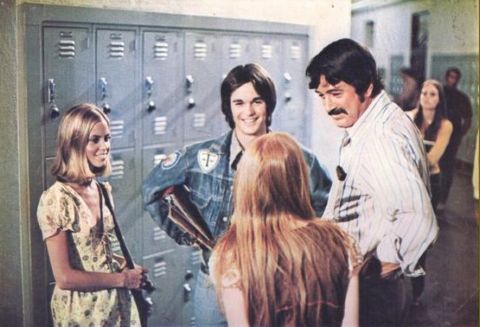
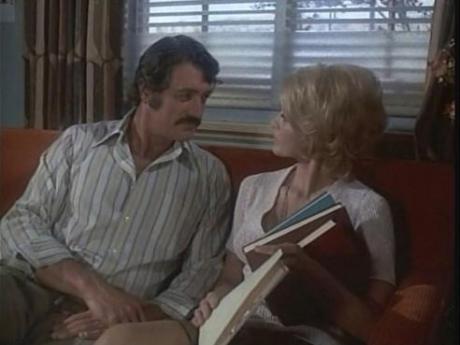
Ponce is taken under the wing of high school guidance counselor Tiger McDrew (Rock Hudson, complete with porn star mustache).  Quickly figuring out exactly what Ponce needs, Tiger sets him up with a teacher played by Angie Dickinson.  However, Tiger has other concerns than just Ponce.  Tiger, it turns out, is a sex addict who is sleeping with nearly every female student at the school. But, American society is so oppressive and puts so much pressure on the American male that Tiger has no choice but to kill every girl that he sleeps with…

This is one of the only film I can think of that not only makes excuses for a serial killer but also presents him as being a heroic  character.  And, while it’s tempting to think that the film is being satirical in its portrayal of Tiger and his murders, it’s actually not.  Don’t get me wrong.  The film is a very broad comedy.  The high school’s principal (Roddy McDowall) is more concerned with the football team than with all of the girls turning up dead at the school.  The local sheriff (Keenan Wynn) is a buffoon.  The tough detective (Telly Savalas) who investigates the murders gets a few one liners.

But Tiger, most assuredly, is the film’s hero.  He’s the only character that the audience is expected to laugh with, as opposed to at.  He is the character who is meant to serve as a mouthpiece for screenwriter Gene Roddenberry’s view on America’s puritanical culture.  If only society was less hung up on sex, Tiger wouldn’t have to kill.  Of course, the film’s celebration of Tiger’s attitude towards sex is not extended towards the girls who sleep with him.  Without an exception, they are all presented as being empty-headed, demanding, shallow, and annoying, worthy only of being leered at by Vadim’s camera until Tiger finally has to do away with them.

(The film’s attitude towards women makes Getting Straight look positively enlightened.)

Rock and Angie

Rock and Angie

ANYWAY!  I spent about 40 minutes watching this movie before I gave up on it.  Actually, if you want to be technical about it, I gave up after 5 minutes.  But I stuck with it for another 35 minutes, waiting to see if the film was going to get any better.  It didn’t and finally, I had to ask myself, “Why am I actually sitting here and wasting my time with this misogynistic bullshit?”  So, I stopped watching and I did so with no regrets.

What I had forgotten is that I had set the DVR to record the film while I was watching it, just in case I later decided to review it.  So, last week, as I was preparing for this series of Back to School posts, I saw Pretty Maids All In A Row on my DVR.  I watched the final 51 minutes of the film, just to see if it ever got better.  It didn’t.

However, on the plus side, Rock Hudson does give a good performance in the role of Tiger, bringing a certain seedy desperation to the character.  (I’m guessing that this desperation was Hudson’s own contribution and not an element of Roddenberry’s screenplay, which more or less presents Tiger as being a Nietzschean superman.).  And beyond that, Pretty Maids serves as evidence as to just how desperate the Hollywood studios were to makes movies that would be weird enough to appeal to young people in the early 70s.

Watching the film, you can practically hear the voices of middle-aged studio executives.

“What the Hell are we trying to do with this movie!?” one of the voices says.

“Who cares!?” the other voice replies, “the kids will love it!”

A70-5583