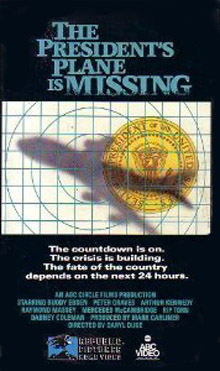
Made-For-TV Movie Review: The President’s Plane Is Missing (dir by Daryl Duke)


President Jeremy Harris (Tod Andrews) has a lot on his plate.  With America and China inching closer and closer to war, Secretary of State Freeman Sharkey (Raymond Massey) is advocating for diplomacy while National Security Advisor George Oldenburg (Rip Torn) feels that America must be more aggressive and ready to launch the first nuclear missile.  Of course, no one pays much attention to Vice President Kermit Madigan (Buddy Ebsen).  Kermit is viewed with such contempt that he’s never even been given a briefing on what’s going on with China.  However, when Air Force One crashes in the California desert and the President cannot be definitively identified as one of the bodies found in the wreckage, Vice President Madigan finds himself with a very difficult decision to make.

That’s quite a crisis.  Personally, though, I’m more interested in how the United States ended up with Secretary of State named Freeman Sharkey.  I mean, that’s just an amazing name for a diplomat.  Why didn’t they elect that guy President?  No one messes with Sharkey!

The majority of 1973’s The President’s Plane Is Missing follows a reporter named Mark Jones (Peter Graves) as he tries to get to the bottom of what has happened to President Harris.  As usual, Graves is likably stoic.  Mark Jones doesn’t show much emotion but, at the very least, he does seem to be trying to do a good job as an old school journalist.  What’s interesting is that Mark has an editor (played by Arthur Kennedy) who is constantly yelling at him and threatening to fire him.  There’s something very odd about seeing Peter Graves taking order from someone who isn’t intimidated by him.

Mark Jones does learn the truth about why the President has gone missing and he also learns why he, as the reporter assigned to follow the President, wasn’t allowed to board Air Force One when it initially took off.  Unfortunately, the solution is a bit anti-climatic.  In fact, it’s so anti-climatic that it’s actually kind of annoying.  All of the drama ultimately feels rather unnecessary and pointless.

By today’s standards, The President’s Plane Is Missing is a bit on the dull side.  There are so many obvious plot holes that I get the feeling that it was probably a bit boring when it originally aired in 1973 as well.  The most interesting thing about the film is that it was directed by Daryl Duke, who also directed Payday, a harrowing film about a self-destructive country-western singer.  Rip Torn, the star of Payday, appears here as a calm and collected intellectual who advocates for nuclear war without a hint of ambivalence.  Torn is a bit miscast as a man without emotions but it’s still always nice to see him in a film.

Who gives the best performance in The President’s Plane Is Missing?  Believe it or not, Buddy Ebsen.  Ebsen is totally believable as the vice president who, after years of being ignored, is suddenly thrust into a position of power.  I’d vote for Kermit Madigan but only if he wasn’t running against Freeman Sharkey.
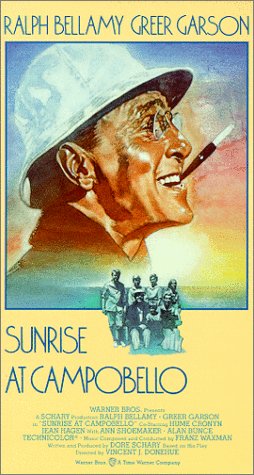
Shattered Politics #15: Sunrise at Campobello (dir by Vincent J. Donehue)


Sunrise_at_Campobello_film

I can still remember that day like yesterday.

I was either 10 or 11 and I was at a big family gathering in Arkansas.  I was at my aunt’s house.  My great-grand uncle was sitting in a corner of the living room and watching the TV.  Because he was nearly blind, only an inch or two separated his face from the screen.  And, because he was almost deaf, the television was blaring.  When we first arrived, he was watching what sounded to be a cartoon but, after a few minutes, he changed the channel.

Apparently, whatever channel he was watching was showing a program about the Great Depression because my great-grand uncle snorted a little and yelled (not because he was mad but because he was deaf), “Some people like Roosevelt!  I say he was a dictator!”

That blew my young mind.  It wasn’t because I necessarily knew that much about Franklin D. Roosevelt, beyond the fact that he had been President.  Instead, it shocked me because that was the first time that I had ever heard anyone call a U.S. President a dictator.  It was the first time that I truly understoodd that not everyone shared the same opinions, especially when it came to politics and history.

Looking back, so many of the things that define me as a person — my skepticism about conventional wisdom, my mistrust of authority, and my tendency to dismiss “experts” — are the result of that day, that documentary on the Great Depression, and my great-grand uncle’s opinion of Franklin D. Roosevelt.

(Want to know why I hate it when the headlines of clickbait articles say stuff like, “Neil deGrasse Tyson gave his opinion on the movies and it was glorious?”  Blame me great-grand uncle.  Nobody was going to tell him FDR wasn’t a dictator.  Nobody’s going tell me what’s glorious.  I’ll make up my own mind.)

And, let’s face it — FDR is a controversial figure.  Most of what you read about Roosevelt is positive but if you glance under the surface, you realize that the legacy of the New Deal is far more ambiguous than most people are willing to admit.  You realize that there are serious questions about whether Roosevelt knew about the upcoming attack on Pearl Harbor.  You discover that Roosevelt wanted to reform the Supreme Court so that it would be a rubber stamp for the executive branch.  And, of course, his decision to run for a third term set up exactly the type of precedent that — if not for a constitutional amendment — could have been exploited by the wrong people.

And, yet, as ambiguous as his legacy may be, how can you not be inspired by FDR’s personal story?  He went from being a dilettante who was often dismissed as being an intellectual lightweight to being four-times elected President of the United States.  In between running unsuccessfully for vice president in 1920 and being elected governor of New York in 1928, Roosevelt was crippled by polio.  It’s always been a huge part of the Roosevelt legend that his battle with polio transformed him and made him into the President who led the country during the Great Depression and World War II.

It’s an inspiring story, regardless of what you may think of Roosevelt’s political ideology or his legacy of government intrusion.

It’s also a story that’s told in our 15th entry in Shattered Politics, the 1960 film Sunrise at Campobello.  This film opens with FDR (played by Ralph Bellamy) as an athletic and somewhat shallow man who, while on a vacation with his family, is struck down my polio.  The film follows he and his wife, Eleanor (Greer Garson), as they learn how to deal with his new physical condition.  Throughout the film, Roosevelt remains upbeat and determined while Eleanor remains supportive and eventually — after being out of the public eye for three years — Roosevelt gets a chance to relaunch his political career by giving a nominating speech for Gov. Al Smith at the Democratic National Convention.

(A little bit of history that everyone should know: Al Smith was the first Catholic to ever be nominated for President by a major political party.)

Sunrise at Campobello is one of those films that tends to show up fairly regularly on TCM.  It’s a well-acted film with Ralph Bellamy and Greer Garson really making the aristocratic Roosevelts into sympathetic and relatable characters.  At the same time, whenever I’ve watched the film, I’ve always been struck by how long it seems.  (The movie itself is only 144 minutes, which means its shorter than the average Christopher Nolan flick but it’s one of those films that seems longer than it actually is.)  Sunrise at Campobello was based on a stage play and it’s directed like a stage play as well, with little visual flair and emphasis on dialogue and character.  The end result is a film that I can’t really recommend for the casual viewer but one that is, at the very least, interesting for students of history like me.