Insomnia File #75: 300 Miles For Stephanie (dir by Clyde Ware)


What’s an Insomnia File? You know how some times you just can’t get any sleep and, at about three in the morning, you’ll find yourself watching whatever you can find on cable or streaming? This feature is all about those insomnia-inspired discoveries!
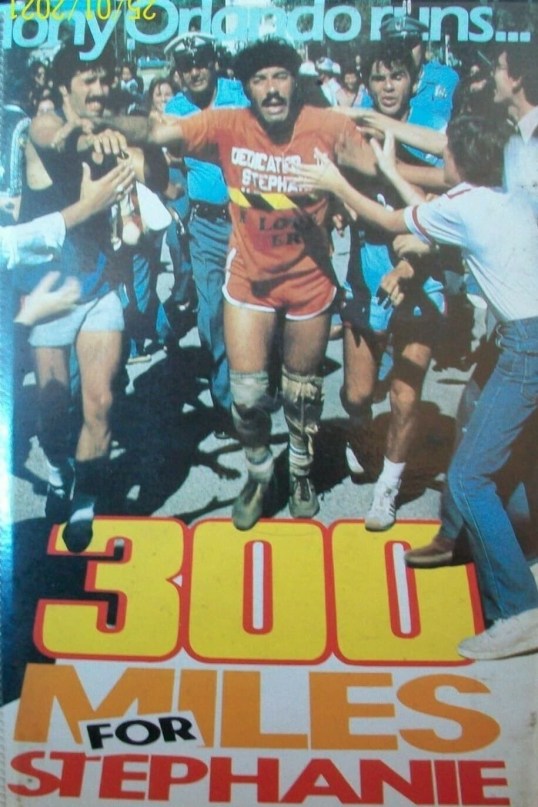
If you were having trouble getting to sleep last night, you could have watched 1981’s 300 Miles For Stephanie.

Tony Orlando — yes, the singer — plays Alberto Rodriguez.  When the movie begins, Alberto is a rambunctious military veteran who is notorious for drinking too much and getting into fights.  After his latest arrest, he is ordered to turn his life around.  With the help of his cousin (Edward James Olmos), he gets a job as a cop in San Antonio.  Eventually, he gets married and he becomes a father to Stephanie.

When Stephanie is born, Alberto is told that his daughter probably won’t make it to her fifth birthday.  The struggle of raising a handicapped daughter becomes too much for Alberto’s wife and soon, Alberto is a single father.  When Stephanie makes it to her fifth birthday, Alberto rides a bicycle 300 miles to a chapel so he can give thanks to God.  Later, after his story is picked up the San Antonio media, Alberto resolves to run to the chapel, covering 300 miles on foot in just five days.

300 Miles For Stephanie is clearly a made-for-TV movie from the early 80s.  It’s the type of movie where every dramatic beat leads to the inevitable fade-out for commercials.  The budget is low and there’s not a single subtle moment to be found in the film but the story itself is so touching that it doesn’t matter.  Maybe it’s because it’s Holy Week.  Maybe it’s because I’ve recently had to say goodbye to people that I loved.  Maybe I’m just as sucker for these type of stories.  It doesn’t matter.  I cried.

As an actor, Tony Orlando was a little stiff but he still brought a likable earnestness to the role and he got good support from Edward James Olmos, Pepe Serna, Gregory Sierra, and Peter Graves.  Graves’s role is small but, as Alberto’s captain, he’s exactly the type of fair-minded authority figure who we could use more of nowadays.

It’s a touching film.  In real life, Stephanie, who no one expected to see her second birthday, lived to be 26 years old.

Previous Insomnia Files:

  1. Story of Mankind
  2. Stag
  3. Love Is A Gun
  4. Nina Takes A Lover
  5. Black Ice
  6. Frogs For Snakes
  7. Fair Game
  8. From The Hip
  9. Born Killers
  10. Eye For An Eye
  11. Summer Catch
  12. Beyond the Law
  13. Spring Broke
  14. Promise
  15. George Wallace
  16. Kill The Messenger
  17. The Suburbans
  18. Only The Strong
  19. Great Expectations
  20. Casual Sex?
  21. Truth
  22. Insomina
  23. Death Do Us Part
  24. A Star is Born
  25. The Winning Season
  26. Rabbit Run
  27. Remember My Name
  28. The Arrangement
  29. Day of the Animals
  30. Still of The Night
  31. Arsenal
  32. Smooth Talk
  33. The Comedian
  34. The Minus Man
  35. Donnie Brasco
  36. Punchline
  37. Evita
  38. Six: The Mark Unleashed
  39. Disclosure
  40. The Spanish Prisoner
  41. Elektra
  42. Revenge
  43. Legend
  44. Cat Run
  45. The Pyramid
  46. Enter the Ninja
  47. Downhill
  48. Malice
  49. Mystery Date
  50. Zola
  51. Ira & Abby
  52. The Next Karate Kid
  53. A Nightmare on Drug Street
  54. Jud
  55. FTA
  56. Exterminators of the Year 3000
  57. Boris Karloff: The Man Behind The Monster
  58. The Haunting of Helen Walker
  59. True Spirit
  60. Project Kill
  61. Replica
  62. Rollergator
  63. Hillbillys In A Haunted House
  64. Once Upon A Midnight Scary
  65. Girl Lost
  66. Ghosts Can’t Do It
  67. Heist
  68. Mind, Body & Soul
  69. Candy
  70. Shortcut to Happiness
  71. Dallas Cowboy Cheerleaders
  72. Dallas Cowboy Cheerleaders II
  73. Don’t Kill It
  74. Listen To Me

Retro Television Review: Miami Vice 4.6 “God’s Work”


Welcome to Retro Television Reviews, a feature where we review some of our favorite and least favorite shows of the past!  On Mondays, I will be reviewing Miami Vice, which ran on NBC from 1984 to 1989.  The entire show can be purchased on Prime!

After a two-week hiatus, the retro television reviews are back!  Let’s start with Miami Vice.

Episode 4.6 “God’s Work”

(Dir by Jan Eliasberg, originally aired on November 6th, 1987)

Father Ernesto Lupe (Daniel Lugo), an old friend of Castillo’s, runs an AIDS hospice in Miami.  When Father Ernesto is shot and murdered, Castillo takes a particular interest in the case.

Was Father Ernesto shot by one of the neighborhood homophobes, the same punks who spend their free time spray-painting obscene graffiti on the front doors of the hospice?

Was Father Ernesto’s death connected to his brother-in-law, notorious drug lord Jorge Cruz (Alfonso Arau)?  The Vice Squad has been investigating the Cruz family.  Francesco (Franceso Quinn) is the brutish son, the one who enjoys throwing his weight around and who goes out of his way to bully everyone that he meets.  Felipe (Esai Morales) is the young son, who has just returned from Miami after making a fortune as a stockbroker in New York.  Is Felipe looking to take over the family business?

Actually, Felipe wants nothing to do with the family business.  He’s returned to Miami because an ex-boyfriend is a patient at the AIDS hospice and Felipe wanted to spend time with him before he died.  And Father Ernesto’s death had nothing to do with drugs.  Instead, Jorge shot him because Jorge blamed Ernesto’s sermons, which stressed God’s love above all else, for being responsible for Felipe “becoming” gay.  Even after Felipe explains that the sermons had nothing to do with it and that he’s always been gay, Jorge still thinks that he can “cure” his son by making him a part of the family business.

Yikes!

There was a lot going on in this episode.  In fact, there was almost too much going on.  Between Castillo investigating Ernesto’s death and Tubbs (working undercover) trying to arrest Franceso, this episode sometimes felt a bit overstuffed.  It was still an effective episode, though, featuring good performances from Arau, Quinn, Morales, and Edward James Olmos.  Castillo actually got to laugh at one point in this episode.  I don’t think that’s ever happened before.

This episode did remind me — as I think almost every episode does — that Crockett and Tubbs undercover work has never made much sense.  Tubbs spends the majority of the first half of the episode pretending to be a criminal looking to make a deal with Francisco.  That’s fine.  It even allows Tubbs to use his fake Caribbean accent.  It’s been a while since we’ve heard that.  But then, after Father Ernesto is shot, Tubbs shows up at the crime scene with his badge.  Now, seriously, Father Ernesto is Francesco’s uncle.  Francesco is a suspect in the murder.  Why would Tubbs run the risk of blowing his cover like that?  For that matter, why was Vice investigating a homicide?

Even when Vice is good, it often doesn’t make sense.

Retro Television Review: Miami Vice 2.9 “Bushido”


Welcome to Retro Television Reviews, a feature where we review some of our favorite and least favorite shows of the past!  On Mondays, I will be reviewing Miami Vice, which ran on NBC from 1984 to 1989.  The entire show can be purchased on Prime!

This week, a man from the past returns to haunt Castillo.

Episode 2.9 “Bushido”

(Dir by Edward James Olmos, originally aired on November 22nd, 1985)

This week’s episode opens with yet another intricately plotted drug bust going awry.  This time, a dealer ends up dead, a DEA Agent ends up knocked out and tied up in a bathroom, and $50,000 goes missing.  Watching the tapes of the bust, Castillo is shocked to spot a familiar face on the scene.  Castillo says that Jack Gretsky (Dean Stockwell) was his partner when he was working for the CIA in Vietnam.  Gretsky has long been thought dead but there he is, on tape and ruining Castillo’s bust.

Realizing that Gretsky was sending him a message, Castillo decides to deal with the situation personally.  After visiting two CIA agents (Jerry Hardin and Tom Bower) who work out of an adult novelty shop, Castillo tracks Gretsky down to a Buddhist temple.  The two of them talk.  Gretsky reveals that he’s married to a Russian woman and that he has a son.  He asks Castillo to watch over them if anything happens to him.  The stoic Castillo agrees and then gives Gretsky a hug.  Castillo says that he has to arrest Gretsky.  Gretsky says he knows and then pulls a machine gun, forcing Castillo to kill him.  The CIA agents are happy to no longer have to deal with Gretsky.

A day later, the coroner’s office calls Vice and says that Gretsky was terminally ill with cancer and probably only had a few days left to live.  When Crockett and Tubbs go to tell Castillo, they find his badge and a note sitting in the office.  Castillo is fulfilling Gretsky’s final wish and protecting his wife (Natasha Schneider) and his son, Marty (Robin Kaputsin).  Castillo sees it as being a part of the samurai code by which he lives his life.  Meanwhile, a rogue CIA agent named Surf (David Rasche, giving a wonderfully unhinged performance) is working with the KGB to track down Gretsky’s family.

Directed by Edward James Olmos, Bushido is a wonderfully odd episode.  With a combination of skewed camera angles and deliberately eccentric performances from Dean Stockwell and David Rasche, this episode plays out with the relentless intensity of a fever dream.  (The opening drug bust even features Zito burying himself in the sand and using a straw to breathe until its time to emerge and knock out one of the bad guys.  It’s weird but it’s great.)  Olmos contrasts Castillo’s trademark stoicism with the more verbose characters played by Stockwell and Rasche and, as a result, Castillo emerges as an honorable man who hides his emotions because he knows that’s the only way to survive in his world.  To fall in love like Jack or to get cocky like Surf can only lead to one’s downfall.

After a few uneven episodes, Bushido is a nice reminder of what Miami Vice was capable of at its best.

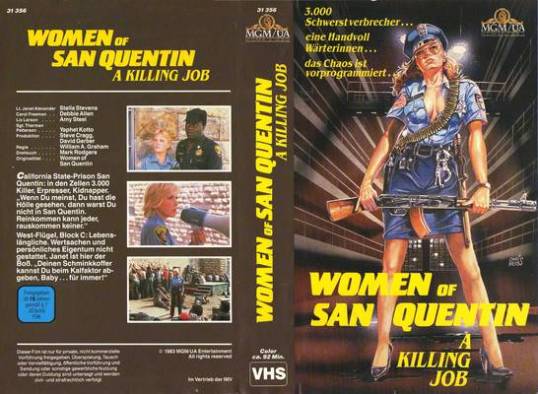
Cleaning Out The DVR: Women of San Quentin (dir by William A. Graham)


(Lisa is currently in the process of cleaning out her DVR!  She’s got over 170 films to watch before the end of 2017!  Will she make it?  Who knows?  She recorded 1983’s Women of San Quentin off of Retroplex on January 25th.)

For some reason, back in January, I felt the need to record several prison movies off of cable.  I’m not sure where my mind was at that I would see a title like Women of San Quentin listed in the guide and think to myself, “That’s something I definitely need to record.”  Maybe I was thinking of pursuing a career as a prison guard.  That seems to be the easiest way to get a show on A&E nowadays.

Anyway, I imagine that anyone reading this review is looking that title and considering the VHS cover art and they’re probably assuming that Women of San Quentin is some sort of Cirio Santiago-directed women in prison film.  And then consider the film’s cast: Amy Steel is best known for Friday the 13th Part II and April Fool’s Day.  Stella Stevens is an exploitation film vet.  One of the prisoners is played by Rockne Tarkington, who starred in a handful of blaxploitation films.  William Sanderson, star of the infamous Fight For Your Life, has a small role.  Yaphet Kotto plays a prison guard here but he’s best known for playing the villain in Live and Let Die.  Gregg Henry plays a sociopath.  Hector Elizondo and Debbie Allen play sympathetic guards.  Even Ernie Hudson, a now-respectable actor with several less-than-savory films on his resume, shows up.  Finally, consider this: Women of San Quentin was written by Larry Cohen, the man who directed both Black Caesar and It’s Alive.

However, despite all of that, Women of San Quentin is not an exploitation film.  Instead, it’s a made-for-TV movie.  (Director William A. Graham has over a hundred TV shows and made-for-TV movies to his credit.)  It follows several storylines.  Lt. Janet Alexander (Stella Stevens) is the tough-but-fair captain who is in charge of one of San Quentin’s most intimidating cell blocks.  She’s great at her job and she has a vaguely romantic relationship with Hector Elizondo but she’s also tempted to find a new career.  Charles Wilson (Ernie Hudson) steps up to lead the prison’s black inmates after another activist is assassinated.  Meanwhile, the leader of the Mexican Mafia plots a prison riot and Yaphet Kotto and Debbie Allen use any means necessary to discover what’s going to happen.

And then there’s Liz Larson (Amy Steel), the newest prison guard who struggles to prove that she belongs in San Quentin.  Sexist colleagues play cruel pranks on her.  The prisoners shout at her whenever she walks past their cells.  When she has to use a gun to break up a fight, she hesitates just a second too long.  Will she be able to step up when real trouble breaks out?  Among horror fans, Amy Steel is remembered for “surviving” several slasher films.  (Her performance as Ginny in Friday the 13th Part 2 largely set the standard for which all final girls are judged.)  Steel does a pretty good job as Liz but, actually, the entire movie is well-acted.  The script is frequently rudimentary but the cast is full of unique talent and it’s always fun to watch so many good actors playing opposite each other.

I assume that the Women of San Quentin was meant to be a pilot for a TV show or something.  It just has that feel to it.  If just for the cast alone, I would recommend watching Women of San Quentin if you get a chance.  I’m as surprised as anyone but, after all, where else are going to get a chance to watch Hector Elizondo, Yaphet Kotto, Stella Stevens, and Amy Steel all hanging out in a bar together?  There are certain opportunities that you just don’t miss.