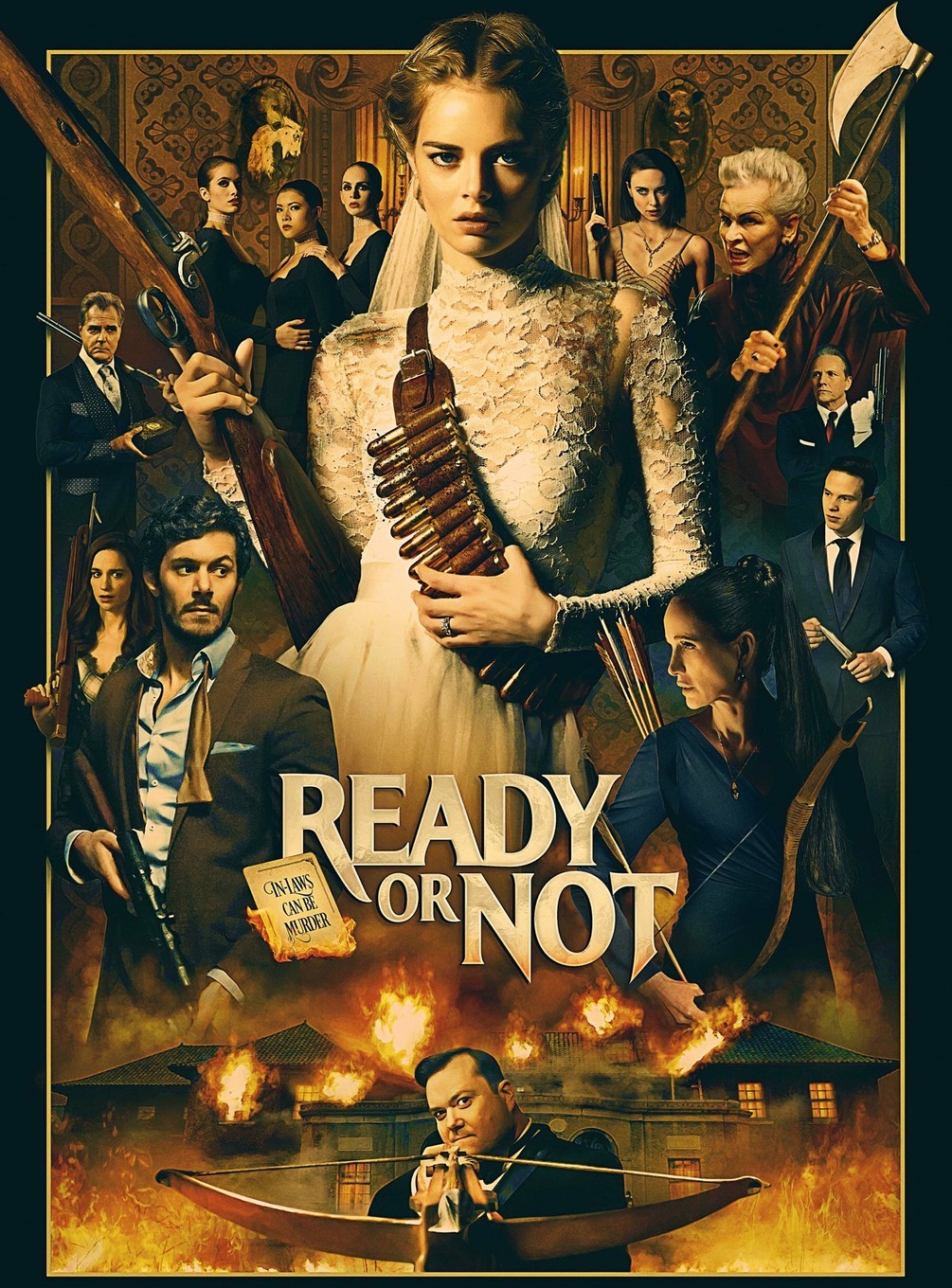
Review: Ready or Not (dir. by Matt Bettinelli-Olpin & Tyler Gillett)


“This is some Lord of the Rings bullshit!” — Grace

Ready or Not is a sharp, nasty, and often very funny horror-comedy that turns a nightmare wedding into a vicious class satire. It works best when it embraces its wild premise with full confidence, even if some of its deeper ideas are only lightly explored.

Directed by Tyler Gillett and Matt Bettinelli-Olpin, the film follows Grace, played by Samara Weaving, on what should be the happiest night of her life, only for her new in-laws to force her into a lethal game of hide-and-seek. That setup is simple, but it gives the movie a strong engine: one part survival thriller, one part dark comedy, and one part social commentary about money, power, and inherited privilege. The elegance of the concept is that it does not need much explanation to be effective, because the rules are clear, the stakes are immediate, and the movie wastes little time before letting the chaos begin.

The biggest strength of Ready or Not is Samara Weaving’s performance. Grace is written as someone who feels believable under pressure, which matters because the film asks her to go through absurd, increasingly brutal scenarios while still retaining her humanity. Weaving handles the tonal balancing act extremely well, moving between fear, frustration, disbelief, and darkly comic determination without losing the character’s core. She gives the film an emotional anchor, and without that, the movie would risk becoming just another splatter-heavy genre exercise.

The supporting cast also deserves credit because the Le Domas family is not just rich, but memorably awful in different ways. Adam Brody, Andie MacDowell, Henry Czerny, and the rest of the ensemble help create a household that feels polished on the surface and rotten underneath. Their performances are broadly heightened, but that fits the movie’s tone. The family’s panic, incompetence, and stubborn devotion to tradition become part of the joke, and the film gets a lot of mileage out of watching these people unravel while trying to appear dignified.

Tonally, the movie is strongest when it leans into the tension between horror and comedy. The violence is graphic, but the film rarely treats gore as the whole point; instead, it uses bloodshed as part of a larger joke about entitlement and ritual. That gives the movie a mischievous energy. It wants you to laugh at the absurdity of the situation while still feeling the danger, and for the most part it succeeds. The pacing is also a real asset, since the film avoids spending too long on setup and gets to the conflict quickly. Once the game begins, it keeps finding new ways to escalate the mayhem.

Thematically, Ready or Not is clearly aiming at class resentment and inherited wealth, and that angle gives the film bite. The Le Domas family represent old money, secrecy, and self-preserving tradition, and the movie uses their ridiculous customs to expose how fragile that world really is. There is a satirical edge to how the film portrays privilege as both absurd and dangerous, especially when the family’s traditions are treated with near-religious seriousness. At the same time, the movie is not especially subtle about this, and that can be either a strength or a limitation depending on what you want from it.

That lack of subtlety is one of the film’s few weaknesses. The “eat the rich” angle is easy to understand, but it is not always developed with much nuance, and some viewers may wish the script pushed its social ideas further. The mythology behind the family’s tradition is also deliberately loose, which helps the movie stay nimble but can make the lore feel less important than the film suggests it should be. In addition, the third act gets increasingly outrageous, and while that is part of the fun, not every twist lands with the same force. A few viewers may find the ending more satisfying than the logic that gets it there.

Even so, the film’s swagger largely carries it through those rough spots. Ready or Not understands that tone is everything in a movie like this, and it keeps its balance surprisingly well for something so gleefully chaotic. It is gory without becoming tedious, funny without undercutting the danger, and mean-spirited without losing sympathy for its lead. That is not an easy combination to pull off, and the filmmakers deserve credit for making the material feel brisk and controlled rather than sloppy or overextended.

What makes Ready or Not memorable is that it knows exactly what kind of movie it is. It is not trying to be profound in the heavy, prestige-drama sense, but it is smarter than a simple bloodbath and more disciplined than a pure shock machine. Its pleasures come from its energy, its attitude, and its willingness to let a ridiculous premise keep escalating without apology. The result is a horror-comedy with enough style, bite, and performance power to remain entertaining even when its thematic ambitions are a little broader than deep.

In the end, Ready or Not is a highly watchable genre piece with a terrific lead performance, a savage sense of humor, and a premise that stays potent from beginning to end. It is not perfect, and its satire can feel a little blunt, but it delivers exactly what it promises: a tense, bloody, darkly funny ride through a family dinner from hell.

The Films of 2024: Horizon: An American Saga: Chapter One (dir by Kevin Costner)


Horizon: An American Saga: Chapter One is the rather unwieldy title of the first part of what Kevin Costner has said will be an epic four-part movie about the settling of the American frontier.

It’s very, very long.

It has a running time of three hours, during which time a lot of characters are introduced and a lot of plotlines are initiated but, because this is the only first chapter, none of them come to a close.  In fact, as the film ends, it’s still a mystery as to how some of the characters are even related.  I watched all three hours and I took my ADD meds this morning so you can be assured that I was actually paying attention.  That said, I still struggled to keep track of who everyone was or even where they were in proximity to each other.  Indeed, it was only towards the end of the film that I realized that several years were supposed to have passed over the course of the first chapter’s running time.

That’s not to say that the film is a disaster.  While it’s not quite the nation-defining epic that Costner obviously envisioned it as being, it’s also not quite the cinematic atrocity that several critics made it out to be.  It’s a throwback of sorts, to the epic westerns of old.  As such, the film features taciturn gunslingers, a woman with a past, dangerous outlaw families, fierce Indian warriors, and a wise Indian chief who has dreamed of the coming of the white man.  The film is full of actors — like Michael Rooker, Sienna Miller, Sam Worthington, Danny Huston, Will Patton, James Russo, Dale Dickey, and Kevin Costner himself — who feel as if they belong to a different era of filmmaking.  Just about everyone in the film is heading to the settlement of Horizon, which sits in Apache territory.  Despite the efforts of the Indians to kill every settler who shows up, they keep coming.  As one army officer explains it, the Indians have made the mistake of thinking that the settlers will come to believe the land is cursed while the settlers, all of whom are full of American optimism, instead chose to believe that the previous settlers were unlucky but that the next wave of settlers will make it work.  Costner has the right visual sensibility for a western.  The film reveals a director who is obviously in love with the Western landscape and the film is at its best when it simply frames the characters against the beauty of the frontier.  But when it comes to actually telling a compelling story, he struggles.  There are a lot of moving parts to the first chapter of Horizon and the problem is not that they don’t automatically connect but instead that Costner never gives us any reason to believe that they’ll ever connect.  There are no visual clues or bits of dialogue to assure the viewer that everything they’re watching is going to eventually pay off.  Costner asks his audience to have faith in him and remember that he directed Open Range and Dances With Wolves while forgetting about The Postman.

The first hour, which features a brutal raid on the settlement by a group of Indians, is the strongest.  It really drives home the brutality of what we now call the old west.  In the style of Michael Cimino’s The Deer Hunter, Costner closely observes the individual customs of the film’s settlers and carefully introduces several appealing characters who leave the viewer feeling as if they’ve met a very special and very unique community of people.  That makes it all the more devastating when the majority of those characters are subsequently wiped out with casual cruelty in a raid led by the Indian warrior Pionsenay (Owen Crow Shoe).  (Later — much later — a tracker played by Jeff Fahey will show similar brutality while wiping out a group of Apaches.)  The first hour establishes the frontier as being beautiful but also dangerous and it also drives home the mix of determination, desperation, and even madness that led so many to follow Horace Greeley’s advice and “Go west!”  Though the film was shot in early 2023, the brutality of the raid brought to mind the terrible images of the October 7th attacks on Israel.  The subsequent scenes in which Pionesenay and his followers ridiculed those in the tribe who wanted peace mirrored the current schism that’s driving apart the worldwide Left.  The U.S. Army, for their part, arrives a day late and can only offer up not-so subtle condescension.  The surviving settlers, however, remain determined to make a home for themselves.

The second hour focuses on Hayes (played by Costner), who rides into a mining town and gets involved with a family of outlaws who are looking for the woman who shot their father.  The second hour is a bit more of a traditional western than the first hour, though some of the violence is still shockingly brutal.  (Even being comedic relief won’t save you in this film.)  Abbey Lee gives a good performance as the woman with a past and a baby and Kevin Costner is  …. well, he’s Costner.  He could play this type of role in his sleep.

The third hour is a mess, introducing a wagon train and featuring a miscast Luke Wilson as the leader of the settlers and Jeff Fahey giving a strong performance as a ruthless tracker.  The third hour meandered as a whole new set of characters were introduced and I was left to wonder why the film needed new characters when the characters from the first two hours were perfectly adequate.  It was during the third hour that I started to really get impatient with the film and its leisurely approach to storytelling.

The film ends with a montage of what we can expect from the next few chapters of Horizon and I will say that the montage actually looked pretty cool.  That’s because the montage was almost totally made up of action scenes, with none of the padding that caused Chapter One to last an unwieldy three hours despite only having 90 minutes worth of story.  Still, one has to wonder if we’ll actually get to see the next three chapters.  The first chapter bombed at the box office and didn’t exactly excite critics.  Costner is producing and financing the films himself and I doubt he’ll give up on them.  The Horizon saga will be completed but will it made it to theaters or will it just end up on streaming?  Personally, I think the whole thing would work best as a miniseries but who knows?  (If Horizon was airing on Paramount, it would probably be a Yellowstone-style hit.)  All I really do know is that Chapter Two has yet to be released.  And that’s a shame because, for all of Chapter One‘s flaws, I’d still like to see how the story turns out.