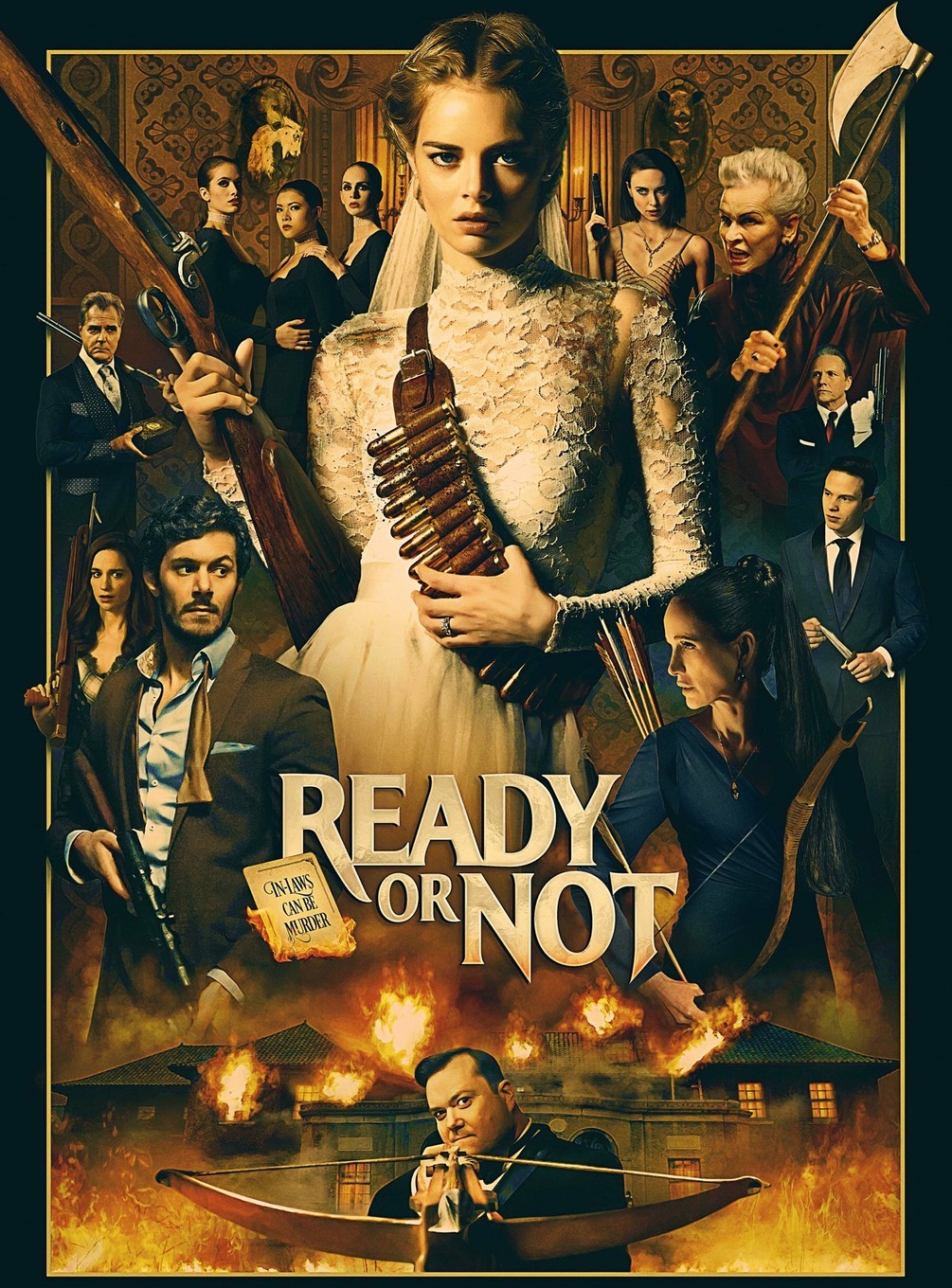
Review: Ready or Not (dir. by Matt Bettinelli-Olpin & Tyler Gillett)


“This is some Lord of the Rings bullshit!” — Grace

Ready or Not is a sharp, nasty, and often very funny horror-comedy that turns a nightmare wedding into a vicious class satire. It works best when it embraces its wild premise with full confidence, even if some of its deeper ideas are only lightly explored.

Directed by Tyler Gillett and Matt Bettinelli-Olpin, the film follows Grace, played by Samara Weaving, on what should be the happiest night of her life, only for her new in-laws to force her into a lethal game of hide-and-seek. That setup is simple, but it gives the movie a strong engine: one part survival thriller, one part dark comedy, and one part social commentary about money, power, and inherited privilege. The elegance of the concept is that it does not need much explanation to be effective, because the rules are clear, the stakes are immediate, and the movie wastes little time before letting the chaos begin.

The biggest strength of Ready or Not is Samara Weaving’s performance. Grace is written as someone who feels believable under pressure, which matters because the film asks her to go through absurd, increasingly brutal scenarios while still retaining her humanity. Weaving handles the tonal balancing act extremely well, moving between fear, frustration, disbelief, and darkly comic determination without losing the character’s core. She gives the film an emotional anchor, and without that, the movie would risk becoming just another splatter-heavy genre exercise.

The supporting cast also deserves credit because the Le Domas family is not just rich, but memorably awful in different ways. Adam Brody, Andie MacDowell, Henry Czerny, and the rest of the ensemble help create a household that feels polished on the surface and rotten underneath. Their performances are broadly heightened, but that fits the movie’s tone. The family’s panic, incompetence, and stubborn devotion to tradition become part of the joke, and the film gets a lot of mileage out of watching these people unravel while trying to appear dignified.

Tonally, the movie is strongest when it leans into the tension between horror and comedy. The violence is graphic, but the film rarely treats gore as the whole point; instead, it uses bloodshed as part of a larger joke about entitlement and ritual. That gives the movie a mischievous energy. It wants you to laugh at the absurdity of the situation while still feeling the danger, and for the most part it succeeds. The pacing is also a real asset, since the film avoids spending too long on setup and gets to the conflict quickly. Once the game begins, it keeps finding new ways to escalate the mayhem.

Thematically, Ready or Not is clearly aiming at class resentment and inherited wealth, and that angle gives the film bite. The Le Domas family represent old money, secrecy, and self-preserving tradition, and the movie uses their ridiculous customs to expose how fragile that world really is. There is a satirical edge to how the film portrays privilege as both absurd and dangerous, especially when the family’s traditions are treated with near-religious seriousness. At the same time, the movie is not especially subtle about this, and that can be either a strength or a limitation depending on what you want from it.

That lack of subtlety is one of the film’s few weaknesses. The “eat the rich” angle is easy to understand, but it is not always developed with much nuance, and some viewers may wish the script pushed its social ideas further. The mythology behind the family’s tradition is also deliberately loose, which helps the movie stay nimble but can make the lore feel less important than the film suggests it should be. In addition, the third act gets increasingly outrageous, and while that is part of the fun, not every twist lands with the same force. A few viewers may find the ending more satisfying than the logic that gets it there.

Even so, the film’s swagger largely carries it through those rough spots. Ready or Not understands that tone is everything in a movie like this, and it keeps its balance surprisingly well for something so gleefully chaotic. It is gory without becoming tedious, funny without undercutting the danger, and mean-spirited without losing sympathy for its lead. That is not an easy combination to pull off, and the filmmakers deserve credit for making the material feel brisk and controlled rather than sloppy or overextended.

What makes Ready or Not memorable is that it knows exactly what kind of movie it is. It is not trying to be profound in the heavy, prestige-drama sense, but it is smarter than a simple bloodbath and more disciplined than a pure shock machine. Its pleasures come from its energy, its attitude, and its willingness to let a ridiculous premise keep escalating without apology. The result is a horror-comedy with enough style, bite, and performance power to remain entertaining even when its thematic ambitions are a little broader than deep.

In the end, Ready or Not is a highly watchable genre piece with a terrific lead performance, a savage sense of humor, and a premise that stays potent from beginning to end. It is not perfect, and its satire can feel a little blunt, but it delivers exactly what it promises: a tense, bloody, darkly funny ride through a family dinner from hell.

An Offer You Can’t Refuse: Irish Eyes (dir by Daniel McCarthy)


First released in 2004, Irish Eyes tells the story of two brother, born eleven months apart.

Tom Phelan (John Novak) is the older brother, the one who is destined to go to law school, join the Justice Department, and to marry Erin (Veronica Carpenter), the daughter of one of Boston’s most prominent attorneys.  Tom’s future lies in politics.  As he makes his reputation by taking down members of the Boston underworld, he finds himself being groomed for attorney general and then who knows what else.

Sean Phelan (Daniel Baldwin) is the younger brother.  Haunted by the murder of his father and stuck at home taking care of his mother (Alberta Watson) while Tom goes to college, Sean soon pursues a life of crime.  He falls under the influence of the Irish mob, led by Kevin Kilpatrick (Wings Hauser).  Sean quickly works his way up the ranks.  It doesn’t matter how much time he does in prison.  It doesn’t matter how many people he has to kill.  It doesn’t matter if it alienates the woman that he loves or if it damages his brother’s political career, Sean is a career criminal.  It’s the one thing that he knows.  When Sean finds himself as the head of the Irish mob and also the American connection for the IRA, his activities are originally overlooked by his brother.  Sean even threatens a reporter who makes the mistake of mentioning that Sean and Tom are brothers.  But soon, Tom has no choice but to come after his brother.  What’s more important?  Family or politics?

Obviously (if loosely) based on Boston’s Bulger Brothers (Whitey became a feared criminal while brother John became a prominent Massachusetts politico), Irish Eyes doesn’t really break any no ground.  Every mob cliché is present here and so is every Boston cliché.  Don’t rat on the family.  Don’t betray your friends.  The only way to move up is to make a move on whoever has the spot above you.  Every bar is full of angry Irish-Americans.  Every fight on the street turns deadly.  Everyone is obsessed with crime or politics.  The film, to its credits, resists the temptation to have everyone speak in a bad Boston accent.  (The Boston accent, much like the Southern accent, is one of the most abused accents in film.)  Sean narrates the films and you better believe he hits all of the expected points about life on the street.

That said, it’s an effective film with enough grit and good performances to overcome the fact that it’s just a wee predictable.  Daniel Baldwin is appropriately regretful as Sean and John Novak does a good job of capturing the conflict between Tom’s love of family and his own political ambitions.  Curtis Armstrong shows up and is surprisingly convincing as a psychotic IRA assassin.  Admittedly, the main reason that I watched this film was because Wings Hauser was third-billed in the credits.  Hauser only appears in a handful of very short scenes and that’s a shame.  In those few scenes, he has the rough charisma necessary to be believable as the crime boss who holds together the neighborhood and it’s hard not to regret that he didn’t get more to do in the film.  That said, the film still works for what it is.  It’s a good mob movie.

This film was originally entitled Irish Eyes.  On Tubi, it can be found under the much clunkier name, Vendetta: No Conscience, No Mercy.

Back to School Part II #49: Degrassi: Don’t Look Back (dir by Phil Earnshaw)


(For the past three weeks, Lisa Marie has been in the process of reviewing 56 back to school films!  She’s promised the rest of the TSL staff that this project will finally wrap up by the end of Monday, so that she can devote her time to helping to prepare the site for its annual October horror month!  Will she make it or will she fail, lose her administrator privileges, and end up writing listicles for Buzzfeed?  Keep reading the site to find out!)

ddlb

Much as in the case of my reviews of School’s Out, Degrassi Goes Hollywood, and Degrassi Takes Manhattan, this review of 2015’s Degrassi: Don’t Look Back is probably not going to make much sense to you if you’re not a huge fan of Degrassi.  Then again, it’s possible that it won’t make sense even if you’ve seen every episode of Degrassi. 

Among the Degrassi fandom, there’s actually a very passionate debate as to whether or not Don’t Look Back should even be considered canonical.  It premiered at the end of season 14, following the graduation episode.  Season 14 was also the last season of Degrassi to be broadcast on TeenNick.  (The series has subsquently moved to Netflix).  Some people don’t consider Netflix Degrassi to be the same as TeenNick Degrassi and since Don’t Look Back is mostly concerned with laying the foundation for Netflix Degrassi, there’s a tendency among some to treat Don’t Look Back as almost being fan fiction.

Admittedly, Don’t Look Back does definitely feel different from the other Degrassi films.  It’s much more light-hearted, with a good deal of the film’s 87 minute running time devoted to parodying different horror films.  (It’s almost as if Don’t Look Back, which premiered in August, was actually conceived with an October premiere in mind.)

The film, which takes place during the summer, follows five storylines, four of which are pretty typical of what you’d expect to see on Degrassi.  Rich girl Frankie Hollingsworth (Sara Waisglass) gets an internship at Toronto’s city hall and has to prove to her coworkers that she’s not just a spoiled brat while, at the same time, resisting the temptation to cheat on her boyfriend, Winston (Andre Kim).  Zoe (Ana Golja) attends summer school and finds herself attracted to her classmate, the acerbic Grace (Nikki Gould).  (As fans of Netflix Degrassi know, Zoe would eventually accept that she was a lesbian while Grace shocked everyone by revealing that she was both straight and seriously ill.)  Tristan Milligan (Lyle Lettau) obsesses over both his dreams of internet stardom and his former boyfriend, Miles.  Maya (Olivia Scriven) gets a job as a nanny for a rock star (Sonia Dhillon Tully) and Zig (Ricardo Hoyos) gets mad because he feels neglected.

But then, there’s the fifth subplot and here’s where things get controversial.  A minor Degrassi character, Gloria Chin (Nicole Samantha Huff), vanishes and soon, everyone in Canada is searching for her.  Fortunately, Grade 10 students of Degrassi Community School are able to use their amazing computer skills and deductive reasoning to figure out where Grace is being held.  It’s one of those weird things that you expect to see in an episode of something like CSI or NCIS or some other show with initials for a title.  It’s not really something you would expect to see on Degrassi.  It feels definitely out-of-place as a part of a franchise that has always prided itself on realistically and honestly exploring teen issues.

But then again, after 14 seasons (and that’s not even including the two series that came before Degrassi: The Next Generation), both the format and tone of Degrassi have changed several times.  That’s the way it’s always been.  Seasons 1  & 2 of Degrassi have a completely different feel from seasons 3 & 4.  And, ultimately, I guess the idea of a bunch of tenners solving a crime is not any stranger than Kevin Smith shooting Jay and Silent Bob Go Canadian, Eh? at the school.

Anyway, if you’re a Degrassi fan, Don’t Look Back is entertaining enough.  And yes, it is canonical.  Even if they’ve never mentioned since that they solved the Canadian crime of the century (and does seem like something that would occasionally come up in conversation), apparently that’s what the students at Degrassi did during their summer vacation.

Good for them!