Retro Television Review: St. Elsewhere 3.15 “Bye, George”


Welcome to Retro Television Reviews, a feature where we review some of our favorite and least favorite shows of the past! On Fridays, I will be reviewing St. Elsewhere, a medical show which ran on NBC from 1982 to 1988.  The show can be found on Daily Motion.
Episode 3.15 “Bye George”

(Dir by Mark Tinker, originally aired on January 9th, 1985)

It’s another busy day at St. Eligius.

  • The then-Governor of Massachusetts, Michael Dukakis, appears as himself, entering the ER after pulling a muscle while out for his daily run.  Fiscus refuses to believe that he’s the governor.  Elliot recognizes him, of course.
  • Three years later, Governor Dukakis ran for President and lost …. big time.  Dukakis is still alive and is the earliest living unsuccessful presidential nominee.  Because he lost to the first President Bush, he used to show up on the news during the second President Bush’s term.  He always came across as being bitter and kind of whiny.
  • With Tshalla’s kidney transplant having been performed and his clinic at risk due to government corruption, Dr. Wyler finally leaves Boston and heads back to Africa.  And really, it’s not a moment too soon.  For all the time the show spent assuring us that Dr. Wyler was a modern-day saint, I found him to be a bit full-of-himself and a little annoying.  We’ve already got Dr. Westphall and Dr. Craig on this show.  We don’t need any more pompous doctors.
  • Speaking of Dr. Westphall, he’s depressed.  Well, what else is new?
  • Since revealing that he only studied for six months at a fly-by-night medical school, Dr. Morrison is no longer allowed to treat patients or go on rounds.  Joan Halloran (played by Nancy Stafford) returns to the hospital (and the show) and announces that she will be defending Morrison in front of the medical review board and that she hopes that Morrison will be able to continue on as a resident.  Morrison just kind of shrugs.  Morrison is easily depressed as Dr. Westphall.
  • Joan talks to everyone around the hospital and everyone agrees that Jack Morrison is the kindest, bravest, warmest, most wonderful human being they’ve ever known in their life.  When Joan tells Jack that he is universally beloved, Jack seems to cheer up a little.  Not much but a little.
  • Poor Mrs. Hufnagel.  She’s finally about to leave the hospital but, before she goes, she asks another patient, stand-up comedian Murray Robbin (Murray Rubin), to marry her.  Murray says he’ll think about it and then he promptly dies.
  • Murray was Elliot’s patient.  Depressed by his death, Elliot goes to Westphall for advice.  Westphall’s advice is as useless as usual.  Given that Westphall can’t even hear the laughter of children without spending the next eight hours obsessing on about how they’re all going to grow up and die someday, he may not be the best person to talk to while feeling down.
  • Elliot finds Hufnagel in the chapel and they both cry together.  It was a touching scene, well-played by Florence Halop and Stephen Furst.
  • Dr. Ehrlich took Dr. Craig out for dinner!  Yay!  I love it Ehrlich tries to suck up to Craig because it neve goes well.  He takes the Craigs to an incredibly tacky Hawaiian place.
  • Uh-oh, Ehrlich’s credit card has been declined!  Surely the wealthy Dr. Craig will help….
  • “Start washing dishes, Ehrlich,” Craig says.
  • As if so often the case, Ellen Craig admonishes her husband for being rude and agrees to help Victor out.

This was a great episode!  Yes, Westphall and Morrison were their usual depressing selves but Elliot and Hufnagel finally got to act like real people (as opposed to just caricatures) and the bit with Ehrlich and the Craigs was wonderfully handled.  Those who only know William Daniels as the kindly old Mr. Fenney are really missing out.  Dr. Craig’s a great character.

I enjoyed this episode.  For once, the humor and the drama were evenly balanced.  With Peter White dead and the cast clicking as an ensemble, St. Elsewhere appears to have really found its pace.
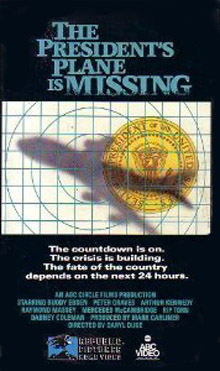
Made-For-TV Movie Review: The President’s Plane Is Missing (dir by Daryl Duke)


President Jeremy Harris (Tod Andrews) has a lot on his plate.  With America and China inching closer and closer to war, Secretary of State Freeman Sharkey (Raymond Massey) is advocating for diplomacy while National Security Advisor George Oldenburg (Rip Torn) feels that America must be more aggressive and ready to launch the first nuclear missile.  Of course, no one pays much attention to Vice President Kermit Madigan (Buddy Ebsen).  Kermit is viewed with such contempt that he’s never even been given a briefing on what’s going on with China.  However, when Air Force One crashes in the California desert and the President cannot be definitively identified as one of the bodies found in the wreckage, Vice President Madigan finds himself with a very difficult decision to make.

That’s quite a crisis.  Personally, though, I’m more interested in how the United States ended up with Secretary of State named Freeman Sharkey.  I mean, that’s just an amazing name for a diplomat.  Why didn’t they elect that guy President?  No one messes with Sharkey!

The majority of 1973’s The President’s Plane Is Missing follows a reporter named Mark Jones (Peter Graves) as he tries to get to the bottom of what has happened to President Harris.  As usual, Graves is likably stoic.  Mark Jones doesn’t show much emotion but, at the very least, he does seem to be trying to do a good job as an old school journalist.  What’s interesting is that Mark has an editor (played by Arthur Kennedy) who is constantly yelling at him and threatening to fire him.  There’s something very odd about seeing Peter Graves taking order from someone who isn’t intimidated by him.

Mark Jones does learn the truth about why the President has gone missing and he also learns why he, as the reporter assigned to follow the President, wasn’t allowed to board Air Force One when it initially took off.  Unfortunately, the solution is a bit anti-climatic.  In fact, it’s so anti-climatic that it’s actually kind of annoying.  All of the drama ultimately feels rather unnecessary and pointless.

By today’s standards, The President’s Plane Is Missing is a bit on the dull side.  There are so many obvious plot holes that I get the feeling that it was probably a bit boring when it originally aired in 1973 as well.  The most interesting thing about the film is that it was directed by Daryl Duke, who also directed Payday, a harrowing film about a self-destructive country-western singer.  Rip Torn, the star of Payday, appears here as a calm and collected intellectual who advocates for nuclear war without a hint of ambivalence.  Torn is a bit miscast as a man without emotions but it’s still always nice to see him in a film.

Who gives the best performance in The President’s Plane Is Missing?  Believe it or not, Buddy Ebsen.  Ebsen is totally believable as the vice president who, after years of being ignored, is suddenly thrust into a position of power.  I’d vote for Kermit Madigan but only if he wasn’t running against Freeman Sharkey.

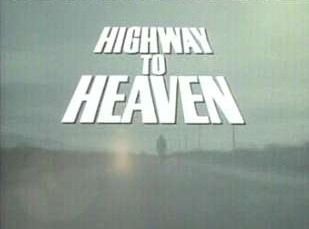
Late Night Retro Television Review: Highway to Heaven 5.8 “Goodbye, Mr. Zelinka”


Welcome to Late Night Retro Television Reviews, a feature where we review some of our favorite and least favorite shows of the past!  On Thursdays, I will be reviewing Highway to Heaven, which aired on NBC from 1984 to 1989.  The entire show is currently streaming on Tubi and several other services!

This week, it’s time for yet another student protest.

Episode 5.8 “Goodbye, Mr. Zelinka”

(Dir by Michael Landon, originally aired on June 23rd, 1989)

The students at Lincoln High are upset to learn that beloved English teacher Mr. Zelinka (Lew Ayres) is going to have to retire because he’s reached the mandatory age of 70.  The school’s new maintenance workers — Jonathan Smith and Mark Gordon — suggest that they should all conduct a walk-out to demand that Zelinka be allowed to keep his job.  The evil school board president (James Karen) says that Zelinka can stay if he takes and passes an exam.  However, the exam is rigged for Zelinka to fail.  Jonathan uses “the stuff” to make sure that Zelinka not only passes but that he also gets the highest score ever.  In the past, Jonathan always refused to use “the stuff” to help people cheat.  Instead, Jonathan would have shown the school board president the error of his ways.  But, for this episode, Jonathan rigs the rigged exam and the villain is left in power so that he can presumably continue to make Mr. Zelinka’s life miserable.

I did not like this episode.  Yeah, it’s heart was in the right place but the entire school walking about in support of Mr, Zelinka just felt kind of silly.  I mean, did every student at the school have Mr. Zelinka for English?  What did everyone’s parents think about the protest?  If Mr. Zelinka had been a compelling character, may be I would have felt differently but  Mr. Zelinka was instead a pretty passive character and I have to admit that I wondered about all the other good teachers who had been forced to retire at 70.  Why didn’t Jonathan show up to help any of them out?  What made Mr. Zelinka so special?  It didn’t help that Lew Ayres was 80 years old when he played Mr. Zelinka and that he looked and sounded even older.  The obviously frail Ayres comes across as someone who maybe does need to retire.

I’ve sat through a lot of Highway to Heaven episodes about clean-cut teenagers walking out of class so that they can protest injustice.  Highway to Heaven was a very earnest show and that was one of the things that made it likable.  But, by the fifth season, Highway to Heaven‘s formula was a bit less effective than it had been in the past.  This is an episode just just seems to be going through the motions.  This is also the rare Highway to Heaven episode in which I wanted someone to tell Jonathan and Mark to just mind their own business.

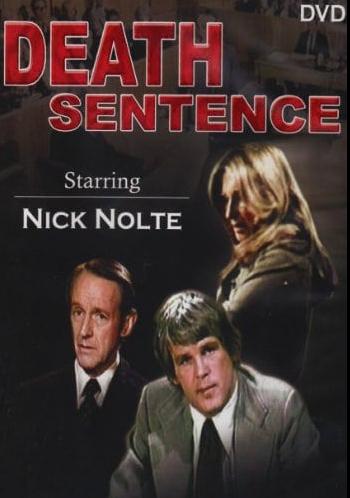
Retro Television Reviews: Death Sentence (dir by E.W. Swackhamer)


Welcome to Retro Television Reviews, a feature where we review some of our favorite and least favorite shows of the past!  On Sundays, I will be reviewing the made-for-television movies that used to be a primetime mainstay.  Today’s film is 1974’s Death Sentence!  It  can be viewed on YouTube!

There’s been a murder!

A young woman has been strangled in her own home.  The nosy neighbor (Hope Summers) testifies that the woman often argued with her woman and that she heard the woman yelling on the night of the murder.  The husband, John Healy (Nick Nolte), is found in a neighborhood bar and, when he’s brought back to his house, his drunken reaction to seeing his dead wife doesn’t do much to keep him from looking totally guilty.

However, the viewer knows that John is innocent because the viewer has already seen that the woman was murdered by Don Davies (Laurence Luckinbill), the man with whom she was having an affair.  She demanded that he leave his wife for her and Don, realizing that his cheating was about to revealed, responded by strangling her.

Don’s wife is Susan Davies (Cloris Leachman), who knows that she and Don have been going through a rough patch but who certainly had no idea that Don was cheating on her.  Shortly after the murder, Susan is called up for jury duty.  She’s placed on the jury and told that she will be an important part of a major trial.  As a result, she and the other jurors will be sequestered in a hotel….

And who is the defendant in this trial?  John, of course!

As opposed to the other members of the jury, who are ready to convict John even before the first bit of testimony is heard, Susan pays attention to what is said in the courtroom.  She listens to Lubell (Alan Oppenheimer), the prosecutor.  She listens to Tanner (William Schallert), the defense attorney.  She comes to believe that John is innocent but will she be able to hold her own against the rest of the jury?  And will she ever figure out that the murder was actually committed by her husband?

It’s an intriguing premise, even if it is a bit far-fetched.  I mean, it really is an amazing coincidence that Susan just happened to end up on the jury for a case involving a murder that was actually committed by her husband.  However, this is a made-for-television movie and, as soon as “Produced by Aaron Spelling” appears on the screen, most viewers should be savvy enough to know what they’re getting into.  Instead, the main problem with the film is that it opens by showing us who the murderer is.  Therefore, there’s really zero suspense as to who actually committed the crime.  Instead, the viewer spends the entire movie waiting for Susan to catch up.  Since the majority of the film takes place in court, it’s a very talky film but there’s no joy to be found in paying close attention to every word said and picking up on the details that will allow you to solve the crime for yourself.  This is a case where the film spoils its biggest twist and, despite good performances from Leachman and Luckinbill, it’s a bit dull.

(Nick Nolte, for his part, spends most of the movie silently sitting in the courtroom.  He’s not bad and his look of anguish is believable but it’s hardly a starring role, regardless of what the film’s video packaging might otherwise claim.)

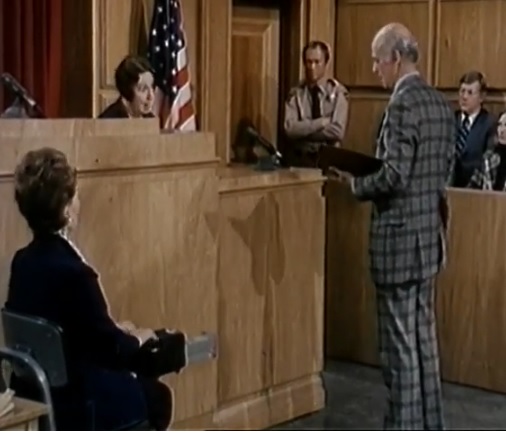
In the end, what I’ll mostly remember about Death Sentence were the atrocious fashion choices made by the prosecutor.  Seriously, would you trust a man wearing this suit?