Guilty Pleasure No. 109: SST — Death Flight (dir by David Lowell Rich)


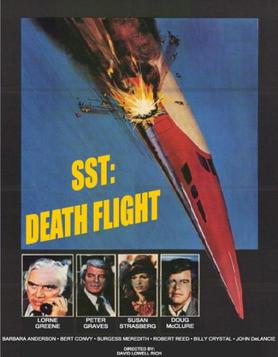
In 1977’s SST: Death Flight, we follow a supersonic jet as it makes it’s maiden flight, going from New York to Paris in just three hours.  Not surprisingly, there’s an “all-star” cast waiting for the plane to take off.

Regis Philbin appears as the reporter who breathlessly covers the excitement at the airport.  Lorne Greene plays the owner of the jet who is staying behind in New York.  Burgess Meredith is the plane’s designer.  Robert Reed is the hard-driving pilot.  Peter Graves is a businessman who is surprised to see that his former secretary (Season Hubley) has boarded the plane with her stick-in-the-mud fiancé (John De Lancie).  Doug McClure is a disgraced pilot who will also be on the flight.  Billy Crystal is a bowtie-wearing flight attendant.  Bert Convy is the PR man who is traveling with his pregnant mistress (Misty Rowe).  Martin Milner, Tina Louise, Susan Strasberg, they’re all on the flight!  Finally, there’s a epidemiologist (Brock Peters) who is transporting a box that contains a sample of the Senegal Flu.   Now, you might question why anyone would transfer a sample of a highly infectious disease that has a 30% fatality rate on a commercial flight and that’s a good question.

Unfortunately, a disgruntled executive (George Maharis) tries to sabotage the plane, which leads to an explosive decompression that causes the Flu box to burst open.  Uh-oh, people are getting sick!  And now, Paris refuses to let the plane land in their city because they don’t have time to set up a quarantine.  London, however, is willing to let the plane land at one of their airports.  However, London hasn’t finalized their quarantine plans so there’s a chance that landing there could lead to British people getting sick.

Brock Peters suggests that they land in Senegal, which already has a quarantine going on.  When it is reasonably pointed out that the plane might not have enough fuel to make it to Senegal and that everyone, including those who are not sick, might die in the resulting crash, Martin Milner gives a speech about morality and demands that all of the passengers agree to further risk their lives by going to Senegal.  John de Lancie argues for London.

And you know what?

Watching the film, I agreed with John de Lancie.  De Lancie points out, quite correctly, the no one on the airplane knew that they were going to be traveling with a deadly disease, that London is preparing a quarantine even while the plane is in flight, and that it’s unfair to demand that everyone on the plane agree to possibly die in a horrific crash.  We’re supposed to really hate de Lancie’s character but he makes sense!

The passengers and crew vote 3 to 1 to go to Senegal.

And, of course, the plane crashes.

“Did we do the right thing?” Susan Strasberg asks.

Well, the plane crashed.  I think that kind of answers your question.

Some survive and some don’t.  The epidemiologist survives without a scratch on him and somehow, no one in the film ever gets mad at him.  Seriously, though, what was he thinking bringing his deadly disease samples on a commercial fight!?

Why is this a guilty pleasure?  Well, first off, it’s a terrible movie but the cast is full of so many familiar faces that it’s hard to look away.  Just the casting of Peter Graves in a “serious” disaster film about an airplane makes this a guilty pleasure.  Secondly, the film is the epitome of both the 70s and the disaster genre.  The supersonic jet can break the sound barrier but it still looks incredibly tacky.  I’m surprised it didn’t have shag carpeting.

Finally, there’s a moment where Bert Convy tells his pregnant girlfriend, “Don’t worry.”

She replies, “That’s what you said last time and look what happened!”

Convy looks straight a the camera and shrugs.

Best guilty pleasure ever!

Previous Guilty Pleasures

  1. Half-Baked
  2. Save The Last Dance
  3. Every Rose Has Its Thorns
  4. The Jeremy Kyle Show
  5. Invasion USA
  6. The Golden Child
  7. Final Destination 2
  8. Paparazzi
  9. The Principal
  10. The Substitute
  11. Terror In The Family
  12. Pandorum
  13. Lambada
  14. Fear
  15. Cocktail
  16. Keep Off The Grass
  17. Girls, Girls, Girls
  18. Class
  19. Tart
  20. King Kong vs. Godzilla
  21. Hawk the Slayer
  22. Battle Beyond the Stars
  23. Meridian
  24. Walk of Shame
  25. From Justin To Kelly
  26. Project Greenlight
  27. Sex Decoy: Love Stings
  28. Swimfan
  29. On the Line
  30. Wolfen
  31. Hail Caesar!
  32. It’s So Cold In The D
  33. In the Mix
  34. Healed By Grace
  35. Valley of the Dolls
  36. The Legend of Billie Jean
  37. Death Wish
  38. Shipping Wars
  39. Ghost Whisperer
  40. Parking Wars
  41. The Dead Are After Me
  42. Harper’s Island
  43. The Resurrection of Gavin Stone
  44. Paranormal State
  45. Utopia
  46. Bar Rescue
  47. The Powers of Matthew Star
  48. Spiker
  49. Heavenly Bodies
  50. Maid in Manhattan
  51. Rage and Honor
  52. Saved By The Bell 3. 21 “No Hope With Dope”
  53. Happy Gilmore
  54. Solarbabies
  55. The Dawn of Correction
  56. Once You Understand
  57. The Voyeurs 
  58. Robot Jox
  59. Teen Wolf
  60. The Running Man
  61. Double Dragon
  62. Backtrack
  63. Julie and Jack
  64. Karate Warrior
  65. Invaders From Mars
  66. Cloverfield
  67. Aerobicide 
  68. Blood Harvest
  69. Shocking Dark
  70. Face The Truth
  71. Submerged
  72. The Canyons
  73. Days of Thunder
  74. Van Helsing
  75. The Night Comes for Us
  76. Code of Silence
  77. Captain Ron
  78. Armageddon
  79. Kate’s Secret
  80. Point Break
  81. The Replacements
  82. The Shadow
  83. Meteor
  84. Last Action Hero
  85. Attack of the Killer Tomatoes
  86. The Horror at 37,000 Feet
  87. The ‘Burbs
  88. Lifeforce
  89. Highschool of the Dead
  90. Ice Station Zebra
  91. No One Lives
  92. Brewster’s Millions
  93. Porky’s
  94. Revenge of the Nerds
  95. The Delta Force
  96. The Hidden
  97. Roller Boogie
  98. Raw Deal
  99. Death Merchant Series
  100. Ski Patrol
  101. The Executioner Series
  102. The Destroyer Series
  103. Private Teacher
  104. The Parker Series
  105. Ramba
  106. The Troubles of Janice
  107. Ironwood
  108. Interspecies Reviewers

The Eric Roberts Collection: To Heal A Nation (dir by Michael Pressman)


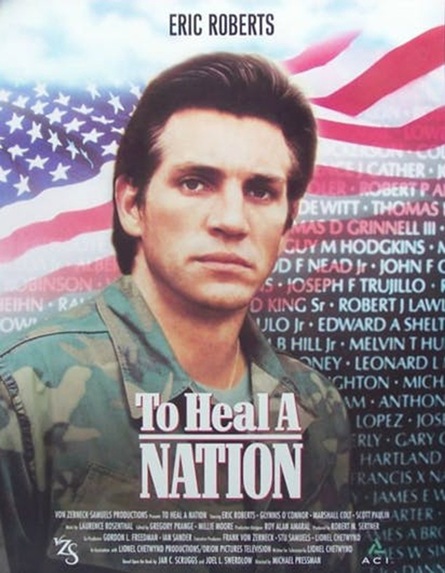
In 1988’s To Heal A Nation, Eric Roberts stars as Jan Scruggs.

When we first meet Scruggs, the year is 1971 and he’s taking his seat on a commercial airliner.  When the blonde woman sitting beside him starts to flirt with him, Scruggs mentions that he’s happy because he’s finished up his tour of duty in Vietnam.  Upon hearing that Scruggs is a Vietnam vet, the woman immediately requests to be moved to a different seat.

Eight years later, things haven’t gotten much better.  Scruggs works for the Department of Labor in Washington D.C.  He’s married to Becky (Glynnis O’Connor) but he’s struggling to deal with the past.  He drinks too much.  He has trouble sleeping.  He doesn’t feel like he can open up about the things that he saw in Vietnam because nobody wants to talk about it.  He was one of the thousands of people who served in Vietnam who now feel as if they’ve been abandoned by their country.  However, after attending a showing of The Deer Hunter, Scruggs has a vision of  a monument that that features the name of every American who was killed in the Vietnam Conflict.

Scruggs devotes the next several years of his life to getting the monument built, appealing to both the government and private citizens for funding.  At first, everyone treats Scruggs and his efforts like a joke.  Even some fellow veterans feel that Scruggs is pushing too hard and that he’s just going to end up embarrassing himself.  But Scruggs refuses to give up and finally, with the support of a senator (Laurence Luckinbill) and a Texas millionaire named H. Ross Perot (Conrad Bachmann), Scruggs is able to make his dream a reality.

Based on the true story of the struggle to build the Vietnam Veterans Memorial in Washington, D.C., To Heal A Nation features a young Eric Roberts giving a nervy but likable performance as Jan Scruggs, a man who becomes so obsessed with building a monument to those who lost their lives in Vietnam that he occasionally seems like he’s close to going over the edge himself.  It’s a good film for Memorial Day and one that still feels relevant today.  The way that Scruggs was treated after returning from Vietnam is the way a lot of our veterans were treated and continue to be treated after returning from Iraq and Afghanistan.  We love our soldiers when they fight in popular wars that result in a definite victory.  When they serve in an unpopular war, they’re often deserted by people who don’t want to be reminded of recent history.  One can certainly see that in the attempts by the national media to gloss over what happened during our final days in Afghanistan.  This film is a reminder that no one should be forgotten.

Previous Eric Roberts Films That We Have Reviewed:

  1. Star 80 (1983)
  2. Runaway Train (1985)
  3. Best of the Best (1989)
  4. Blood Red (1989)
  5. The Ambulance (1990)
  6. The Lost Capone (1990)
  7. Best of the Best II (1993)
  8. Love, Cheat, & Steal (1993)
  9. Voyage (1993)
  10. Love Is A Gun (1994)
  11. Sensation (1994)
  12. Dark Angel (1996)
  13. Doctor Who (1996)
  14. Most Wanted (1997)
  15. Mercy Streets (2000)
  16. Raptor (2001)
  17. Rough Air: Danger on Flight 534 (2001)
  18. Strange Frequency (2001)
  19. Wolves of Wall Street (2002)
  20. Border Blues (2004)
  21. Mr. Brightside (2004)
  22. Six: The Mark Unleased (2004)
  23. We Belong Together (2005)
  24. Hey You (2006)
  25. Depth Charge (2008)
  26. Amazing Racer (2009)
  27. The Chaos Experiment (2009)
  28. In The Blink of an Eye (2009)
  29. Bed & Breakfast (2010)
  30. Enemies Among Us (2010)
  31. The Expendables (2010) 
  32. Sharktopus (2010)
  33. Beyond The Trophy (2012)
  34. The Dead Want Women (2012)
  35. Deadline (2012)
  36. The Mark (2012)
  37. Miss Atomic Bomb (2012)
  38. Assault on Wall Street (2013)
  39. Bonnie And Clyde: Justified (2013)
  40. Lovelace (2013)
  41. The Mark: Redemption (2013)
  42. The Perfect Summer (2013)
  43. Self-Storage (2013)
  44. Sink Hole (2013)
  45. A Talking Cat!?! (2013)
  46. This Is Our Time (2013)
  47. Bigfoot vs DB Cooper (2014)
  48. Doc Holliday’s Revenge (2014)
  49. Inherent Vice (2014)
  50. Road to the Open (2014)
  51. Rumors of War (2014)
  52. Amityville Death House (2015)
  53. Deadly Sanctuary (2015)
  54. A Fatal Obsession (2015)
  55. Las Vegas Story (2015)
  56. Stalked By My Doctor (2015)
  57. Enemy Within (2016)
  58. Hunting Season (2016)
  59. Joker’s Poltergeist (2016)
  60. Prayer Never Fails (2016)
  61. Stalked By My Doctor: The Return (2016)
  62. The Wrong Roommate (2016)
  63. Dark Image (2017)
  64. The Demonic Dead (2017)
  65. Black Wake (2018)
  66. Frank and Ava (2018)
  67. Stalked By My Doctor: Patient’s Revenge (2018)
  68. Clinton Island (2019)
  69. Monster Island (2019)
  70. The Reliant (2019)
  71. The Savant (2019)
  72. Seven Deadly Sins (2019)
  73. Stalked By My Doctor: A Sleepwalker’s Nightmare (2019)
  74. The Wrong Mommy (2019)
  75. Exodus of a Prodigal Son (2020)
  76. Free Lunch Express (2020)
  77. Her Deadly Groom (2020)
  78. Top Gunner (2020)
  79. Deadly Nightshade (2021)
  80. The Elevator (2021)
  81. Just What The Doctor Ordered (2021)
  82. Killer Advice (2021)
  83. Megaboa (2021)
  84. Night Night (2021)
  85. The Poltergeist Diaries (2021)
  86. The Rebels of PT-218 (2021)
  87. Red Prophecies (2021)
  88. A Town Called Parable (2021)
  89. Bleach (2022)
  90. Dawn (2022)
  91. My Dinner With Eric (2022)
  92. 69 Parts (2022)
  93. The Rideshare Killer (2022)
  94. D.C. Down (2023)
  95. Aftermath (2024)
  96. Bad Substitute (2024)
  97. Devil’s Knight (2024)
  98. The Wrong Life Coach (2024)
  99. When It Rains In L.A. (2025

Retro Television Review: Broken Angel (dir by Richard T. Heffron)


Welcome to Retro Television Reviews, a feature where we review some of our favorite and least favorite shows of the past!  On Sundays, I will be reviewing the made-for-television movies that used to be a primetime mainstay.  Today’s film is 1988’s Broken Angel!  It  can be viewed on YouTube.

Chuck Coburn (William Shatner) has a nice house in the suburbs, a nice job, a nice car, and a nice Bruins jacket.  He’s hoping that he can once against have a nice marriage with his wife (Susan Blakely), despite the fact that she cheated on him and she still thinks that he spends too much time at work.

Chuck is proud of his teenage daughter, Jaime (Erika Eleniak).  Jaime seems like the perfect suburban and angelic teenager.  But then Jaime goes to prom and her best friend, Jenny (Amy Lynne), is gunned down in front of her.  Jaime runs from the scene and vanishes.  As Chuck searches for his daughter, he is stunned discover that Jaime, Jenny, and their boyfriends were all a part of a gang!  His perfect daughter was smoking weed, doing cocaine, selling crack, and taking part in rumbles with a rival Asian gang.  Even worse, Jaime’s gang was called …. LFN!

LFN?  That stands for Live For Now.  The Live For Now Gang.  Whenever we see the members of the gang preparing to get into a fight with another gang, they all chant, “LFN!  LFN!”  LFN is a gang of white suburban teenagers and they look just as dorky as they sound.  I mean, I think it would be bad enough to discover that your child is in a gang but discovering they were in a dorky gang would probably make it even worse.

The majority of Broken Angel is made up of scenes of Chuck searching the mean streets of Los Angeles.  He partners with a social worker (Roxann Dawson) who is herself a former gang member.  Chuck discovers that his daughter’s street name was — *snicker* — Shadow.  He also befriend a member of the LFN’s rival Asian gang and tries to encourage her to go straight.  This leads to scene in which he is attacked by Al Leong.  Somehow, middle-aged William Shatner manages to beat up Al Leong.  That, in itself, is worth the cost of admission.

Broken Angel deals with a serious issue but it does so in such an overwrought and melodramatic fashion that most viewers will be moved not to tears but to laughter.  In Broken Angel, William Shatner gave the type of overly dramatic and self-serious performance that he routinely pokes fun at today.  If you’re one of those people who enjoys listening as Shatner emphasize random syllables and takes meaningly pauses, this movie will give you a lot to enjoy.  In every scene, Shatner seems to be saying, “Notice me, Emmy voters!  Notice me!”  Of course, it wouldn’t be until Shatner learned how to laugh at himself that the Emmy voters would finally notice him.

The film ends on an abrupt note but with the promise of better days ahead.  Just remember — keep an eye out for the LFN!

Framed (1975, directed by Phil Karlson)


Revenge can be brutal, especially when you’ve been framed.

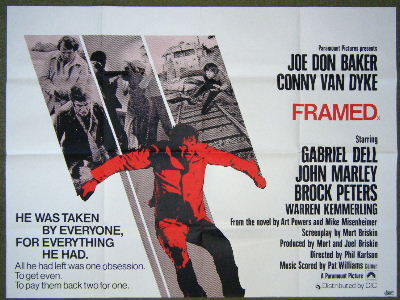
Joe Don Baker plays Ron Lewis, a surly nightclub owner and gambler who wins a small fortune, witnesses a crime, and nearly gets shot all in the same night.  When he reaches his house, he’s planning on calling the police but he’s confronted in his own garage by a sheriff’s deputy who tries to kill him!  In a lengthy and brutal scene, Ron beats the deputy to death and gouges out his eyes.  Even though Ron was only acting in self-defense, he’s charged with murder.  Told that there is no way that he’ll be able to win an acquittal, Ron pleads guilty to a lesser charge and is sent to prison for four years.

While he’s in prison, Ron befriends a mob boss (John Marley, who famously woke up with a horse’s head in his bed in The Godfather) and the boss’s number one hitman, Vince (Gabriel Dell).  While Ron is in prison, a group of men assault his girlfriend (country singer Conny Van Dyke) and tell her not to ask any questions about the events that led to Ron being framed.

After serving his sentence and getting into numerous fights with the guards, Ron is finally released.  When Vince shows up and tells Ron that he’s been hired to kill him, the two of them team up with an honest deputy (Brock Peters) and set out to find out why Ron was set up and to get revenge.

Framed is a brutal movie, Ron and his friends hold nothing back in their quest to get revenge.  Whether he’s shooting a man in cold blood or hooking someone up to a car battery in order to get information out of him, there’s little that Ron won’t do and the movie lingers over every act of violence.  Several pounds overweight and snarling out of his lines, Joe Don Baker may not be a conventional action hero but he’s believable in his rage.  He’s the ultimate country boy who has been pushed too far and now he doesn’t care how much blood he has to get on his hands.  However, because Baker does seem more like an ordinary person than a Clint Eastwood or a Charles Bronson-type, he retains the audience’s sympathy even as he splashes blood all over the screen.  As violent as his action may be, they always feel justified.

Baker’s performance and the believable violence are the film’s biggest strengths.  It’s biggest weakness is a plot that revolves around an elaborate conspiracy that doesn’t always make sense and some notably weak supporting performances.  Ron’s revenge may be brutal but it takes a while to get there and the first hour gets bogged down with Ron’s struggle to adjust to life in prison.  John Marley does a good job as Ron’s prison mentor but then he abruptly disappears from the movie.

Before making Framed, Baker and director Phil Karlson previously collaborated on Walking Tall.  Framed is far more violent than that film was but its plot doesn’t hold together as well.  However, if you’re just looking for a violent action film that features Joe Don Baker doing what he does best, Framed delivers.

A Movie A Day #33: Two-Minute Warning (1976, directed by Larry Peerce)


mpw-8771

For the longest time, I thought that Two-Minute Warning was a movie about a gang of art thieves who attempt to pull off a heist by hiring a sniper to shoot at empty seats at the Super Bowl.  As planned by a master criminal known as The Professor (Rossano Brazzi), the sniper will cause a riot and the police will be too busy trying to restore order to notice the robbery being committed at an art gallery that happens to be right next to the stadium.

I believed that because that was the version of Two-Minute Warning that would sometimes show up on television.  Whenever I saw the movie, I always through it was a strange plan, one that had too many obvious flaws for any halfway competent criminal mastermind to ignore them.  What if the sniper was captured before he got a chance to start shooting?  What if a riot didn’t break out?  The sniper spent the movie aiming at empty seats but, considering how many people were in the stadium, it was likely that he would accidentally shoot someone.  Were the paintings really worth the risk of a murder charge?

Even stranger was that Two-Minute Warning was not only a heist film but it was also a 1970s disaster film.  Spread out throughout the stadium were familiar character actors like Jack Klugman, John Cassevetes, David Janssen, Martin Balsam, Gena Rowlands, Walter Pidgeon, and Beau Bridges.  It seemed strange that, once the shots were fired and Brazzi’s men broke into the gallery, all of those familiar faces vanished.  When it comes to disaster movies, it is an ironclad rule that at least one B-list celebrity has to die.  It seemed strange that Two-Minute Warning, with all those characters, would feature a sniper shooting at only empty seats.  For that matter, why would there be empty seats at the Super Bowl?

That wasn’t the strangest thing about Two-Minute Warning, though.  The strangest thing was that Charlton Heston was in the film, playing a police captain.  In most of his scenes, he had dark hair.  But, in the scenes in which he talked about the art gallery, Heston’s hair was suddenly light brown.

Recently, I watched Two-Minute Warning on DVD and I was shocked to discover that the movie on the DVD had very little in common with the movie that I had seen on TV.  For instance, the television version started with the crooks discussing their plan to rob the gallery.  The DVD version opened with the sniper shooting at a couple in the park.  In the DVD version, there was no art heist.   The sniper had no motive and no personality.  He was just a random nut who opened fire on the Super Bowl.  And,  in the DVD version, he did not shoot at empty seats.  Several of the characters who survived in the version that I saw on TV did not survive in the version that I saw on DVD.

What happened?

The theatrical version of Two-Minute Warning was exactly what I saw on the DVD.  A nameless sniper opens fire and kills several people at the Super Bowl.  In 1978, when NBC purchased the television broadcast rights for Two-Minute Warning, they worried that it was too violent and too disturbing.  There was concern that, if the film was broadcast as it originally was, people would actually think there was a risk of some nut with a gun opening fire at a crowded event.  (In 1978, that was apparently considered to be implausible.)  So, 40 minutes of new footage was shot.  Charlton Heston even returned to film three new scenes, which explains his changing hair color.  The new version of Two-Minute Warning not only gave the sniper a motive (albeit one that did not make much sense) but it also took out all of the violent death scenes.

Having seen both versions of Two-Minute Warning, neither one is very good, though the theatrical version is at least more suspenseful than the television version.  (It turns out that it was better to give the sniper no motive than to saddle him with a completely implausible one.)  But, even in the theatrical version, the potential victims are too one-dimensional to really care about.  Ultimately, the most interesting thing about Two-Minute Warning is that, at one time, an art heist was considered more plausible than a mass shooting.

tmw

Shattered Politics #19: To Kill A Mockingbird (dir by Robert Mulligan)


To_Kill_a_Mockingbird_poster

So, I guess I should explain why I’m including the classic 1962 film (and best picture nominee), To Kill A Mockingbird, in this series of reviews of films about politicians.  After all, while To Kill A Mockingbird dealt with the issue of racism in Alabama in a surprisingly honest manner, it doesn’t feature any elected officials.  Nobody shows up playing Gov. Benjamin J. Miller or President Franklin Roosevelt.  Instead, this film is about a wise lawyer named Atticus (Gregory Peck), an innocent man named Tom (Brock Peters), a girl named Scout (Mary Badham) and her older brother Jem (Philip Alford), and a mysterious recluse named Boo (Robert Duvall).

However, if you’ve read Harper Lee’s wonderful novel, then you know that Atticus is not just the smartest man in Maycomb, Alabama.  He’s also a member of the Alabama state legislature and his political career is a fairly important subplot in the book, with him occasionally having to leave home so he can go down to Montgomery and help to write the budget.  (Incidentally, Harper Lee’s father actually was a member of the Alabama House of Representatives.)

In the film, no mention of Atticus being a member of the state legislature is made but I still choose to believe that he was.  Because, as played by Gregory Peck, Atticus Finch is exactly the type of man who you would want to think of as serving in government.  He’s wise, compassionate, and firm.  For much of To Kill A Mockingbird, he is literally the only sane adult in Maycomb.  He’s the only attorney willing to defend Tom Robinson when Tom is accused of raping a white girl.  When a mob shows up to lynch Tom, Atticus is the only adult willing to stand up to them.  (Fortunately, Jem also runs up and shames the mob by reminding them that she goes to school with their children.)  And, in court, it is Atticus who proves that Tom is innocent.

When Tom is still convicted, what makes it all the more devastating is that wise and compassionate Atticus doesn’t seem to be surprised as all.  If even Atticus feels that there is no hope for a black man to get a fair trial from an all-white jury, the film seems to be saying, then there truly is no hope.

Of course, the film is not just about Atticus.  It’s about Scout and Jem and their friend Dill (John Megna) and how the three of them grow up and learn the truth about their world.  Watching them from behind the closed doors of his house is the mysterious and reclusive Boo Radley.  When Boo shows up towards the end of the film, I always find tears in my mismatched eyes.  Boo is played, in his film debut, by Robert Duvall.  Duvall doesn’t say a word but he still makes an incredible impression as the shy and withdrawn Boo.

So, I may be cheating a lot by including To Kill A Mockingbird in this series of reviews.  Oh well.  Who am I to turn down a chance to rewatch it?  To Kill A Mockingbird is just a great film.


Embracing The Melodrama #22: The Incident (dir by Larry Peerce)


The Incident

The 1967 film The Incident could just as easily have been called Train of Fools.  Much like Ship of Fools, it’s an ensemble piece in which a group of people — all of whom represent different aspect of modern society — find themselves trapped in their chosen mode of transportation and forced to deal with intrusions from the outside world.

That intrusion comes in the form of two sociopaths who have decided to spend the entire ride tormenting their fellow passengers.  The more dominant of the two is Joe (played by Tony Musante, who would later star in Dario Argento’s Bird With The Crystal Plumage), who the film hints might also be a pedophile.  His partner is Artie (Martin Sheen), who is less intelligent than Joe but just as viscous.  (And yes,even though he does a good job in the role,  it is odd to see an intelligent and reportedly very nice actor like Martin Sheen playing a character who is both so evil and so stupid.)

Among the passengers:

Bill (Ed McMahon) and Helen (Diana Van Der Vills) are only on the train because Bill refused to pay the extra money to take a taxi back home. Now, they’re stuck on the train with their young daughter who, in one of the film’s more disturbing scenes, Joe starts to show an interest in.

Teenage Alice (Donna Mills) is on a date with the far more sexually experienced Tony (Victor Arnold).  When Joe and Artie start to harass her, her date proves himself to be pretty much useless.

Douglas McCann (Gary Merrill) is a recovering alcoholic who, before Artie and Joe got on the train, was spending most of his time scornfully watching Kenneth (Robert Otis), a gay man who previously attempted to pick Doug up at the train station and who will eventually fall victim to one of Artie’s crueler jokes.

Muriel Purvis (Jan Sterling) resents her meek husband, Harry (Mike Kellin) and see the entire incident as another excuse to cast doubts upon his manhood.

Sam and Bertha Beckerman (played by Jack Gilford and Thelma Ritter) are an elderly Jewish couple who, over the course of a lifetime, have already had to deal with far too many bullies.  Sam’s attempt to stand up to Joe and Artie results in both he and his wife being trapped on the train.

Arnold (Brock Peters) and Joan (Ruby Dee) are the only black people on the train.  Arnold, at first, enjoys watching the white people fight among each other and even turns down a chance to get off the train because he finds it to be so entertaining.  But finally, Joe turns on him as well.

And then there’s the two soldiers, streetwise Phil (Robert Bannard) and his best friend, Felix (Beau Bridges).  Felix speaks with a soft Southern accent and has a broken arm.

And finally, there’s the bum.  When we first see the bum (Henry Proach) he is asleep.  He doesn’t even wake up when Joe and Artie attempt to set him on fire.

One-by-one, Joe and Artie attack and humiliate every single person on the train.  The other passengers, for the most part, remain passive.  Even when some try to stand up to Joe and Artie, their fellow passengers don’t offer to help.  It’s only when one last passenger finally stands up to the two that the rest of them show any reaction at all and even then, it’s not necessarily the reaction that anyone was hoping for.

The Incident, which shows up on TCM occasionally, is a heavy-handed but effective look at what happens when good people choose to do nothing in the face of evil.  Joe and Artie can be viewed as stand-ins for any number of distasteful groups or ideologies and both Tony Musante and Martin Sheen are believable as dangerous (if occasionally moronic) petty criminals.  For that matter, the entire film is well-acted with the entire cast managing to bring life to characters that, in lesser hands, could have come across as being one-dimensional.  The entire film basically takes place in that one subway car but fortunately, the harsh black-and-white cinematography and the continually roaming camera all come together to keep things visually interesting.

The Incident may not be a great film (it’s occasionally bit too stagey and, after watching the first 30 minutes, you’ll be able to guess how the movie is going to end) but it’s still one to keep an eye out for.

Martin Sheen in The Incident