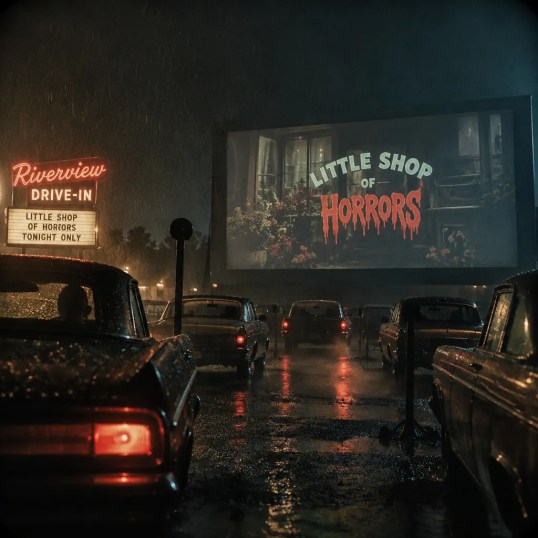
Whenever it’s time to share this film for Horrorthon, I have a little story that I like to tell:
Enter singing.
Little Shop.…Little Shop of Horrors.…Little Shop.…Little Shop of Terrors….
When I was 19 years old, I was in a community theater production of the musical Little Shop of Horrors. Though I think I would have made the perfect Audrey, everybody always snickered whenever I sang so I ended up as a part of “the ensemble.” Being in the ensemble basically meant that I spent a lot of time dancing and showing off lots of cleavage. And you know what? The girl who did play Audrey was screechy, off-key, and annoying and after every show, all the old people in the audience always came back stage and ignored her and went straight over to me. So there.
Anyway, during rehearsals, our director thought it would be so funny if we all watched the original film. Now, I’m sorry to say, much like just about everyone else in the cast, this was my first exposure to the original and I even had to be told that the masochistic dentist patient was being played by Jack Nicholson. However, I’m also very proud to say that — out of that entire cast — I’m the only one who understood that the zero-budget film I was watching was actually better than the big spectacle we were attempting to perform on stage. Certainly, I understood the film better than that screechy little thing that was playing Audrey.
The first Little Shop of Horrors certainly isn’t scary and there’s nobody singing about somewhere that’s green (I always tear up when I hear that song, by the way). However, it is a very, very funny film with the just the right amount of a dark streak to make it perfect Halloween viewing.
So, if you have 72 minutes to kill, check out the original and the best Little Shop of Horrors….
Today’s horror scene that I love comes from 1935’s Bride of Frankenstein!
In this scene, directed by James Whale, the Monster (Boris Karloff) meets his first friend, a blind hermit played by O.P. Heggie. It’s a scene that features Karloff at his best and it’s still touching, even if it is kind of hard to watch it without thinking about Peter Boyle accidentally burning down Gene Hackman’s shack in Young Frankenstein.
2021’s The Order of Rights tells the story of two teenagers.
Emma Stein (Emma Elle Roberts) is artistic and creative and we know this because she’s working the lights for the current high school theater production. I have to say that I did a lot of high school theater and I always really disliked having to deal with the members of the backstage crew, They were always worried about something. Whenever I was waiting to make my entrance, I always knew some crew person was going to wander up and start talking to me about the lighting cues. And I would just be like, “Just make sure I look good.” Wow, that was mean of me. I feel kind of bad now.
Anyway, back to the movie….
Ethan (Ben Davies) is a jock. When know he’s a jock because he always wears his baseball cap backwards. For Ethan and Emma it’s love at first sight. Ethan is also a Christian and he feels really guilty after he and Emma give into temptation and have sex. He feels even more guilty after Emma informs him that she’s pregnant.
Ethan talks to his parents (Matthew Welling and Julie Silcott). They tell him that, before he was born, they found themselves in a similar situation. They weren’t married at the time so Ethan’s mother decided to have an abortion. They have always felt that they made a mistake. When they learn that Emma’s mother is pressuring Emma to get an abortion, they hire a lawyer (Richard Cutting) to file a civil case against Emma, claiming that Emma is denying her baby its rights under the 14th amendment.
The case becomes national news. We get a montage of real-life conservative podcasters and talk show hosts discussing the case. The second half of the movie takes place almost exclusively in the court room and if you enjoy scenes of people saying, “Objection!” and a judge replying with “Overruled,” rest assured that this film is full of them. Each side is given a chance to make its case. That said, it’s hard not to notice that Ethan’s lawyer is extremely earnest while Emma’s lawyer is extremely smug.
Much like One Nation Under God, this is a film that was largely made to annoy liberals and, judging from the reviews left on Letterboxd, it certainly managed to do that. It’s really not any more heavy-handed than most mainstream movies about abortion. It’s just, in this case, the film comes at things from the pro-life point of view as opposed to the pro-choice point of view. It’s a film that’s full of awkward scenes and there are quite a few performances that don’t work, especially during the film’s first half. The actors playing Emma’s theater friends offer up some of the worst line readings that I’ve ever heard. That said, Emma Elle Roberts probably gives a better performance than the film deserves and, regardless of what else you may want to say about the movie, it doesn’t turn Emma into a cardboard villain. In the end, one feels very sorry for her as both sides are just using her pregnancy to push their own agenda.
This film was released in 2021. A year later, Roe v Wade was overturned, making The Order of Rights feel very dated indeed.
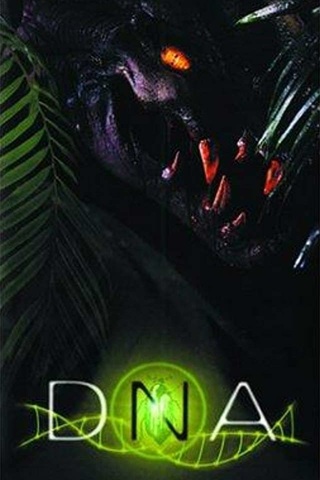
In 1996’s DNA, Mark Dacascos plays Dr. Ash Matteley, an American doctor who works to bring healthcare to the residents of Borneo. When Ash’s former boss, Dr. Carl Wessinger (Jürgen Prochnow), approaches Ash and invites him to take part in a jungle expedition to track down some beetles whose genetic material can cure all known diseases, Ash agrees. However, once Wessinger, Ash, and their native helpers find the beetles in an ancient tomb, it turns out that Wessinger has plans of his own. He shoots Ash in the shoulder and then makes his escape.
Two years later, Ash has long hair and he’s taken to wearing a Hawaiian shirt, but he’s still dedicated to taking care of the poor of Borneo. When CIA agent Claire Sommers (Robin McKee) approaches him and asks him to help lead her through the jungle, Ash says that he’s not interested. But when Sommers reveals that she’s looking for Wessinger, Ash realizes that he has no choice but to help her. For some reason, they take a child named Matzu with them. Why you would recruit a child for a dangerous mission that involves going upriver in a canoe, I’m not sure. Then again, I’m also not sure why Claire would wear a dress while exploring the jungle either, other than the fact that the film needed an excuse to have Ash look away and then sneak a peek while Claire undresses and changes into something more jungle-appropriate.
It probably won’t surprise you to learn that Dr. Wessinger has not been spending his time trying to cure all known diseases. Instead, he’s been splicing genetic material to try to bring an ancient creature back to life. Now, before you say that this sounds like a Jurassic Park rip-off, allow me to point out that Wessinger is not bringing back a dinosaur. Instead, he’s bringing back a big alien creature, one that perhaps crashed on Earth during the prehistoric age. This is not Jurassic Park. At most, it’s Jurassic Alien.
Or maybe it’s just Alien. Once Ash and Claire and the little kid make it inside Dr. Wessinger’s headquarters, there are a lot of scenes of people hiding in offices and nervously walking down hallways and hoping that the monster won’t jump out of nowhere and kill them.
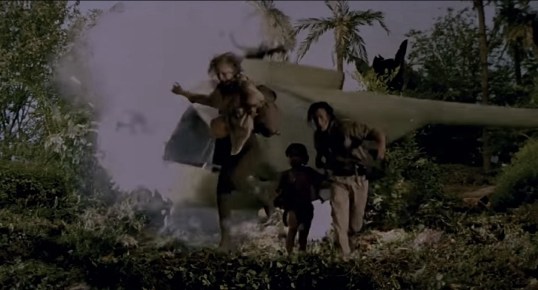
Then again, maybe we should just call this movie Predator because eventually, the action moves back into the jungle and Ash finds himself being stalked by the alien, who is apparently a very good hunter and who lives for the hunt. Ash goes from being a hippie doctor to being a full-blown action hero. There’s even a scene where he and Claire and the kid have to run away from a crashing helicopter. Of course, the helicopter was obviously a model. Still, it was hard not to imagine Mark Dacascos saying, “Get away from da choppah!”
My point is that a lot of different DNA was spliced together to create this movie. Take a little from Indiana Jones and a little from Apocalypse Now and then toss in Alien, Predator, and Jurassic Park and you’ve got DNA. Unfortunately, the film still isn’t as entertaining as it should have been. Mark Dacascos barely gets to show off his martial arts skills while the film can’t even give us one good Jürgen Prochnow freak-out. Even with all of the shameless plagiarism, the film still feels like it’s just going through the motions. Sadly, DNA is never as much fun as it should have been.
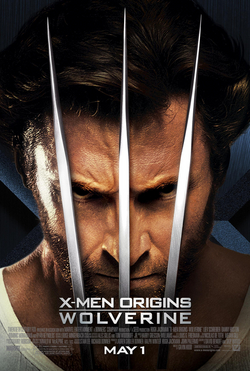
Decades before he joins the X-Men, James “Logan” Howlett (Hugh Jackman) is just another mutant with retractable claws and a super-healing ability that essentially makes him immortal. With his half-brother Victor Creed (Liev Schreiber), Logan fights in wars throughout the centuries. When both Logan and Creed (who share Logan’s healing abilities) survive being executed by a firing squad, they are recruited by William Stryker (Danny Huston) to serve as members of Team X. Eventually, Logan tires of being an assassin and goes off on his own. However, both Stryker and Creed have plans for him and all the other mutants that they’ve captured or killed over the years. Several familiar characters appear—Scott Summers (Tim Pocock), Gambit (Taylor Kitsch), and the Blob (Kevin Durand) amongst others—but none of them have much of the personality that made them popular to comic book readers. (Just imagine including Gambit in an X-Men film but not Rogue.) Those who made it to the end of the film were given a Patrick Stewart cameo, albeit one that used CGI to de-age Stewart and make him look like an automaton.
With the majority of the X-Men either dead or cured at the end ofX-Men: The Last Stand, it only made sense to spin Hugh Jackman’s Wolverine off into his own series of films. Unfortunately, 20th Century Fox didn’t understand that the thing that made Wolverine so interesting as a character was that his past was shrouded in mystery. Their first Wolverine film revealed his origin and it turned out to be not that interesting. X2 had been filled with so many hints about Wolverine’s past that the origin story didn’t feel as if it was telling us anything that we hadn’t already figured out. Even the many fight scenes between Sabretooth and Wolverine felt dull because it was established that both of them were essentially immortal and impervious to pain.
Today, this movie is mostly remembered for featuring the first appearance of Wade Wilson, the mercenary who will eventually become Deadpool. There’s very little of Deadpool to be found in this film’s version of Wilson. He tells a few jokes before getting his lips sewn shut. Imagine introducing a character who is affectionately known as “the merc with a mouth” and then rendering him silent for the majority of the movie. In Deadpool 2, there’s a scene where Deadpool goes back in time and kills this earlier version of Wade Wilson (or Weapon XI as he’s called here). The audience I saw the film with cheered.
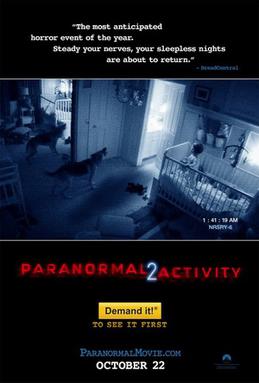
After a burglary, Kristi (Sprague Grayden) and her husband Daniel Rey (Brian Boland) install security cameras throughout their house. The cameras capture footage of Daniel firing the maid (Vivis Colombetti) for burning sage to ward off “evil spirits” and a visit from Kristi’s sister, Katie (Katie Featherston). They also capture doors opening and closing by themselves, a dog barking at nothing, and a possessed Kristi ominously staring at her newborn son, Hunter.
Paranormal Activity 2 begins a few weeks before the start of the first Paranormal Activity. By the end, the two movies have caught up with each other and the audience learns what Katie did after she killed Micah. The film also reveals what specifically led to the spirit going after Katie in the first place. (Daniel, you idiot.)
Considering that the sequel repeats the found-footage format and recreates many of the same scares from the first film, it’s surprising just how well it works. The stakes are a little bigger here, in that it’s established that the evil spirit is after baby Hunter. In the first film, nobody cared about Micah, but in this film we actually do care about Kristi, the baby, and Kristi’s stepdaughter, Ali (Molly Ephraim). We don’t care about Daniel because he’s a jerk. Kristi and Katie appear to have really bad judgment when it comes to picking a mate.
Lisa has already done an excellent job reviewing the third, fourth, and fifth films in this series. So I’ll be jumping forward to the sixth film tomorrow.
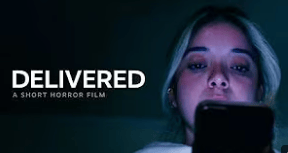
Why am I supposed to care about this woman? Ok, she lives alone and she ordered food. Maybe, the guy delivered the food to the inside of her house. But how? She was at the door and there was no way he could’ve gotten past her and she didn’t have headphones on.
Is he a ghost delivery driver? If so, score! No tip! I’m not tipping a dead guy and neither should you. I think that I’m going to review AI again because people are really disappointing me!
“It’s so easy to create a victim, young lady, so easy.” — Mademoiselle
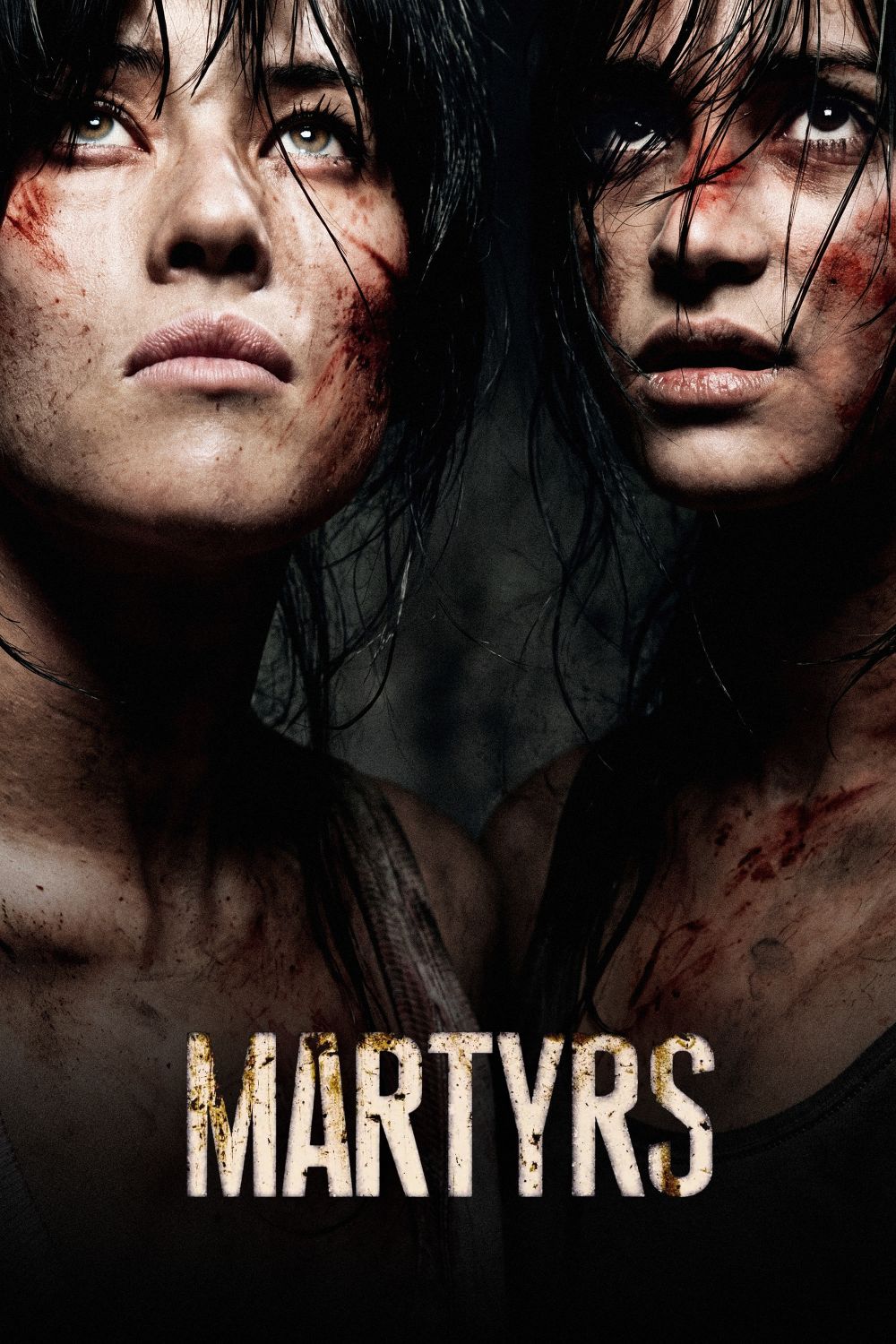
The scariest thing in Martyrs isn’t how much pain people can inflict, but how calmly they can explain why they’re doing it. Pascal Laugier’s 2008 French horror film begins with violence that feels desperate and chaotic, then gradually reveals something colder behind it. Anger gives way to procedure, and cruelty acquires the language of a higher purpose. That progression makes the film more disturbing than its reputation as an endurance test might suggest. The graphic brutality is impossible to ignore, but what lingers is the ease with which human suffering becomes somebody else’s project.
That makes Martyrs a particularly bleak entry in the New French Extremity, even though Laugier resisted the association. Emerging around the turn of the century, this loosely connected wave of filmmaking challenged audiences through confrontational violence, sexuality, and bodily vulnerability. Films like Trouble Every Day, Irréversible, High Tension, and Inside helped establish a cinema in which physical safety could disappear without warning. Martyrs shares that willingness to push past comfortable boundaries, but its most unsettling quality isn’t simply excess. It’s the suggestion that the people crossing those boundaries might regard themselves as thoughtful, disciplined, and entirely justified.
The tradition is still going strong today, although its influence is easier to trace than any fixed membership. Julia Ducournau’s Titane and Coralie Fargeat’s The Substance demonstrate the continuing appetite for French filmmaking that uses bodily destruction and transformation to explore larger anxieties. Neither is doing exactly what Laugier does, and their differences matter. Where those films find room for provocative humor or unexpected tenderness, Martyrs offers very little breathing space. Its approach is brutally direct: before asking what suffering might mean, it makes you confront the person who has to endure it.
The story initially centers on Lucie, who escapes horrific captivity as a child and grows into an adult still trapped by what happened to her. Played by Mylène Jampanoï, she believes she has located the people responsible, now living an apparently ordinary family life. Her friend Anna, played by Morjana Alaoui, becomes involved in the aftermath of Lucie’s attempt to confront them. At first, the setup suggests a revenge thriller, with the possibility that identifying and punishing the guilty might bring some kind of closure. Laugier quickly makes that expectation feel inadequate. The past isn’t something Lucie can simply shoot her way out of.
Jampanoï gives Lucie a frightening volatility without reducing her to a spectacle of instability. Her anger feels inseparable from terror, and every apparent assertion of control seems dangerously temporary. There’s nothing slick or triumphant about her. Even when she acts decisively, she looks like someone fighting an emergency that nobody else can fully see. That performance keeps the early violence from becoming satisfying payback. Lucie’s actions may have a target, but her suffering doesn’t have a clear endpoint. The film understands the difference between stopping an abuser and undoing what the abuse has already done.
Anna provides the emotional connection that keeps all this from becoming an abstract exercise in misery. Alaoui makes her loyalty feel affectionate, frightened, and occasionally overwhelmed rather than conveniently heroic. She wants to help Lucie, even when she can’t fully understand her or accept what she’s done. Their relationship gives the film something worth caring about before its larger machinery reveals itself. Anna’s instinct is to stay with someone in pain, not turn that pain into an explanation. That distinction becomes increasingly important as the film introduces people whose interest in suffering has nothing to do with compassion.
Laugier’s control of the changing narrative is one of the film’s biggest strengths. Each discovery reshapes what came before, moving the story from personal retaliation toward organized cruelty. These shifts could have felt like disconnected attempts to top the previous shock, but they follow a disturbing emotional logic. The further we move from Lucie’s frantic perspective, the more controlled the surrounding world becomes. Unfortunately, control doesn’t mean safety. The ordinary house becomes especially unsettling because its domestic spaces and hidden horrors belong to the same functioning environment. Nothing about comfort or respectability guarantees innocence.
The violence changes along with that perspective. Early attacks are abrupt and messy, shaped by panic, confusion, and immediate danger. Later, brutality becomes repetitive and procedural, stripped of anything resembling excitement. That’s where Martyrs becomes hardest to watch. Laugier doesn’t always offer the relief of a new development or a plausible escape route; sometimes he forces the audience to sit with the awful predictability of what comes next. The horror lies as much in routine as in injury. Someone’s worst imaginable experience can be another person’s ordinary assignment, carried out without any visible emotional investment.
Catherine Bégin’s Mademoiselle embodies that detachment. Her composure is more upsetting than a theatrical display of sadism would have been, because she treats the film’s atrocities as reasonable steps toward an important goal. Still, this is also where Martyrs becomes open to criticism. Its philosophical explanation can feel like an attempt to lend profundity to prolonged images of women being brutalized. Whether that framework deepens the experience or merely rationalizes it is a fair question. For me, the film works best when Mademoiselle’s reasoning exposes her moral emptiness, not when it seems to invite admiration for the supposed grandeur of her inquiry.
The ending leaves that inquiry unresolved, refusing to turn everything we’ve witnessed into a clear answer. Its ambiguity is effective because certainty has become such a destructive obsession throughout the film. Some viewers may find that withholding frustrating, especially after such an exhausting ordeal, but a tidy revelation would risk validating the people who engineered it. Martyrs remains an exceptional horror film precisely because its ideas don’t make its violence comfortable. Beneath the blood and philosophical speculation is a much simpler moral horror: people can become so convinced of the importance of their questions that they stop seeing the humanity of whoever they force to answer them.
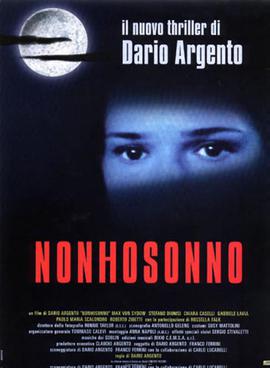
In Italy, a young boy named Giacomo Gallo can only hide under a bed as he witnesses his mother being stabbed to death by an English horn. He doesn’t see the murderer, who is believed to be a serial killer known as The Dwarf Killer due to his short stature. All he can remember for sure is the blood and a strange hissing sound. Detective Ulisse Moretti (Max von Sydow) promises Giacomo that he will capture the Dwarf Killer.
Twenty years later, Moretti is retired. He never caught the Dwarf Killer, whose killing spree ended just as abruptly as it began. However, when a sex worker named Angela (Barbara Lerici) is brutally murdered on a train, there is evidence that indicates the Dwarf Killer has returned. Moretti comes out of retirement, determined to close the one case that he never solved. Unfortunately, it’s going to be difficult because Moretti’s memory is failing. As he puts it at one point, there are times when he can’t even remember his late wife’s face. Moretti has forgotten much about the case, though as he investigates, it all starts to come back to him. Moretti finds himself working with the now grown-up Giacomo (Stefano Dionisi), who hopes to finally capture the man who killed his mother. And while Moretti may be struggling to remember the past and Giacomo still isn’t quite sure what he saw while hiding under the bed, it soon becomes clear that the killer remembers both of them.
After the disappointingly mean-spirited Phantom of the Opera, Sleepless was a return to form for Dario Argento. The film is a giallo and, in typical Argento fashion, the mystery involves not just the physical clues but also how people interpret and edit their own memories. The hiss that Giacomo heard turns out to be not what he originally believed. The killer also turns out to be something even more disturbing than what the police originally assumed. At the heart of the mystery is a rather morbid nursery verse, the sort of thing that can be either innocent or dangerous depending on how one interprets the words. Sleepless is a throwback to the type of films that made Mario Bava famous and also the type of films with which Argento started his directorial career. Max von Sydow’s Moretti is not just a detective. He’s also a symbol of an aging genre, a reminder of the clever mysteries that shed blood with style without ever losing their essential humanity.
Argento has often been criticized for not getting particularly complex performances from his actors. I don’t think that criticism is always fair. One need only see David Hemmings and Daria Nicolodi in Deep Red or Jessica Harper in Suspiria to see what Argento can do with the right cast. In Sleepless, Max von Sydow gives a strong performance as Moretti. In fact, it’s probably one of the best performances to have ever appeared in an Argento film. He plays Moretti as being a kindly man on a mission, someone who has seen the worst that the world has to offer but who hasn’t given up his soul. Von Sydow gives us someone who we truly care about, which makes the film’s set pieces (which are bloody even by Argento standards) all the more effective.
It’s become a bit of a cliché to claim that Argento went into a decline after Tenebrae. While it’s true that Argento’s post-Opera films have been uneven, Sleepless shows what he was still capable of producing.
I had not heard of TOO SCARED TO SCREAM when I came across it the other day on Tubi, but there were a few things that caught my interest. First, it had some cool artwork on the poster, which my fellow TSL contributor Erin has highlighted on the site before during Horror-Thon past. Next, I saw that one of the leads was Ian McShane. He’s been around for a long time, but I didn’t really discover his work until I got wrapped up in his excellent characterization of Al Swearengen in the HBO series DEADWOOD. This was a chance to fill in some of his back catalog. And probably one of the more interesting aspects of the film to me is the fact that it’s directed by the actor Tony Lo Bianco (THE HONEYMOON KILLERS, THE FRENCH CONNECTION, THE SEVEN-UPS). This is the only movie he would direct, so I needed to see it!
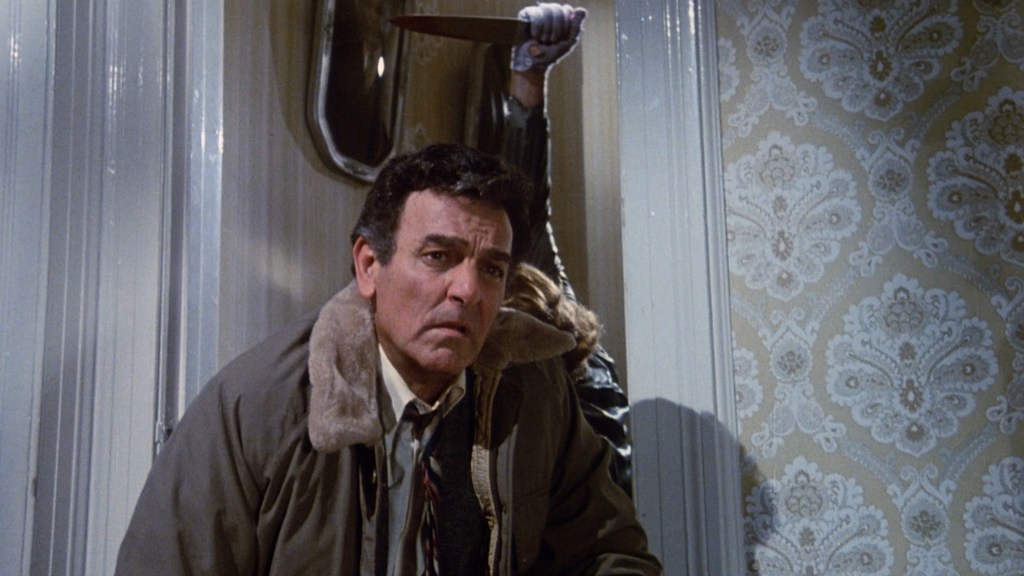
Lieutenant Alex Dinardo (Mike Connors) is investigating a series of knife murders at the upscale Royal Towers high-rise apartment building in New York City. One of the building’s doormen, the odd and theatrical Vincent Hardwick (Ian McShane), quickly becomes a person of interest. Dinardo brings in undercover cop Kate Bridges (Anne Archer) to help with the investigation, going so far as renting a room at the Royal Towers. As the victims continue piling up, the story gives us a variety of strange and suspicious characters, along with enough twists and turns to keep things moving.
I must admit that it’s been a blast discovering so many movies during this year’s Horror-Thon that have slipped past my radar over the years. Of course, sometimes you find a hidden gem, and other times you find a movie that seems to have fallen by the wayside for good reason. TOO SCARED TO SCREAM falls somewhere in between, but I’m glad I watched it. It has some interesting elements for sure, but it’s also a strange, oddball of a film. Its pacing is slow at times, and the opening credits theme song got my attention for all the wrong reasons. However, I did enjoy the combination of police procedural and slasher movie. Charles Bronson may have done it better around the same time in TEN TO MIDNIGHT, but there was still something nice about seeing veteran TV star Mike Connors (MANNIX) on the case. Another thing this had in common with the Bronson slasher is some impressive nudity! There’s a scene in a sauna that any red-blooded American male should enjoy!
And what a cast this movie has! I’ve mentioned before that one of the things I love most about movies is watching actors I enjoy. This is filled with so many familiar faces. Honestly, the show MANNIX was a little before my time, as I was only 2 when it ended its run, but I still enjoyed seeing Connors and being able to appreciate him really for the first time. My guess is that the character he plays here is a lot like Joe Mannix. Ian McShane seems to be having a lot of fun. His character is very strange, but the actor goes all in, and his performance gives the movie some personality. Anne Archer has always had that ability to portray tough and smart, and her character here has that in abundance. To those leads, you can add even more flavor with actors like Leon Isaac Kennedy (LONE WOLF MCQUADE), Maureen O’Sullivan (THE TALL T), Murray Hamilton (JAWS), Val Avery (LOVE AND BULLETS), and even John Heard (HOME ALONE), with each actor taking me back to memories of movies past.
One of the more interesting aspects of watching this film is that it feels very much like watching an 80’s television show until the clothes start coming off or the blood starts flowing. We see the murders, watch the matter-of-fact investigation, meet the suspects, and at the end the killer is revealed. I’m not very good at guessing who the killers are in movies, and I certainly would not have gotten this one. I’ll be honest, I’m not sure the ending would stand up to the scrutiny of a rewatch, but it actually made me smile in its absurdity.
TOO SCARED TO SCREAM isn’t a great movie, and there’s probably a legitimate reason that it’s not very well known or remembered these days. However, with its oddball mix of the 80s slasher film and TV police procedural, I still had a good time with it, especially when you consider the game cast of actors that pop up throughout the film. Part of our joy in movies comes from discovering them at the right time. I may or may not ever watch this one again, but this year, it was a fun part of my October.