Review: Dark City (dir. by Alex Proyas)


“First there was darkness. Then came the strangers.” — Dr. Schreber

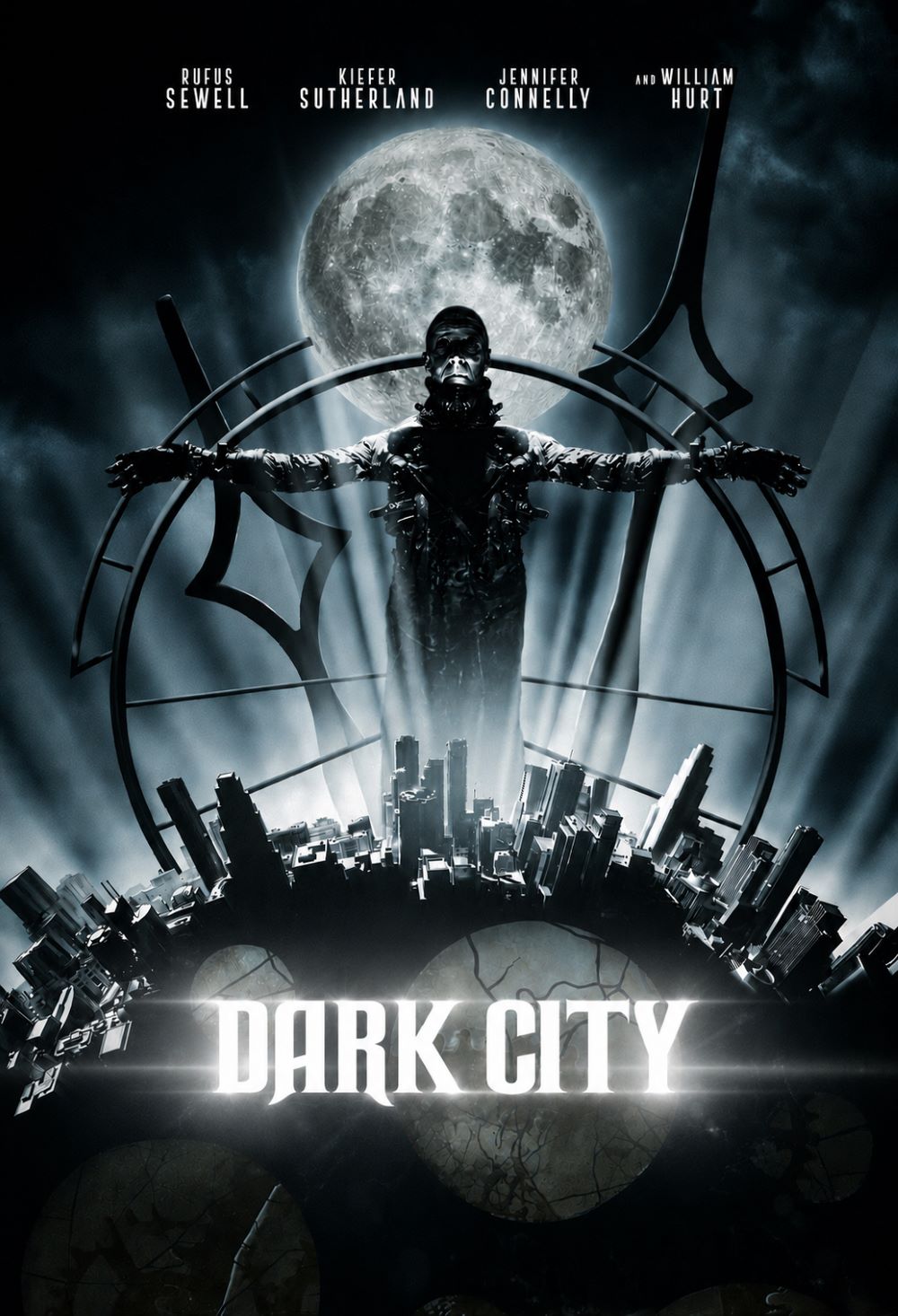
Dark City opens like a half-remembered nightmare, and that’s exactly the kind of vibe the movie sustains from start to finish. Alex Proyas builds a world that feels trapped between a detective story, a fever dream, and a sci-fi conspiracy, and the result is one of the most atmospheric films of the late ’90s.

What makes Dark City so distinctive is the way it treats its setting like an active force rather than a backdrop. The city itself feels oppressive and unstable, all sharp angles, heavy shadows, looming buildings, and damp streets that seem permanently stuck in the middle of the night. That visual approach owes a lot to German expressionism, with its warped architecture and unnatural spaces, and Proyas uses that legacy to make the city feel psychologically trapped and visually wrong in the best way. You can see the noir influence too, especially in the low-key lighting, the sense of fatalism, and the way the whole film feels like a detective story pushed through a nightmare filter.

The sci-fi side of the film is just as memorable because it doesn’t rely on shiny futurism. Instead, it leans into mystery, memory loss, and identity breakdown, which gives it a more unsettling and human quality. That’s part of why the film works so well: the weirdness is not just decorative, it’s built into the story’s central questions. The result is a movie that feels cerebral without becoming cold, and atmospheric without losing narrative momentum. Even when the film is being highly stylized, it still moves with purpose, and that keeps the viewer locked in.

The performances help sell all of that, especially Rufus Sewell as John Murdoch. He has to carry the audience through confusion, paranoia, and growing dread, and he does it with a mix of physical vulnerability and stubborn intensity. William Hurt gives the film a weary, grounded presence, while Kiefer Sutherland turns Dr. Schreber into one of those slippery, unforgettable supporting characters who always seems one step ahead of the audience. Jennifer Connelly brings warmth and melancholy to the film, which matters a lot because her character gives the story a human anchor amid all the conceptual chaos. The cast doesn’t play the material like it’s just an exercise in style; they commit to the oddness while keeping the emotional stakes legible.

What’s especially impressive is how the acting matches the movie’s visual language. A lesser cast could have made this feel overcooked or self-conscious, but here the heightened performances fit the artificial, dreamlike quality of the world. The characters are somewhat archetypal, yet that works because the film is so interested in identity as something constructed, remembered, and manipulated. In that sense, the performances aren’t just good in isolation; they’re part of the movie’s design, helping it feel like a living puzzle instead of a hollow aesthetic showcase.

The film’s influence on later sci-fi thrillers is hard to miss. A lot of movies after Dark City seem to borrow its basic flavor: the paranoid atmosphere, the reality-questioning premise, the noir-scifi crossover, and the feeling that the world itself is a conspiracy. Films like The Matrix, Memento, Minority Report, Equilibrium, and even Sin City all exist in a creative space that Dark City helped sharpen or popularize, whether directly or indirectly. It didn’t always get the mainstream recognition of some of those titles, but in terms of tone and visual influence, it was incredibly important.

Part of that legacy comes from the way Dark City captured a very specific late-’90s anxiety: the fear that memory, identity, and reality could all be manufactured. That idea became a major engine for sci-fi thrillers moving forward, especially films that wanted to combine philosophical unease with stylized action or mystery. Even the movie’s look, with its blend of noir shadows and surreal production design, became a kind of template for how to make sci-fi feel adult, moody, and psychologically unstable. It helped prove that science fiction didn’t need clean lines and sterile futures to feel intelligent; it could be dirty, haunted, and expressionist.

Dark City remains such a strong film because it understands that style and theme should feed each other. The shadows, the tilted buildings, the endless night, and the fractured sense of self all point in the same direction, creating a unified experience that feels deliberately unsteady. That’s why it lingers: not just because it looks incredible, but because it turns visual design into emotional pressure. It’s a smart, strange, and beautifully murky piece of sci-fi noir that helped clear the way for a whole wave of thrillers that wanted to feel just as paranoid and disorienting.

In the end, Dark City is the kind of movie that rewards both first-time viewers and people revisiting it years later. The plot twists are memorable, but the real achievement is the atmosphere, which is so complete it almost becomes the main character. Proyas made a film that feels like it came from the crossroads of German expressionism, classic noir, and modern sci-fi anxiety, and the result is a cult landmark that still casts a long shadow over the genre.
18 Days of Paranoia #9: Blunt, The Fourth Man (dir by John Glenister)


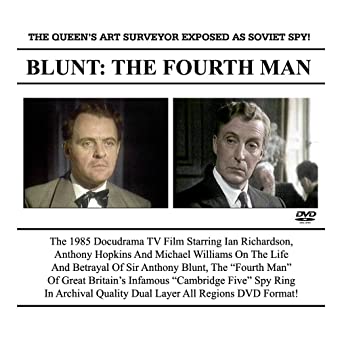
Based on a true story and taking place in 1951, the 1985 film, Blunt: The Fourth Man, tells the story of Anthony Blunt (played by Ian Richardson).

A graduate of Cambridge, Anthony Blunt appears to be a proud member of the British establishment.  He’s upper class with impeccable manners.  He’s the King’s art surveyor, which he says makes him literally a member of the Royal Family.  He belongs to all the right clubs and he expresses all of the right opinions and he has all of the right friends.

However, Anthony Blunt leads a secret life.  First off, he’s gay at a time when that was still illegal in the United Kingdom.  Unlike his flamboyant lover, Guy Burgess (Anthony Hopkins), Blunt is discreet and always keeping an eye out for the vice cops.  Blunt is also a socialist and has been one since his days at Cambridge.  However, he’s not just a socialist.  He’s also spying for the Russians.  It’s not that Anthony thinks much of Russia as much as it’s just that he thinks even less of the U.S. and the U.K.  He feels that the U.S. is pushing the world towards nuclear war.  When his driver says that the UK needs a Joe McCarthy of their own, Blunt can barely hide his distaste.

Even though it was Guy who originally recruited Anthony to spy for the Russians, Anthony now appears to be in charge of the so-called Cambridge Spy Ring.  He’s the one who regularly meets with the group’s Russian contact and he’s also the one who is put in charge of arranging for one of the spies to flee the UK.  The Russians don’t seem to have much faith in Guy Burgess, largely because Guy is an alcoholic and a drug addict.  (Upon returning to London from America, Guy declares that he’s no longer drinks whiskey and that he’s given up Benzedrine.  He then proceeds to get very drunk.)  In fact, the only person who seems to really care about Guy is Anthony but how much does Guy actually care about Anthony?

Almost everyone in Blunt, the Fourth Man is either a spy or a former spy.  And yet, we really don’t see anyone doing much spying.  Guy has a closet that’s full of undeveloped film, official files, and a picture of Lenin and that’s about it.  Throughout the film, Guy brags about how powerful he and his fellow spies are but we’re left to wonder whether Guy’s telling the truth or if he’s just drunk.  For his part, Anthony is more concerned with getting caught and losing his place in society.  He knows that one member of the group is on the verge of getting unmasked and has made arrangements for him to escape to Russia while visiting France.  The problem is that the plan involves Guy and Anthony is not sure if he can trust Guy to play his part.  If Guy’s willing to betray his country, why not his friends and lover?

For the most part, the entire film is Anthony and Guy having cryptic discussion with themselves and with others.  There’s a threatening subtext to almost every conversation in this film.  There’s also a pervasive atmosphere of regret.  Anthony, Guy, and their friends are no longer the idealists that they were back in Cambridge.  They’re now middle-aged men who know that they’ve devoted their lives to a lost cause.  Each deals with it in their own way.  Guy drinks.  Anthony insists that his spying has less to do with betraying a country and more with staying loyal to his friends.  What’s perhaps most interesting is that almost all of these upper class socialists are most worried about losing their place in society.

This is a very talky film.  Fortunately, it stars two great talkers, Ian Richardson and Anthony Hopkins.  The two of them play off each other very well and create two fascinating, if not necessarily likable, characters.  Admittedly, there are a few scenes where Hopkins comes dangerous close to going a bit overboard with Guy’s drunken ramblings but Ian Richardson’s performance is close to perfect.  Somehow, he makes Anthony both smug and vulnerable at the same time.

Obviously, this isn’t a film for everyone.  It requires a bit of patience.  But, for history nerds like me, it’s an interesting historical document, a recreation of one of biggest spy scandals of the previous century.

Other Entries In The 18 Days Of Paranoia:

  1. The Flight That Disappeared
  2. The Humanity Bureau
  3. The Private Files of J. Edgar Hoover
  4. The Falcon and the Snowman
  5. New World Order
  6. Scandal Sheet
  7. Cuban Rebel Girls
  8. The French Connection II


Horror Film Review: From Hell (dir by The Hughes Brothers)


Who was Jack the Ripper?

That’s a question that people have been asking for 129 years.  Arguably the world’s first famous serial killer, Jack the Ripper killed at least five prostitutes in the Whitechapel section of London.  Some claim that he killed as many as twenty.  He may have also written several taunting letters to the police.  Again, some say that the letters are authentic and some say that they were hoaxes.  Hell, there’s even some people who say that Jack the Ripper himself is a myth and the five murders attributed to him were actually five unconnected crimes.  It was speculated that Jack the Ripper was a butcher, a surgeon, or maybe a midwife.  Just as suddenly as the murders began, they ended.  The London police claimed that he had committed suicide by jumping into the Thames.  Few people believed them then and even less now.

The reason that there is so much uncertainty is because Jack the Ripper was never caught.  He was never identified.  There were stories of confessions, though many of them came from the mentally infirm or they were heard by someone who was a friend of someone who claimed to be the Butcher of Whitechapel.  At one point, there was even a claim that Jack’s diary had been found.

As a horror fan, a true crime fanatic, and a lover of history, I’ve read quite a few theories about who Jack the Ripper was.  Nearly every prominent (or, at the very least, remembered) Victorian has been accused of having been Jack the Ripper.  Oscar Wilde has been accused of hiding a confession in The Picture of Dorian Gray.  Various members of the Royal Family have been fingered as the culprit.  Even Lewis Carroll could not escape accusation.  The true crime author Patricia Cornwell wrote an entire book where she (wrongly) accused the painter Walter Sickert.  Cornwell’s case could basically be summed up as follows: “Walter Sicket’s paintings were weird.  Walter Sickert must be Jack the Ripper.”  Apparently, she managed to destroy one of Sickert’s paintings while looking for clues.

The truth of the matter is that Jack the Ripper was probably some guy who no one has ever heard of, most probably one of the unknown men who lived and worked in the shadows of Whitechapel.  For all the talk of Jack being a doctor, it can be argued that the surgical precision of his murders has been overstated.  He didn’t get away with murder because he was particularly clever.  Instead, he got away with it because, in 1888, even fingerprinting was considered to be a radical science.

But, honestly, that’s not very intriguing.  For those of us who have researched the case, it’s far more interesting to speculate that Jack the Ripper was either a famous person or that the murders were all the result of a huge conspiracy.

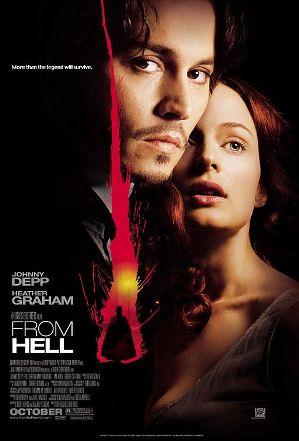
That’s certainly the appeal of From Hell, the 2001 film from The Hughes Brothers.  Making the same basic case as Bob Clark’s Murder By Decree, From Hell argues that the Jack the Ripper murders were the result of a royal conspiracy.  In reality, that theory has been discredited but it certainly is the most cinematic of all the possibilities.

And, speaking of cinematic, it must be said that From Hell is very stylish movie.  Though the title comes from one of Jack the Ripper’s letters, From Hell also could just as easily be used to describe the film’s vision of Whitechapel.  Whitechapel is full of shadows and secrets and the blood flows freely.  If Mary Kelly (Heather Graham) isn’t killed by Jack the Ripper, it’s just as likely she’ll be killed by one of her clients.  Even as the murders are committed, life and business in Whitechapel goes on.  What other choice is there?  It’s either risk being killed or starve.

It falls to Frederick Abberline (Johnny Depp) to solve the murders.  The real-life Abberline was an almost legendary detective who lived for decades after the final Jack the Ripper murder.  The movie’s Abberline is an opium addict who always seems to be on the verge of a breakdown.  When he and Mary Kelly fall in love, you’re not really sure if it’s something to be happy about.  Abberline seems just as likely to go crazy as everyone else.

From Hell is an uneven and somewhat overlong movie but I like it.  Heather Graham and Johnny Depp give somewhat odd performances but the oddness fits right in with the Hughes Brothers’s vision of a world that’s been turned permanently upside down.  It’s a movie that’s full of atmosphere and the story is intriguing even if it’s never exactly convincing.  For obvious reasons, I can’t reveal who plays Jack the Ripper but I will say that he gives a very good performance.  When he says that, “One day, men will look back and say that I gave birth to the 20th century,” you believe him.