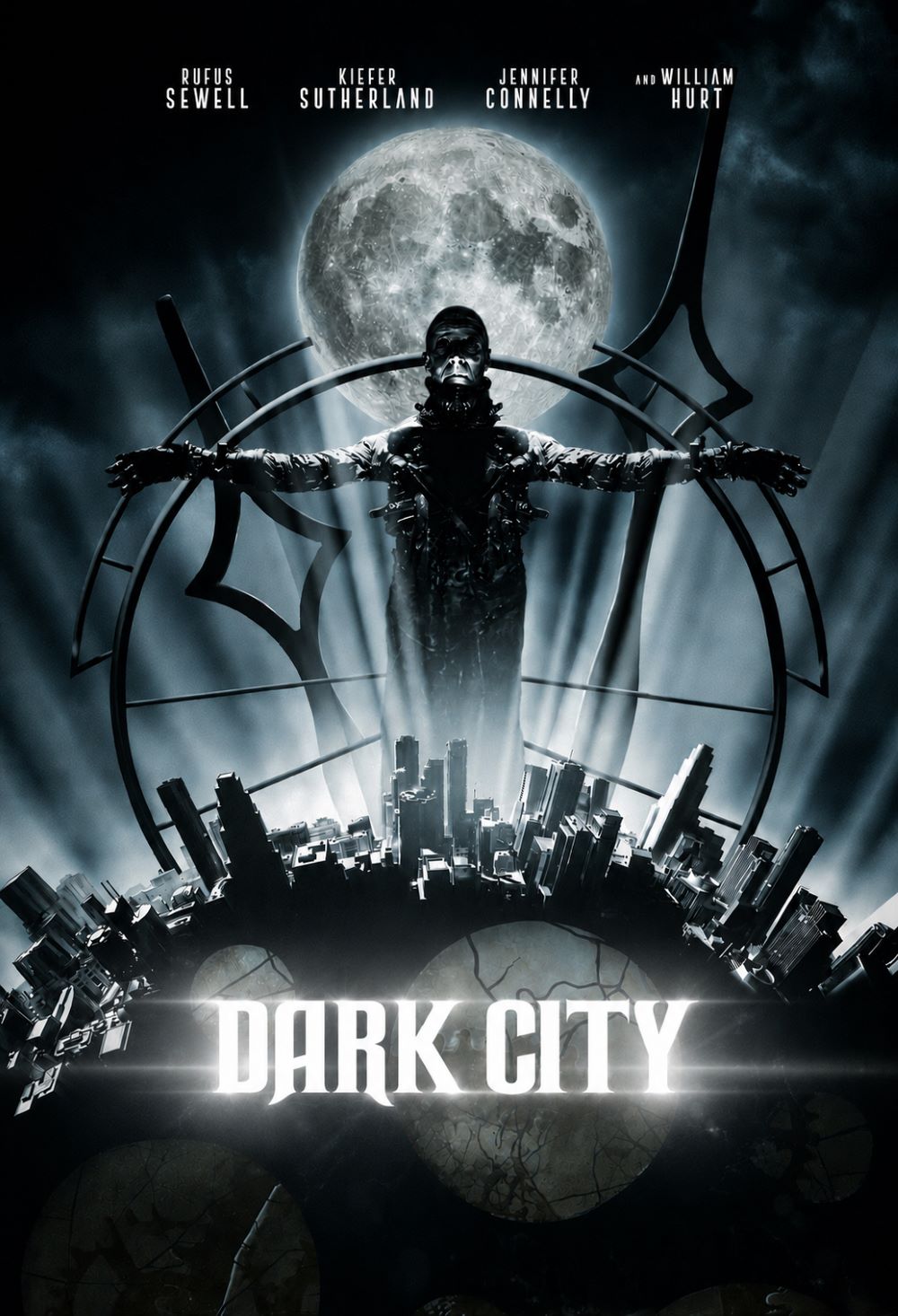
Review: Dark City (dir. by Alex Proyas)


“First there was darkness. Then came the strangers.” — Dr. Schreber

Dark City opens like a half-remembered nightmare, and that’s exactly the kind of vibe the movie sustains from start to finish. Alex Proyas builds a world that feels trapped between a detective story, a fever dream, and a sci-fi conspiracy, and the result is one of the most atmospheric films of the late ’90s.

What makes Dark City so distinctive is the way it treats its setting like an active force rather than a backdrop. The city itself feels oppressive and unstable, all sharp angles, heavy shadows, looming buildings, and damp streets that seem permanently stuck in the middle of the night. That visual approach owes a lot to German expressionism, with its warped architecture and unnatural spaces, and Proyas uses that legacy to make the city feel psychologically trapped and visually wrong in the best way. You can see the noir influence too, especially in the low-key lighting, the sense of fatalism, and the way the whole film feels like a detective story pushed through a nightmare filter.

The sci-fi side of the film is just as memorable because it doesn’t rely on shiny futurism. Instead, it leans into mystery, memory loss, and identity breakdown, which gives it a more unsettling and human quality. That’s part of why the film works so well: the weirdness is not just decorative, it’s built into the story’s central questions. The result is a movie that feels cerebral without becoming cold, and atmospheric without losing narrative momentum. Even when the film is being highly stylized, it still moves with purpose, and that keeps the viewer locked in.

The performances help sell all of that, especially Rufus Sewell as John Murdoch. He has to carry the audience through confusion, paranoia, and growing dread, and he does it with a mix of physical vulnerability and stubborn intensity. William Hurt gives the film a weary, grounded presence, while Kiefer Sutherland turns Dr. Schreber into one of those slippery, unforgettable supporting characters who always seems one step ahead of the audience. Jennifer Connelly brings warmth and melancholy to the film, which matters a lot because her character gives the story a human anchor amid all the conceptual chaos. The cast doesn’t play the material like it’s just an exercise in style; they commit to the oddness while keeping the emotional stakes legible.

What’s especially impressive is how the acting matches the movie’s visual language. A lesser cast could have made this feel overcooked or self-conscious, but here the heightened performances fit the artificial, dreamlike quality of the world. The characters are somewhat archetypal, yet that works because the film is so interested in identity as something constructed, remembered, and manipulated. In that sense, the performances aren’t just good in isolation; they’re part of the movie’s design, helping it feel like a living puzzle instead of a hollow aesthetic showcase.

The film’s influence on later sci-fi thrillers is hard to miss. A lot of movies after Dark City seem to borrow its basic flavor: the paranoid atmosphere, the reality-questioning premise, the noir-scifi crossover, and the feeling that the world itself is a conspiracy. Films like The Matrix, Memento, Minority Report, Equilibrium, and even Sin City all exist in a creative space that Dark City helped sharpen or popularize, whether directly or indirectly. It didn’t always get the mainstream recognition of some of those titles, but in terms of tone and visual influence, it was incredibly important.

Part of that legacy comes from the way Dark City captured a very specific late-’90s anxiety: the fear that memory, identity, and reality could all be manufactured. That idea became a major engine for sci-fi thrillers moving forward, especially films that wanted to combine philosophical unease with stylized action or mystery. Even the movie’s look, with its blend of noir shadows and surreal production design, became a kind of template for how to make sci-fi feel adult, moody, and psychologically unstable. It helped prove that science fiction didn’t need clean lines and sterile futures to feel intelligent; it could be dirty, haunted, and expressionist.

Dark City remains such a strong film because it understands that style and theme should feed each other. The shadows, the tilted buildings, the endless night, and the fractured sense of self all point in the same direction, creating a unified experience that feels deliberately unsteady. That’s why it lingers: not just because it looks incredible, but because it turns visual design into emotional pressure. It’s a smart, strange, and beautifully murky piece of sci-fi noir that helped clear the way for a whole wave of thrillers that wanted to feel just as paranoid and disorienting.

In the end, Dark City is the kind of movie that rewards both first-time viewers and people revisiting it years later. The plot twists are memorable, but the real achievement is the atmosphere, which is so complete it almost becomes the main character. Proyas made a film that feels like it came from the crossroads of German expressionism, classic noir, and modern sci-fi anxiety, and the result is a cult landmark that still casts a long shadow over the genre.

For Your Consideration #4: I, Frankenstein (dir by Stuart Beattie)


I_Frankenstein_Poster

For the tonight’s final entry in For Your Consideration, I’m going to suggest that everyone take the time to consider a film that came out way back in January — I, Frankenstein.

“WHAT!?” someone out there is saying.  “It was bad enough when you tried to convince us that The Purge: Anarchy deserved an Oscar nomination…”

Okay, okay — hold on a minute.  You get upset so easily, it can’t be good for your blood pressure.  Anyway, have you calmed down now?  Good.

Here’s the thing — I said that I was going to suggest some films that I thought were worthy of award consideration.  The Oscars aren’t the only awards around.  There’s also the Razzie Awards.  The Razzies claim that their mission is to honor the worst movies and performers of each year.  To be honest, looking over some of their past nominations, it looks like they’re more interested in picking on easy targets like Lindsay Lohan and … well, I was going to say Adam Sandler but there’s a reason why most of his films are such easy targets.

Now, as far as this year is concerned, I’m sure that the people behind the Razzie awards are already busy coming up with snarky things to say about that Kirk Cameron Christmas movie.  And good for them!  However, I’m simply suggesting that instead of just settling for nominated Kirk Cameron a gazillion times, the Razzies might want to give some consideration to another potentially deserving film that came out this year.

Personally, I really wanted to like I, Frankenstein.  It was produced by the people behind the Underworld films, all of which are definitely guilty pleasures of mine.  And it starred Aaron Eckhart, who is such a good actor even if he rarely seems to get the lead roles that he deserves.  That said, even before I saw the film, I had my doubts about whether an actor with the almost satirically all-American facial features of Aaron Eckhart would be believable as a reanimated corpse and sad to say, he was not.  You could definitely imagine Eckhart playing a legendary big game hunter who has decided that he’s going to add Frankenstein’s monster to his wall of trophies.  But as the monster — well, not so much.

In I, Frankenstein, Frankenstein’s Monster survives through the centuries and eventually ends up fighting a bunch of demons for some reason.  Or something like that.  I have to admit that I was never quite sure what was going on in I, Frankenstein.  Some of that was because I was bored with the movie and a lot of it was because the movie felt less like an actual film and more like a collection of highlights.  This is one of those films where off-screen narration was necessary to describe a huge chunk of the movie’s plot.

And, finally, I just couldn’t buy Aaron Eckhart as a monster.  He’s too handsome in his own clean-cut, middle American way.  There’s a reason why Aaron Eckhart was convincing as the symbol of good government decency in The Dark Knight and that’s the same reason why he’s not very convincing playing a creature who has been built out of random body parts.

So, to the people behind the Razzies, I would encourage them to continue to try to come up with the perfect Kirk Cameron joke.  But don’t forget about I, Frankenstein.

It’s worthy of your consideration.

And speaking of consideration, For Your Consideration will continue tomorrow with 6 more films that are worthy of your awards consideration!

Trailer: Don’t Be Afraid of the Dark


I love films, all films, in general but if there’s one particular film genre that really floats my boat then it would be in the horror category. This summer will see the release of a title that I’ve been anticipating since I heard about it at last year’s San Diego Comic-Con. The film I speak of is the remake of the 1973 tv horror film of the same name: Don’t Be Afraid of the Dark.

While Troy Nixey takes the director’s chair for this film he’s working on a story written by Guillermo Del Toro who’s been known to dabble in the horror genre (Cronos, The Devil’s Backbone). Del Toro promised a horror film that would bring back horror the way it’s meant to be and that’s with genuine scares and not horror predicated on torture and extreme use of gore. Don’t Be Afraid of the Dark will be a throwback to the atmospheric, almost gothic horror, that reached it’s peak during the late 70’s before the slasher boom hit.

The film has been delayed several times as Miramax Films was sold by Disney and the restructuring of the studio after it’s owners finalized it’s purchase put the film on the backburner. It now has an official August 26, 2011 release and it looks like the film got an R-rating from the MPAA for “pervasive scariness”. While Del Toro, Nixey and the rest of the film crew were hoping for a PG-13 rating the one given by the MPAA who seemed to really enjoy said “pervasive scariness” recommended it go out as an R-rated horror (one with little to no gore).

So, we have an upcoming horror film by an upcoming filmmaker handpicked by Del Toro. A film written by Del Toro himself and one which just got an R-rating which made Del Toro as happy as a clam. Plus, it’s a horror film that relies on genuine scares and not gore. My answer to that is August 26, 2011 cannot come sooner.