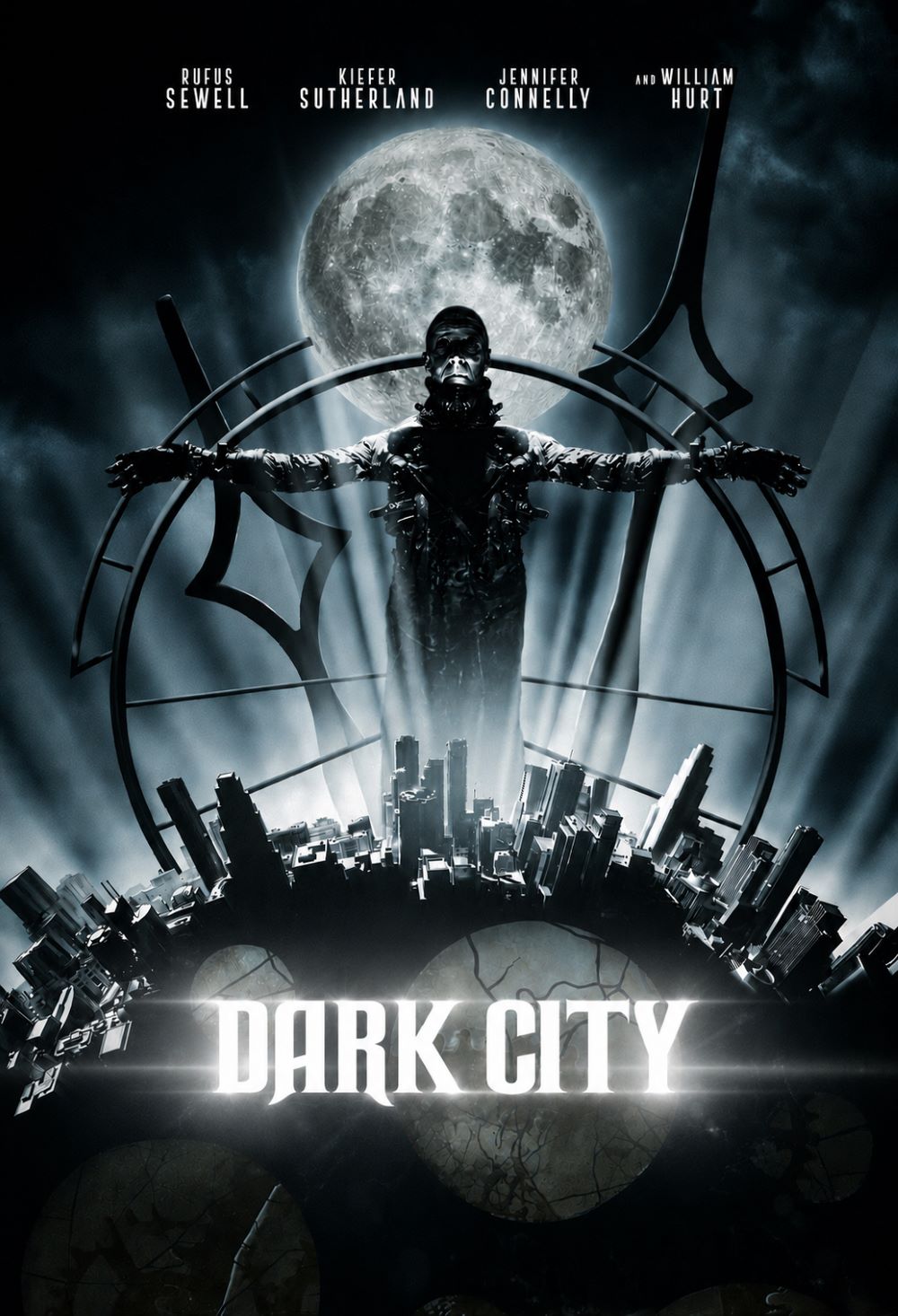
Review: Dark City (dir. by Alex Proyas)


“First there was darkness. Then came the strangers.” — Dr. Schreber

Dark City opens like a half-remembered nightmare, and that’s exactly the kind of vibe the movie sustains from start to finish. Alex Proyas builds a world that feels trapped between a detective story, a fever dream, and a sci-fi conspiracy, and the result is one of the most atmospheric films of the late ’90s.

What makes Dark City so distinctive is the way it treats its setting like an active force rather than a backdrop. The city itself feels oppressive and unstable, all sharp angles, heavy shadows, looming buildings, and damp streets that seem permanently stuck in the middle of the night. That visual approach owes a lot to German expressionism, with its warped architecture and unnatural spaces, and Proyas uses that legacy to make the city feel psychologically trapped and visually wrong in the best way. You can see the noir influence too, especially in the low-key lighting, the sense of fatalism, and the way the whole film feels like a detective story pushed through a nightmare filter.

The sci-fi side of the film is just as memorable because it doesn’t rely on shiny futurism. Instead, it leans into mystery, memory loss, and identity breakdown, which gives it a more unsettling and human quality. That’s part of why the film works so well: the weirdness is not just decorative, it’s built into the story’s central questions. The result is a movie that feels cerebral without becoming cold, and atmospheric without losing narrative momentum. Even when the film is being highly stylized, it still moves with purpose, and that keeps the viewer locked in.

The performances help sell all of that, especially Rufus Sewell as John Murdoch. He has to carry the audience through confusion, paranoia, and growing dread, and he does it with a mix of physical vulnerability and stubborn intensity. William Hurt gives the film a weary, grounded presence, while Kiefer Sutherland turns Dr. Schreber into one of those slippery, unforgettable supporting characters who always seems one step ahead of the audience. Jennifer Connelly brings warmth and melancholy to the film, which matters a lot because her character gives the story a human anchor amid all the conceptual chaos. The cast doesn’t play the material like it’s just an exercise in style; they commit to the oddness while keeping the emotional stakes legible.

What’s especially impressive is how the acting matches the movie’s visual language. A lesser cast could have made this feel overcooked or self-conscious, but here the heightened performances fit the artificial, dreamlike quality of the world. The characters are somewhat archetypal, yet that works because the film is so interested in identity as something constructed, remembered, and manipulated. In that sense, the performances aren’t just good in isolation; they’re part of the movie’s design, helping it feel like a living puzzle instead of a hollow aesthetic showcase.

The film’s influence on later sci-fi thrillers is hard to miss. A lot of movies after Dark City seem to borrow its basic flavor: the paranoid atmosphere, the reality-questioning premise, the noir-scifi crossover, and the feeling that the world itself is a conspiracy. Films like The Matrix, Memento, Minority Report, Equilibrium, and even Sin City all exist in a creative space that Dark City helped sharpen or popularize, whether directly or indirectly. It didn’t always get the mainstream recognition of some of those titles, but in terms of tone and visual influence, it was incredibly important.

Part of that legacy comes from the way Dark City captured a very specific late-’90s anxiety: the fear that memory, identity, and reality could all be manufactured. That idea became a major engine for sci-fi thrillers moving forward, especially films that wanted to combine philosophical unease with stylized action or mystery. Even the movie’s look, with its blend of noir shadows and surreal production design, became a kind of template for how to make sci-fi feel adult, moody, and psychologically unstable. It helped prove that science fiction didn’t need clean lines and sterile futures to feel intelligent; it could be dirty, haunted, and expressionist.

Dark City remains such a strong film because it understands that style and theme should feed each other. The shadows, the tilted buildings, the endless night, and the fractured sense of self all point in the same direction, creating a unified experience that feels deliberately unsteady. That’s why it lingers: not just because it looks incredible, but because it turns visual design into emotional pressure. It’s a smart, strange, and beautifully murky piece of sci-fi noir that helped clear the way for a whole wave of thrillers that wanted to feel just as paranoid and disorienting.

In the end, Dark City is the kind of movie that rewards both first-time viewers and people revisiting it years later. The plot twists are memorable, but the real achievement is the atmosphere, which is so complete it almost becomes the main character. Proyas made a film that feels like it came from the crossroads of German expressionism, classic noir, and modern sci-fi anxiety, and the result is a cult landmark that still casts a long shadow over the genre.
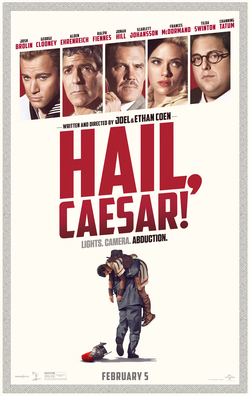
Guilty Pleasure No. 31: Hail, Caesar! (dir by the Coen Brothers)


Sometimes, I wonder if I was the only filmgoer who actually enjoyed Hail, Caesar! when it was released in February.

Oh, don’t met wrong.  I know that I’m being a bit overdramatic when I say that.  It got some good reviews from the critics, though the praise was rather muted when compared to the reviews that traditionally greet the latest film from the Coen Brothers.  I know more than a few people who have agreed with me that Hail, Caesar! was an entertaining lark of a film.

But I know a lot more people who absolutely hated Hail, Caesar!  Of course, no film is going to please everyone and the Coen Brothers have always had a tendency to attempt to deliberately alienate their audience.  But what has always struck me is the fact that the people who disliked Hail, Caesar seem to really, really dislike it.  Talk to them and you get the feeling that they view Hail, Caesar as almost being some sort of a crime against both humanity and cinema.

Taking place in a stylized Hollywood in 1951, Hail, Caesar! tells the story of Eddie Mannix (Josh Brolin).  Eddie is a shadowy figure.  As head of production at Capitol Pictures, Eddie’s job is to keep the “bad” behavior of the stars from getting out into the press.  (The press is represented by Tilda Swinton who, in a typical Coen Brothers twist, plays twin sisters who are rival gossip columnists.  If the thought of that makes you smile, you are potentially a part of the right audience for Hail Caesar.  If it makes you roll your eyes, you should probably avoid the film.)  Eddie is the most powerful man in Hollywood and he will do anything to protect the image of the American film industry.  He will lie.  He will cheat.  He will threaten.  He is so ruthless and so good at his job that even Lockheed Martin is trying to hire him away from Capitol.  And yet, at the same time, Eddie is also a family man and a Catholic who is so devout that he goes to confession on a nearly hourly basis.

(For all you non-Catholics out there, Pope Francis only goes to confession twice a month.)

Hail, Caesar! follows Eddie as he deals with a series of potential problems.  Temperamental director Laurence Laurentz (Ralph Fiennes) is upset because he’s been forced to cast Hobie Doyle (Alden Ehrenreich, giving the film’s best performance), a good-natured but inarticulate cowboy star, in his sophisticated comedy.  Synchronized swimmer DeeAnna Moran (Scarlett Johansoon) is not only pregnant but unmarried as well!  (It’s the 50s, remember.)

However, the biggest crisis is that Baird Whitlock (George Clooney) has vanished from the set of his latest film. A mysterious group known as The Future has taken credit for kidnapping him.  It’s not really much of a spoiler to reveal that The Future is a cell of communist scriptwriters and they are determined to convert the rather dumb Baird to the struggle.  As opposed to most films about Hollywood in the 50s, the communist screenwriters are portrayed as being a bunch of self-righteous and rather cowardly nags, the majority of whom spend more time debating minutiae than actually trying to the overthrow capitalism.  In many ways, Hail, Caesar is the anti-Trumbo.

As you might guess from the plot description, there’s a lot going on in Hail, Caesar but none of it really adds up too much.  Nor is it supposed to.  We’re encouraged to laugh at these frantic characters, as opposed to sympathize with them.  Eddie Mannix and Hobie Doyle both emerge as heroes because they’re the only characters who remain calm and confident, regardless of what strangeness is happening onscreen.  Eddie may be ruthless, the film tells us, but at least he gets results.  Hobie may not be the smartest or most talented guy in Hollywood, we are told, but at least he doesn’t pretend to be anything other than who he is.

Hail, Caesar! is a bit of a lark, a celebration of style over substance.  As far as Coen Brother films go, Hail, Caesar has more in common with Burn After Reading than No Country For Old Men.  The film is largely an inside joke aimed at people who know the history of Hollywood, which is perhaps why some viewers reacted so negatively.  Inside jokes are fun when you’re in on the joke.  When you’re not in on it, though, they’re just annoying.

As for me, I thoroughly enjoyed Hail, Caesar!  It may not be the Coens at their best but it’s a lot of fun and it appealed me as both a history nerd and a lover of old movies.  The best parts of Hail, Caesar! are the scenes that parody the largely forgotten, big-budget studio productions of the 1950s.  This is the rare film that acknowledges that not every film made before the 1960s was a masterpiece.  The Coens love movies but that doesn’t keep them from getting a little bit snarky.  For example, check out this production number featuring Channing Tatum:

Is Hail, Caesar self-indulgent?

Yes.

Is it largely an inside joke?

Yes.

Did I absolutely adore it?

You better believe I did.

Hail,_Caesar!_Teaser_poster

Previous Guilty Pleasures

  1. Half-Baked
  2. Save The Last Dance
  3. Every Rose Has Its Thorns
  4. The Jeremy Kyle Show
  5. Invasion USA
  6. The Golden Child
  7. Final Destination 2
  8. Paparazzi
  9. The Principal
  10. The Substitute
  11. Terror In The Family
  12. Pandorum
  13. Lambada
  14. Fear
  15. Cocktail
  16. Keep Off The Grass
  17. Girls, Girls, Girls
  18. Class
  19. Tart
  20. King Kong vs. Godzilla
  21. Hawk the Slayer
  22. Battle Beyond the Stars
  23. Meridian
  24. Walk of Shame
  25. From Justin To Kelly
  26. Project Greenlight
  27. Sex Decoy: Love Stings
  28. Swimfan
  29. On the Line
  30. Wolfen