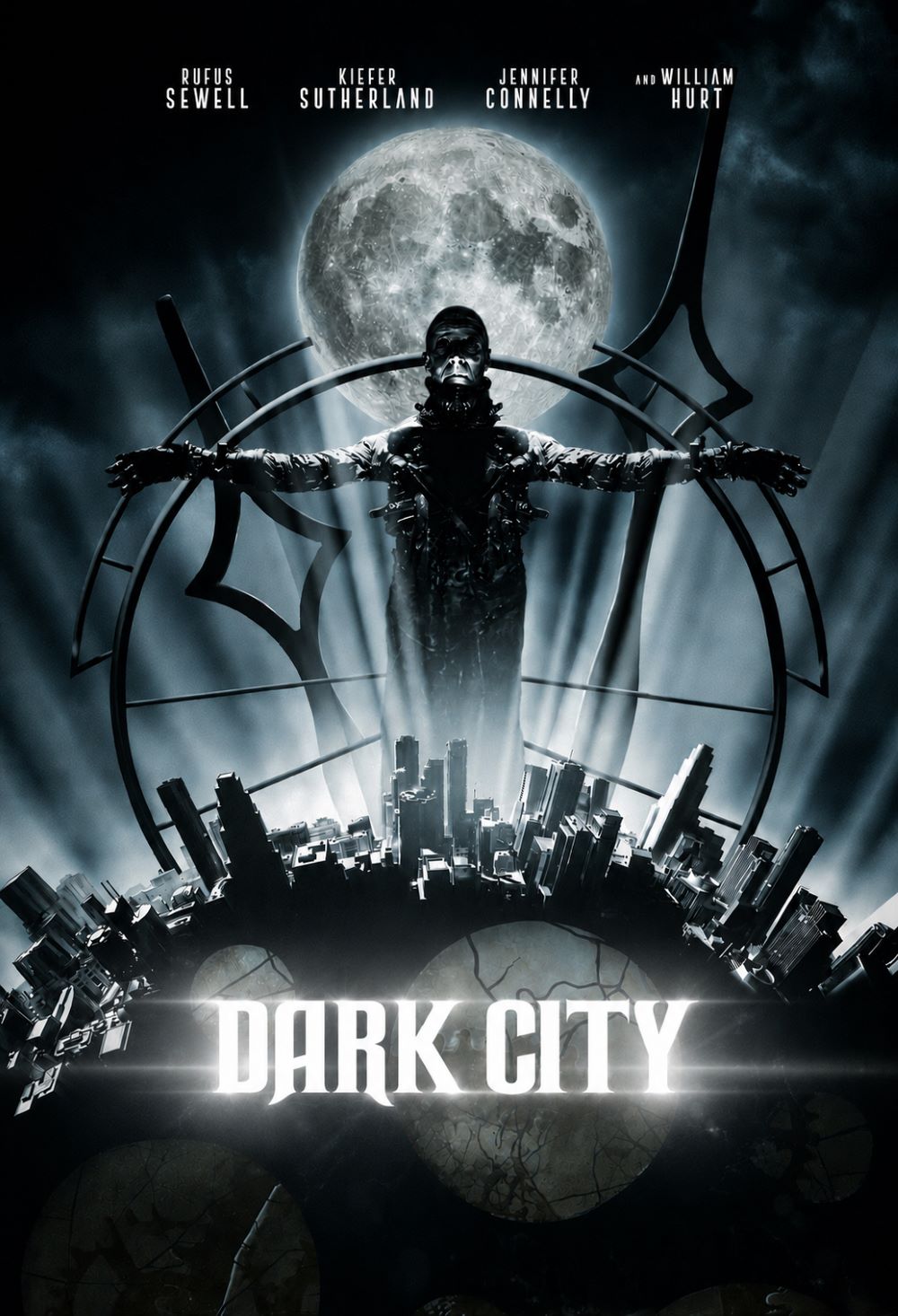
“First there was darkness. Then came the strangers.” — Dr. Schreber
Dark City opens like a half-remembered nightmare, and that’s exactly the kind of vibe the movie sustains from start to finish. Alex Proyas builds a world that feels trapped between a detective story, a fever dream, and a sci-fi conspiracy, and the result is one of the most atmospheric films of the late ’90s.
What makes Dark City so distinctive is the way it treats its setting like an active force rather than a backdrop. The city itself feels oppressive and unstable, all sharp angles, heavy shadows, looming buildings, and damp streets that seem permanently stuck in the middle of the night. That visual approach owes a lot to German expressionism, with its warped architecture and unnatural spaces, and Proyas uses that legacy to make the city feel psychologically trapped and visually wrong in the best way. You can see the noir influence too, especially in the low-key lighting, the sense of fatalism, and the way the whole film feels like a detective story pushed through a nightmare filter.
The sci-fi side of the film is just as memorable because it doesn’t rely on shiny futurism. Instead, it leans into mystery, memory loss, and identity breakdown, which gives it a more unsettling and human quality. That’s part of why the film works so well: the weirdness is not just decorative, it’s built into the story’s central questions. The result is a movie that feels cerebral without becoming cold, and atmospheric without losing narrative momentum. Even when the film is being highly stylized, it still moves with purpose, and that keeps the viewer locked in.
The performances help sell all of that, especially Rufus Sewell as John Murdoch. He has to carry the audience through confusion, paranoia, and growing dread, and he does it with a mix of physical vulnerability and stubborn intensity. William Hurt gives the film a weary, grounded presence, while Kiefer Sutherland turns Dr. Schreber into one of those slippery, unforgettable supporting characters who always seems one step ahead of the audience. Jennifer Connelly brings warmth and melancholy to the film, which matters a lot because her character gives the story a human anchor amid all the conceptual chaos. The cast doesn’t play the material like it’s just an exercise in style; they commit to the oddness while keeping the emotional stakes legible.
What’s especially impressive is how the acting matches the movie’s visual language. A lesser cast could have made this feel overcooked or self-conscious, but here the heightened performances fit the artificial, dreamlike quality of the world. The characters are somewhat archetypal, yet that works because the film is so interested in identity as something constructed, remembered, and manipulated. In that sense, the performances aren’t just good in isolation; they’re part of the movie’s design, helping it feel like a living puzzle instead of a hollow aesthetic showcase.
The film’s influence on later sci-fi thrillers is hard to miss. A lot of movies after Dark City seem to borrow its basic flavor: the paranoid atmosphere, the reality-questioning premise, the noir-scifi crossover, and the feeling that the world itself is a conspiracy. Films like The Matrix, Memento, Minority Report, Equilibrium, and even Sin City all exist in a creative space that Dark City helped sharpen or popularize, whether directly or indirectly. It didn’t always get the mainstream recognition of some of those titles, but in terms of tone and visual influence, it was incredibly important.
Part of that legacy comes from the way Dark City captured a very specific late-’90s anxiety: the fear that memory, identity, and reality could all be manufactured. That idea became a major engine for sci-fi thrillers moving forward, especially films that wanted to combine philosophical unease with stylized action or mystery. Even the movie’s look, with its blend of noir shadows and surreal production design, became a kind of template for how to make sci-fi feel adult, moody, and psychologically unstable. It helped prove that science fiction didn’t need clean lines and sterile futures to feel intelligent; it could be dirty, haunted, and expressionist.
Dark City remains such a strong film because it understands that style and theme should feed each other. The shadows, the tilted buildings, the endless night, and the fractured sense of self all point in the same direction, creating a unified experience that feels deliberately unsteady. That’s why it lingers: not just because it looks incredible, but because it turns visual design into emotional pressure. It’s a smart, strange, and beautifully murky piece of sci-fi noir that helped clear the way for a whole wave of thrillers that wanted to feel just as paranoid and disorienting.
In the end, Dark City is the kind of movie that rewards both first-time viewers and people revisiting it years later. The plot twists are memorable, but the real achievement is the atmosphere, which is so complete it almost becomes the main character. Proyas made a film that feels like it came from the crossroads of German expressionism, classic noir, and modern sci-fi anxiety, and the result is a cult landmark that still casts a long shadow over the genre.
 Through the Shattered Lens