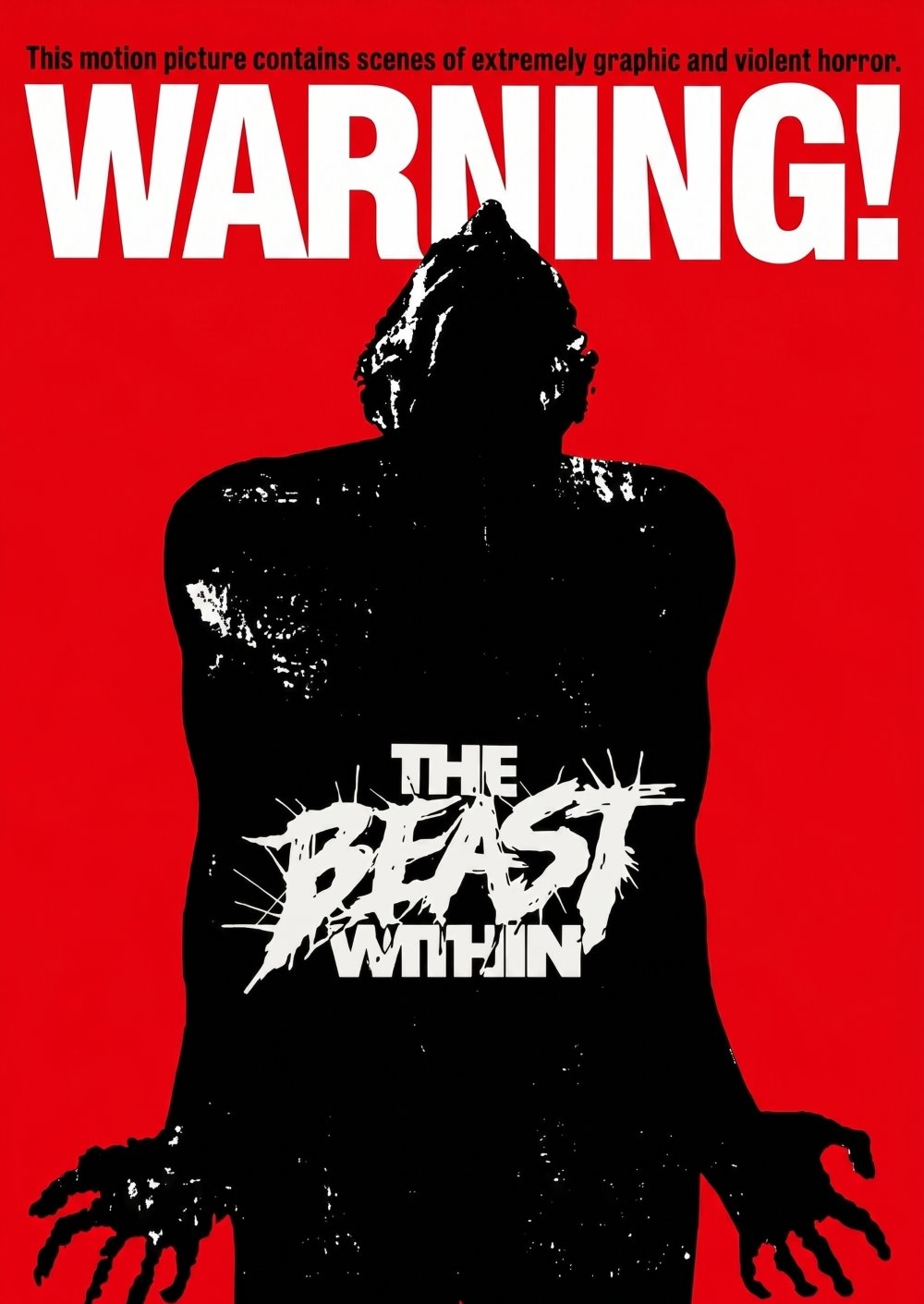
Guilty Pleasure No. 115: The Beast Within (dir. Philippe Mora)


The Beast Within (1982), directed by Philippe Mora, is one of those strange, sticky relics of early ’80s horror that feels like it crawled out of a drive-in double feature and just kept mutating long after the credits rolled. It’s not a good film—let’s just get that out of the way early—and it barely qualifies as a coherent one, but it lands squarely in that fascinating gray area where failure and ambition collide. This is the kind of messy, overstuffed genre hybrid that earns its reputation less through quality and more through sheer, stubborn weirdness. It’s got ambition in odd places, tonal swings that don’t quite land, and a sincerity that almost convinces you it knows what it’s doing. Almost.

What makes The Beast Within so compelling is how aggressively it borrows from exploitation cinema without ever fully committing to being exploitative in tone. All the raw ingredients are here: sexual violence, grotesque bodily transformation, cannibalistic undertones, grave robbing, demonic suggestion, and generational curses. It’s like Mora raided the entire playbook of grindhouse staples and tried to stitch them together into something resembling a prestige Southern Gothic drama. The result is a tonal contradiction that becomes the film’s defining trait. You’re watching material that, in another context, would lean hard into sleaze or pulp sensationalism, yet here it’s played with a stiff, almost theatrical seriousness.

The film opens with one of its most infamous sequences—a brutal assault in the woods by something that is distinctly not human. It’s uncomfortable, lurid, and feels like the start of a much nastier film than what ultimately unfolds. Seventeen years later, the child born from that attack begins to change, physically and psychologically unraveling as something monstrous pushes its way to the surface. From there, the narrative spirals into a hazy blend of small-town mystery, family melodrama, and creature feature chaos, with buried secrets clawing their way into the present.

There’s a clear attempt to elevate all of this with Southern Gothic sensibilities. The setting leans heavily into decay and repression—sweltering air, crumbling structures, and a community weighed down by unspoken sins. Characters behave as if they’ve wandered in from a Tennessee Williams play, all strained emotions and suppressed truths, but the film keeps undercutting that mood with bursts of grotesque horror. It’s an awkward balancing act that never quite works. If anything, the material might have been better served by leaning into something closer to a Joe R. Lansdale tone—meaner, pulpier, and more self-aware—rather than reaching for a kind of literary weight it can’t sustain.

Still, what keeps The Beast Within watchable—sometimes even oddly engaging—is how seriously everyone takes it. Ronny Cox and Bibi Besch play the parents with unwavering commitment, treating the story as a straight drama about a family unraveling under impossible circumstances. Their performances don’t wink at the audience or acknowledge the absurdity creeping in around the edges, and that refusal to break tone actually works in the film’s favor. It creates a strange tension where the more ridiculous the plot becomes, the more grounded the performances try to keep it.

Paul Clemens, as the afflicted son Michael, is tasked with carrying the film’s most extreme elements, and he does what he can within the limits of the material. His performance is less about subtlety and more about physical deterioration and panic as his body betrays him, but he sells the desperation well enough to keep things from completely falling apart. When the transformation finally takes center stage, the film dives headfirst into full-on creature horror, complete with practical effects that are equal parts impressive and absurd. They’re messy, tactile, and unmistakably of their era—exactly the kind of thing that feels right at home in a late-night grindhouse slot.

And then there’s L.Q. Jones as Sheriff Poole, who shows up like icing on top of this bizarre, overcooked cake. Jones brings that weathered, lived-in presence he honed across decades of Westerns and genre films, and he slips into this decaying Southern setting effortlessly. There’s a quiet authority to his performance that helps ground the film, even when everything else is threatening to spiral into nonsense. He doesn’t overplay the role or try to elevate it beyond what it is, but his presence adds a layer of credibility that the film desperately needs. It’s like he wandered in from a more confident, self-aware movie and decided to play it straight anyway, and somehow that makes the chaos around him feel just a little more intentional.

Visually, Mora leans into atmosphere when he can, giving the film a hazy, humid texture that reinforces its Southern Gothic aspirations. The town feels insular and vaguely cursed, like it’s been rotting from the inside out long before the events of the film begin. There are moments where the imagery and tone almost align into something genuinely evocative, but they’re fleeting, quickly swallowed up by the film’s inability to maintain a consistent identity.

That lack of cohesion is ultimately what keeps The Beast Within from being anything close to a good film, but it’s also what makes it linger in your mind. It’s constantly shifting—family drama one minute, body horror the next, then veering into supernatural mystery without warning. That unpredictability gives it a kind of scrappy energy, like it’s trying to reinvent itself scene by scene. Most of those attempts don’t quite land, but they’re rarely dull.

What’s surprising is the film’s underlying sincerity. For all its exploitation trappings, this isn’t a cynical or lazy effort. There’s a genuine attempt here to grapple with themes of inherited trauma, guilt, and the inescapability of the past, even if those ideas get buried under layers of monster makeup and narrative clutter. That earnestness creates an odd charm, making it easier to forgive the film’s many missteps.

In the end, The Beast Within sits comfortably in guilty pleasure territory. It’s not something you’d point to as an overlooked gem, and it certainly doesn’t rise to the level of a true grindhouse classic, but it has all the markings of one. It’s messy, uncomfortable, tonally confused, and packed with more ideas than it knows what to do with—but it’s also strangely compelling because of that. Not great, not even good, but just effective enough in flashes to make the whole experience worthwhile. It’s the kind of film that sticks with you less for what it achieves and more for how bizarrely it tries.

Previous Guilty Pleasures

  1. Half-Baked
  2. Save The Last Dance
  3. Every Rose Has Its Thorns
  4. The Jeremy Kyle Show
  5. Invasion USA
  6. The Golden Child
  7. Final Destination 2
  8. Paparazzi
  9. The Principal
  10. The Substitute
  11. Terror In The Family
  12. Pandorum
  13. Lambada
  14. Fear
  15. Cocktail
  16. Keep Off The Grass
  17. Girls, Girls, Girls
  18. Class
  19. Tart
  20. King Kong vs. Godzilla
  21. Hawk the Slayer
  22. Battle Beyond the Stars
  23. Meridian
  24. Walk of Shame
  25. From Justin To Kelly
  26. Project Greenlight
  27. Sex Decoy: Love Stings
  28. Swimfan
  29. On the Line
  30. Wolfen
  31. Hail Caesar!
  32. It’s So Cold In The D
  33. In the Mix
  34. Healed By Grace
  35. Valley of the Dolls
  36. The Legend of Billie Jean
  37. Death Wish
  38. Shipping Wars
  39. Ghost Whisperer
  40. Parking Wars
  41. The Dead Are After Me
  42. Harper’s Island
  43. The Resurrection of Gavin Stone
  44. Paranormal State
  45. Utopia
  46. Bar Rescue
  47. The Powers of Matthew Star
  48. Spiker
  49. Heavenly Bodies
  50. Maid in Manhattan
  51. Rage and Honor
  52. Saved By The Bell 3. 21 “No Hope With Dope”
  53. Happy Gilmore
  54. Solarbabies
  55. The Dawn of Correction
  56. Once You Understand
  57. The Voyeurs 
  58. Robot Jox
  59. Teen Wolf
  60. The Running Man
  61. Double Dragon
  62. Backtrack
  63. Julie and Jack
  64. Karate Warrior
  65. Invaders From Mars
  66. Cloverfield
  67. Aerobicide 
  68. Blood Harvest
  69. Shocking Dark
  70. Face The Truth
  71. Submerged
  72. The Canyons
  73. Days of Thunder
  74. Van Helsing
  75. The Night Comes for Us
  76. Code of Silence
  77. Captain Ron
  78. Armageddon
  79. Kate’s Secret
  80. Point Break
  81. The Replacements
  82. The Shadow
  83. Meteor
  84. Last Action Hero
  85. Attack of the Killer Tomatoes
  86. The Horror at 37,000 Feet
  87. The ‘Burbs
  88. Lifeforce
  89. Highschool of the Dead
  90. Ice Station Zebra
  91. No One Lives
  92. Brewster’s Millions
  93. Porky’s
  94. Revenge of the Nerds
  95. The Delta Force
  96. The Hidden
  97. Roller Boogie
  98. Raw Deal
  99. Death Merchant Series
  100. Ski Patrol
  101. The Executioner Series
  102. The Destroyer Series
  103. Private Teacher
  104. The Parker Series
  105. Ramba
  106. The Troubles of Janice
  107. Ironwood
  108. Interspecies Reviewers
  109. SST — Death Flight
  110. Undercover Brother
  111. Out for Justice
  112. Food Wars!
  113. Cherry
  114. Death Race

October True Crime: Into Thin Air (dir by Roger Young)


Originally broadcast in 1985, Into Thin Air is a made-for-TV movie that is based on a true story.  It’s film that brings to life the horror of every family’s nightmare.  Brian Walker (Tate Donavon) is an intelligent, soft-spoken, and somewhat naive college student in Ottawa.  He’s been accepted into a summer writing program in Colorado.  As he gets in the van that he will be driving to Colorado, he promises his mother, Joan (Ellen Burstyn), that he’ll call her when he reaches Nebraska and again when he reaches Colorado.

Brian drives away and that’s the last time that Joan ever sees her son.  Brian calls from Nebraska and talks to his brother, Stephen (Sam Robards).  Joan arrives home just as Stephen is saying goodbye.  Brian never calls from Colorado.  He has vanished, seemingly into thin air.

Joan, Stephen, and Joan’s ex-husband, Larry (played the great character actor Nicholas Pryor) travel to America to search for him.  At one point, Stephen thinks that he’s spotted Brian’s van on the road and chase after it, just to discover that it’s a different van.  Joan talks to cops in Nebraska and Colorado and discovers that different jurisdictions don’t work together or share information.  As the days pass, Joan keeps hoping that Brian is somehow still alive….

I was about ten minutes into this film when I started sobbing.  I pretty much cried through the entire film.  Some of that was because I knew that they were never going to see Brian again.  Some of that was because of the powerful, heartfelt performances of Ellen Burstyn, Nicholas Pryor, and Sam Robards.  Most of it was because this film did such a good job of capturing the feeling of hopelessness and the dread that comes with not knowing what has happened to someone who you love.  I found myself crying for Brian’s lost potential.  He was a writer and he was engaging in a time-honored writing tradition.  He was taking a road trip and he was discovering the world.  He deserved better than whatever happened to him.  He deserved see his novel sitting in a bookstore.  Instead, he ran into the wrong people.

It’s the little details that really got to me.  Stephen flies into a rage when he sees his younger brother wearing one of Brain’s sweaters.  Joan momentarily gets her hopes up when she discovers that Brian reported some lost traveler’s checks, just to have that hope shot down when she’s told that the bank can’t reveal where Brian called them from unless Brian himself gives permission.  When the van eventually turn up in Maine, it’s been totally trashed by whoever took it from Brian.

Eventually, Joan hires a private detective and Robert Prosky is well-cast as Jim Conway, a seemingly cynical ex-cop who dedicates himself to trying to provide closure for the Walkers.  The scene where he finally discovers what happened to Brian is one of the strongest in the film and one of the most upsetting.  So many people could have saved Brian if they only had the courage to speak up.

Into Thin Air is a powerful film.  No one should ever be forgotten.

Retro Television Review: Fantasy Island 7.10 “Goin’ On Home/Ambitious Lady”


Welcome to Retro Television Reviews, a feature where we review some of our favorite and least favorite shows of the past!  On Tuesdays, I will be reviewing the original Fantasy Island, which ran on ABC from 1977 to 1984.  Unfortunately, the show has been removed from most streaming sites.  Fortunately, I’ve got nearly every episode on my DVR.

This week is another trip to the Island that feel a bit too familiar.

Episode 7.10 “Goin’ On Home/Ambitious Lady”

(Dir by Don Ingalls, originally aired on January 7th, 1984)

Nope.  I’m just not going to do it.  I refuse to spend too much time on this episode.  This episode felt like a rehash of several earlier episodes, all of which worked considerably better and didn’t feature Lawrence hovering in the background.

Billy Joe Pine (Mickey Gilley) is a country-western star who comes to the Island because he wants to be reunited with the family that he left behind when he traveled from the farm to …. Nashville, I guess.  His father (Leif Erickson) forgives him but his younger brother (John Dennis Johnston) is less inclined.  Mickey Gilley was a real-life country western singer and the only reason I know this is because he appeared previously on Fantasy Island as himself.  That episode wasn’t great but it was a masterpiece compared to this one.  “They don’t let you swim in your long johns!” is a line that is uttered at one point and I cringed like I’ve never cringed before.  This whole thing just felt rehashed and tired.

The second fantasy featured fashion designer Bryana Spencer (Mary Ann Mobley) and her husband, Fred Nelson (Ron Ely).  Fred gave up a promising entertainment career so that he could work as the exclusive emcee for Bryana’s fashion shows.  Bryana’s fantasy is for Fred to find the success that he gave up while Fred’s fantasy is for Bryana and him to experience that type of love that they felt for each other before Bryana became successful.  In other words, it’s time for another Fantasy Island fashion show!

Character actor George Wyner (you would recognize him) made me smile as the fashion show’s choreographer but otherwise, this was a pretty boring fantasy.  Mobley and Ely didn’t have much chemistry.  Then again, neither did Roarke and Lawrence.  The entire time I watched this episode, I kept thinking to myself, “Tattoo liked country western music.  Tattoo liked fashion shows.  This could have been a great Tattoo episode!”

This was not a great trip to the Island.

KISS Meets The Phantom Of The Park (1978, directed by Gordon Hessler)


In 1978, KISS appeared to have it all.  The band was famous for both their makeup and their anthemic stadium rock.  They had just released not only a new studio album but also four solo albums.  They had starred in their own Marvel comic and gained notoriety for supposedly allowing their blood to mixed in with the comic’s ink.  Teenagers loved KISS and parents and religious leaders feared that the band’s name stood for Knights In Satan’s Service.  KISS had everything except for motion picture stardom.

KISS Meets The Phantom Of The Park was supposed to change that.  The film starred Anthony Zerbe as Abner Devereaux, an engineer and an expert at animatronics who loses his job at Magic Mountain and seeks revenge by using robot versions of KISS to drive the audience of their concert to riot.  Fortunately, the real members of KISS are not just rock stars but also alien beings who descend from the heavens and shoot lightning bolts from their eyes.  (Gene Simmons can breathe fire.)  The real KISS isn’t going to allow their fan to be manipulated by a robot version of the band, which leads to a battle between KISS and the robots that protect Abner’s underground lair.

KISS Meets The Phantom of the Park aired on NBC on October 28th, 1978.  It was later given a theatrical release in Europe, where it was re-edited and retitled Attack of the Phantom.  Since then, it has become a very difficult film to see.  (On Amazon, old VHS copies go for several hundred dollars.)  One reason why the movie is so hard to see is because the members of the KISS hated the movie and felt that they were portrayed as being clowns instead of super heroes.  Even though the members of the band have since mellowed out about the film (with Gene Simmons suggesting it should be viewed on a double bill with Plan 9 From Outer Space), KISS Meets The Phantom Of The Park is still a film that is more talked about than actually watched.

While looking for clips of the movie on YouTube, I came across an upload of the entire film.  The only problem was that all of the dialogue was dubbed into German and that’s not a language that I speak.  Still, figuring that you have to take your opportunities when they’re available, I decided to watch.  I figured that the dialogue might not actually be that important and it wasn’t.  I was able to follow the plot just fine.  (The only weird thing about watching the move in German was listening to the members of the band speak in something other than a New York accent.)  Fortunately, there’s actually more singing than talking in Kiss Meets The Phantom Of The Park and the songs are untouched and in English.  KISS plays Magic Mountain in the film and they actually performed a real concert for filming.  Those are real fans of the band going crazy whenever Gene Simmons sticks out his tongue.

The movie itself is definitely a product of its time and not meant to be taken seriously.  The members of KISS are both aliens that descend from the heavens and rock musicians and they are never seen without their makeup.  Even when they’re hanging out at a hotel pool, they are in full costume and they’re wearing their makeup. When the members of the band enter the Phantom’s underground lab, they have to fight a series of very 70s robots, including some that know karate and two who have lightsabers.  For better or worse, it’s a very silly move that epitomizes an era.  The special effects are cheesy, the members of the band often look straight at the camera, and the rest of the cast does what they can with what they’ve been given.  Anthony Zerbe plays the Phantom with a hint of empathy while Deborah Ryan is the ingenue who searched for her missing boyfriend while Beth plays on the soundtrack.  Keep an eye out for Brion James, playing a security guard.

Overall, the band probably would have been smarter to just release a concert film but then the rest of us wouldn’t have the fun of watching Paul Stanley face off against a robot version of Bruce Lee.  KISS Meets The Phantom of The Park is worth watching at least once, even in German!

Film Review: Streets of Fire (dir by Walter Hill)


File this one under your mileage may vary…

Okay, so here’s the deal.  I know that this 1984 film has a strong cult following.  A few months ago, I was at the Alamo Drafthouse when they played the trailer and announced a one-night showing and the people sitting in front of me got so excited that it was kind of creepy.  I mean, I understand that there are people who absolutely love Streets of Fire but I just watched it and it didn’t really do much for me.

Now, that may not sound like a big deal because, obviously, not everyone is going to love the same movies as everyone else.  I love Black Swan but I have friends who absolutely hate it.  Arleigh and I still argue about Avatar.  Leonard and I still yell at each other about Aaron Sorkin.  Erin makes fun of me for watching The Bachelorette.  Jedadiah Leland doesn’t share my appreciation for Big Brother and the Trashfilm Guru and I may agree about Twin Peaks but we don’t necessarily agree about whether or not socialism is a good idea.  And that’s okay.  There’s nothing wrong with healthy and respectful disagreement!

But the thing is — Streets of Fire seems like the sort of film that I should love.

It’s a musical.  I love musicals!

It’s highly stylized!  I love stylish movies!

It’s from the 80s!  I love the 80s films!  (Well, most 80s films… if the opening credits are in pink neon, chances are I’ll end up liking the film…)

It takes place in a city where it never seems to stop raining.  Even though the neon-decorated sets give the location a futuristic feel, everyone in the city seems to have escaped from the 50s.  It’s the type of city where people drive vintage cars and you can tell that one guy is supposed to be a badass because he owns a convertible.  All of the bad guys ride motorcycles, wear leather jackets, and look like they should be appearing in a community theater production of Grease.

Singer Ellen Aim (Diane Lane) has been kidnapped by the Bombers, a biker gang led by Raven (Willem DaFoe).  Ellen’s manager and lover, Billy Fish (Rick Moranis), hires Tom Cody (Michael Pare) to rescue Ellen.  Little does Billy know that Cody and Ellen used to be lovers.  Cody is apparently a legendary figure in the city.  As soon as he drives into town, people starting talking about how “he’s back.”  The police see Cody and automatically tell him not to start any trouble.  Raven says that he’s not scared of Cody and everyone rolls their eyes!

It’s up to Cody to track Ellen down and rescue her from Raven and … well, that’s pretty much what he does.  I think that was part of the problem.  After all of the build-up, it’s all a bit anti-climatic.  It doesn’t take much effort for Cody to find Ellen.  After Cody escapes with Ellen, it doesn’t take Raven much effort to track down Cody.  It all leads to a fist fight but who cares?  As a viewer, you spend the entire film waiting for some sort of big scene or exciting action sequence and it never arrives.  The film was so busy being stylish that it forgot to actually come up with a compelling story.

I think it also would have helped if Tom Cody had been played by an actor who had a bit more charisma than Michael Pare.  Pare is too young and too stiff for the role.  It doesn’t help to have everyone talking about what a badass Tom Cody is when the actor playing him doesn’t seem to be quite sure what the movie’s about.  Also miscast is Diane Lane, who tries to be headstrong but just comes across as being petulant.  When Cody and Ellen get together, they all the chemistry of laundry drying on a clothesline.

On the positive side, Willem DaFoe is believably dangerous as Raven and Amy Madigan gets to play an ass-kicking mercenary named McCoy.  In fact, if McCoy had been the main character, Streets of Fire probably would have been a lot more interesting.

I guess Streets of Fire is just going to have to be one of those cult films that I just don’t get.