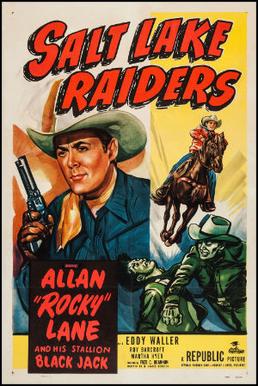
Salt Lake Raiders (1950, directed by Fred C. Brannon)


When convicted murderer Fred Mason (Myron Healey) escapes during a prison transfer, frontier Marshal Rocky Lane (Allan Lane) is brought in to re-capture him.  It’s believed that Fred has returned to the ghost town of Silver City so that he can retrieve a buried treasure of $100,000.  But when Rocky tracks Fred down, Fred insists that he was set up and that he didn’t kill anyone.  Rocky, Fred, and Nugget Clark (Eddy Waller) are soon captured by outlaw Brit Carson (Roy Barcroft), who is also searching for the money.

I wasn’t planning on watching Salt Lake Raiders today.  I’ve long wanted to review a Whip Wilson western and I was hoping I would be able to find one of his films, Silver Raiders, on YouTube.  However, every search that I did for Silver Raiders just returned Salt Lake Raiders.  Instead of watching a Whip Wilson western, I ened up just watching another Allan Lane western.

Salt Lake Raiders is a competently-made but not very memorable western.  The person who set up Fred is no big surprise.  The ghost town is a good location and, as always, Allan Lane is a believable hero.  Eddy Waller, as usual, plays sidekick Nugget Clark and lovely Martha Hyer plays the daughter of the man who Fred was accused of killing,  The movie holds your interest but it’s also so predictable that it is easy to understand why the studios abandoned B-western movies once television started giving them to people for free.

Unless I missed it, there is no mention of Salt Lake City or any other salt lakes in this movie.
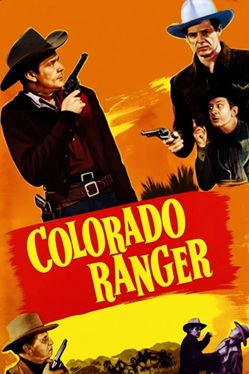
Colorado Ranger (1950, directed by Thomas Carr)


The Shamrock Kid (James Ellison), Lucky (Russell Hayden), and the Colonel (Raymond Hatton) ride into the town of Cattle Junction.  They are on the trail of a group of outlaws who have been causing trouble but everyone in town mistakes them for being outlaws themselves.  Feisty ranch owner Anne Hayden (Julie Adams, beautiful as always) even locks them in a basement to keep them from causing trouble!  Far more serious, though, is Jim Morgan (Stephen Carr), who tries to hire the men to force the ranchers off of their property.

This is a typical homesteader vs ranchers film.  The story behind the making of the film is more interesting than the film itself.  It was one of six films that the director and the cast shot concurrently over the course of a handful of days.  Each day, the cast and crew would set up at a different location and shoot scenes for all six films.  The other interesting thing about this film is that Elllison and Hayden were better known for playing Hopalong Cassidy’s sidekicks than for being leading men.  Like Fuzzy Knight (who appears in this film), Ellison and Hayden were born sidekicks.  They were likeable but not particularly convincing as being tough lawmen.

This film has all of the familiar faces who usually appeared in these films, actor like Fuzzy Knight, George Cheseboro, Tom Tyler, and Bud Osborne.  Fans of the B-western genre will be happy to see them but the overall film is memorable only for Julie Adams.  I wonder if this movie was a hit in Colorado.

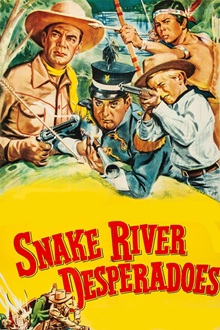
Snake River Desperadoes (1951, directed by Fred Sears)


A young Indian brave named Little Hawk (Don Reynolds) runs across the countryside, hoping to run into the Durango Kid.  Instead, he runs into Steve Reynolds (Charles Starrett), who listens as Little Hawk explains that the Indians and the white men are about to go to war.  Steve promises to deliver the message to Durango.  That will be easy for Steve because he is Durango!

White bandits are disguising themselves as Native Americans and attacking stagecoaches.  The local townspeople are getting riled up.  Meanwhile, businessmen Jim Haverly (Monte Blu) is running a trading post and secretly selling weapons to the Indians.  Jim is hoping to profit from the upcoming war.  Jim is also the uncle to Little Hawk’s best friend, Billy (Tommy Ivo).  When Durango and his sidekick Smiley Burnette show up, they team up with Billy and Little Hawk and try to stop the war before it happens.

This is one of the many B-westerns that featured Charles Starrett as the Durango Kid.  The Durango Kid was always an agent of the federal government but he pretended to be an outlaw to make it easier for him to get information.  Sometimes, it really didn’t make sense for Steve to pretend to be the Durango Kid, like in this movie.  I guess no one wanted to give up the gimmick, just like no one wanted to give up Smiley Burnette’s musical comedy.

This one has all of the horse-riding and gun-shooting that fans of the genre would expect from a Charles Starrett western.  It also has a lot of stock footage that appeared in a countless number of other B-westerns.  Starrett is a convincing cowboy and Monte Blue is a good villain, as always.  The child actors can sometimes be difficult to tolerate but I imagine the kids in the audience preferred watching them to sitting through the romantic subplots that these films usually had.  Fans of the gerne will enjoy the film, if just on a nostalgic level.  Those who are not into westerns will still not be into them after watching.

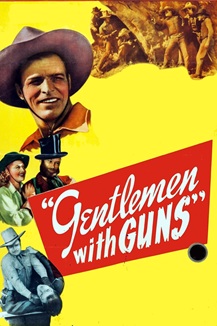
Gentlemen With Guns (1946, directed by Sam Newfield)


In the old west, Billy Carson (Buster Crabbe) gets a letter from his old friend, Fuzzy Q. Jones (Al St. John).  Fuzzy writes that he’s in “a little trouble” and requests that Billy “mosey on over” if he has time.  When Billy shows up at Fuzzy’s ranch, Fuzzy explains that Jim McAllister (Steve Derrell) wants his land and his water rights.  McAllister not only his own gang but he’s got the sheriff in his pocket as well.  When two of McAllister’s men show up at the ranch to try to force Fuzzy out, Billy is there to throw a punch in the defense of his good friend.

Billy is surprised to learn that Fuzzy is getting married to a woman that he’s never met for.  Fuzzy gotten to know Matilda Boggs (Patricia Knox) only through the letters that they’ve exchanged as members of a lonely hearts club.  By the time Matilda arrives in town, McAllister has already arranged for Fuzzy to be framed for murder and arrested.  Fuzzy is sitting in jail, hoping that Billy can clear his name.  Matilda is only after Fuzzy’s money and if they get married and Fuzzy gets hanged for murder or shot after breaking out jail to see her, that’ll just make it easier for her to get all of it.  Billy can see through Matilda’s schemes but Fuzzy is blinded by love.

This was an interesting and engaging B-western.  It had all the usual fist fights and horse chases that you expect to find in these films but there was also some unexpected emotional depth.  Usually, Fuzzy was the just comedic sidekick in these movies.  In this one, he’s not only facing the hangman’s noose but he’s also looking for love.  Life gets lonely on the frontier.  Buster Crabbe is his usual dependable and likable self.  Buster always looked convincing throwing a punch and both he and Fuzzy get to throw a lot of them here.

For many, B-westerns like this will always be an acquired taste but, for fans of the genre, Gentlemen With Guns is a superior example.


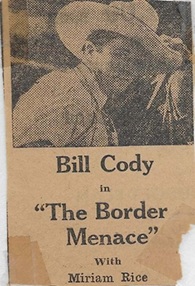
The Border Menace (1934, directed by Jack Nelson)


Ranger Bill Williams (Bill Cody) is working undercover.  First, he meets up with and goes to prison with rustler Dragon Morris (Ben Corbett).  After Bill finds out that Dragon’s boss is Chuck Adams (George Chesebro), Bill gets out of prison, tracks down Chuck, and then has a fake posse pursue him in order to prove his bona fides as an outlaw.  Chuck invites Bill to be a member of his gang.  However, Dragon has figured out that Bill’s a lawman and, when he escapes from prison, he tries blow Bill’s cover.

I know I make a lot of excuses for Poverty Row westerns.  I can’t do it with this one.  The Border Menace is really bad.  Produced by Aywon Film, one of the least success of the Poverty Row studios, nothing about The Border Menace works, not even the stock footage of the posse.  This is one slow movie, even with barely enough plot to fill out its 50-minute run time.  The acting is bad all around, except for veteran western baddie George Cheseboro and Bill Cody, who at least is likable as the hero.  Bill has a comedic sidekick but it’s not Fuzzy St. John or Gabby Hayes.  Instead, it’s Jimmy Aubrey as Polecat Pete.  Polecat Pete yells and sings.  I don’t think I’ve ever rooted for the comic relief to get caught in that crossfire before.

Bill Cody starred in a handful of B-westerns in the 30s.  He was a former stuntman and looked convincing on a horse.  He really wasn’t a bad actor but the main reason he found success was because he shared his name with “Wild Bill” Cody.  The two Codys were not related.

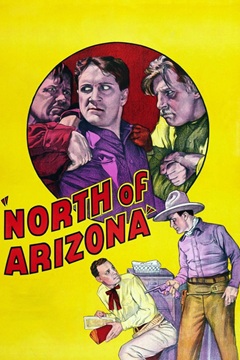
North of Arizona (1935, directed by Harry S. Webb)


Newly hired ranch foreman Jack Loomis (Jack Perrin) comes to the aid of two Indians who were nearly swindled out of their land during a card game.  The Indians inform Jack that his new boss, George Tully (Al Bridge), is actually a crook and the ranch is just a front for his criminal activities.  When Jack says he doesn’t want to be a part of Tully’s schemes, Tully and his men frame Jack for a robbery.

After you watch enough of these Poverty Row westerns, you start to get the feeling that anyone in the 30s could walk into a studio and star in a B-western.  Jack Perrin was a World War I veteran who had the right look to be the star of several silent films but once the sound era came along, his deficiencies as an actor became very apparent.  He could ride a horse and throw a punch without looking too foolish but his flat line delivery made him one of the least interesting of the B-western stars.  That’s the case here, where Perrin is a boring hero and the entire plot hinges on the villain making one really big and really stupid mistake.  John Wayne could have pulled this movie off but Jack Perrin was lost.

Jack Perrin’s career as a star ended just a few years after this film but not because he was a bad actor.  Instead, Perrin filed a lawsuit after a studio failed to pay him for starring in one of their films.  From 1937 until he retirement in 1960, Perrin was reduced to playing minor roles for which he often went uncredited.  Hollywood could handle a bad actor but not an actor who expected to be paid for his work.

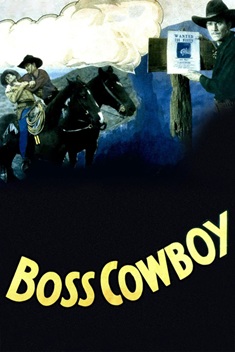
Boss Cowboy (1934, directed by Victor Adamson)


Boss Cowboy takes place in the 30s but it’s very much a western.  One car shows up and telephone poles dot the countryside but almost everyone in the movie rides a horse.  The Nolans and the Rosses are two ranching families.  Both families are losing cattle.  Nolan foreman Dick Taylor (Buddy Roosevelt) suspects that the culprit is the Ross foreman, Jack Kearns (George Cheseboro) and he’s right.  Kearns is ripping off both families.  Complicating Taylor’s effort to stop Kearns are his romantic feelings towards Mary Ross (Frances Morris), who is visiting from “back east.”  Sally Nolan (Fay McKenzie) is also visiting and running joke is her handing off her small dog to a ranch hand named Slim (Alan Holbrook).

No apparent relation to either Teddy or FDR, Buddy Roosevelt was a respected stunt man who tried his hand at starring in a few westerns,  Unfortunately, Buddy Roosevelt wasn’t much of an actor, which is painfully apparent while watching him in Boss Cowboy.  He’s fine when he’s riding a horse and pulling a gun but when he has to speak, it’s difficult to watch.  As bad as Buddy Roosevelt’s acting was, he was not the worst actor in Boss Cowboy.  That honor was split between Frances Morris and Fay McKenzie.  Boss Cowboy is pretty dull.  Every scene drags and there are plenty of awkward silences while the cast tries to remember their lines.

Though he wasn’t much of an actor, Buddy Roosevelt remained in a demand as a stunt man throughout the 40s.  In the 50s and 60s, he was kept busy playing townsmen in shows like The Life and Legend of Wyatt Earp.  In 1962, he made his final film appearance in The Man Who Shot Liberty Valance.  He then retired to Colorado, where he did at age of 75 in 1973.  In all, his Hollywood career spanned 46 years, from 1916 to 1962.


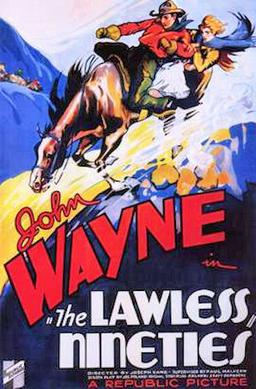
The Lawless Nineties (1936, directed by Joseph Kane)


The year is 1890 and Wyoming is on the verge of voting for statehood.  Newspaperman Major Carter (George “Gabby” Hayes) believes that it’s time for Wyoming to become a state and most of the locals agree with him.  Businessman Charles Plummer (Harry Woods) does not want Wyoming to become a state and he’s willing to send out his main henchman, Steele (Al Bridge), to intimidate the voters and to silence Carter.  Plummer has a profitable racket going and the last thing he wants is for the U.S. government to get involved in his activities.  It falls to two federal agents, John Tipton (John Wayne) and Bridger (Lane Chandler), to supervise the voting and protect the citizen.  When Major Carter is shot by a drunk anti-statehood activist, the mission to make Wyoming a part of the Union becomes personal.

The Lawless Nineties is typical of the B-movies that John Wayne made for Republic Pictures before John Ford resurrected his struggling career by casting him as The Ringo Kid in Stagecoach.  There are plenty of gunfights and horse chases and explosions as the bad guys try to keep the townspeople from voting and the federal agents set up their own sting operation to expose Plummer’s gang.  Wayne seems more relaxed here than he did in some of his other B-movies.  He was obviously getting more comfortable with being on camera and playing the hero.  Probably the most interesting thing about this film is that Gabby Hayes (credited as George Hayes, without his famous nickname) plays the renowned and intelligent Major Carter.  Hayes was just a year away from establishing himself as a perennial B-movie sidekick and supplier comedy relief.  He would soon be best-known for playing characters who had little in common with the intelligent and well-spoken Major Carter.  In The Lawless Nineties, Hayes gets a chance to play something other than the comedic relief and turns out to be petty good at it.

This is another one of those westerns that will be enjoyed by fans of the genre.  It’s nothing special but it does allow Wayne to show hints of his future stardom and it also gives Gabby Hayes a chance to show what he was actually capable of.

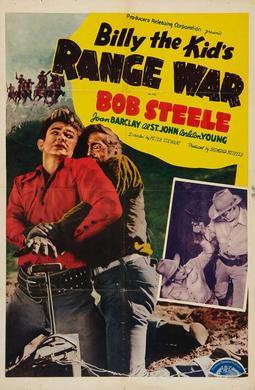
Billy The Kid’s Range War (1941, directed by Sam Newfield)


Billy the Kid was a big damn hero.

At least that’s the claim of Billy The Kid’s Range War, in which Billy (played by middle-aged Bob Steele) is a do-gooder with a comedic sidekick named Fuzzy (Al St. John) and a hankering to help Ellen Gorman (Joan Barclay) bring a new stagecoach line to town.  Williams (Karl Hackett) does want to the Gorman family to success so he hires Buck (Rex Lease) to dress up like Billy the Kid and ride a horse that looks like Billy the Kid’s and commit crimes, like killing Ellen’s father.  Framed for all those crimes that he didn’t commit and with his best friend (Carleton Young) ordered to arrest him, Billy decides to go under cover so that he can clear his good name.  Someone pretending to be Billy the Kid got him into this mess.  Now, Billy’s going to get out of it by pretending to be someone else.

The action is pretty standard for a B-western.  Mostly, it’s interesting to see a movie where Billy the Kid is actually a nice guy who gets framed.  No wonder a whole generation grew up with no idea about true history of the American frontier.  Sam Newfield directed a handful of Billy the Kid films and the capable Bob Steele starred in most of them but this is the only one that I’ve sat down and watched and it actually left me missing the production values of the Johnny Mack Brown films.  For fans of these type of westerns, there’s the promise of seeing familiar actors like George Cheseboro and Ted Adams doing there thing.  Even the outstanding character actor Milton Kibbee makes an appearance.  For those who do not like westerns, this film is not going to change their minds.

Despite the promise of the title, there is no range war in this movie.  There’s just Billy the Kid, trying to clear his good name.

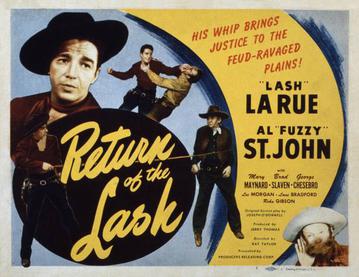
Return of the Lash (1947, directed by Ray Taylor)


There’s another range war brewing on the frontier.  Big Jim Kirby (George Chesebro) knows there’s plans for a new railroad so he wants to steal the land from the ranchers so he can make a fortune off a selling it.  Kirby calls in everyone’s mortgage, knowing they’ll never be able to pay.  Rancher Tom Grant (Buster Slaven) reaches out to Cheyenne Davis (Lash LaRue, a look alike for Humphrey Bogart)) and Fuzzy Q. Jones (Al St. John) for help.  Cheyenne raises the money but then he makes the mistake of trusting Fuzzy to deliver it.  Fuzzy takes a knock to the noggin and now, he’s got amnesia.  Where’s the money?

This is a standard B-western and you know the drill.  Big Jim’s henchmen don’t want that money to get paid.  Cheyenne is on the side of the angels.  Fuzzy provides comic relief.  Lash LaRue appeared in several B-westerns.  He never became as big a star as some of his contemporaries but he did have a gimmick that made him memorable.  Most westerns stars used guns.  LaRue had a bullwhip.  When LaRue was first offered the role of Cheyenne, he lied and said he could crack a whip.  After he struggled to teach himself, tiny production company PRC hired a professional trainer.  That was a huge expense for a poverty row studio but it paid off because LaRue became proficient with the whip and he had a surprisingly long career.  He was born Alfred LaRue.  The studio came up with the Lash nickname.  Many western stars, like Johnny Mack Brown, played characters who shared their name.  Lash almost always played Cheyenne Davis.

Lash LaRue’s movies were cheap and never that memorable.  In this one, Lash barely appears and most of the action is carried out by Al St. John as Fuzzy.  But Lash LaRue did play an important part in Hollywood history when he briefly came out of retirement to teach Harrison Ford how to crack a whip for a little film called Raiders of the Lost Ark.