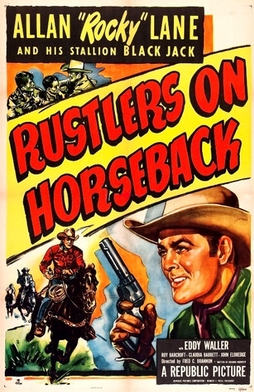
Before I say anything else, want to express how much I appreciate how straight-forward the title of Rustlers On Horseback is. There are horses and there are rustlers and often the rustlers do ride the horses. No lies detected.
Mistaken for being an outlaw, Marshal Rocky Lane (Allan Lane) becomes a member of a gang that’s led by Leo Straykin (Roy Barcroft). Leo has taken over the Reynolds Ranch and he’s planning on cheating a land agent out of $100,000 so that he can finance his future crimes. However, Leo isn’t working on his own and Lane and Nugget Clark (Eddy Waller) work to discover who the outlaw’s secret boss really is. (This is a low-budget, Poverty Row western so there aren’t that many possibilities.) However, Lane is not the only person working undercover. George Nader plays the son of the murdered ranch owner. Nader is looking for his own revenge.
This is a pretty standard Poverty Row western, with Lane looking convincing while riding a horse and shooting a gun. The “secret boss” makes the film a little bit more interesting than I was expecting but not that much more interesting. As is so often the case with these movies, how you react will depend on whether nor not you’re already a fan of the western genre when you watch it. If you like westerns that don’t have much filler between the chases and the gunfights, a western like this will be up your alley. If you’re not a fan of the genre, this film won’t change your mind.
This film was one of George Nader’s early roles. Nader made a handful of B-movies, including the infamous Robot Monster, before he branched into more mainstream films. Eventually, he found work in Europe and found fame as FBI Agent Jerry Cotton in a series of German films. After an accident left him sensitive to light and ended his acting career, Nader found success as a writer.
As for Allan Lane, he went on to become the voice of Mr. Ed.
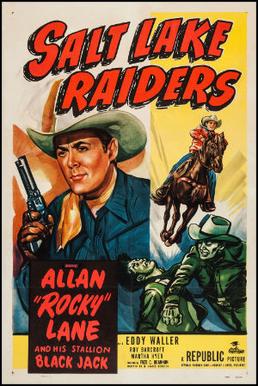
When convicted murderer Fred Mason (Myron Healey) escapes during a prison transfer, frontier Marshal Rocky Lane (Allan Lane) is brought in to re-capture him. It’s believed that Fred has returned to the ghost town of Silver City so that he can retrieve a buried treasure of $100,000. But when Rocky tracks Fred down, Fred insists that he was set up and that he didn’t kill anyone. Rocky, Fred, and Nugget Clark (Eddy Waller) are soon captured by outlaw Brit Carson (Roy Barcroft), who is also searching for the money.
I wasn’t planning on watching Salt Lake Raiders today. I’ve long wanted to review a Whip Wilson western and I was hoping I would be able to find one of his films, Silver Raiders, on YouTube. However, every search that I did for Silver Raiders just returned Salt Lake Raiders. Instead of watching a Whip Wilson western, I ened up just watching another Allan Lane western.
Salt Lake Raiders is a competently-made but not very memorable western. The person who set up Fred is no big surprise. The ghost town is a good location and, as always, Allan Lane is a believable hero. Eddy Waller, as usual, plays sidekick Nugget Clark and lovely Martha Hyer plays the daughter of the man who Fred was accused of killing, The movie holds your interest but it’s also so predictable that it is easy to understand why the studios abandoned B-western movies once television started giving them to people for free.
Unless I missed it, there is no mention of Salt Lake City or any other salt lakes in this movie.
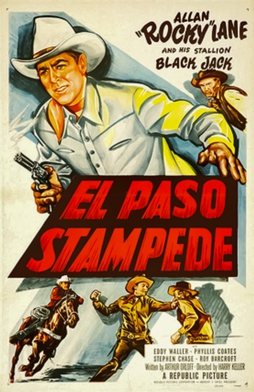
With the country distracted by the Spanish-American war, someone is stealing cattle on the border between Mexico and the United States. Federal marshal Rocky Lane (Allan Lane) is sent to investigate. He gets a job with Nugget Clark (Eddy Waller), a local feed merchant, and gets to know Nugget’s daughter, Alice (Phyllis Coates). As was usually the case with these B-westerns, it turns out that the band of onery outlaws is secretly being led by a villain who is an otherwise respectable member of society. When it comes to the Old West in these films, the biggest threat was not from the outlaws but instead from the greedy and corrupt settlers who wanted to get their own piece of the action and who were willing to sell out their own neighbors and sometimes their own country to get it. It falls to Rocky and Nugget to save the day, rescue Alice from the bad guys, and recover the cattle.
This was the last of the B-westerns to star Allan Lane as Rocky Lane and Eddy Waller as his sidekick. Unfortunately, the arrival of television made short programmers like this one obsolete. Kids could now just watch westerns on television instead of spending the day down at the theater. This was not a bad western for the Rocky Lane character to go out on, though. The plot is predictable but that’s to be expected for a 53-minute programmer like this one. However, Rocky is an appropriately square-jawed hero. He rides his horse, Black Jack, with authority and he looks convincing handling a gun and throwing a punch. There are actually some good shots involving the outlaws’s hideout, which just happens to be hidden behind a waterfall. For western fans, El Paso Stampede is a watchable and undemanding genre entry.
As I mentioned earlier, this was the last film to star Allan Lane. He appeared in a few more westerns after El Paso Stampede but it was always in supporting roles. Allan Lane appeared in 88 films, the majority of which were B-westerns like this one. Today, though, Lane is best-remembered for a role for which he wasn’t even given onscreen credit, providing the voice of the talking horse, Mr. Ed.
(Lisa is once again cleaning out her DVR! She recorded the 1931 film Night Nurse off of TCM on May 3rd.)
Night Nurse follows the sordid nights and quiet days of Lora Hart (Barbara Stanwyck), a high school dropout who dreams of becoming a nurse. Fortunately, she manages to get hired on as a trainee nurse at a big city hospital. Along the way, she gets a new BFF (Joan Blondell), a potential new boyfriend named Mortie (Ben Lyon), who is not only handsome and nice but a bootlegger too, and valuable life lessons on how to defend herself against smirky male doctors. Yay!
Unfortunately, even if you manage to survive the rigorous training program, the life of a night nurse is never easy. For instance, Lora gets hired to help look after the Ritchie children. The Ritchies may be rich but they’ve got so much drama going on that maybe it would be better if they were poor. The kids, for instance, are always sick and their doctor (Ralf Harolde) is apparently hooked on morphine. The mother (Charlotte Merriam) is always passed out drunk. Meanwhile, the family’s chauffeur, Nick (Clark Gable!), is a total brute who appears to have dangerous plans of his own.
Made in 1931, Night Nurse is a pre-code film, which is to say that it was made before the production code mandated what was and was not acceptable in the movies. Occasionally, among film fans like myself, there’s a tendency to assume that any pre-code film is actually going to be some sort of subversive, over-the-top masterpiece. We always think about the epic orgies that Cecil B. DeMille would slip into his silent films or maybe Douglas Fairbanks playing a constantly sniffing detective named Coke Ennyday in The Mystery of the Leaping Fish or the old stories about anonymous stagehands accidentally getting gunned down during the filming of Little Caesar or The Public Enemy. However, just as often, the pre-code label just means that a film is going to feature a few winky double entendres, a bootlegger hero, and at last one scene of the film’s heroine getting undressed. If you want to become an expert on 1930s lingerie, just spend a weekend watching pre-code films.
That’s certainly the case with Night Nurse, which only takes 7 minute to reach its first scene of nurses changing out of street clothes and into uniform. As for the bootlegger hero, that’s taken care of as soon as Mortie shows up and flashes his charming smile despite having a bullet in his hand. As played by Ben Lyon, Mortie is not exactly the most convincing gangster to ever show up in a pre-code film but no matter! He’s got charm and not every gangster can be Edward G. Robinson…
If it sound like I’m being critical of Night Nurse, I’m not. I watch Night Nurse every time that it shows up on TCM and I actually love the film. It’s a cheerfully silly melodrama, the type of innocently risqué film that could only be made during the pre-code era. Stanwyck and Blondell are a perfect team and whenever I listened to them trade sarcastic quips or watched them as they try to get away with breaking curfew, I couldn’t help but think of my own friends. Seriously, everyone should be as lucky as to have a BFF like Joan Blondell. And finally, you get Clark Gable as the bad guy. Gable is really mean and hateful in this movie and it takes a while to get used to seeing him without his mustache. To be honest, he’s not as handsome without the facial hair. But still — he’s Clark freaking Gable and, even in this early role, he had so much charisma and screen presence that it’s impossible not to watch him.
I was going to start this review by saying that Night Nurse sounded like a good title for an MCU film. However, my boyfriend informed me that apparently, there actually was a Marvel comic book called Night Nurse. Apparently, it had nothing to do with this movie. That’s a shame but hopefully, someone at Lifetime will read this review and decide to remake Night Nurse with an all Canadian cast. I’m keeping my fingers crossed on this one!
Anyway, Night Nurse shows up on TCM constantly. Keep an eye out for it!
Cowboy star Harry Carey had been around since motion pictures were knee-high to a cactus. He made his first film in 1908, working with pioneer director D.W. Griffith. He was already one of silent film’s biggest sagebrush stars by the time he made 1918’s STRAIGHT SHOOTER, the directorial debut of John Ford. When the talkies rolled around, Carey was over fifty and his leading man days were behind him. He transitioned into a fine character actor, and his talents are given a good showcase in the low-budget Western THE LAW WEST OF TOMBSTONE.
Carey is champion liar Bill Barker, a charming rascal who spins tall tales of his bravery fighting bloodthirsty Indians. The old windbag gets himself thrown out of New York circa 1881 when he tries to run a con on Wall Street tycoon Sam Kent. Not even his ex, a former saloon girl now passing herself off as continental singing…
 Before I say anything else, want to express how much I appreciate how straight-forward the title of Rustlers On Horseback is. There are horses and there are rustlers and often the rustlers do ride the horses. No lies detected.