Welcome to Retro Television Reviews, a feature where we review some of our favorite and least favorite shows of the past! On Tuesdays, I will be reviewing Saved By The Bell: The New Class, which ran on NBC from 1993 to 2o00. The show is currently on Prime.
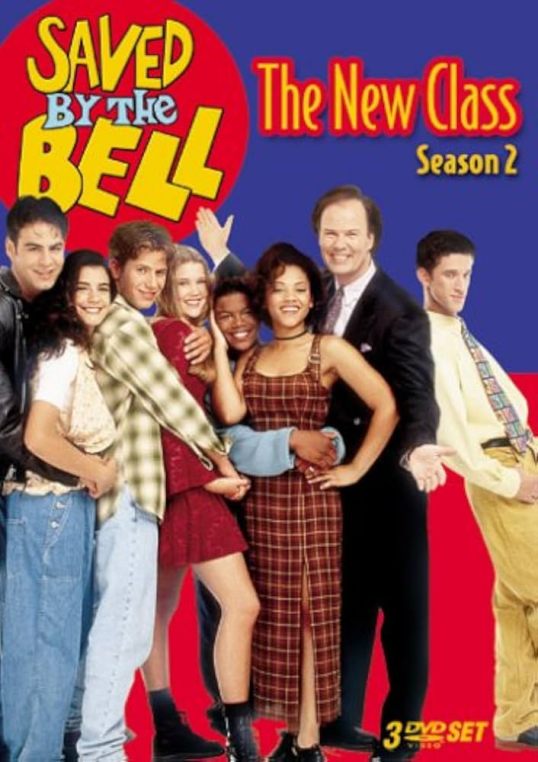
Oh no, it’s another Bayside vs Valley episode!
Episode 2.13 “Bayside Story”
(Dir by Don Barnhart, originally aired on October 22nd, 1994)
It’s time for Bayside and Valley to meet on the athletic field …. again!
*sigh*
Seriously, how much water can this show draw from the well of this particular rivalry? Ever since the original Saved By The Bell, there have been episodes about Bayside competing against Valley. Every episode begins with Mr. Belding complaining that Bayside never beats Valley. And yet, every episode also seems to end with Bayside defeating Valley so I’m really not sure what Belding’s problem is.
This episode, after Valley toilet papers the Bayside hallways, Mr. Belding complains that Bayside hasn’t defeated Valley since Slater graduated. Tommy D, Lindsay, Rachel, Megan, Brian, and Bobby all nod in agreement, which is odd since Slater graduated before any of them started at Bayside. Belding also mentions that Screech is in Vegas for Zack and Kelly’s wedding and, again, everyone nods as if they know who Zack and Kelly are. None of these students knew who Screech was when he first came back so how would they know Zack and Kelly? Am I just giving this too much thought? Perhaps.
As the head cheerleader, Megan is determined that the cheerleading squad (which is apparently made up of only her, Rachel, and Lindsay) is ready to declare death to Valley. But then she meets Doug (Bumper Robinson), the captain of Valley’s football team, and she ends up falling for him. Her friends are horrified that Megan would date someone from Valley but that doesn’t stop them from using Megan’s relationship to take advantage of Doug by pulling off one of those elaborate SBTB schemes where everyone dresses up in a stupid costume and distracts Doug long enough for Brian and Bobby to use a spy camera to take pictures of Valley’s playbook.
(Seriously, the whole thing is really stupid.)
Shortly afterwards, Megan ends up breaking up with Doug because she can’t handle everyone’s disapproval. The Gang feels guilty so they decide to give the pictures of the playbook back to Doug but, as opposed to just giving him the film, they instead decide to pull off another elaborate prank that involves everyone putting on costumes.
The reason why I’m not going into a lot of details about the pranks and the costumes is that it’s all really stupid. And I’m worried that if I spend too much time describing all of this, my brain might short-circuit. Let’s just say that it never occurs to anyone to just do the simplest of things, like maybe practicing really hard on the football field and trying to win the game legitimately.
That said, there a few things that work in this episode.
Amazingly, there actually is a funny running joke in this episode. Unlike most of the characters on this show, Brian knows nothing about American sports and continually has to be told the most basic facts about football. (“It’s played on a field, not a rink!”) Christian Oliver delivered his lines with the right amount of enthusiastic naivete and it was kind of nice to see Brian transformed into something more than just a stand-in for Zack.
The episode ends with the Bayside Gang meeting the Valley Gang at the Maxx and everyone crying as they realize that they’re not so different after all. That was actually kind of sweet. And then Belding ran in wearing riot gear because he was convinced a fight was about to break out. That actually made me laugh a little. So, dumb pranks aside, this episode wasn’t a total loss.
In conclusion, I should mention that my high school had a hated rival that was actually only a few blocks away from us. Our football team hated their football team and all that other stuff. Unfortunately, since my school was pretty much an art school, I don’t think we ever won a game against them. Some of that was because my school didn’t even have a football field so our team had to go over to the rival school whenever they wanted to practice.
Seriously, not even Slater could have saved them.

 Long before

