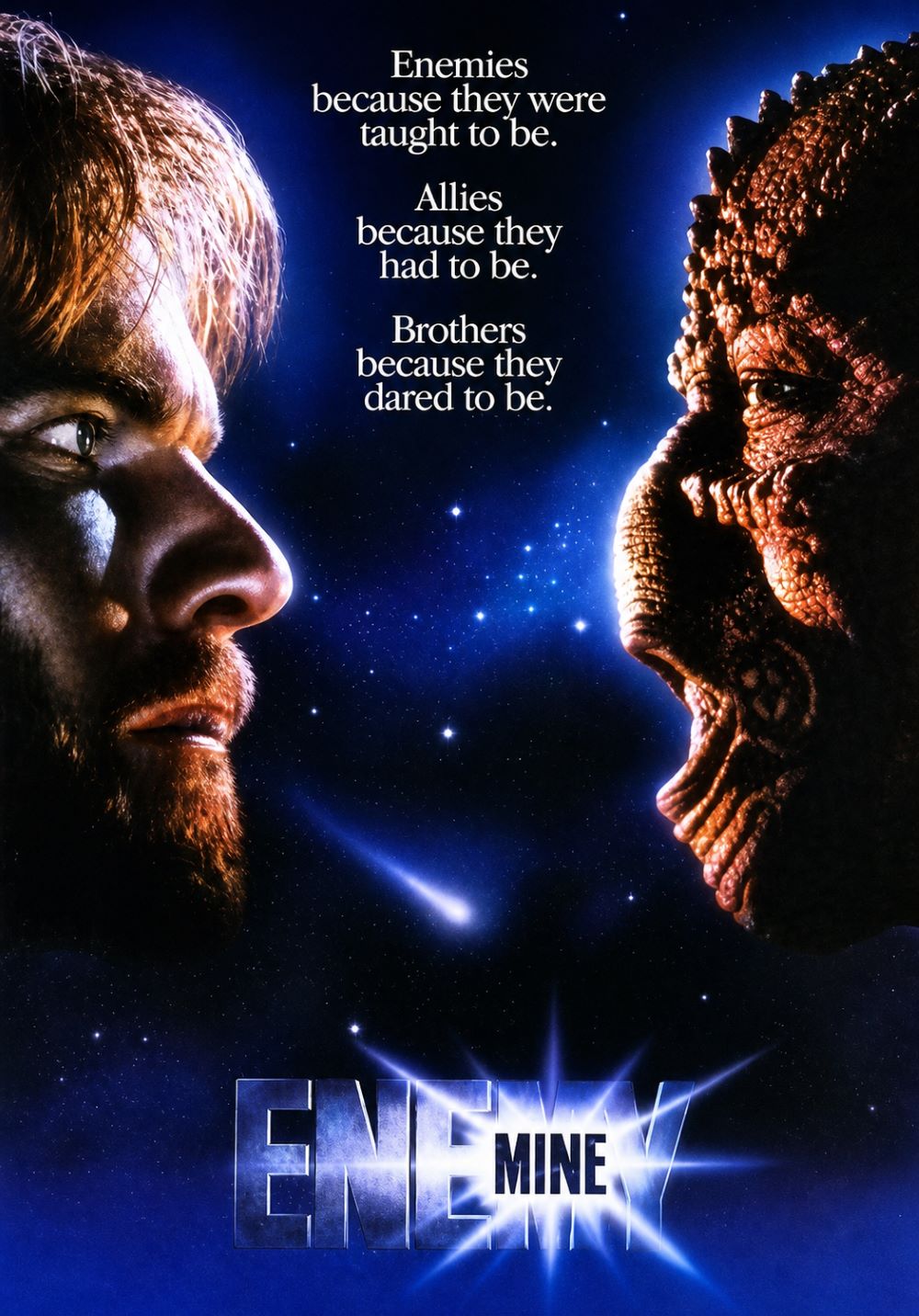
“Truth is truth.” – Jeriba Shigan
One of those 1980s sci-fi movies that sneaks up on you with more heart than flash, Enemy Mine turns a pulpy premise into something genuinely moving under Wolfgang Petersen’s steady hand. What starts as a straightforward tale of enemies forced together ends up digging deep into survival, prejudice, and the unlikely bonds that form when everything else falls away.
The storyline kicks off in the middle of an interstellar war between humans and the Drac, a reptilian alien species. Human pilot Willis Davidge, played by Dennis Quaid, crash-lands on a harsh, storm-battered planet after a dogfight with Drac warrior Jeriba Shigan. At first, it’s pure hate: they clash, scheme, and barely survive the planet’s brutal environment—freezing winds, toxic air, and hungry scavengers. But necessity breeds uneasy teamwork, and from there, the film charts a slow thaw into mutual respect and friendship. The plot builds to bigger stakes when Jeriba faces a pregnancy unique to their species, leading to themes of parenthood, loss, and legacy that give the story real emotional weight.
Interestingly, Enemy Mine‘s basic premise echoes John Boorman’s 1968 war drama Hell in the Pacific, where an American airman (Lee Marvin) and a stranded Japanese soldier (Toshiro Mifune) wash up on the same deserted island and must cooperate to survive after initial violent antagonism. Both films hinge on that classic setup of mortal enemies isolated together, grappling with a language barrier that heightens the tension—grunts, gestures, and improvised signals become their only bridge. But where Boorman leans into raw cynicism, ending on an ambiguous and bleak note that questions if reconciliation is even possible, Enemy Mine flips the script toward optimism, letting understanding bloom into a full-fledged familial bond.
What elevates Enemy Mine beyond typical space opera is its focus on themes that feel timeless, even if the delivery is pure ’80s cheese. The human-Drac conflict is a clear stand-in for racism and xenophobia, showing how propaganda and fear turn “others” into monsters in our minds. Davidge starts spouting all the usual human supremacist lines, while Jeriba embodies alien pride, but isolation strips away those defenses. The movie argues that empathy isn’t innate—it’s forged through shared hardship, language lessons (Davidge memorably recites Drac poetry), and vulnerability. There’s a queer undercurrent too, in the intense, almost parental intimacy that develops, challenging binary ideas of enemy and ally.
Dennis Quaid nails Davidge as a cocky everyman with a hidden soft side. He brings brash energy to the early fights—grinning through gritted teeth, improvising weapons from junk—but lets cracks show as grief and responsibility hit. His arc from hothead to devoted guardian feels earned, especially in quieter moments like teaching the Drac child human songs. Louis Gossett Jr. is even more impressive under layers of prosthetics as Jeriba, giving the alien a dignified, wry voice that cuts through the makeup. He conveys wisdom and humor without preaching, making Jeriba’s final lessons about tolerance land with quiet power. Their chemistry carries the film; you buy the shift from foes to family because these two sell every beat.
Thematically, Enemy Mine shines brightest in its exploration of fatherhood across species lines. After tragedy strikes, Davidge steps up for Jeriba’s child, Zammis, turning the story into a tale of nurture over nature. It’s about breaking cycles—passing on culture, rituals, and values not to perpetuate war, but to build peace. The film critiques blind loyalty to one’s side, showing how the real enemy might be the systems that demand it. Petersen, fresh off Das Boot, keeps the tone earnest, balancing tense survival scenes with tender rituals like Jeriba’s egg-laying or Davidge’s makeshift cradle. Sure, the effects age unevenly—those Drac faces look rubbery now—but the emotional core holds up.
Revisiting it today, Enemy Mine feels like a forgotten gem in the era of Aliens and Star Wars sequels. It dares to be intimate amid the spectacle, prioritizing character over conquest. The climax, with its courtroom-like showdown back in human space, hammers home the anti-war message without feeling forced. Quaid and Gossett elevate the script’s earnestness, making the bromance-turned-familial bond resonate. It’s not flawless—the pacing drags in spots, and some twists feel convenient—but its sincerity wins out. In a genre often about blowing stuff up, this one’s about building something human (or Drac) from the wreckage.
Enemy Mine reminds us that enemies are just strangers we haven’t met yet. Through Davidge and Jeriba’s journey, it champions understanding over ideology, legacy over vengeance. Quaid’s charisma and Gossett’s gravitas make it stick, turning a B-movie setup into a heartfelt plea for connection. If you’re into thoughtful sci-fi with soul, it’s worth a rewatch—imperfect, but profoundly kind.