Documentary Review: Marjoe (dir by Howard Smith and Sarah Kernochan)


Before Marjoe Gortner was an actor, he was a preacher.

Actually, that might be a bit too glib on my part. According to Marjoe, he was never more of an actor than when he was standing under a tent and preaching.

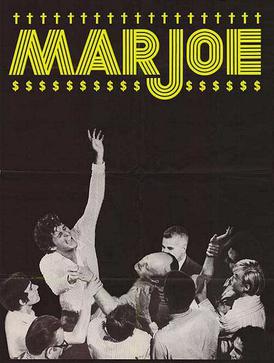
The 1972 documentary Marjoe opens with footage of a four-year-old Marjoe Gortner wearing a white button-down shirt and a bow tie and preaching about how all the sinners are going to burn in Hell. We watch as young Marjoe performs a marriage. We see his parents beaming as Marjoe delivers a fire-breathing sermon. In a voice-over, an adult Marjoe Gortner explains that he was named after Mary and Joseph and that both of his parents were active on the Pentecostal revival circuit. His father was a preacher. At four years old, Marjoe became the world’s youngest ordained preacher. Marjoe talks about how the novelty of a child preacher drew in crowds. By the time he was 14, he had brought in over four million dollars to his family’s ministry. When crowds turned out to be less interested in a teenage preacher than they had been in a child preacher, Marjoe’s father left the family and took the money with him.

We cut to Marjoe Gortner at 27. He’s tall, a little bit gawky. He has curly hair and a beak-like nose. He’s not exactly handsome, but when he speaks, he still has the charisma that once made him a superstar in evangelical circles. He’s talking to a documentary crew who are about to follow him on what he says will be his final revival tour. Marjoe claims that, even as a child, he never really believed or even understood what he was preaching. He was raised to perform, and that’s what he did. Now, Marjoe says that he’s had a crisis of conscience. In public, he’s still a fire-and-brimstone preacher who claims to be able to heal the sick and whose rhythmic sermons cause people to dance, speak in tongues, and give away their money. (The money, Marjoe explains, is the important part.) He preaches against drugs and sin and anyone who believes differently than he does. In private, Marjoe is a pot-smoking beatnik (and indeed, beatnik would be the right term to use because Marjoe’s a bit too cynical to be considered a hippie) who enjoys hanging out with the same people that he condemns from the stage.

The documentary features a lot of footage of Marjoe at various revival meetings, preaching and showing off the moves that he says he copied from Mick Jagger. We watch as Marjoe has an awkward reunion with his estranged father, who shows up to preach under the same tent as his son. We watch as Marjoe repeatedly counts his money. Marjoe revels in being a showman and admits that he still loves the feeling of holding the emotions of his audience in the palm of his hand. As creepy as the footage sometimes is, there’s a definite elitism to the documentary crew, of which they don’t really seem to be aware. Of course, the film seems to be saying, this would happen in the South. We Northerners are too smart to fall for Marjoe’s act. And yet, just the fact that they’re filming him shows that they have fallen for his act. They just don’t realize it.
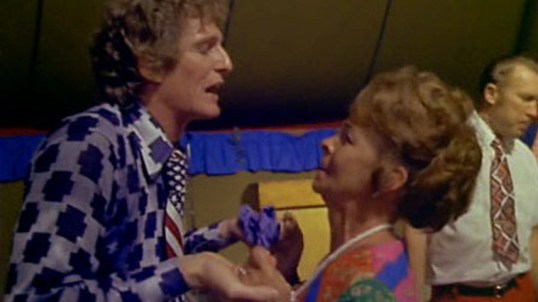
While the revival footage is indeed fascinating (one can really feel the audience getting swept up in Marjoe’s sermons), the film’s most interesting moments are when we see Marjoe talking to the documentarians. For all the talk about how he wants to finally be himself, Marjoe never stops performing. Even when he’s confessing and claiming to be telling the truth, Marjoe is acting. One gets the feeling that performing is all that Marjoe ever knew, and certainly it makes it easy to understand why, in the years following this documentary, he found success as a character actor. There’s never a moment in the documentary in which Marjoe isn’t “on.” In the end, one gets the feeling that he’s conning the documentarians just as easily as he’s conning the faithful. When Marjoe says that he is “bad but not evil,” it ultimately feels like another performance. Marjoe spends the documentary taking viewers behind the scenes, and yet he’s as much of an enigma at the end of the documentary as he was at the beginning. He’s a fascinating character, if only because it’s impossible to tell how much of anything is real to him.

(Indeed, watching Marjoe, I was reminded of Elizabeth Holmes’s disturbingly empty smile in the trailer for the upcoming documentary You Can See Everything.)

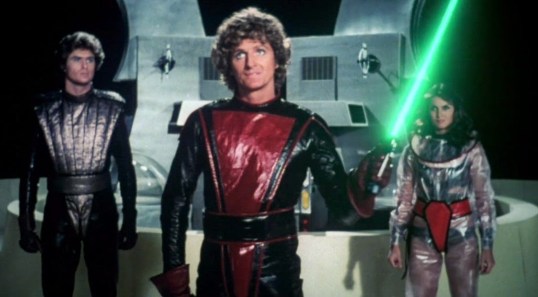
Released in 1972, Marjoe won the Oscar for Best Documentary. Marjoe Gortner, who passed away last week at the age of 82, had a lengthy acting career, one in which he often played con men and other outlaws. His final role was in 1995’s Wild Bill. He played a preacher.  My favorite Gortner role will always be as Akton in 1978’s Starcrash.
Horror on the Lens: I Bury The Living (dir by Albert Band)


Today’s Horror on the Lens comes to use from 1958.  It’s entitled I Bury The Living and say whatever you want about the actual film, that’s a great title.

In I Bury The Living, Richard Boone plays Robert Kraft, the newly appointed chairman of a committee that oversees the local cemetery.  Through a series of unlikely events, Kraft becomes convinced that, through the use of black and white push-pins, he can control who will live and who will die.

Does Robert really have God-like powers or is something else happening?

Watch below to find out!  I Bury The Living is no Dellamorte Dellamore but it’s still an enjoyably over the top piece of cemetery mayhem.

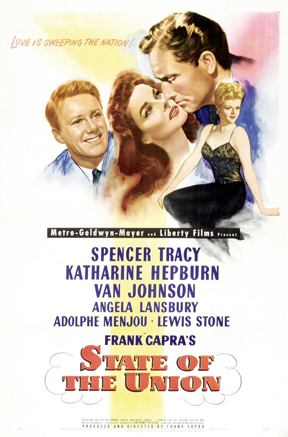
Shattered Politics #9: State of the Union (dir by Frank Capra)


Sotu1948

“Politicians have remained professionals only because the voters have remained amateurs!” — State of the Union (1948)

Does anyone remember the Americans Elect fiasco of 2012?

Americans Elect was an organization set up by a bunch of businesspeople, attorneys, and out-of-office politicians.  Their stated goal was to challenge the political establishment, shake up the two-party system, and elect a president.  The idea was that the party would hold a nationwide primary.  Any registered U.S. voter could go online and cast their vote on what they thought should be in the party’s platform and who they thought should be the Americans Elect presidential candidate.  Whoever won this nationwide primary would be required to 1) run on the platform and 2) pick a vice presidential candidate from the opposite party.

And all would be right with the world, right?

Right.

Anyway, I did register as an American Elect delegate, just because I was curious to see who was getting votes in the nationwide primary and who wasn’t.  (And yes, I did cast a vote.  I voted for Dallas County Commissioner Elba Garcia.)  Looking over the site, I saw that all of the usual suspects were getting votes — Ron Paul, Hillary Clinton, Michael Bloomberg, Donald Trump, and even Barack Obama.  None of the big vote getters were exactly nonpartisan or independent figures.  With the possible exception of Ron Paul, all of them were members of the very establishment that Americans Elect was claiming to challenge.

Anyway, Americans Elect ended up nominating no one for President and, as we all know, the 2012 election came down to choosing between two candidates who both received money from the same millionaires and, in the end, the status quo was upheld.

To be honest, everyone should have realized that Americans Elect was a sham as soon as the New York Times printed a column praising the effort.  Any truly independent political organization would never be praised by the New York Times.  Instead, like most so-called independent political organizations, Americans Elect was just a case of certain members of the establishment slumming.

So, the lesson of American Elect would seem to be that any attempt to run outside of the mainstream will, in the end, simply lead you back to the mainstream.  That was an expensive lesson for all of the volunteers who devoted their time to getting Americans Elect on the ballot in 28 states.  It was a lesson that they could have learned much more easily by watching the 1948 film, State of the Union.

In State of the Union, newspaper publisher Kay Thorndyke (Angela Lansbury) wants to make her lover, Grant Matthews (Spencer Tracy), President of the United States.  Grant is a no-nonsense, plain-spoken businessman who is quick to explain that he loves and cares about his country but that he hates partisan politics.  (In many ways, it’s impossible not to compare Grant to … well, to just about every single wealthy businessman who has ever run for public office while claiming to essentially be nonpolitical.  The big difference is that Grant actually means it.)  However, by subtly appealing to both his ego and his patriotism, Kay convinces Grant to run.  With the help of sleazy Jim Conover (Adolphe Menjou) and the sardonic Spike McManus (Van Johnson), Kay uses her money and her newspapers to turn Grant into a viable candidate.

The only problem is that Grant is separated from his wife Mary (Katharine Hepburn) and, since this movie was made in the 1940s, everyone knows that Grant has to be seen as being a family man if he’s going to be elected.  For the election, Mary and Grant pretend to be happily married.

As the primary season continues, Grant finds himself being more and more manipulated by Kay and Jim.  Eventually, Grant is forced to make a decision between his campaign and his integrity…

Following Mr. Smith Goes To Washington and Meet John Doe, State of the Union was the third part of director Frank Capra’s political trilogy.  Based on a play (which, itself, was supposedly inspired by the 1940 Republican presidential candidate, Wendell Willkie), State of the Union never quite escapes its stage-bound origins.  Add to that, the film was probably a bit more shocking when it was first released in 1948.  In 2015, we’re used to idea of politicians being controlled by money.  But, in 1948, audiences were perhaps a little bit more innocent.

But, that said, State of the Union is still an entertaining film.  Needless to say, Spencer Tracy and Katharine Hepburn have a wonderful chemistry together and Hepburn gets a great drunk scene.  (Hepburn had such an aristocratic presence that it’s always fun to watch her do comedy.)  Angela Lansbury also does well, playing a character who could very well grow up to be the role she played in The Manchurian Candidate.

67 years after it was first released, State of the Union remains an entertaining film that makes some good and still relevant points.  In 2016, when you’re tempted to get involved with the latest version of Americans Elect, watch State of the Union instead.