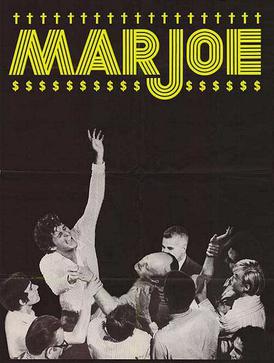
Before Marjoe Gortner was an actor, he was a preacher.
Actually, that might be a bit too glib on my part. According to Marjoe, he was never more of an actor than when he was standing under a tent and preaching.
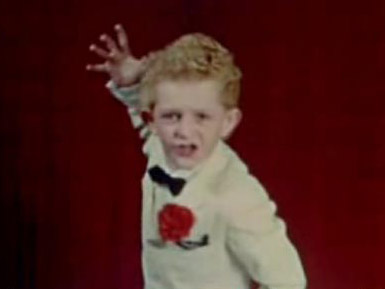
The 1972 documentary Marjoe opens with footage of a four-year-old Marjoe Gortner wearing a white button-down shirt and a bow tie and preaching about how all the sinners are going to burn in Hell. We watch as young Marjoe performs a marriage. We see his parents beaming as Marjoe delivers a fire-breathing sermon. In a voice-over, an adult Marjoe Gortner explains that he was named after Mary and Joseph and that both of his parents were active on the Pentecostal revival circuit. His father was a preacher. At four years old, Marjoe became the world’s youngest ordained preacher. Marjoe talks about how the novelty of a child preacher drew in crowds. By the time he was 14, he had brought in over four million dollars to his family’s ministry. When crowds turned out to be less interested in a teenage preacher than they had been in a child preacher, Marjoe’s father left the family and took the money with him.
We cut to Marjoe Gortner at 27. He’s tall, a little bit gawky. He has curly hair and a beak-like nose. He’s not exactly handsome, but when he speaks, he still has the charisma that once made him a superstar in evangelical circles. He’s talking to a documentary crew who are about to follow him on what he says will be his final revival tour. Marjoe claims that, even as a child, he never really believed or even understood what he was preaching. He was raised to perform, and that’s what he did. Now, Marjoe says that he’s had a crisis of conscience. In public, he’s still a fire-and-brimstone preacher who claims to be able to heal the sick and whose rhythmic sermons cause people to dance, speak in tongues, and give away their money. (The money, Marjoe explains, is the important part.) He preaches against drugs and sin and anyone who believes differently than he does. In private, Marjoe is a pot-smoking beatnik (and indeed, beatnik would be the right term to use because Marjoe’s a bit too cynical to be considered a hippie) who enjoys hanging out with the same people that he condemns from the stage.
The documentary features a lot of footage of Marjoe at various revival meetings, preaching and showing off the moves that he says he copied from Mick Jagger. We watch as Marjoe has an awkward reunion with his estranged father, who shows up to preach under the same tent as his son. We watch as Marjoe repeatedly counts his money. Marjoe revels in being a showman and admits that he still loves the feeling of holding the emotions of his audience in the palm of his hand. As creepy as the footage sometimes is, there’s a definite elitism to the documentary crew, of which they don’t really seem to be aware. Of course, the film seems to be saying, this would happen in the South. We Northerners are too smart to fall for Marjoe’s act. And yet, just the fact that they’re filming him shows that they have fallen for his act. They just don’t realize it.
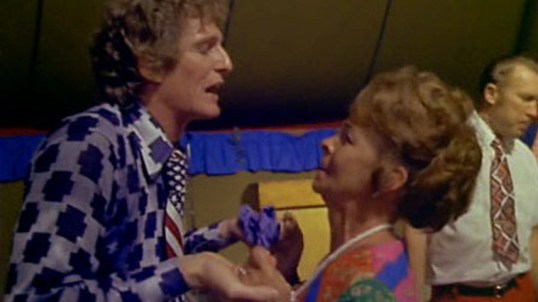
While the revival footage is indeed fascinating (one can really feel the audience getting swept up in Marjoe’s sermons), the film’s most interesting moments are when we see Marjoe talking to the documentarians. For all the talk about how he wants to finally be himself, Marjoe never stops performing. Even when he’s confessing and claiming to be telling the truth, Marjoe is acting. One gets the feeling that performing is all that Marjoe ever knew, and certainly it makes it easy to understand why, in the years following this documentary, he found success as a character actor. There’s never a moment in the documentary in which Marjoe isn’t “on.” In the end, one gets the feeling that he’s conning the documentarians just as easily as he’s conning the faithful. When Marjoe says that he is “bad but not evil,” it ultimately feels like another performance. Marjoe spends the documentary taking viewers behind the scenes, and yet he’s as much of an enigma at the end of the documentary as he was at the beginning. He’s a fascinating character, if only because it’s impossible to tell how much of anything is real to him.
(Indeed, watching Marjoe, I was reminded of Elizabeth Holmes’s disturbingly empty smile in the trailer for the upcoming documentary You Can See Everything.)
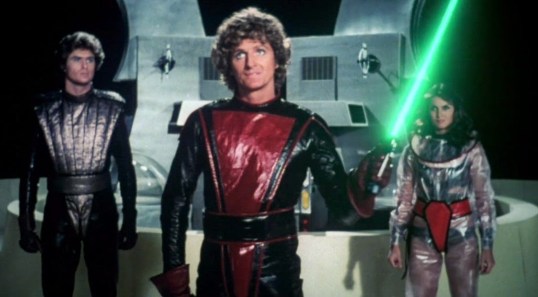
Released in 1972, Marjoe won the Oscar for Best Documentary. Marjoe Gortner, who passed away last week at the age of 82, had a lengthy acting career, one in which he often played con men and other outlaws. His final role was in 1995’s Wild Bill. He played a preacher. My favorite Gortner role will always be as Akton in 1978’s Starcrash.