“There is an evil which I have seen under the sun, and it is common among men.” — Ecclesiastes 6:1
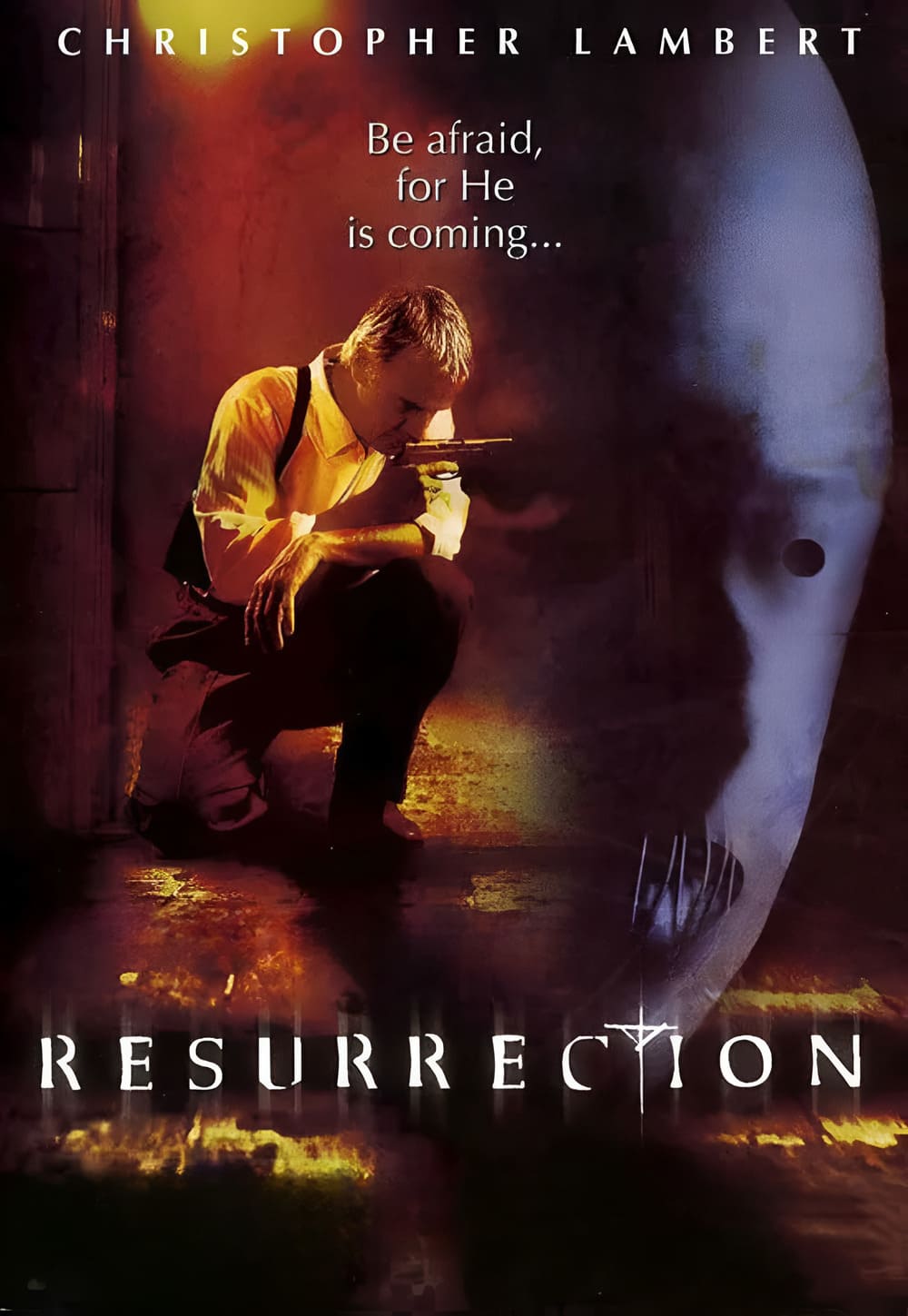
There is a fine line between a serial-killer thriller that gets under your skin and one that simply throws enough severed limbs at you to make an impression. Resurrection (1999) spends most of its running time somewhere between the two. Russell Mulcahy’s film has the haunted detective, the religiously obsessed murderer, and the crime scenes that look like nobody has paid the electricity bill in years. None of that is particularly original, but originality is not necessarily the deciding factor with a movie like this. What matters is whether the atmosphere, performances, and central mystery make you willing to follow it into another dark room. More often than not, they do.
Christopher Lambert plays John Prudhomme, a Chicago detective still struggling with the accidental death of his young son. His latest assignment involves a series of murders in which the victims have been left with body parts missing. Working alongside his partner, Andrew Hollinsworth, played by Leland Orser, Prudhomme discovers that the mutilations follow a biblical pattern. The killer believes he can reconstruct the body of Christ, with Easter serving as his deadline. It is an outrageous premise, but an effective one for a horror thriller: every murder advances a larger project, and every breakthrough brings the detectives closer to understanding just how far their suspect intends to go.
The obvious comparison is Se7en, and pretending otherwise would be giving Resurrection more credit for individuality than it earns. The oppressive city, elaborate murders, and collision of religious language with human depravity all feel familiar. Where Mulcahy’s film establishes some identity is in its willingness to push the material toward gruesome pulp. It is less interested in carefully cultivating philosophical dread than in making the killer’s obsession physically revolting. That does not make it the better movie, but it gives it something to work with beyond imitation. The mystery is not just about catching a murderer; it is about interrupting a grotesque act of construction.
That distinction makes the crime scenes more effective than their shock value alone would suggest. The missing limbs are not random embellishments designed to make an already unpleasant murder look worse. They are the reason the murders happen. Each victim has been reduced to a useful piece of somebody else’s fantasy, and that cold practicality is genuinely disturbing. The religious angle sometimes becomes heavy-handed, particularly when the screenplay spells out connections that already seem clear. Still, the central idea holds together well enough to give the investigation momentum. Knowing what the killer wants does not immediately tell the detectives how to stop him.
Mulcahy gives that investigation a suitably miserable visual landscape. Rooms feel cramped and contaminated, shadows seem to swallow whatever light reaches them, and the city offers very little relief from the ugliness indoors. At its best, the direction makes an ordinary doorway or hallway feel like the entrance to something nobody should discover. At its worst, the stylization starts competing with the material. Restless camerawork and aggressive visual flourishes occasionally announce the film’s anxiety rather than allowing the viewer to feel it. There are scenes where a steadier approach might have been more unsettling. Even so, the atmosphere remains one of the movie’s strongest selling points.
Lambert helps because he approaches Prudhomme without any apparent embarrassment about the material. His performance has rough edges, and some of the more emotional dialogue does not land with complete ease, but his tired expression and gravelly voice suit a man who is barely keeping himself together. He looks worn down before the investigation really gets moving, which gives the case somewhere to push him. More importantly, he does not treat the grisly premise like an invitation to ham it up. His sincerity gives the film a degree of emotional weight, even when the writing leans on familiar shorthand for a grieving father.
Orser makes a useful partner, bringing a different energy without turning Hollinsworth into comic relief. Their exchanges help establish the practical business of working a case, something the movie needs whenever the religious symbolism threatens to take over. They are more convincing as colleagues trying to make sense of horrible evidence than as pieces in an elaborate thematic puzzle. That distinction matters because the screenplay is not always as persuasive as its actors. Clues sometimes arrive with suspicious convenience, and certain complications feel less like believable obstacles than devices intended to keep the chase going for another stretch.
The same problem affects Prudhomme’s personal story. Connecting his grief to a case built around resurrection gives the film an obvious emotional framework, but it does not always develop that connection with much delicacy. The ideas are there: the desire to reverse death, the damage caused by loss, and the difference between faith and obsession. Too often, though, the movie states those concerns more clearly than it dramatizes them. Once the investigation shifts into its later confrontations, the balance tips further toward thriller mechanics. The tension survives, but some of the unsettling possibilities raised by the premise get left behind.
What ultimately makes Resurrection worth watching is not that it transcends its influences, but that it gets enough of the fundamentals right. The murders are disturbing, the central obsession is memorable, and Lambert gives the ugliness a battered human presence to work against. Mulcahy occasionally pushes too hard, while the screenplay occasionally asks for too much patience, but neither problem completely drains the experience. This is not the serial-killer thriller you recommend for airtight plotting or subtle insights into belief. It is the one you put on when you want something dark, lurid, and committed to making its familiar nightmare unpleasant again.