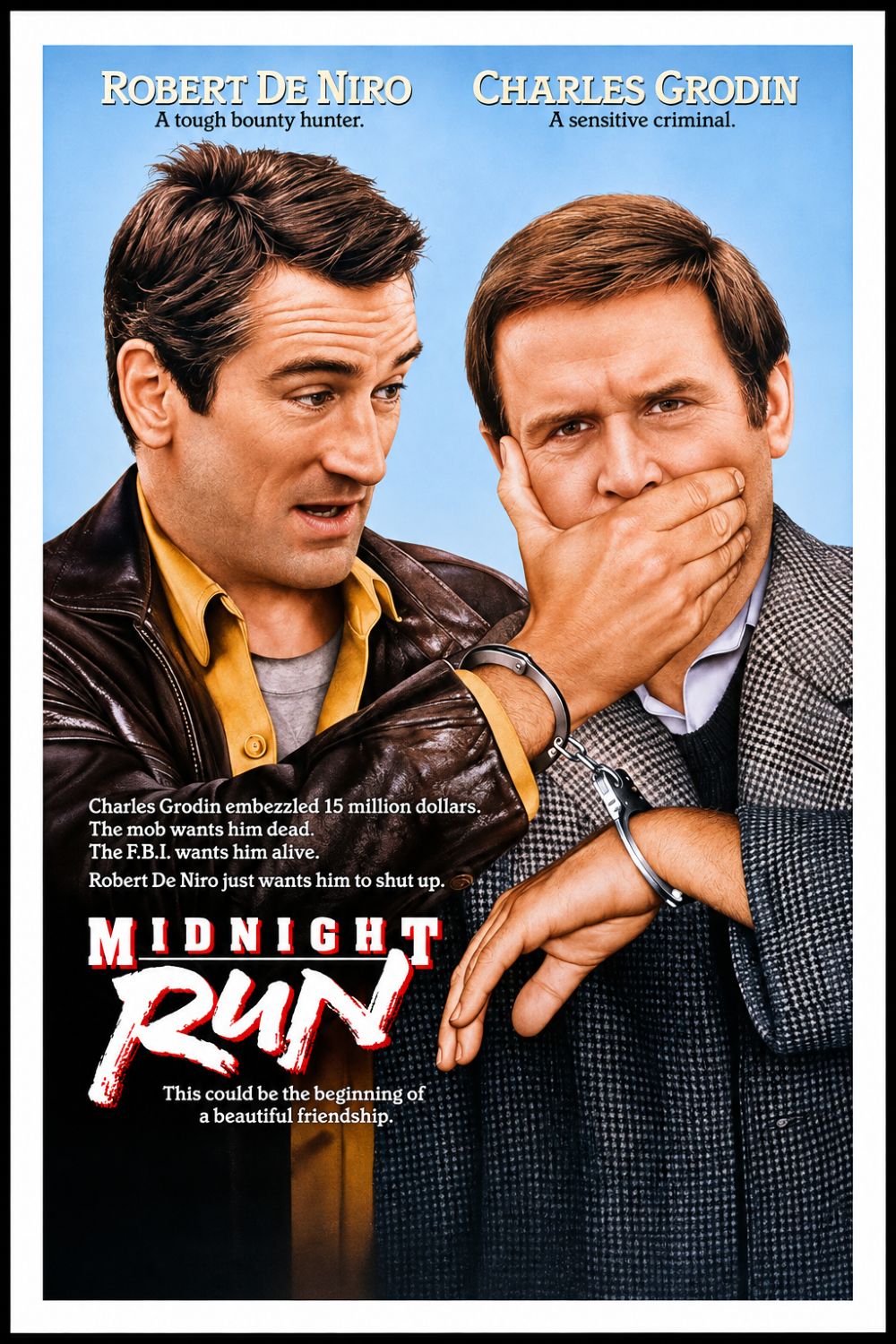
Film Review: Midnight Run (dir. by Martin Brest)


“Is this moron number one? Put moron number two on the phone.” — Jimmy Serrano

There’s a special kind of movie friendship that starts with one guy wanting to throw the other out of a moving vehicle, and Midnight Run might be the best version of it ever put on film. Released in 1988 and directed by Martin Brest, it looks like a routine action comedy and plays like a love story between two people who’d never admit it. Robert De Niro and Charles Grodin spend about two hours getting on each other’s nerves, and somehow that’s the most charming thing you’ll watch all year. Everything else in the movie, from the chases to the mobsters, is basically an excuse to keep them in the same space.

The plot is straightforward. Robert De Niro plays Jack Walsh, a former cop who now hunts down people who skip bail, and he’s desperate for a payday that will let him quit. His target is Jonathan “The Duke” Mardukas, an accountant who embezzled millions from a mob boss and then disappeared. All Jack has to do is bring him from New York to Los Angeles. Naturally, the FBI wants The Duke too, the mob wants him silenced, and a rival bounty hunter keeps popping up to snatch the reward. Every plan Jack makes falls apart, and the two end up improvising across the country, each stop more chaotic than the last.

The reason it works so well is that neither lead is the designated joker. In most buddy comedies, one character delivers the jokes while the other reacts, but here both men play their roles completely straight. Jack is blunt, tired, and quick to lose patience. The Duke is calm, courteous, and weirdly unbothered by the fact that people are trying to kill him. The humor comes from how stubbornly each sticks to his own view of the world, and it feels fresh because nobody is mugging for the camera.

De Niro is a revelation here, and a big part of the fun is watching him go against type. He’s best known for intense, dangerous characters, so seeing him play a worn-out guy who just wants to be left alone feels like a pleasant surprise. His comic timing is subtle: he lets a tense moment slide into the absurd without ever dropping the seriousness. There’s also real sadness in Jack, since he’s estranged from his family and bitter about the career he left behind. That emotional undercurrent gives the humor a little extra weight, and it makes the character easy to root for.

Charles Grodin, though, might be the film’s secret weapon. As The Duke, he delivers lines in a soft, reasonable voice that makes everything funnier. He criticizes Jack’s diet, warns him about the dangers of smoking, and tries to negotiate his own freedom like it’s a business meeting, all while the situation spirals. Grodin never overplays it, and his unflappable calm is the perfect counter to De Niro’s frustration. Their scenes feel loose and improvised, which gives the movie a natural rhythm you don’t often get in a big studio comedy.

The supporting cast fills out the world beautifully. Yaphet Kotto plays the FBI agent on their trail with a hilarious, weary dignity. John Ashton is the clueless rival bounty hunter Marvin Dorfler, whose overconfidence is a running gag. Dennis Farina is the menacing but funny mob boss Jimmy Serrano, and Joe Pantoliano is gloriously smarmy as the bail bondsman Eddie Moscone. Everyone gets a moment, and none of them feel like cardboard. Even the smallest characters have a distinct personality, which makes the whole film feel crowded in the best possible way.

As for the action, it’s good fun without stealing the spotlight. You get a desert car chase, a bus-station shootout, a helicopter, and a rough river escape, all of which keep the story moving. These scenes matter mostly because they force Jack and The Duke to rely on each other, and that slow shift is the real story. Danny Elfman’s lively score keeps the mood bouncy, so even the dangerous moments feel playful. Honestly, I remember the conversations more than the stunts, and I think that’s exactly what the movie intends.

What makes Midnight Run more than a standard comedy is the quiet emotional arc. Jack and The Duke start as captor and captive, trading insults and trying to outsmart each other, but their relationship gradually changes. There are no big speeches to mark it. Instead, it happens in small moments, like sharing food, telling a secret, or making a sacrifice when it would be easier to walk away. By the final stretch, you realize the movie has sneakily made you care about both men, so the stakes feel personal.

It does have flaws. The mob subplot can drag, and the “one last job” setup is a familiar trick that was already worn out in the late eighties. A couple of plot turns lean on coincidence, and some of the dialogue wears its era on its sleeve. But these small issues never sink the movie, because the characters are so strong and the pacing so confident. It knows when to be funny, when to be tense, and when to simply let two great actors talk.

I also admire how well it has aged. Plenty of comedies from the same decade feel stuck in their time, but this one stays sharp because its humor comes from personality rather than gimmicks. I’ve seen it more than once, and each viewing reveals something new, like a throwaway line or a tiny facial reaction I missed before. It showed audiences that De Niro could be wonderfully funny, and it remains the best showcase for Grodin’s gift for deadpan comedy.

So if you’ve got a long holiday weekend, leftovers in the fridge, and a free couple of hours, Midnight Run is exactly the kind of movie to put on. It’s easy to settle into, quick on its feet, and warm without being sappy. By the time it ends, you’ll feel like you’ve spent the evening with two old friends who never stopped bickering, and you’ll probably want to do it all over again soon.
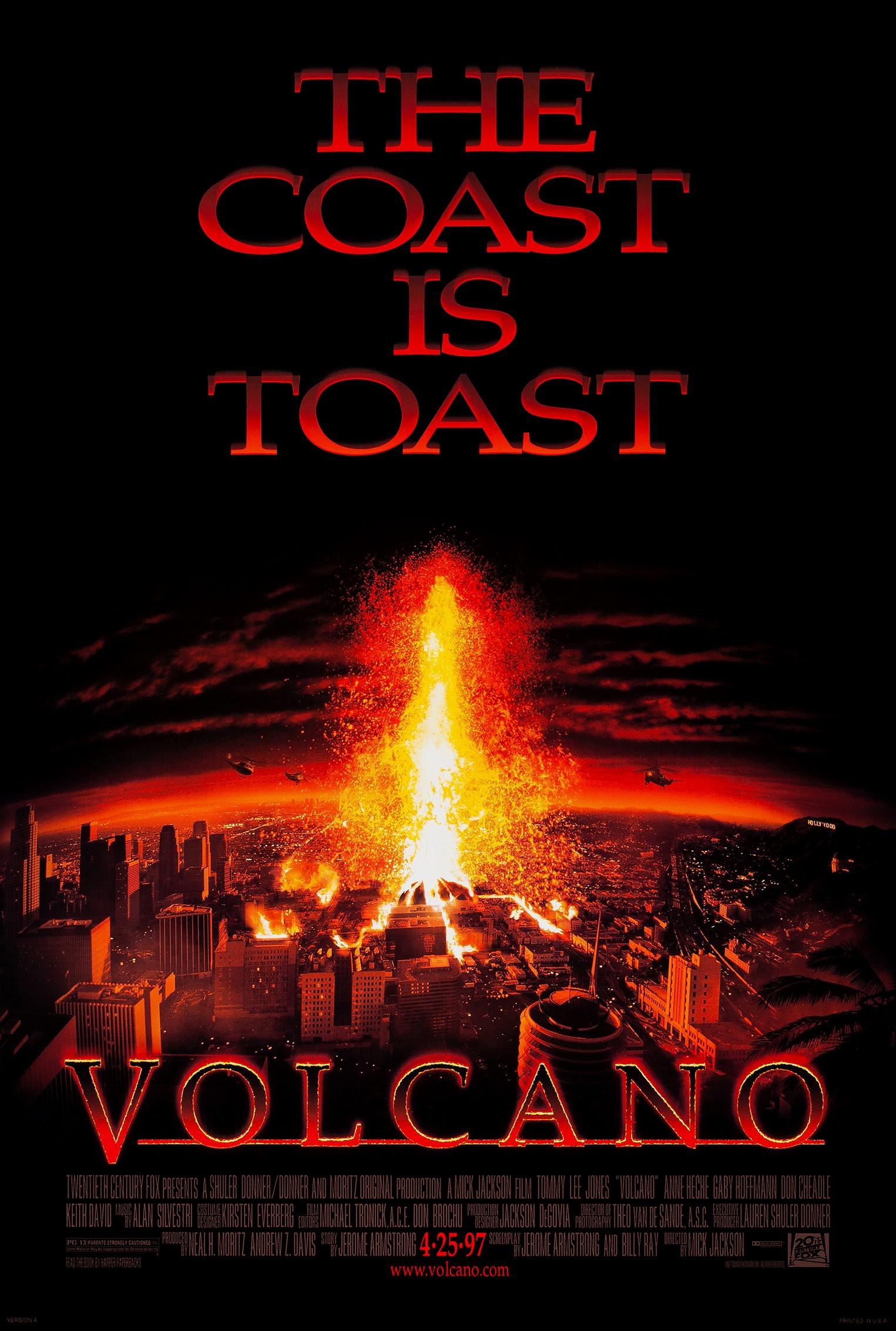
Review: Volcano (dir. by Mick Jackson)


“Lava? Right here in L.A.?” — Mike Roark

In Volcano, Los Angeles does not just face an earthquake, fire, or some ordinary civic emergency—it finds itself threatened by a river of lava tearing through the heart of the city. Directed by Mick Jackson, the 1997 disaster movie takes a premise that is almost impossible to accept on paper and sells it through speed, scale, and the sheer force of Tommy Lee Jones barking orders at people. A volcano erupting beneath Los Angeles, near the La Brea Tar Pits no less, is not exactly a model of scientific credibility. Still, the film is energetic enough to make its absurdity part of the entertainment.

The setup is wonderfully direct. An earthquake rattles Los Angeles, workers begin dying in underground tunnels, and a strange source of extreme heat is discovered beneath the city. Before long, lava is spilling into the streets, buildings are catching fire, and the city’s Emergency Management director Mike Roark, played by Tommy Lee Jones, has to coordinate an increasingly desperate effort to keep downtown Los Angeles from being wiped out. Anne Heche plays Dr. Amy Barnes, the geologist who realizes that the city is dealing with more than an earthquake or a gas leak. Together, Roark and Barnes become the film’s central problem-solving team: he is the practical, politically frustrated municipal leader, while she is the scientific expert trying to explain the impossible thing happening under everyone’s feet.

What makes Volcano enjoyable is that it does not waste much time pretending to be a subtle character drama. The movie’s main concern is escalation. Every time the heroes think they have contained the problem, the lava finds another way to spread. It comes through the subway. It crashes through pavement. It turns a normal Los Angeles intersection into a landscape from hell. The film understands the simple pleasure of watching ordinary urban infrastructure become a weapon or a liability. A train tunnel, a concrete barrier, construction equipment, storm drains, and even a city block all become parts of an enormous improvised plan to redirect molten rock.

Mick Jackson directs the action with enough urgency that the movie often works even when the science is wobbling badly. The special effects are very much of their era, combining practical fire, miniatures, digital lava, and lots of actors reacting to bright orange light. Some of the CGI has aged about as gracefully as one would expect from 1997, but the physical effects still have impact. The lava itself has a thick, almost muscular quality in the film. It does not just look like glowing liquid; it moves like an unstoppable wall that eats concrete, cars, and people. The images of lava flooding Los Angeles streets remain the reason to watch the movie. They are absurd, but memorably absurd.

The film also benefits from treating the crisis as a citywide emergency rather than simply a personal survival story. Roark is not a scientist, soldier, or superhero. He is basically a city official who has to make decisions under impossible conditions, manage multiple agencies, argue with politicians, and keep people from panicking. Tommy Lee Jones is perfect casting for that role. He has the right mixture of exhaustion, irritation, authority, and reluctant decency. Jones does not play Roark as a polished action hero; he plays him like a man who had plans for a quiet weekend with his daughter and instead ends up trying to stop Los Angeles from being buried under lava. His natural gruffness gives the movie more weight than it might otherwise have.

Anne Heche brings a different energy as Amy Barnes. Her character is often stuck delivering exposition, explaining volcanic activity, underground pressure, and why everyone is probably about to die, but Heche commits to it. She gives Amy enough urgency and intelligence that the scientific dialogue feels less like a lecture and more like another kind of emergency response. The relationship between Roark and Amy is also refreshingly restrained. The movie could have forced a big romantic subplot between them, but it mostly keeps their connection professional. They respect each other because they are both good at their jobs, which is more interesting than a last-minute disaster-movie love story.

The supporting cast is solid as well. Don Cheadle has a memorable role as Emmit Reese, a subway supervisor who becomes one of Roark’s most important allies. Keith David also adds welcome presence as a police lieutenant helping coordinate the response. Gaby Hoffmann plays Roark’s daughter Kelly, and while the daughter-in-peril material is fairly standard, it gives Jones’s character an emotional stake outside the command center. The film occasionally leans hard on familiar disaster-movie formulas, including separated family members, skeptical officials, and civilians making terrible decisions near obviously dangerous lava, but that is part of the package. Volcano is not trying to reinvent the genre. It is trying to make the genre run hot and fast for 104 minutes.

It is hard not to compare Volcano with Dante’s Peak, the other major volcano disaster movie released earlier in 1997. Dante’s Peak at least tries to ground its eruption in recognizable volcanic warning signs, scientific procedure, and the danger of officials ignoring experts until it is too late. Even when it becomes exaggerated, the film wants viewers to feel that its disaster could plausibly grow out of real geological conditions. Volcano, on the other hand, does not have much interest in maintaining that kind of credibility. Its premise is already much wilder: molten lava suddenly emerging beneath one of the largest cities in the United States. Rather than fight that inherent silliness, Mick Jackson’s film leans into it. Where Dante’s Peak aims for science-flavored suspense, Volcano goes for spectacle, turning Los Angeles itself into a giant disaster-movie set piece.

The biggest issue is that the movie never really decides how seriously it wants to take itself. At times, it is a grim urban catastrophe film in which people die in horrifying ways. One scene involving a transit worker trying to rescue another man from the lava is still surprisingly brutal and sad. At other times, Volcano is close to accidental comedy, especially whenever the film attempts to explain its geology with complete confidence. The idea of a full-scale volcanic eruption beneath Los Angeles is already a major stretch, but the movie goes beyond that into a kind of aggressively convenient science. The lava moves where the plot needs it to move, barriers hold until they need to fail, and the city seems able to mobilize massive engineering projects at a speed that would make any real emergency planner laugh.

Still, questioning the realism too closely misses the appeal. Volcano belongs to that specific 1990s era when major studios were throwing big budgets at destruction spectacles with recognizable stars and high-concept premises. The movie is essentially a monster film where the monster is a river of lava rolling through Los Angeles. Instead of a creature smashing buildings, it is molten rock swallowing streets, derailing infrastructure, and forcing ordinary people to run for their lives.

The movie is also unintentionally revealing about late-1990s disaster filmmaking. It has a strong faith in public-service workers, engineers, transit employees, firefighters, police officers, and regular people doing dangerous jobs because somebody has to do them. Roark’s strategy is not to defeat nature through one genius solution. It is to coordinate an enormous group effort, with people hauling concrete barriers, driving equipment, evacuating neighborhoods, and taking risks to buy the city more time. That civic-minded quality gives the film a little more heart than its reputation as a silly lava movie might suggest.

In the end, Volcano is neither a great disaster movie nor a completely disposable one. It is too scientifically goofy to be taken seriously as a realistic thriller, and its dialogue can be very blunt. Yet it has pace, personality, some genuinely effective spectacle, and a reliably entertaining Tommy Lee Jones performance at its center. It is the kind of movie where a man can face a molten river in downtown Los Angeles and somehow make you believe that yelling louder might solve the problem. For viewers in the mood for a big, fiery, unapologetically 1990s popcorn movie, Volcano remains a fun eruption of chaos.