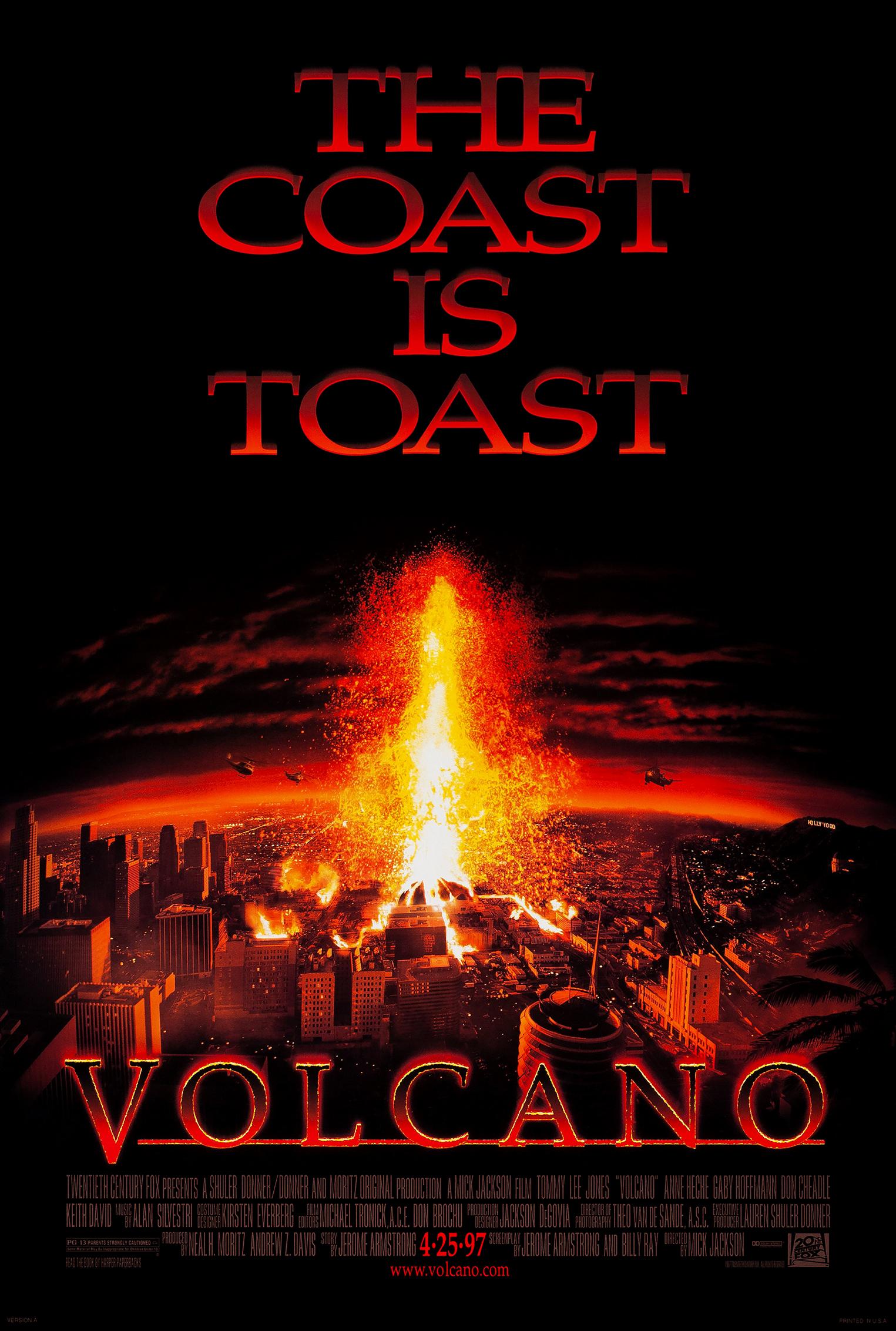
Review: Volcano (dir. by Mick Jackson)


“Lava? Right here in L.A.?” — Mike Roark

In Volcano, Los Angeles does not just face an earthquake, fire, or some ordinary civic emergency—it finds itself threatened by a river of lava tearing through the heart of the city. Directed by Mick Jackson, the 1997 disaster movie takes a premise that is almost impossible to accept on paper and sells it through speed, scale, and the sheer force of Tommy Lee Jones barking orders at people. A volcano erupting beneath Los Angeles, near the La Brea Tar Pits no less, is not exactly a model of scientific credibility. Still, the film is energetic enough to make its absurdity part of the entertainment.

The setup is wonderfully direct. An earthquake rattles Los Angeles, workers begin dying in underground tunnels, and a strange source of extreme heat is discovered beneath the city. Before long, lava is spilling into the streets, buildings are catching fire, and the city’s Emergency Management director Mike Roark, played by Tommy Lee Jones, has to coordinate an increasingly desperate effort to keep downtown Los Angeles from being wiped out. Anne Heche plays Dr. Amy Barnes, the geologist who realizes that the city is dealing with more than an earthquake or a gas leak. Together, Roark and Barnes become the film’s central problem-solving team: he is the practical, politically frustrated municipal leader, while she is the scientific expert trying to explain the impossible thing happening under everyone’s feet.

What makes Volcano enjoyable is that it does not waste much time pretending to be a subtle character drama. The movie’s main concern is escalation. Every time the heroes think they have contained the problem, the lava finds another way to spread. It comes through the subway. It crashes through pavement. It turns a normal Los Angeles intersection into a landscape from hell. The film understands the simple pleasure of watching ordinary urban infrastructure become a weapon or a liability. A train tunnel, a concrete barrier, construction equipment, storm drains, and even a city block all become parts of an enormous improvised plan to redirect molten rock.

Mick Jackson directs the action with enough urgency that the movie often works even when the science is wobbling badly. The special effects are very much of their era, combining practical fire, miniatures, digital lava, and lots of actors reacting to bright orange light. Some of the CGI has aged about as gracefully as one would expect from 1997, but the physical effects still have impact. The lava itself has a thick, almost muscular quality in the film. It does not just look like glowing liquid; it moves like an unstoppable wall that eats concrete, cars, and people. The images of lava flooding Los Angeles streets remain the reason to watch the movie. They are absurd, but memorably absurd.

The film also benefits from treating the crisis as a citywide emergency rather than simply a personal survival story. Roark is not a scientist, soldier, or superhero. He is basically a city official who has to make decisions under impossible conditions, manage multiple agencies, argue with politicians, and keep people from panicking. Tommy Lee Jones is perfect casting for that role. He has the right mixture of exhaustion, irritation, authority, and reluctant decency. Jones does not play Roark as a polished action hero; he plays him like a man who had plans for a quiet weekend with his daughter and instead ends up trying to stop Los Angeles from being buried under lava. His natural gruffness gives the movie more weight than it might otherwise have.

Anne Heche brings a different energy as Amy Barnes. Her character is often stuck delivering exposition, explaining volcanic activity, underground pressure, and why everyone is probably about to die, but Heche commits to it. She gives Amy enough urgency and intelligence that the scientific dialogue feels less like a lecture and more like another kind of emergency response. The relationship between Roark and Amy is also refreshingly restrained. The movie could have forced a big romantic subplot between them, but it mostly keeps their connection professional. They respect each other because they are both good at their jobs, which is more interesting than a last-minute disaster-movie love story.

The supporting cast is solid as well. Don Cheadle has a memorable role as Emmit Reese, a subway supervisor who becomes one of Roark’s most important allies. Keith David also adds welcome presence as a police lieutenant helping coordinate the response. Gaby Hoffmann plays Roark’s daughter Kelly, and while the daughter-in-peril material is fairly standard, it gives Jones’s character an emotional stake outside the command center. The film occasionally leans hard on familiar disaster-movie formulas, including separated family members, skeptical officials, and civilians making terrible decisions near obviously dangerous lava, but that is part of the package. Volcano is not trying to reinvent the genre. It is trying to make the genre run hot and fast for 104 minutes.

It is hard not to compare Volcano with Dante’s Peak, the other major volcano disaster movie released earlier in 1997. Dante’s Peak at least tries to ground its eruption in recognizable volcanic warning signs, scientific procedure, and the danger of officials ignoring experts until it is too late. Even when it becomes exaggerated, the film wants viewers to feel that its disaster could plausibly grow out of real geological conditions. Volcano, on the other hand, does not have much interest in maintaining that kind of credibility. Its premise is already much wilder: molten lava suddenly emerging beneath one of the largest cities in the United States. Rather than fight that inherent silliness, Mick Jackson’s film leans into it. Where Dante’s Peak aims for science-flavored suspense, Volcano goes for spectacle, turning Los Angeles itself into a giant disaster-movie set piece.

The biggest issue is that the movie never really decides how seriously it wants to take itself. At times, it is a grim urban catastrophe film in which people die in horrifying ways. One scene involving a transit worker trying to rescue another man from the lava is still surprisingly brutal and sad. At other times, Volcano is close to accidental comedy, especially whenever the film attempts to explain its geology with complete confidence. The idea of a full-scale volcanic eruption beneath Los Angeles is already a major stretch, but the movie goes beyond that into a kind of aggressively convenient science. The lava moves where the plot needs it to move, barriers hold until they need to fail, and the city seems able to mobilize massive engineering projects at a speed that would make any real emergency planner laugh.

Still, questioning the realism too closely misses the appeal. Volcano belongs to that specific 1990s era when major studios were throwing big budgets at destruction spectacles with recognizable stars and high-concept premises. The movie is essentially a monster film where the monster is a river of lava rolling through Los Angeles. Instead of a creature smashing buildings, it is molten rock swallowing streets, derailing infrastructure, and forcing ordinary people to run for their lives.

The movie is also unintentionally revealing about late-1990s disaster filmmaking. It has a strong faith in public-service workers, engineers, transit employees, firefighters, police officers, and regular people doing dangerous jobs because somebody has to do them. Roark’s strategy is not to defeat nature through one genius solution. It is to coordinate an enormous group effort, with people hauling concrete barriers, driving equipment, evacuating neighborhoods, and taking risks to buy the city more time. That civic-minded quality gives the film a little more heart than its reputation as a silly lava movie might suggest.

In the end, Volcano is neither a great disaster movie nor a completely disposable one. It is too scientifically goofy to be taken seriously as a realistic thriller, and its dialogue can be very blunt. Yet it has pace, personality, some genuinely effective spectacle, and a reliably entertaining Tommy Lee Jones performance at its center. It is the kind of movie where a man can face a molten river in downtown Los Angeles and somehow make you believe that yelling louder might solve the problem. For viewers in the mood for a big, fiery, unapologetically 1990s popcorn movie, Volcano remains a fun eruption of chaos.
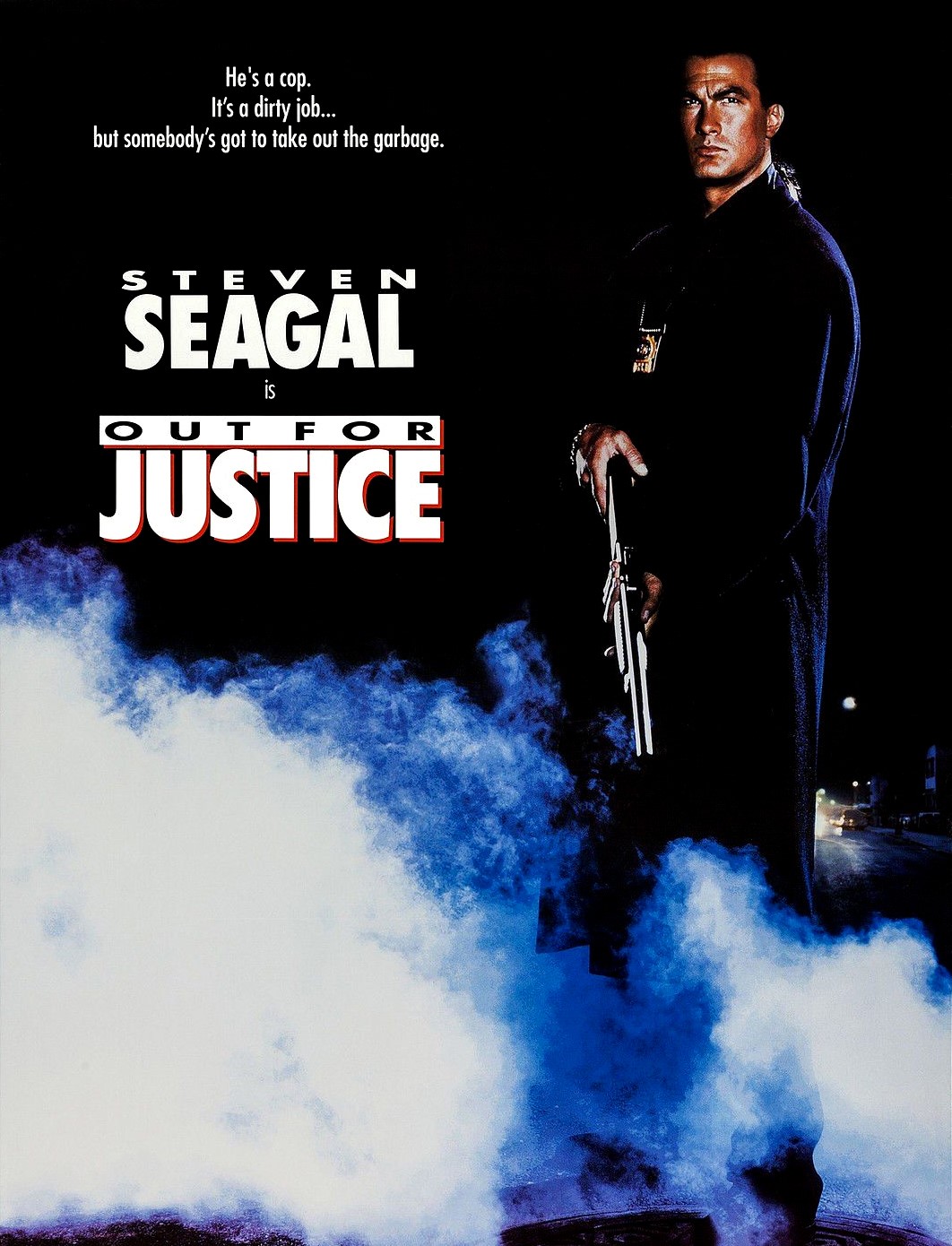
Guilty Pleasure No. 111: Out for Justice (dir. by John Flynn)


Out for Justice is the kind of movie that leans so heavily on its star’s ridiculous swagger that it stops being merely bad and ridiculous and becomes entertaining in a “can’t‑look‑away from the car‑crash” sort of way. It’s not a polished or especially sophisticated action film, but it has a rough, gleefully over‑the‑top energy that makes it a perfect guilty pleasure, the kind of early ’90s action crime movie that works less because of craft and more because of attitude, bruises, and sheer confidence.

At its core, Out for Justice is a revenge story so simple it barely bothers pretending to be anything else. Steven Seagal plays Gino Felino, a Brooklyn cop chasing the man responsible for his partner’s death, and the plot mostly functions as a chain of excuses to send him from one grimy neighborhood stop to the next, collecting broken noses and wounded pride along the way. That stripped‑down structure is part of the movie’s charm, because there’s no attempt to dress it up with complicated twists or emotional depth; it’s all forward momentum, all hard stares, all macho problem‑solving by fist and elbow.

One of the things that gives Out for Justice its off‑kilter charm is how every actor in the cast seems to have read the script as an invitation to extremes. Performances swing violently between scenery‑chewing over‑the‑top theatrics and barely‑there, almost sleepwalking subtlety, with almost nothing in the middle. Either you’re shouting, staring down suspects inches from their faces, or you’re slouched in the background mugging in silence. It shouldn’t work, but the sheer imbalance in energy somehow makes the film feel like a live wire instead of a flat ’90s programmer.

Nowhere is that more obvious than with William Forsythe’s villain, Richie Madano, who plays the role so far “out there” that it’s hard not to wonder if he was actually on a lot of coke like the character was written to be. He leans into every sneer, every twitch, and every unhinged stare until he starts to look less like a character and more like a walking drug‑induced nightmare. There’s a manic, unpredictable edge to his performance that makes him feel genuinely dangerous, even when the dialogue around him is pure tough‑guy parody. It’s a kind of commitment that could easily tip into self‑parody, but Forsythe owns it so completely that he ends up grounding the film’s madness instead of derailing it.

What really makes Out for Justice memorable is how fully it leans into Seagal’s absurd screen persona. He’s at his best here when he’s acting like a man who believes every room belongs to him, and that attitude gives the movie a weird, shameless energy that a lot of his later work lacked. Even when the dialogue is clunky or the Brooklyn swagger feels more imagined than lived‑in, Seagal’s self‑serious delivery turns the whole thing into a performance art piece of tough‑guy certainty. The film is unintentionally funny at times, but that only adds to the appeal, because it makes the movie feel even more like a relic from a time when action stars could be gloriously excessive without irony.

The action is the main draw, and this is where Out for Justice earns most of its reputation. The fights have that satisfying, bone‑crunching roughness that makes the violence feel tangible instead of slick, and the movie keeps finding excuses to escalate from intimidation to outright brutality. Seagal’s style here is less flashy than some of his contemporaries, but that works in the film’s favor because the choreography has a mean, close‑quarters edge to it. The result is a movie that often feels like it’s trying to win by sheer stubbornness, and honestly, that suits it perfectly.

There’s also a strong sleaze factor running through the whole thing, and that’s another reason it works as a “bad but good” movie. The neighborhoods feel dirty, the criminals are exaggerated to the point of cartoonish menace, and the film’s idea of atmosphere is basically to keep everything sweaty, smoky, and angry. Forsythe’s villain, in particular, leans so extravagantly into that sleaze that he ends up giving the film a properly nasty center. A lot of the supporting characters are basically there to be insulted, questioned, or thrown into a wall, but the movie gets enough mileage out of that rhythm that it never really becomes boring.

Still, there’s no reason to pretend Out for Justice is secretly elegant. The script is thin, the character work is mostly functional, and the movie often feels like it was assembled to move from one confrontation to the next as efficiently as possible. Some of the scenes drag, and the film’s macho posturing can wear thin if you’re not already in the mood for this kind of energy. It also has that peculiar Seagal‑era problem where the movie wants him to be a street‑level man of the people, but the character sometimes comes across more like a self‑mythologizing neighborhood warlord than an actual human being. That disconnect is part of the fun, but it is still a disconnect.

What keeps Out for Justice from becoming a throwaway is the confidence behind the nonsense. It feels like a movie made by people who believed that attitude could substitute for sophistication, and in this case, they were mostly right. The pacing may be uneven, the story may be paper‑thin, and the acting may veer into laughable territory, but the movie never loses its nerve, and that gives it a strange kind of integrity. It doesn’t apologize for being dumb, and that unashamed commitment is exactly why it has aged into cult‑status entertainment instead of disappearing into the pile of generic action forgettables.

That’s why Out for Justice works so well as a guilty pleasure. It’s violent, ridiculous, and very much stuck in its own macho time capsule, but those flaws are inseparable from the appeal. The movie’s “bad but good” vibe comes from the way it accidentally becomes bigger and funnier than it likely intended, while still delivering enough real action‑movie satisfaction to justify the ride. It’s the kind of film that invites eye‑rolling and cheers in almost equal measure, and that balancing act is what makes it such a durable little cult object.

In the end, Out for Justice is not a masterpiece, and it doesn’t need to be. It’s a bruised, swaggering, over‑confident slab of early ’90s action cheese that knows how to sell its own nonsense with just enough force to make it lovable. To borrow from film reactor EOM Reacts (who is hilarious, by the way), “This whole movie screams cocaine.” If you want clean storytelling or nuanced performances, it will probably frustrate you. If you want a hard‑edged, trashy, surprisingly watchable Seagal vehicle that embodies the “bad it’s good” spirit—including a cast that either chews every morsel of the scenery or fades into the wallpaper—Out for Justice hits the mark.

Also, be on the look out for a quick cameo of Kane Hodder (who played Jason Voorhees for many of the franchise’s many sequels) as a gang member and for Dan Inosanto (teacher to Bruce Lee and Chuck Norris) as a character named “Sticks.”

Previous Guilty Pleasures

  1. Half-Baked
  2. Save The Last Dance
  3. Every Rose Has Its Thorns
  4. The Jeremy Kyle Show
  5. Invasion USA
  6. The Golden Child
  7. Final Destination 2
  8. Paparazzi
  9. The Principal
  10. The Substitute
  11. Terror In The Family
  12. Pandorum
  13. Lambada
  14. Fear
  15. Cocktail
  16. Keep Off The Grass
  17. Girls, Girls, Girls
  18. Class
  19. Tart
  20. King Kong vs. Godzilla
  21. Hawk the Slayer
  22. Battle Beyond the Stars
  23. Meridian
  24. Walk of Shame
  25. From Justin To Kelly
  26. Project Greenlight
  27. Sex Decoy: Love Stings
  28. Swimfan
  29. On the Line
  30. Wolfen
  31. Hail Caesar!
  32. It’s So Cold In The D
  33. In the Mix
  34. Healed By Grace
  35. Valley of the Dolls
  36. The Legend of Billie Jean
  37. Death Wish
  38. Shipping Wars
  39. Ghost Whisperer
  40. Parking Wars
  41. The Dead Are After Me
  42. Harper’s Island
  43. The Resurrection of Gavin Stone
  44. Paranormal State
  45. Utopia
  46. Bar Rescue
  47. The Powers of Matthew Star
  48. Spiker
  49. Heavenly Bodies
  50. Maid in Manhattan
  51. Rage and Honor
  52. Saved By The Bell 3. 21 “No Hope With Dope”
  53. Happy Gilmore
  54. Solarbabies
  55. The Dawn of Correction
  56. Once You Understand
  57. The Voyeurs 
  58. Robot Jox
  59. Teen Wolf
  60. The Running Man
  61. Double Dragon
  62. Backtrack
  63. Julie and Jack
  64. Karate Warrior
  65. Invaders From Mars
  66. Cloverfield
  67. Aerobicide 
  68. Blood Harvest
  69. Shocking Dark
  70. Face The Truth
  71. Submerged
  72. The Canyons
  73. Days of Thunder
  74. Van Helsing
  75. The Night Comes for Us
  76. Code of Silence
  77. Captain Ron
  78. Armageddon
  79. Kate’s Secret
  80. Point Break
  81. The Replacements
  82. The Shadow
  83. Meteor
  84. Last Action Hero
  85. Attack of the Killer Tomatoes
  86. The Horror at 37,000 Feet
  87. The ‘Burbs
  88. Lifeforce
  89. Highschool of the Dead
  90. Ice Station Zebra
  91. No One Lives
  92. Brewster’s Millions
  93. Porky’s
  94. Revenge of the Nerds
  95. The Delta Force
  96. The Hidden
  97. Roller Boogie
  98. Raw Deal
  99. Death Merchant Series
  100. Ski Patrol
  101. The Executioner Series
  102. The Destroyer Series
  103. Private Teacher
  104. The Parker Series
  105. Ramba
  106. The Troubles of Janice
  107. Ironwood
  108. Interspecies Reviewers
  109. SST — Death Flight
  110. Undercover Brother