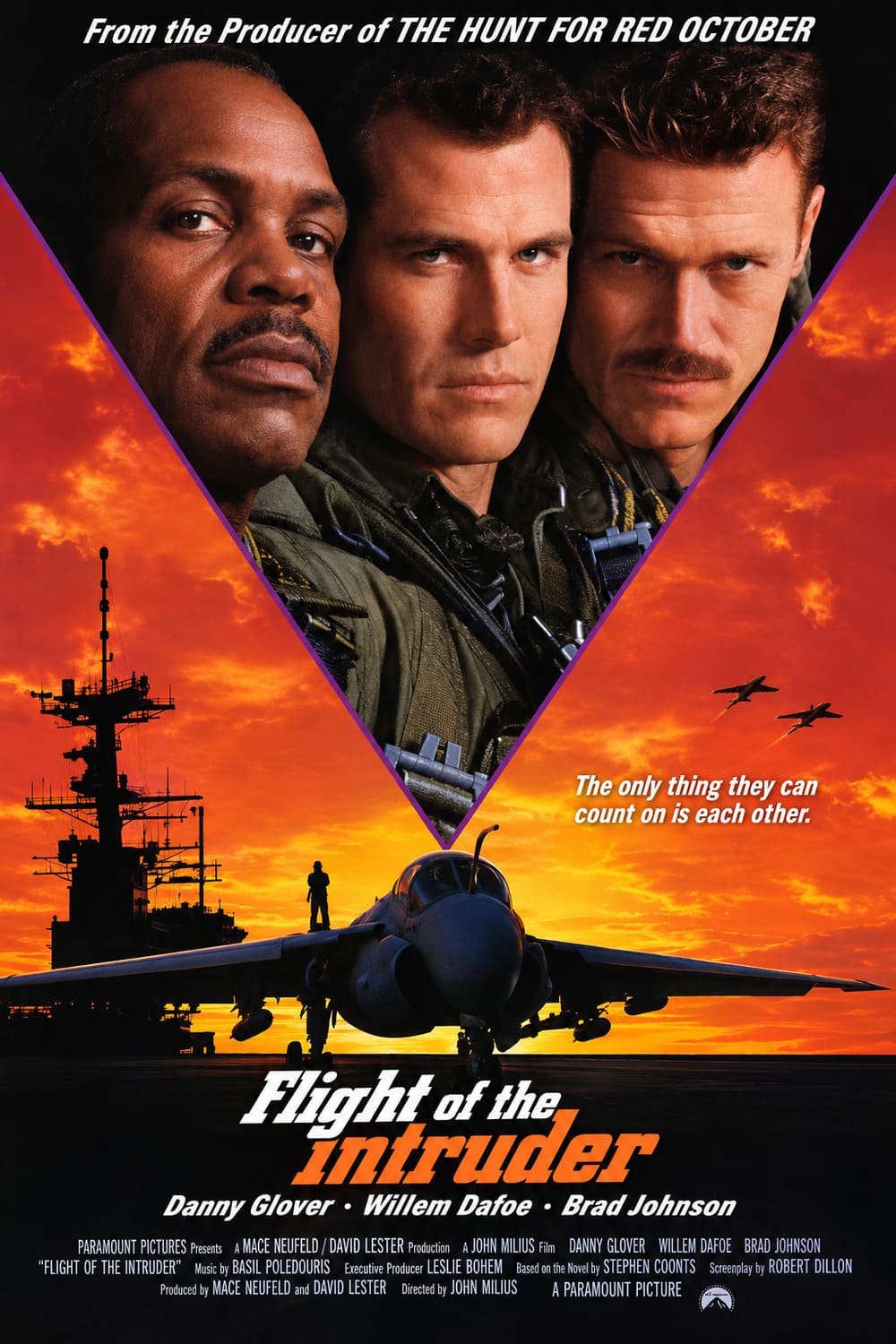
Film Review: Flight of the Intruder (dir. by John Milius)


“I do know the difference between dying for something and dying for nothing.” — Jake Grafton

There is a difference between knowing how to fly into danger and knowing what that danger is supposed to accomplish. That gap gives Flight of the Intruder its most interesting material. John Milius’s 1991 war film follows men who trust their training, their aircraft, and each other far more than they trust the decisions sending them into combat. Adapted from Stephen Coonts’s novel of the same name, it mixes a story of wartime disillusionment with an old-fashioned action adventure. Those two sides do not always fit together, but the friction gives this uneven movie more personality than a routine military thriller.

Brad Johnson plays Lieutenant Jake Grafton, a Navy pilot flying an A-6 Intruder during the Vietnam War. When his bombardier is killed on a mission against a seemingly worthless target, Grafton begins questioning the purpose behind the daily cycle of takeoffs, bombing runs, and dangerous returns. He is not afraid of doing his job. He is angry that doing it well might make no difference. That distinction gives the character an accessible emotional foundation. Even when the screenplay pushes him toward predictable acts of rebellion, his initial frustration feels like something more substantial than the usual action hero’s dislike of authority.

The film’s central idea is that Grafton needs to recover a sense of purpose, but it gets into trouble when it starts treating that need as its own justification. His answer is an unauthorized strike against a missile depot in Hanoi, undertaken with veteran bombardier Virgil Cole. It is an exciting premise because the mission carries both military danger and personal consequences. As an answer to Grafton’s disillusionment, though, it feels suspiciously convenient. The movie raises difficult questions about waste and obedience, then suggests that choosing a better target might settle them. The action becomes clearer just as the thinking becomes fuzzier.

Johnson gives Grafton a restrained, earnest quality that generally suits the role. He looks comfortable playing someone who expresses himself more easily through work than conversation. That reserve helps sell the character’s professionalism, although it also limits the emotional impact of scenes that need him to reveal more. There are moments when Grafton seems less like a man struggling with grief than a leading man waiting for the next plot development. Johnson is never a fatal weakness, but he does not consistently provide the intensity needed to make every stage of Grafton’s transformation feel fully earned.

Willem Dafoe is much more immediately engaging as Cole. He brings an unpredictable edge that keeps their partnership from becoming a simple arrangement between an inexperienced hothead and a wise veteran. Cole has experience, certainly, but Dafoe makes that experience look potentially dangerous rather than automatically reassuring. His confidence suggests someone who has spent enough time around death to develop an unusual relationship with it. That gives his scenes with Johnson a welcome tension. Grafton wants reassurance that his anger means something, while Cole seems ready to turn that anger into action without offering much comfort about the consequences.

Danny Glover gives the movie another useful source of resistance as commanding officer Frank Camparelli. His job is partly to stand between frustrated men and the decisions they might make when frustration takes over. Glover brings enough authority to prevent Camparelli from feeling like a cardboard obstacle placed in the heroes’ path. You can understand why Grafton resents restrictions while also recognizing that somebody has to think beyond the emotional needs of one crew. The film is more interesting whenever it allows that disagreement to remain unresolved. It becomes less interesting when military discipline is treated mainly as something adventurous men must work around.

Once the aircraft leave the carrier, the movie becomes noticeably more assured. The cockpit sequences give the action a sense of process: these men have equipment to manage, threats to interpret, and very little time to make decisions. That practical detail makes the danger engaging. Instead of relying entirely on spectacle, the better scenes build suspense around what the crews can see, what they cannot see, and how quickly their situation might change. Some effects have aged better than others, but the flying still supplies the film’s strongest argument for watching it. Competence under pressure remains compelling even when the visuals look dated.

The ground-level material is considerably patchier. Drinking, banter, and romantic interludes are meant to show what these men do with the time between missions, but too much of it feels borrowed from other military movies. The romantic subplot involving Rosanna Arquette is especially thin, offering a softer side of Grafton without developing much emotional momentum of its own. These scenes should make the next flight matter more by showing what exists outside the cockpit. Instead, they sometimes make you impatient for another launch. The issue is not that a combat film needs constant action; its quieter moments simply need more individuality.

Milius is better at conveying loyalty than examining the assumptions behind it. The bonds between the aviators have weight, and the later rescue-centered action draws real energy from their refusal to abandon one another. Yet the film’s perspective stays narrow. Vietnamese lives remain largely outside its emotional focus, while American courage receives sustained attention. That imbalance matters because the story wants its heroes’ frustration to carry moral significance, not merely dramatic interest. It understands how war damages these men, but seems less curious about what their determination might cost anyone else. The result is emotionally direct without being especially searching.

By the end, Flight of the Intruder has made a stronger case for the men’s devotion to each other than for the decisions they make. That is both its saving grace and its limitation. Dafoe’s sharp presence, Glover’s authority, and the tense flying sequences give it enough substance to remain watchable through the slower stretches. Still, the film keeps reaching for complicated questions and accepting action-movie answers. It is worth seeing as an imperfect combat adventure, especially for its cockpit tension, but its most revealing moments occur when skill and courage stop being enough—when getting home safely cannot explain why the mission mattered.
Late Night Retro Television Review: Hunter 1.17 “The Last Kill”


Welcome to Late Night Retro Television Reviews, a feature where we review some of our favorite and least favorite shows of the past!  On Thursdays, I will be reviewing Hunter, which aired on NBC from 1984 to 1991.  The entire show is currently streaming on Tubi and several other services!

This week, Hunter helps an ex-girlfriend.

Episode 1.17 “The Last Kill”

(Dir by Bruce Kessler, originally aired on April 20th, 1985)

Internationally famous model Christine Le Masters (Stephanie Blackmore) thinks that her husband, Kerry (Madison Mason), is cheating on her. Christine tells Kerry that she’s heading to the airport to catch a flight for Europe and a new ad campaign. Instead, she follows Kerry when he heads over to a cheap motel. Christine is expecting to catch her husband with his mistress. Instead, she finds a prostitute who has been shot in the back of the head by a hitman.

Not wanting her husband to know that she lied about leaving the country, Christine goes to an ex-boyfriend for help. The name of that ex-boyfriend? Rick Hunter.

Hunter and McCall do investigate and discover that the prostitute is just one of many low-level criminals who have apparently all been killed by the same assassin. Hunter uses his little-mentioned mob contacts to dig into the murders and finds out that there’s a hitman named George who has been killing everyone involved in a plot to blackmail a mob boss. However, George appears to be doing this out of the kindness of his heart. Hunter suspects that George is just trying to get close to the mob boss so that he can kill him. He also suspects that George is actually Kerry Le Masters!

Is Hunter just jealous that Kerry is married to his ex-girlfriend, or is he correct about Kerry being a killer? It turns out that both things can be true! Don’t worry, though. Even though Kerry is holding a gun at his wife’s head at the time, Hunter is still able to shoot him without hurting Christine. Hunter tells police dispatch to send “the coroner’s wagon.” The police dispatcher doesn’t sound surprised. Hunter kills an average of three people a day.

This episode never really made it clear why Kerry would decide to become a hitman in the first place. I mean, he’s already rich. But I did appreciate that the Hunter family’s mob ties were mentioned again and that we got to learn a little about his past. When Kerry told Hunter that the two of them were heading for a standoff that only one would survive, Hunter replied, “Works for me.” It was a cool moment on an otherwise standard episode of Hunter.

A Movie A Day #320: Dangerously Close (1986, directed by Albert Pyun)


Vista Verde, an exclusive suburban high school in California, has a problem.  Some of the students have a bad attitude.  Some of them are experimenting with drugs.  Graffiti is showing up all over the school.  What better way to return peace to Vista Verde than for a bunch of WASPy rich kids and other jocks to organize into a secret vigilante force?  The headmaster thinks that it’s a great idea and soon “The Sentinels” are holding mock trials and shooting the other students with paintball guns.  One bad kid even turns up dead.  Graffiti is no joke.
The leader of the Sentinels is a rich kid named Randy (John Stockwell, who also co-wrote the script).  Randy knows the importance of good PR so he befriend the editor of the school newspaper, Donny (J. Eddie Peck).  Donny may not be rich but, because of his amazing journalism skills, he has been allowed to attend Vista Verde as a magnet student.  At first, Donny is skeptical of The Sentinels but he soon finds himself seduced by not only Randy’s wealthy lifestyle but also by Randy’s beautiful girlfriend (Carey Lowell).  Meanwhile, Donny’s friend Krooger (Bradford Bancroft) not only listens to punk music but also has a mohawk so he naturally becomes the latest target of the Sentinels.

A teen film with a conscience, Dangerously Close was one of the better films to come out of the Cannon Group in the mid-80s.  The script is smarter than the average 80s teen film and Albert Pyun’s slick direction captures the appeal of being young and rich in the suburbs.  Stockwell, Peck, and Lowell all give better than average performances  and there is actually some unexpected depth to Stockwell and Peck’s friendship.  Stockwell does not play Randy as just being a typical rich villain.  Instead, he is someone who thinks he’s doing the right thing even when he’s not.

The cast is full of faces that will be familiar to anyone who has ever been a fan of 80s high school films.  Keep an eye out for Thom Matthews, Don Michael Paul, Gerard Christopher, Miguel Nunez, Jr., and DeeDee Pfeiffer, all doing their part to keep the halls of Vista Verde safe.


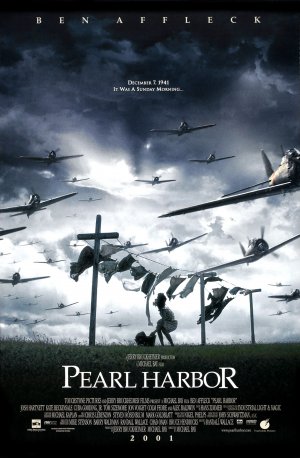
Embracing the Melodrama Part II #100: Pearl Harbor (dir by Michael Bay)


Pearl_harbor_movie_poster

“And then all this happened…”

Nurse Evelyn Johnson (Kate Beckinsale) in Pearl Harbor (2001)

The “this” that Evelyn Johnson is referring to is the Japanese attack on Pearl Harbor.  You know, the date will live in infamy.  The attack that caused the United States to enter World War II and, as a result, eventually led to collapse of the Axis Powers.  The attack that left over 2,000 men died and 1,178 wounded.  That attack.

In the 2001 film Pearl Harbor, that attack is just one of the many complications in the romance between Danny (Ben Affleck), his best friend Rafe (Josh Hartnett), and Evelyn (Kate Beckinsale).  The other complications include Danny briefly being listed as dead, Danny being dyslexic before anyone knew what dyslexia was (and yet, later, he’s still seen reading and writing letters with absolutely no trouble, almost as if the filmmakers forgot they had made such a big deal about him not being able to do so), and the fact that Rafe really, really likes Evelyn.  Of course, the main complication to their romance is that this is a Michael Bay film and he won’t stop moving the camera long enough for anyone to have a genuine emotion.

I imagine that Pearl Harbor was an attempt to duplicate the success of Titanic, by setting an extremely predictable love story against the backdrop of a real-life historical tragedy.  Say what you will about Titanic (and there are certain lines in that film that, when I rehear them today, make me cringe), Leonardo DiCaprio and Kate Winslet had genuine chemistry.  None of that chemistry is present in Pearl Harbor.  You don’t believe, for a second, that Ben Affleck and Josh Hartnett are lifelong friends.  You don’t believe that Kate Beckinsale is torn between the two of them.  Instead, you just feel like you’re watching three actors who are struggling to give a performance when they’re being directed by a director who is more interested in blowing people up than in getting to know them.

Continuing the Titanic comparison, Pearl Harbor‘s script absolutely sucks.  Along with that line about “all this” happening, there’s also a scene where Franklin D. Roosevelt (Jon Voight) reacts to his cabinet’s skepticism by rising to his feet and announcing that if he, a man famously crippled by polio and confined to a wheelchair, can stand up, then America can win a war.

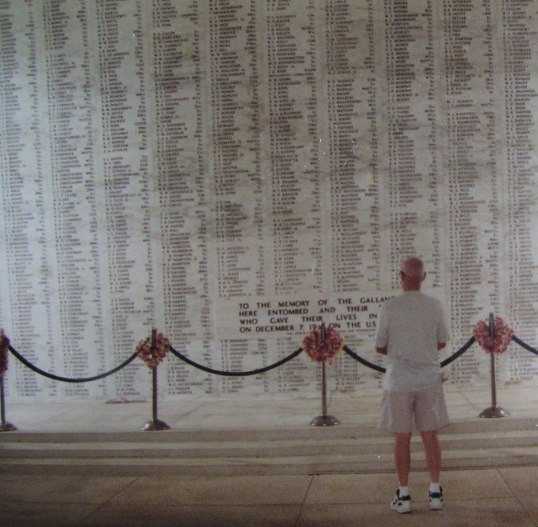
I’ve actually been to Pearl Harbor in Hawaii.  I have gone to the USS Arizona Memorial.  I have stood and stared down at the remains of the ship resting below the surface of the ocean.  It’s an awe-inspiring and humbling site, one that leaves you very aware that over a thousand men lost their lives when the Arizona sank.

I have also seen the wall which lists the name of everyone who was killed during the attack on Pearl Harbor and until you’ve actually been there and you’ve seen it with your own eyes, you really can’t understand just how overwhelming it all is.  The picture below was taken by my sister, Erin.

Pearl Harbor 2003If you want to pay tribute to those who lost their lives at Pearl Harbor, going to the Arizona Memorial is a good start.  But avoid Michael Bay’s Pearl Harbor at all costs.

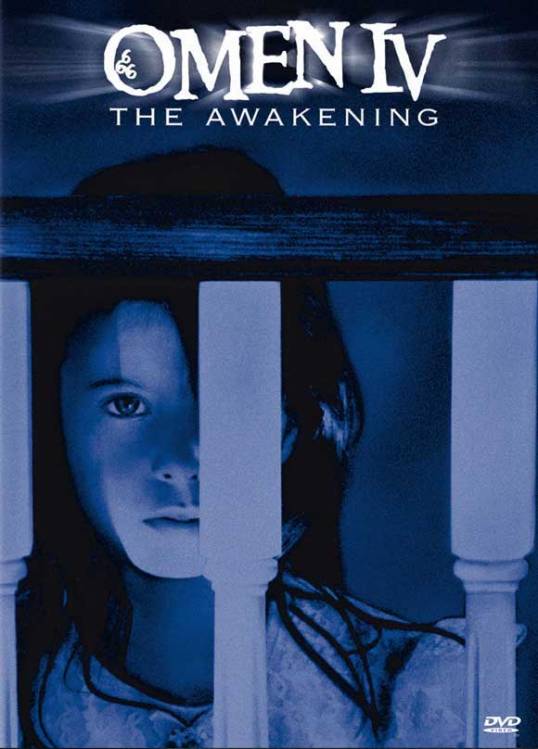
Horror Film Review: Omen IV: The Awakening (dir by Jorge Montesi and Dominique Othenin-Girard)


Omen_IV_DVD_cover

“Why am I watching this crap?”

That was the question that I asked myself many times last night as I watched Omen IV: The Awakening.

Seriously, it is just the WORST* and, if not for my own need to be a completist, I probably would have stopped watching after the first ten minutes.  But you know what?  I love movies, I love this site, and even more importantly — I LOVE YOU!  And I would do anything for you so I watched Omen IV: The Awakening so you wouldn’t have to.

Of course, when would you ever have to?  I probably should have considered that before I sat down to watch the film.

ANYWAY — let’s keep this quick.  The Omen IV: The Awakening was made for television and was originally broadcast way back in 1991.  It tells the story of Virginia Congressman Gene York (Michael Woods) and his wife, Karen (Faye Grant, who is currently in the news because of a tape that’s surfaced of her ex-husband Stephen Collins confessing to being a child molester).  Gene and Karen cannot have children so they adopt a baby from a bunch of nuns.  What they don’t suspect is that some of the nuns are actually in league with Satan and that their new daughter is actually the child of Damien Thorn!

Seven years later, they’ve named their daughter Delia and Delia has grown up to be something of a sociopath.  A bunch of new age hippie types suspect the truth about Delia but, whenever they get close to revealing that truth, they end up getting killed in freak accidents.  Meanwhile, Gene insists nothing is wrong while Karen…

Oh, forget it.  This movie is so bad that it’s painful to even try to describe the plot.

Let’s just say that this is an amazingly bad movie that has none of the power of the first Omen.  Nor is it as unintentionally fun as Damien: Omen II.  And none of the actors do as good as job as Sam Neill did in The Final Conflict.  Instead, it’s just a rather dull film where the tedium is only occasionally interrupted by somebody dying a terrible death.  There are two effective sequences — one in which a private detective (Michael Lerner) is chased by demonic spirits and another where a snake handler gets distracted just long enough to get bitten a few thousand times.  Otherwise, Omen IV: The Awakening deserves its terrible reputation.

AVOID IT AT ALL COSTS!

(Which probably won’t be hard since I imagine that the only way you could be tricked into watching it would be if you’re one of those film bloggers who insists on being a completist…)

—–

* Yes, it’s so bad that it gets the all caps treatment.