Horror Film Review: Ghost Story (dir by John Irvin)


ghoststory

A Fred Astaire horror movie!?

Yes, indeed.  Ghost Story is a horror movie and it does indeed star Fred Astaire.  However, Fred doesn’t dance or anything like that in Ghost Story.  This movie was made in 1981 and Fred was 82 years old when he appeared in it.  Fred still gave an energetic and likable performance and, in fact, his performance is one of the few things that really does work in Ghost Story.

Fred Astaire isn’t the only veteran of Hollywood’s Golden Age to appear in Ghost Story.  Melvyn Douglas, John Houseman, and Douglas Fairbanks, Jr. all appear in the movie as well.  They play four lifelong friends, wealthy men who have formed an informal little club called The Chowder Society.  They gather one a week and tell ghost stories.  Myself, I’m wondering why these four intelligent and accomplished men (one is a lawyer, another a doctor, another a politician, and another is Fred Astaire) couldn’t come up with a better name than Chowder Society.

(But I guess that’s something that people do up north.  Harvard has something called the Hasty Pudding Club, which just sounds amazingly annoying.)

Unfortunately, the members of the Chowder Society have a deep, dark secret.  Way back in the 1930s, the boys listening to too much jazz and they all ended up lusting after the mysterious and beautiful Eva Galli (Alice Krige).  As Astaire explains it, “We killed her, the Chowder Society.”

(Of course, there’s more to the story.  It was more manslaughter than murder but either way, it was pretty much the fault of the Chowder Society.)

And now, decades later, a woman named Alma (Alica Krige, again) has mysteriously appeared.  When she sleeps with David (Craig Wasson), the son of a member of the Chowder Society, David falls out of a window and ends up splattered on the ground below.  David’s twin brother, Don (also played by Craig Wasson), returns to their childhood home and attempts to make peace with his estranged father.

However, now the member of the Chowder Society are starting to die.  One falls off a bridge.  Another has a heart attack in the middle of the night.  Fred Astaire thinks that Eva has come back for revenge.  John Houseman is a little more skeptical…

I pretty much went into Ghost Story with next to no knowledge concerning what the film was about.  I thought the plot desription sounded intriguing.  As a classic film lover, I appreciated that Ghost Story was not only Fred Astaire’s final film but the final film of Douglas and Fairbanks as well.  Before he deleted his account, I had some pleasant interactions with Craig Wasson on Facebook.   I was really hoping that Ghost Story would be a horror classic.

Bleh.

Considering all the talent involved, Ghost Story should have been great but instead, it just fell flat.  Alice Krige is properly enigmatic as both Alma and Galli and really, the entire cast does a pretty good job.  But, with the exception of exactly three scenes, the film itself is never that scary.  (Two of those scary scenes involve a decaying corpse and it’s not that hard to make decay scary.  The other is a fairly intense nightmare sequence.)  Largely due to John Irvin’s detached direction, you never really feel any type of connection with the characters.  I mean, obviously, you don’t want to see the star of Top Hat die a terrible death but that has more to do with the eternal charm of Fred Astaire than anything that happens in Ghost Story.

Add to that, Ghost Story‘s special effects have aged terribly.  There are two scenes in which we watch different characters fall to their death and both times, you can see that little green outline that always used to appear whenever one image was super imposed on another.  It makes it a little hard to take the movie seriously.

Sadly, Ghost Story did not live up to my expectations.  At least Fred Astaire was good…
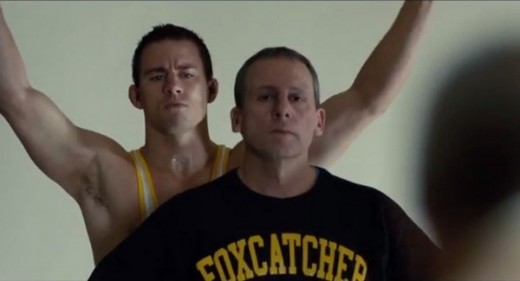
Film Review: Foxcatcher (dir by Bennett Miller)


What a long and strange trip it has been for Foxcatcher.

Originally, Bennett Miller’s latest film was scheduled to be released at the end of 2013 and it was expected to be a major player in the 2013 Oscar race.  And then it was suddenly announced that Sony Pictures would, instead, wait an extra year to release the film.  Usually, this is a sign of a film that’s not expected to live up to expectations.  (Case in point: The Monuments Men.) But, in this case, it was seen as being the exact opposite.  Sony had such faith in the Oscar prospects of Foxcatcher that they were willing to hold off a year so it wouldn’t get lost in all of the attention that was being given to American Hustle, Gravity, 12 Years A Slave, and Wolf of Wall Street.

And, in many ways, it was a smart move.  Overnight, Foxcatcher went from being that weird movie with Steve Carell to being one of the most anticipated film of 2014.

Then, during the summer, Foxcatcher premiered at Cannes and was one of the hits of the festival.  With the notable exception of the A.V. Club’s A.A. Dowd, the reviewers at Cannes were rapturous in their praise of Foxcatcher.  And, though it failed to win the Palme d’Or, it did win best director for Bennett Miller and it cemented it’s status as the Oscar front-runner.

And then, something started to happen.

There was backlash against Foxcatcher.  As more and more critics saw the film, we started to hear more and more speculation that the film would fail to live up to all of the hype.  Critics generally praised the performers but many complained that the film was too cold and detached for its own good.  At first, it was easy to say that this was partially the result of unrealistically high expectations.  But, as more and more reviews came in, it became almost fashionable to speculate that Foxcatcher would be left out of the Oscar race.

Of course, most of us who were doing the speculating were doing so without actually having seen the film for ourselves.  After all, film critics and festival goers aren’t the ones who actually vote on what films will be nominated for and win Oscars.  One need only look at the nominations for Extremely Loud and Incredibly Close to realize that.

Well, Foxcatcher has finally been released and we’ve all finally gotten a chance to see it.  I saw it last week, while I was in Fort Worth for the Christmas holidays.  And my reaction…

Well, there’s a reason why it’s taken me nearly a week to write this review.

Ultimately, Foxcatcher is a good film.  In fact, on a purely technical level, it’s probably one of the best films of the year.  If it is nominated for best picture, the nomination will not necessarily be undeserved.  Bennett Miller comes up with some hauntingly chilly images.  Steve Carell, Channing Tatum, and Mark Ruffalo all give excellent performances.  It’s a film that stays with you, a powerful depiction of a true crime.

But it’s still not an easy film to enjoy.

Those critics who complained that Miller’s approach was too cold and detached have a point.  You watch the film with a sense of dread, knowing what’s going to eventually happen.  (Though I didn’t know anything about the murder of Dave Schultz before the film, I had read the reviews and I knew that eventually Mark Ruffalo’s kind-hearted family man would end up being gunned down in front of his family.)  But Miller always keeps the characters and the story at a distance.  You watch the characters and you struggle to understand them but, by the end of the film, you’re no closer to understanding why John E. du Pont (the eccentric millionaire turned murdered, played by Steve Carell) murdered Dave Schultz than you were at the beginning.

Instead, Miller is more interested as looking at John du Pont as being an example of American exceptionalism gone crazy.  Throughout the film, characters frequently comment on the fact that the du Ponts are one of the oldest and richest families in America.  (Not coincidentally, we’re also told that they initially made their fortune by producing and selling gunpowder.)  Du Pont is an outspoken and proud American.  Along with training wrestlers on the grounds of his estate (the Foxcatcher of the title), he also frequently invites the police to use the grounds for target practice.  Though Miller couldn’t have realized it when the film was originally shot in 2013, the scenes of the obviously unstable du Pont hanging out with the cops take on an extra resonance in this time of Eric Garner and Tamir Rice.

John du Pont frequently talks about how his plan to open a world-class wrestling training facility is, at heart, a patriotic act.  The world wrestling championship, du Pont believes, belongs in America and he’s going to make sure that it gets there.  In order to achieve this goal, he hires Olympic gold medalist Mark Schultz (Channing Tatum) to be his wrestling coach.  Mark, who has always lived in the shadow of his older brother Dave (Mark Ruffalo), jumps at the chance to establish his own identity.  At first, du Pont is like the father that Mark has never had.  They even become friends.  (Du Pont, at one point, talks about discovering that all of his childhood friends had been paid to be his friend.)  Mark shows du Pont some wrestling moves.  Du Pont introduces Mark to cocaine.

But, ultimately, it becomes apparent that du Pont’s friendship with Mark was really just a ruse to get Mark to convince his older brother to come work for du Pont.  When Dave finally does join Mark at Foxcatcher, it causes Mark to turn self-destructive and du Pont to eventually turn into a murderer.

And, as I said, it’s a powerful film.  Channing Tatum gives the performance of his career and Steve Carell is frighteningly believable as John du Pont.  (One minor complaint: Carell is being promoted for best actor, even though his performance was clearly a supporting one.)  Mark Ruffalo, as well, does great work as Dave and somehow manages to make innate human decency compelling.

But the film itself is so cold and detached that, ultimately, this is a film that you end up respecting more than you end up enjoying.

Foxcatcher