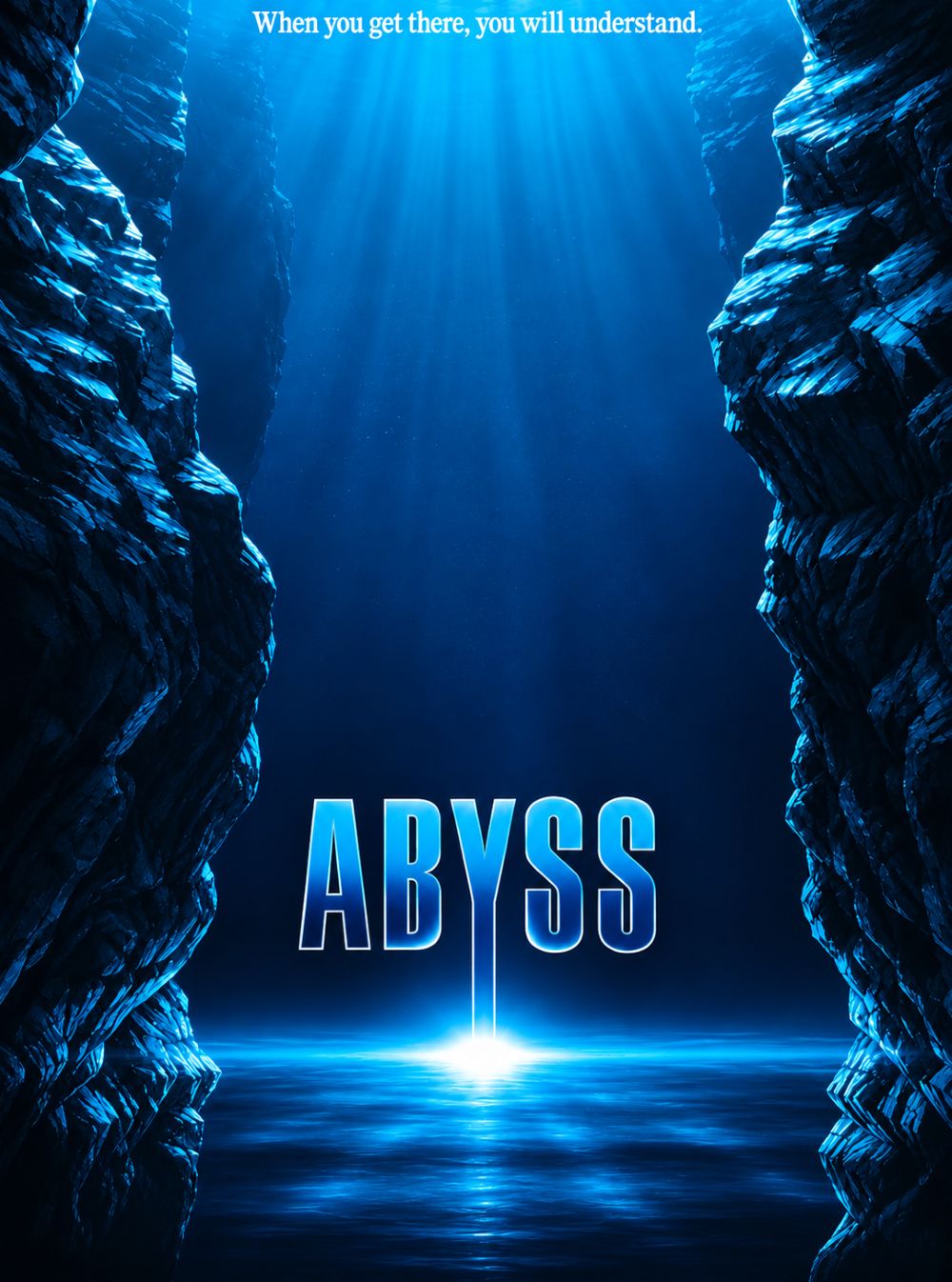
Film Review: The Abyss (dir. by James Cameron)


“We all see what we want to see. Coffey looks and he sees Russians. He sees hate and fear. You have to look with better eyes than that.” — Lindsey Brigman

James Cameron has never seemed particularly interested in keeping things small, but The Abyss gets much of its power from people who can barely move. They’re trapped in tight compartments, weighed down by equipment, and forced to make decisions while the ocean presses in around them. His 1989 underwater adventure turns those restrictions into gripping entertainment, then asks the story to carry a troubled marriage and a message about humanity’s future. It’s an uneven combination, but an engaging one. This review covers the 171-minute extended Special Edition, which can be considered Cameron’s preferred cut, with its fuller character development and substantially expanded ending.

The story begins with an American nuclear submarine sinking after an encounter with something unexplained. A civilian drilling crew is recruited to assist a Navy SEAL team, turning its underwater platform into the headquarters for a tense recovery operation. Bud Brigman, played by Ed Harris, runs the civilian side with the weary confidence of someone accustomed to solving problems without outside help. Then his estranged wife, Lindsey, arrives because she designed the platform and understands its capabilities. That’s good news for the operation, less welcome news for Bud, and an effective way to make an already uncomfortable workplace even more volatile.

Cameron gives that workplace enough personality that the danger matters before the plot gets especially strange. The crew members tease each other, complain about instructions, and handle complicated machinery with practiced familiarity. Their conversations don’t always advance the story, which is part of why they work. These people seem to have lives and routines beyond whatever emergency the movie has prepared for them. Some supporting characters remain broad sketches, but their reactions help establish the group’s identity. You believe they’ve spent enough time together to recognize when an argument is harmless and when someone has become a genuine problem.

The platform itself contributes just as much to that credibility. Its passageways, working areas, and sleeping quarters feel designed around necessity rather than comfort. Cameron gives you enough familiarity with the space that damage has consequences beyond the immediate thrill of water bursting through an opening. A flooded room means a route lost, equipment gone, or another reduction in the crew’s already narrow options. Outside, lights reveal only fragments of an environment that remains overwhelmingly dark. The contrast is unsettling: the platform is claustrophobic, but leaving it means entering a space so vast and indifferent that the cramped interior starts looking reassuring.

Harris anchors the film by making Bud capable without making him invulnerable. He has the authority of a man who will take the difficult job himself, but that same stubbornness causes problems when persistence isn’t the answer. You can see why the crew trusts him and why living with him might be exhausting. Harris lets those qualities coexist rather than separating Bud into admirable and flawed versions. His warmth doesn’t erase his defensiveness, and his courage doesn’t mean he always knows what he’s doing. That makes him a useful center for a story that eventually moves far beyond anything its characters can reasonably understand.

Mary Elizabeth Mastrantonio gives Lindsey the sharp edges needed to make their relationship convincing. She isn’t simply waiting for Bud to demonstrate his worth, and her professional confidence doesn’t disappear whenever the film wants an emotional moment. She can be impatient and cutting, sometimes unnecessarily so, but Mastrantonio allows concern to surface beneath the defensiveness. Her scenes with Harris suggest arguments repeated so often that both people know their parts. They’re good at identifying each other’s weaknesses and less accomplished at acknowledging their own. The affection remains visible, though neither seems eager to make the first move toward admitting it.

The extended edition gives that conflict more room, which matters because the romance needs to function as more than an interruption between emergencies. Bud and Lindsey don’t resolve their differences through one convenient conversation. Instead, the situation gradually exposes how much attention they still pay to each other. Irritation and concern keep occupying the same moments. The wedding ring becomes a particularly effective detail, connecting the marriage to the physical action without requiring another argument about what commitment means. Cameron isn’t always subtle, but he understands the value of giving an emotional idea a concrete object that can matter within a scene.

Michael Biehn’s Lieutenant Coffey brings a more dangerous response to uncertainty. Biehn plays him with a rigid intensity that becomes increasingly unsettling as his judgment deteriorates. Coffey responds to confusion by tightening control, even when that response makes the situation worse. There’s something frightening about a man who mistakes escalating fear for clear thinking, especially when he retains the authority and weapons to act on it. The writing occasionally leans too heavily on the contrast between aggressive soldiers and adaptable civilians. Still, Biehn gives Coffey enough nervous physicality that he registers as an immediate threat rather than merely the representative of a bad idea.

As an action director, Cameron understands how to make a simple objective feel almost impossible. A character has to reach a doorway, repair a system, or cover a distance with too little air. The underwater setting adds resistance to everything, and the film makes that resistance tangible. People struggle with equipment, lose visibility, and spend precious time doing things that would be easy on land. The sequences generally establish their geography and stakes clearly, so suspense comes from anticipating failure rather than trying to understand the editing. Even success rarely brings much relief. Everyone looks increasingly exhausted, and the next task always seems to demand energy nobody has left.

That exhaustion becomes emotionally devastating in the resuscitation sequence. Cameron keeps the scene going long enough to strip away the reassurance that a movie usually offers when a major character is in danger. Harris lets Bud’s practical determination collapse into desperation, exposing feelings he has struggled to express in ordinary conversation. It’s forceful, openly manipulative filmmaking, and not everyone will welcome how hard it pushes. But the intensity has a foundation. The relationship has established what could be lost, while the crew’s helpless presence makes the moment feel painfully public. People accustomed to fixing problems reach the limit of what effort and expertise can accomplish.

The visitors offer something beyond another threat, and the water-tentacle encounter works beautifully because curiosity briefly takes over from fear. There’s humor in it, and an intimacy that feels surprising after so much noise and conflict. The effect matters because it allows a strange intelligence to interact with people on a recognizable emotional level. For a moment, the movie stops treating the unknown as an obstacle. The extended ending then expands that possibility into a confrontation with human violence, bringing international tensions and enormous thousand-foot waves into the resolution. It gives the visitors a clearer purpose, but turns suggestion into a rather blunt explanation. Cameron’s sincerity remains appealing even when his argument becomes too simple.

What makes The Abyss memorable is the way its tenderness survives all that machinery, noise, and pressure. The extended edition occasionally explains what its strongest scenes have already made clear, and its global ambitions aren’t as persuasive as its intimate observations. Yet Harris and Mastrantonio keep pulling it toward something believable: two difficult people discovering that their attachment still matters. Cameron gives that possibility the same attention he gives a failing oxygen supply, treating trust as something that requires effort and carries consequences. Not every grand statement lands, but the quieter feeling underneath does. After so much struggle just to stay alive, having someone worth reaching for feels like a convincing reward.

October True Crime: Sins of the Mother (dir by John Patterson)


In the city of Spokane, Washington, Kevin Coe (Dale Midkiff) is a real estate agent who always tries to come across as being the slickest guy in the room.  With his quick smile and his moderately expensive suits, Kevin certainly seems to fit the stereotype.  It’s only when you start to look a little closer that the surface starts to crack.

For someone who goes out of his way to come across as being confident, Kevin is actually very immature and more than a little whiny.  He’s living with a perfectly nice young woman named Ginny (Heather Fairfield) but it’s obvious that he’s keeping secrets from her.  He comes home one morning with scratches on his face and, when she asks about them, he claims that 1) he got mauled by a dog and 2) he doesn’t need any sort of medical attention.  Kevin is someone who frequently loses his job because he’s just not that good at it.  When one boss fires him, Kevin replies that he’s going to start his own business and someday, maybe he’ll be the one doing the hiring and firing.  It’s classic empty cope.

And then there’s Kevin’s mother.  Ruth Coe (Elizabeth Montgomery) is someone who likes to present herself as being a grand diva, in the manner of a Golden Screen star.  She’s extremely close to her son, at times overprotective and at times overly critical.  Kevin often goes from yelling at his mom to dancing with her within minutes.  Ruth makes it clear that she doesn’t like Ginny and Ginny eventually grows to dread seeing Ruth wandering around their house, uninvited.  And yet, despite all of the time that Kevin spends talking about how wants to get away from his mother and to live his own life, Kevin doesn’t really make much of an effort to do that.

Meanwhile, Detective Liz Trent (Talia Balsam) is investigating a series of rapes that have been committed in Spokane.  When she comes to suspect that Kevin is the rapist, Kevin claims that it’s not true and it’s just another case of the world treating him unfairly.  Ruth stands by her son and eventually shocks everyone with just how far she’s willing to go to try to keep him out of prison.

Sins of the Mother is based on a true story.  Kevin Coe may have only been convicted of four rapes but he is suspected of having committed at least 41.  In prison, he insisted he was innocent and refused to attend any counseling programs.  He also refused to apply for parole, even after he became eligible.  After his criminal sentence was completed in 2008, he was sent to the Special Commitment Center on Washington’s McNeil Island, which is a institution that houses sexual predators who are likely to reoffend.  I’m writing this review on September 15th.  Coe, as of this writing, is scheduled to be released from McNeil on October 3rd so, by the time you’re reading this, he could already be out.  Coe is 78 and is reported to be in fragile health.

As for the movie, it’s mostly memorable for Elizabeth Montgomery’s over the top performance as Ruth Coe.  Sweeping into every scene and delivering her lines in what appears to be a deliberately fake-sounding Southern accent, Montgomery chews the scenery with gusto.  While the rest of the cast often seems to be going through the motions, Montgomery grabs hold of this movie and refuses to surrender it.

Retro Television Review: Miami Vice 3.21 “Knock Knock …. Who’s There?”


Welcome to Retro Television Reviews, a feature where we review some of our favorite and least favorite shows of the past!  On Mondays, I will be reviewing Miami Vice, which ran on NBC from 1984 to 1989.  The entire show can be purchased on Prime!

This week, the one hand doesn’t know what the other one is doing.  That’s life in Miami.,

Episode 3.21 “Knock Knock …. Who’s There?”

(Dir by Tony Wharmby, originally aired on March 27th, 1987)

An drug buy that Crockett and Tubbs (as Burnett and Cooper) set up with Esteban Montoyo (a miscast Ian McShane), falls apart when a group of DEA agents show up.  Or, at least, they say that they’re DEA agents.  Oddly, they just take the money and the drugs and then leave, saying that Miami metro will take care of the rest.

It quickly becomes apparent that the DEA agents were fake but Crockett and Tubbs have no way to confirm that because the DEA refuses to share any information about their activities with the Vice Squad.  Even though the DEA and detectives are all after the same people and are supposedly soldiers in the same war, they don’t trust each other and they don’t share information.  Meanwhile, Internal Affairs is convinced that Crockett and Tubbs stole the money and the drugs for themselves and are determined to prove it.  Apparently, it doesn’t matter that Crockett and Tubbs have killed a variety of different drug lords over the past three seasons.  No one in Miami trusts anyone!

As for the fake DEA busts, they’re being set up by an agent named Linda Colby (Elizabeth Ashley).  Linda’s husband (Jimmie Ray Weeks) is a former agent who is now in a wheelchair and who is a friend of Crockett’s.  Their son is in the hospital, fighting for his life.  Linda’s crimes are helping her to pay for his treatment.  It’s not greed that motivates her, or at least greed isn’t the only thing.  She’s also motivated by love.

Of course, in the end, she still gets shot during a showdown between Crockett, Tubbs, and Montoya.  Unlike the majority of Miami Vice‘s guest stars, Linda survives being shot.  But, as she’s lying on the stretcher, Crockett has to arrest her.  Linda says that Crockett would have done the same thing for his son.  With tears in his eyes, Crockett proceeds to recite Linda’s Miranda rights.  Though Crockett doesn’t say it, he knows that she’s right but he’s also a cop and he has no choice but to arrest her.  Now, her son will no longer receive medical treatment and his mother is going to be in jail.  Wow, Miami Vice, depressing much?

Of course, happy endings were a rarity on Miami Vice.  That was one of the show’s strengths.  No one ever got a truly happy ending.  Every drug lord that Crockett and Tubbs took down would be replaced by someone else.  Anyone who ever tried to help usually fell victim to a bullet.  People like Linda did things for desperate reasons and paid the price, all in the service of an unwinnable war.

This episode was uneven.  Ian McShane was not a particularly interesting villain and Crockett getting his cover blown happens so frequently that it’s no longer a shock.  But that final scene definitely packed a punch.  Never have the Miranda rights sounded so hollow.

Next week …. it’s Crockett and Tubbs vs. a motorcycle gang!  We’ll see what happens.  It can’t be any more depressing than this episode.

Retro Television Reviews: Miami Vice 1.7 “One Eyed Jack”


Welcome to Retro Television Reviews, a feature where we review some of our favorite and least favorite shows of the past!  On Mondays, I will be reviewing Miami Vice, which ran on NBC from 1984 to 1989.  The entire show is currently streaming on Tubi!

This week, Vice gets a new leader!

Episode 1.7 “One Eyed Jack”

(Dir by Lee H. Katzin, originally aired on November 2nd, 1984)

Oh, that Sonny Crockett.  He’s got problems!

For one thing, animal control is still showing up at the harbor and trying to repossess his pet alligator, Elvis.  Sonny manages to talk them out of it by explaining that Elvis is actually employed by the Miami Police Department.  Sonny even flashes his badge as proof, which I found strange since I thought the whole idea of Sonny living on the boat was so that he could convince everyone that he was actually a big time drug dealer.  For someone who is supposed to be deep undercover, Sonny never seems to make much of an effort to hide the fact that he’s a cop.

Crockett and Tubbs have been assigned to stakeout a bookie in the hope that it’ll lead to the arrest of his boss, a supposedly “untouchable” gangster named Al Lombard (Dennis Farina, who was always a totally convincing gangster despite actually being a Chicago cop).  Crockett is shocked to see his ex-girlfriend, Barbara (Janet Constable), begging the bookie for more time to pay off her gambling debts.  Apparently, Barbara is so far in debt that Lombard’s second-in-command, Vince DeMarco (played by former Andy Warhol superstar, Joe Dallesandro), has stolen the tools that Barbara’s husband needs to make a living.

Seeking to help out his ex, Crockett approaches Vince and requests that he return the tools.  Vince explains that the tools have already been destroyed and then offers Crockett an envelope full of cash as payment for them.  Crockett takes the envelope and is promptly arrested by Internal Affairs Detective Schroeder (Dan Hedaya, as wonderfully sleazy as ever).  It turns out that Vince agreed to expose a dirty  cop in return for being granted immunity on some racketeering charges.

Everyone knows that Crockett has been framed.  In the past, Lou Rodriguez would have stood by Crockett but Rodriguez died two episodes ago and the new head of vice is Lt. Martin Castillo (Edward James Olmos).  Accurately described as being “Charles Bronson by way of Havana,” by Tubbs, Castillo is an enigmatic figure, one who rarely speaks or shows the slightest hint of emotion.  He has a withering stare that can be terrifying in its intensity.  When Tubbs, feeling that Castillo isn’t being properly supportive of Crockett, demands to know, “Whose side are you on?,” Castillo replies, “Don’t ever come up to my face like this again, Detective,” and the viewer is left with no doubt that Castillo is perhaps the most terrifying man in Miami.

After Barbara turns up dead, Tubbs goes undercover.  After meeting with DeMarco, Tubbs works his way up to Lombard.  Tubbs claims to be a gangster from Philadelphia who is looking to get in on the action in Miami.  (“If Miami doesn’t have it,” DeMarco assures him, “nobody’s thought of it yet.”)  Lombard takes a liking to Tubbs and hires him to deal with his Black and Spanish “clientale.”  Soon, Tubbs and DeMarco are hitting the cockfights and going to the club with Lombard.  Tubbs also frames DeMarco for the theft of $2,000.  Realizing that Lombard is probably going to try to kill him, DeMarco not only signs a paper exonerating Crockett but he also wears a wire the next time that he and Tubbs visit Lombard’s yacht.

Good news, right?  Well, it would be …. except that Barbara’s husband Jerry (Jimmie Ray Weeks) sneaks onto the yacht and shoots DeMarco dead before Lombard says anything incriminating.  Jerry goes to prison and Lombard goes free.  Crockett and Tubbs end up on Crockett’s boat, fishing at ten o’clock at night.  Crockett says that it’s the only way to stay sane.

What a dark episode!  Crockett was exonerated but his otherwise perfect plan fell apart.  This episode truly presented Miami as being a decadent playground, one that could make someone rich just as easily as it could destroy them.  While Jerry and Barbara lived in a small, run-down house, DeMarco wore expensive suits and Lombard lived on an expensive yacht and neither one gave much thought to the people whose lives were destroyed by their activities.  With Crockett sidelined by the IA investigation, Tubbs finally got his chance to shine and Philip Michael Thomas did a good job of capturing the adrenaline rush of becoming a part of Lombard’s world.  As opposed to the cynical and weary Crockett, Tubbs seems like he could be seriously tempted to switch sides in the war on crime.  In the end, Tubbs outsmarted DeMarco not by being better than him but instead by being even more ruthless.  And yet, for all the dark vibes to be found in this episode, the glamour of life in Miami was undeniably appealing.  Where else, the episode asked, can you arrest the bad guys while also working on your tan and hanging out on the beach?

Indeed, I find myself feeling a bit jealous of Gina (played by Saundra Santiago).  So far, she hasn’t gotten to do much on the show beyond being Sonny’s sometime girlfriend.  But she still gets to wear the best clothes and hang out with the coolest people and she gets to do it all while carrying a gun.  What more could one ask for?

Next week, Bruce Willis makes his television debut!

A Movie A Day #208: War Party (1988, directed by Franc Roddam)


On the hundredth year anniversary of a battle between the U.S. Calvary and the Blackfeet Indians, the residents of small Montana town decide to reenact the battle and hopefully bring in some tourist dollars.  The white mayor (Bill McKinny) and the sheriff (Jerry Hardin) both think that it is a great idea.  Even the local Indian leader, Ben Cowkiller (Dennis Banks, in real-life a founder and leader of the American Indian Movement), thinks that it will be a worthwhile for the Indians to participate.  The Calvary’s guns will be full of blanks.  The Indians will play dead.  However, as the result of a bar brawl the previous night, one of the local rednecks, Calvin Morrisey (Kevyn Major Howard), shows up with a gun full of bullets.  After he shoots one of the Indians, Calvin ends up with a tomahawk buried in his head.  Three Indian teenagers, Warren (Tim Sampson), Skitty (Kevin Dillon), and Sonny (Billy Wirth), flee into the wilderness.  Thirsty for revenge, a white posse heads off in pursuit.

War Party is an underrated and surprisingly violent movie.   Franc Roddam brings the same sensitivity to his portrayal of alienated Indians that he brought to portraying alienated Mods in Quadrophenia.  Though, at first, Kevin Dillon seems miscast as an Indian, he, Wirth, and Sampson all give good performances, as does Dennis Banks.  The movie is often stolen by M. Emmett Walsh and Rodney A. Grant, playing renowned trackers who are brought in to help the posse chase down the three youths.  That Grant’s character is a member of the Crow adds a whole extra layer of meaning to his role. Even though the setup often feels contrived and heavy-handed and anyone watching should be able to easily guess how the movie is going to end, War Party still packs a punch.