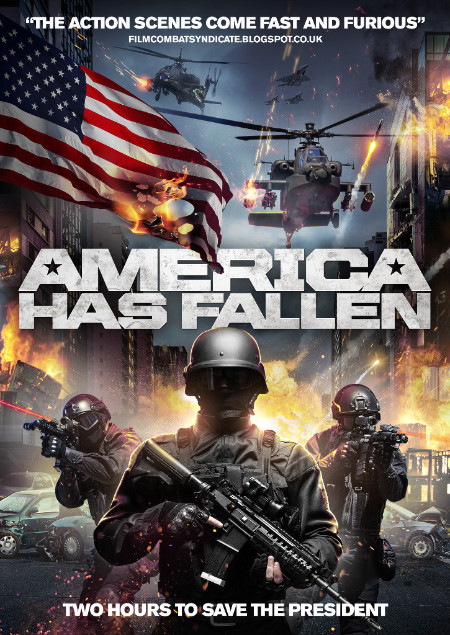
When a former marine is framed for a deadly terrorist bombing, he must track down the mastermind behind the plot. But soon he discovers an even deadlier conspiracy that threatens the nation. One that will force him to choose between the freedom of millions, and his own survival.
Review:
I am going to make this short and sweet:
I love low budget indie films. They are the bread and butter of what I review. Getty somehow manages to pull me in by keeping a torrent pace, which is a good thing. You never really get to focus on what is right in front of you.
The CGI is just what you would expect. The acting, well the same.
Would I recommend this movie?
Let’s grab a few beers, sit down and watch the trailer:
And if you want, I’ll watch the movie with you!
America Has Fallen will be available on VOD July 4th 2017
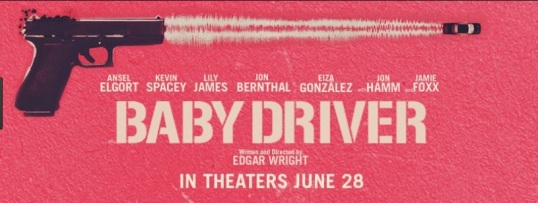
Baby Driver, the new film from director Edgar Wright, is awesome!
That’s the succinct way of putting it and, if you really want to fully enjoy this film, I suggest that you stop reading this review now. There’s no way that a review cannot, to a certain extent, spoil a movie. Baby Driver is a kinetic blend of action, comedy, romance, and music and it is a movie that you should see without any preconceived notions and expectations. It’s a movie that earns the right to surprise you with just how good and entertaining it is. It’s a movie that you should experience fresh.
So, go see the movie. Seriously, go right now. GET OUT OF HERE AND SEE THE MOVIE! This review will still be waiting for you when you get back. Who knows? Maybe, while you’re watching the movie, I’ll actually correct some of the typos. Or maybe not.
Anyway, go away. I’ll wait for you to return.
la dee da la dee da…
Okay, did you see the movie? It’s really great, isn’t it?
As a result of the childhood car accident that killed his parents, Baby (Ansel Elgort) has been left with a permanent case of tinnitus. He uses music to drown out the constant ringing in his ears. There’s almost never a time that Baby isn’t listening to his ipod. When we first see Baby, he’s sitting behind the wheel of a car, singing along with Jon Spencer and the Blues Explosion. The second time that we see him, he’s getting coffee while listening to Harlem Shuffle. In a delirious homage to Singin’ In The Rain (and in a scene that puts the opening traffic jam of La La Landto shame), Baby literally dances across the streets of Los Angeles. For Baby, every day is a musical.
Of course, Baby doesn’t just use music to block out the ringing. He also uses the music (and an ever-present pair of sunglasses) to keep the world out. He rarely speaks or even makes eye contact and, as long as he’s listening to his ipod, he has an excuse not to interact. He doesn’t have to explain the small scars around his eyes or how he makes his money. The few times that he does speak to people, it’s to record their voices, which he then turns into music. Music and the driving are the only two ways this orphan can express his feelings.
When the movie begins, Baby appears to be close to only two men. One is his deaf foster father, Joseph (CJ Jones). Baby lives with Joseph, in an apartment where Baby regularly stashes thousands of dollars. Joseph always watches in disapproval as Baby hides the money under the floorboards. Joseph signs at Baby that he deserves better than the life he’s leading. Baby always signs back that he’s only a few jobs away from being done.
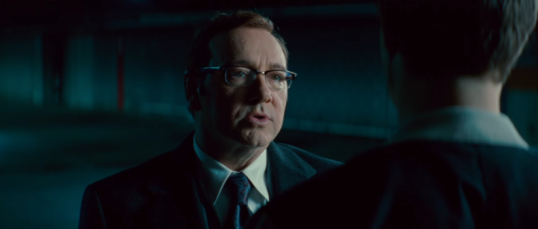
Baby’s other father figure is Doc (Kevin Spacey). Doc is a rich and connected man. At times, he seems to sincerely care about Baby but there are other times when Doc is just as quick to threaten to kill him and everyone that he loves. Doc plans bank robberies for a living. Doc may change associates from robbery to robbery but one thing always remains consistent. Baby is always his driver because Baby is the best. As Doc explains it, the first time he saw Baby, he was stealing Doc’s Mercedes. Baby drives for Doc as a way of paying off his debt to the older man but you still believe Baby’s sincerity when he tells Doc, “We’re a team.” (One the film’s best throw-away jokes is the line where Doc reveals that he knows where Baby got the idea to say that.)
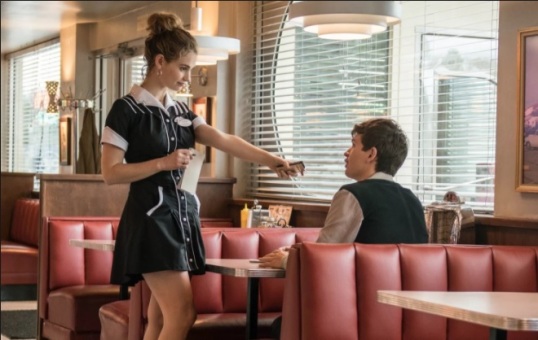
Things start to change for Baby when he meets Debora (Lily James), a waitress who appears to love music just as much he does. For Baby and Debora, it’s love at first sight but Doc has one more job that he needs Baby for. It’s their most dangerous job yet and, making thing even more complicated, are the three people who Doc has recruited to work with Baby. Buddy (Jon Hamm) is a former wall street banker who is eager to prove what a badass he is. Darling (Eiza Gonzalez) is his wife, who enjoys talking about how many of their former partners have died. And finally, there’s Bats (Jamie Foxx), a complete and total psycho who brags about never telling a single story that doesn’t end with someone getting killed.
Baby Driver is a propulsive blast of pure adrenaline, perhaps the closest that we will ever get to a genuine pulp musical. The action scenes left me literally breathless. I saw the movie at the Alamo Drafthouse and, before the film started, there was a clip of Edgar Wright listing his favorite car chases. He listed all of the usual suspects, Bullitt, The French Connection, Mad Max: Thunder Road. The chases scenes in Baby Driver can proudly be listed next to all of those scenes. This is genuinely exciting crime film, featuring wonderfully over-the-top turns from Foxx, Hamm, and especially Spacey.
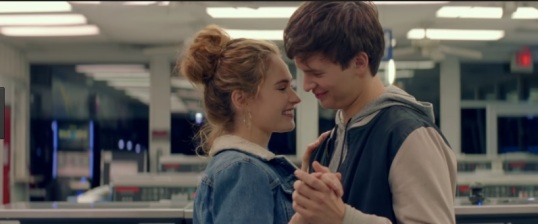
But you know what? Baby Driver may be a great action film but what makes it special is that it’s also a film with a heart. Rather bravely, Edgar Wright has not only made an action musical but he’s also mixed in a very sincere and unabashedly sentimental love story. You never doubt for a second that Baby would give up everything — music, driving, even his life — for Debora. The scenes between Baby and Debora are almost deliriously romantic. Ansel Elgort and Lily James both share a very likable and very real chemistry. You want things to work out for Debora and Baby. You feel like they belong together and, when it looks like either Baby or Debora might be in danger, you worry for both of them. As exciting as the film’s action sequences were, it was the ending that brought tears to my eyes and that was almost totally due to the performances of Elgort and James.
Baby Driver is one of the best films that I’ve seen so far this year. See it this weekend! If you’ve already seen it, see it again! This film deserves to be rewarded.
What’s an Insomnia File? You know how some times you just can’t get any sleep and, at about three in the morning, you’ll find yourself watching whatever you can find on cable? This feature is all about those insomnia-inspired discoveries!
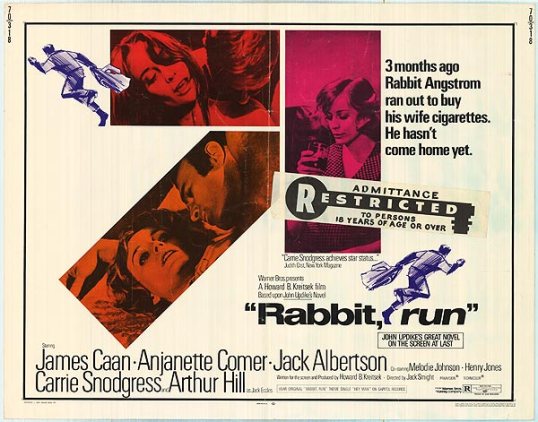
If, at one in the morning on Wednesday, you were suffering from insomnia, you could have turned over to TCM and watched the 1970 film, Rabbit Run. That’s what I did.
Rabbit Run is the epitome of a dumb lug film. In a dumb lug film, a male character finds himself living an unfulfilling life but he can’t figure out the reason. Why can’t he figure it out? Because he’s a dumb lug, with the emphasis on dumb. Usually, the viewer is supposed to sympathize with the dumb lug because he doesn’t mean to hurt anyone and everyone else in his world is somehow even more annoying than he is. Typically, the dumb lug will have an emotionally distant wife who refuses to have sex with him and who is usually portrayed as being somehow at fault for everything bad that has happened in the dumb lug’s face. (Want to see a more recent dumb lug film than Rabbit Run?American Beauty.) Ever since the silent era, there have been dumb lug films. In particular, male filmmakers and critics seem to love dumb lug films because they allow them to pat themselves on the back for admitting to being dumb while, at the same time, assuring them that everything is the fault of the wife or the girlfriend or the mother or the mother-in-law.
In Rabbit Run, the dumb lug is named Harry Angstrom (James Caan), though most people still remember him as Rabbit, the high school basketball star. Harry’s life peaked in high school. Now, he’s 28 and he can’t hold down a job. He’s married to Janice (Carrie Snodgress), who spends all of her time drinking and watching TV. He has a son and another baby is on the way. One day, when the pregnant Janice asks him to go out and get her a pack of cigarettes, Harry responds by getting in his car and driving all the way from Pennsylvania to Virginia.
When he returns to Pennsylvania, Rabbit doesn’t go back to his wife. Instead, he drops in on his former basketball coach (Jack Albertson) and begs for advice on what he should do. The coach, it turns out, is more than little creepy. He also has absolutely no practical advise to give. He does introduce Rabbit to a part-time prostitute named Ruth (Anjanette Comer). Rabbit quickly decides that he’s in love with Ruth and soon, he’s moved in with her.
Meanwhile, there’s all sorts of little things going on. Rabbit gets a job working as a gardener. Rabbit befriends the local Episcopal minister (Arthur Hill), even while the minister’s cynical wife (Melodie Johnson) tries to tempt Rabbit away from both his wife and his mistress. Rabbit both resents and envies the sexual freedom of the counter culture, as represented by his younger sister. And, of course, Janice is pregnant…
Rabbit Run is based on a highly acclaimed novel by John Updike. I haven’t read the novel so I can’t compare it to the film, beyond pointing out that many great works of literature have been turned into mediocre movies, largely because the director never found a way to visually translate whatever it was that made the book so memorable in the first place. Rabbit Run was directed by Jack Smight, who takes a rather frantic approach to the material. Since Rabbit Run is primarily a character study, it needed a director who would be willing to get out of the way and let the actors dominate the film. Instead, Smight overdirects, as if he was desperately trying to prove that he could keep up with all the other trendy filmmakers. The whole movie is full of extreme close-ups, abrupt jump cuts, intrusive music, and delusions of ennui. You find yourself wishing that someone had been willing to grab Smight and shout, “Calm down!”
(On the plus side, as far as the films of 1970 are concerned, Smight’s direction of Rabbit Run still isn’t as bad as Richard Rush’s direction of Gettting Straight.)
James Caan actually gives a likable performance as Rabbit, which is good because Rabbit would be totally unbearable if not played by an actor with at least a little genuine charisma. There’s nothing subtle about Caan’s performance but he makes it work. You never like Rabbit but, at the same time, you don’t hate him.
Unfortunately, there’s nothing subtle about the rest of the cast either. Something rather tragic happens about 80 minutes into the film and, as much as I knew I shouldn’t, I still found myself giggling because Carrie Snodgress’s performance was so bad that it was impossible for me to take any of it seriously. Even worse is Arthur Hill, as the minister who won’t stop trying to help Rabbit out. I eventually reached the point where, every time that sanctimonious character started to open his mouth, I found myself hoping someone would hit him over the head and knock him out. Among the major supporting players, only Anjanette Comer is allowed a chance to be something more than just a sterotype. Like Caan, she does the best that she can but ultimately. this is James Caan’s movie.
It’s a disappointing movie but it did not put me to sleep. Give credit for that to James Caan, who is the only reason to see Rabbit Run.
Earlier tonight, on TCM, I watched the 1968 science fiction film, Countdown.
Who will be the first man to walk on the moon? Will it be Chiz (Robert Duvall), who is a colonel in the Air Force and who has been training for years and who really should get the chance just because he has a really cool name like Chiz? Or will it be Chiz’s best friend, Lee (James Caan)? Lee may not have Chiz’s experience but he’s a scientist and selecting him would allow NASA to portray the mission of being one of peace as opposed to one of war. Add to that, Lee has a full head of hair and he looks like a young James Caan, who was an undeniably handsome man back in his younger days! I mean, seriously — who would you rather have as the face of the space program: Tom Hagen or Sonny Corleone?
Of course, it might not really matter who NASA picks because the Russians are determined to get to the moon as well. And you know what that means! If the Russians land on the moon first, they’ll turn it into a Socialist utopia and that’ll mean ugly architecture, bread lines, and a three-month wait for toilet paper. The stakes have never been higher!
Countdown was made and released at the height of the space race, at a time when Americans really did feel that they were competing with the Russians to be the first to reach the moon. (Of course later, it would be learned that the Russian space program actually managed to kill far more cosmonauts than it successfully sent into orbit.) It came out a year before Apollo 11 landed on the moon and Neil Armstrong became the first Earthling since Stanley Kubrick to ever step on the lunar surface. As such, it’s interesting to see how Countdown imagines the experience of exploring the moon. I won’t spoil who reaches the moon first but I will say that he moves remarkably quickly and with great ease for someone in a gravity-free environment.
Countdown is a good example of what I like to call a “time capsule” film. Seen today, it’s kinda slow and a bit predictable. For all the time that is spent on getting the astronauts ready to go into space, very little time is actually spent in orbit. This is a very Earth-bound film. And yet, if you’re a history nerd like me, it’s hard not to be a little bit fascinated by a movie like this. In everything, from its fashions to its dialogue to its cultural outlook, this is very much a document of its time. It may be a while until we have the technology necessary to travel through time. Until then, watching a film like this might be as close as I’ll ever get to experiencing what the straight, non-Hippie crowd was doing in 1968.
If you’re a student of film history, Countdown is significant for being one of the first films to be directed by Robert Altman. To be honest, if not for his name in the opening credits, you would probably never guess that Countdown was directed by one of America’s most influential and iconic directors. Altman specialized in making film that were almost defiantly iconaclastic and there’s very little of that to be found in Countdown. Admittedly, there are a few scenes that make use of overlapping dialogue and there’s a party scene that’s definitely Altmanesque. However, the only reason I really noticed that party scene is because I was specifically looking for evidence of Altman’s style. For the most part, the most identifiably Altmanesque element of Countdown is the casting of Michael Murphy in a small role.
The film is dominated by Robert Duvall and James Caan and, especially if you’re a fan of The Godfather, it’s undeniably fun to see these two acting opposite each other in something other than an epic gangster film. (Duvall and Caan also acted together in The Rain People and The Killer Elite and were reportedly great friends off-camera as well.) Duvall is especially good in Countdown, playing Chiz as a man torn between an innate sense of loyalty and his own competitive nature. The scenes between Duvall and Caan have a charge to them that occasionally bring some much-needed life to this film.
In the end, Countdown is a fairly forgettable film but it’s worth seeing as a piece of history.
Well, it’s time for me to make my monthly Oscar predictions! Though my predictions are no longer “too early,” they are still definitely early. Most of these predictions are based on a combination of wild speculation and wishful thinking.
For instance, do I really think that Wonder Womanwill be an Oscar contender?
Well, I think it could be. I’d like it if it was. If really pressed, I’ll say that I think it has a better chance of being nominated than Logan does. And, as you’ll remember, I had Logan listed as a best picture nominee back in March.
I guess what I’m saying is that these predictions should always be taken with a grain of salt. To be honest, right now, the only precursor that we have is Cannes and Cannes is notoriously unreliable when it comes to being used as a tool to predict what will actually be nominated.
Anyway, these predictions will probably be good for a laugh or two next February. Be sure to check out my previous predictions for January,February, March, April, and May!
Last night, I watched The Killing Pact on Lifetime!
Why Was I Watching It?
Because it was on Lifetime, of course! Y’all know that I can’t resist a Lifetime movie, especially one that has the word “killing” in the title. At the very least, I figured The Killing Pact would feature the over the top melodrama and tasteful interior design that we’ve all come to expect from Lifetime movies.
(That said, The Killing Pact was advertised as being a premiere but, actually, it aired on the Lifetime Movie Network last month. I DVR’d it when it first aired but I hadn’t gotten around to watching it yet. By watching it on Lifetime last night, I was able to clear a little more space on my DVR. Yay!)
What Was It About?
Strangers In An Uber!
Strangers In A Train Without The Train!
Take your pick, they’re both adequate descriptions of what was going on in The Killing Pact. When Hayley (Emily Rose), a single mother and Uber driver, gives a ride to two weirdos (Melanie Stone and Brandon Ray Olive), she is drawn into an unexpected situation. It turns out that all three of them have people in their lives that they wish were dead. So, why not agree to a killing pact? At first, Hayley thinks it’s all a joke but then her sleazy loser of an ex-husband is brutally murdered. Hayley’s new friends have kept their end of the bargain. Now, it’s time for Hayley to do her part…
What Worked?
I liked the look of the film. Almost every scene was drenched in this moody, overcast atmosphere and, as a result, the film was almost always interesting to look at, even if the plot didn’t always work. There was one scene — of Hayley pulling up in front of a cheap motel — that I thought was especially well put together. The dark clouds, the wet pavement, the dilapidated motel — the whole scene was full of menace.
What Did Not Work?
For the most part, this film just didn’t work for me. At first, I was a little confused as to why the movie was doing so little for me but, the more I thought about it, the more I realized that the film just moved way too slowly, especially for a movie that was frequently interrupted by commercials. The typical Lifetime film has 8 acts. That means that, over the course of a typical Lifetime movie, there are at least 7 cliffhangers, all designed to make you stick around through the commercials so you can see what happens during the 8th act. The Killing Pact, however, felt more like a three or four act movie. There was no forward momentum to hold your interest even through the commercial breaks. The film’s pacing was definitely off and Lifetime films are all about maintaining a steady pace.
“Oh my God! Just like me!” Moments
One of the murders involved an autocratic theater producer. It reminded me of all the murders that nearly occurred during a community theater production of Little Shop ofHorrors that I was once involved with.
4 Shots From 4 Films is just what it says it is, 4 shots from 4 of our favorite films. As opposed to the reviews and recaps that we usually post, 4 Shots From 4 Films is all about letting the visuals do the talking.
Today is the birthday of the Italian film director, Lucio Fulci! In honor of the big day, here are 4 shots from 4 films!
4 Shots From 4 Films is just what it says it is, 4 shots from 4 of our favorite films. As opposed to the reviews and recaps that we usually post, 4 Shots From 4 Films is all about letting the visuals do the talking.
We survived Tuesday the 13th!
To celebrate, here are 4 shots from 4 underground films!
4 Shots From 4 Films
Vinyl (1965, directed by Andy Warhol)
Beauty No. 2 (1965, dir by Andy Warhol)
Kitchen (1966, dir by Andy Warhol)
Chelsea Girls (1966, dir by Andy Warhol and Paul Morrissey)
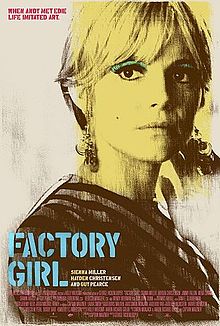
Released in 2006, Factory Girl was a biopic about Edie Sedgwick, the tragic model/actress/artist who was briefly both Andy Warhol’s muse and one of the most famous women in America. Before I talk too much about this film, I should probably admit that I’m probably the worst possible person to review a movie about Edie Sedgwick.
Why?
Allow me to repost something that I wrote when I reviewed Edie’s final film, Ciao Manhattan:
“In the late 60s, Edie Sedgwick was a model who was briefly the beautiful face of the underground. Vogue called her a “youthquaker.” She made films with Andy Warhol, she dated the rich and the famous and for a brief time, she was one of the most famous women in America. But a childhood full of tragedy and abuse had left Edie fragile and unprepared to deal with the pressures of being famous. She was fed drugs by those who claimed to care about her, she had numerous mental breakdowns, and, when she was at her most vulnerable, she was pushed away and rejected by the same people who had loved her when she was on top of the world. Edie died because, when she asked for help, nobody was willing to listen.
Edie Sedgwick (1943 — 1971)
I guess I should explain something. I don’t believe in reincarnation but if I did, I would swear that I was Edie Sedwick in a past life. Of all the great icons of the past, she, Clara Bow, andVictoria Woodhull are the ones to whom I feel the closest connection. (Edie is the reason why, for the longest time, I assumed I would die when I was 28. But now I’m 29, so lucky me.)”
(Incidentally, I wrote that two years ago and I’m still alive so, once again, lucky me.)
Anyway, my point is that I’m always going to be a hundred times more critical of a film about Edie Sedgwick as I would be about any other film. If you’re already guessing that I didn’t particularly care for Factory Girl, you’re right. However, there are some people whose opinions I respect and some of them love this film.
Anyway, Factory Girl is a biopic that’s structured so conventionally that it even opens with Edie (played by Sienna Miller) narrating her story to an unseen interviewer. I can count on one hand the number of successful biopics that have featured someone telling the story of their life to an unseen interviewer. It’s a conventional and kind of boring technique. Anyway, the film follows all of the expected beats. Edie arrives in New York. Edie is spotted by Andy (Guy Pearce). Edie makes films with Warhol. Her famous dance in Vinyl is recreated. Edie becomes Andy’s platonic girlfriend but then, she meets and falls in love with Bob Dylan…
Oh, sorry. He’s not actually Bob Dylan. According to the credits, his name is Folksinger. He says Bob Dylan type stuff. He rides around on a motorcycle. He carries a harmonica. Oh, and he’s played by Hayden Christensen.
See, the first half of Factory Girl is actually not bad. Sienna Miller gives a pretty good performance as Edie, even if she never comes close to capturing Edie’s unforced charisma. Despite being several years too old, Guy Pearce is also credible as Andy Warhol. The film itself is full of crazy 60s clichés but, even so, that’s not always a terrible thing. Some of those 60s clichés are a lot of fun, if they’re presented with a little imagination.
But then Hayden Christensen shows up as Bob Dylan and the film loses whatever credibility it may have had. Hayden, who gave his best performance when he played a soulless and largely empty-headed sociopath in Shattered Glass, is totally miscast as a musician who once said that if people really understood what his songs were about, he would have been thrown in jail. The film attempts to portray Dylan and Warhol as two men fighting for Edie’s soul but Christensen is so outacted by Guy Pearce that it’s never really much of a competition. Even though the film makes a good case that Edie’s relationship with Andy was ultimately self-destructive, Guy Pearce is still preferable to Hayden Christensen trying to imitate Dylan’s distinctive mumble.
Anyway, Factory Girl doesn’t really work. Beyond the odd casting of Hayden Christensen, Factory Girl is too conventionally structured. In its portrayal of the Factory and life in 1960s New York, the film never seems to establish a life beyond all of the familiar clichés. (Before anyone accuses me of contradicting myself, remember that I said that the old 60s clichés are fun if they’re presented with a little imagination. That’s a big if.) At no point, while watching the film, did I feel as if I had been transported back to the past. If you want to learn about Edie Sedgwick, your best option is to try to track down her Warhol films.
I Shot Andy Warhol was not the only 1996 film to feature Andy Warhol as a character. He was also a prominent supporting character in Basquiat. In this film, he’s played by David Bowie and Bowie gives a far different performance than Jared Harris did in I Shot Andy Warhol. Whereas Harris played Andy as a detached voyeur, Bowie’s performance is far more sympathetic. (Of course, it should be noted that Harris and Bowie were playing Andy Warhol at very different points in the artist’s life. Harris played the younger, pre-shooting Warhol. Bowie played the older, post-shooting Warhol.)
Then again, it’s not just Andy Warhol who is portrayed more positively in Basquiat than in I Shot Andy Warhol. The entire New York art scene is portrayed far more positively in Basquiat. Whereas I Shot Andy Warhol was a film about an outsider who was destined to forever remain an outsider, Basquiat is a film about an outsider who becomes an insider. On top of that, Basquiat was directed by a fellow insider, painter Julian Schnabel.
The film itself is a biopic of Jean-Michel Basquiat (very well played by Jeffrey Wright), the graffiti artist who, in the 1980s, briefly became one of the superstars of the New York art scene. However, it’s less of a conventional biopic and more of a meditation on what it means to be an artist. Throughout the film, Basquiat looks up to the New York skyline and sees a surfer riding a wave across the sky. The image itself is never explicitly explained. We never learn why, specifically, Basquiat visualizes a surfer. But then again, that’s what makes the surfer a perfect symbol of Basquiat’s artistic sensibility and talent. It’s a reminder that, while we can appreciate an artist’s work, only the artist can truly understand what that work is saying. All attempts to try to explain or categorize art are as pointless as trying to understand why that surfer is in the sky. Ultimately, the why is not as important as the simple fact that the surfer is there.
The film follows Basquiat as he goes from living on the streets to being a protegé of Andy Warhol’s and, until he overdosed on heroin, one of the shining lights of the New York art scene. Along the way, Basquiat struggles to maintain a balance between art and the business. In one of the key scenes of the film, an empty-headed suburbanite (Tatum O’Neal) looks at Basquiat’s work and whines that there’s too much green. She just can’t handle all of that green.
Basquiat’s friendship with Andy Warhol provides this film with a heart. When Bowie first appears — having lunch with a German art dealer played by Dennis Hopper — one’s natural instinct is to assume that Bowie as Warhol is stunt casting. However, Bowie quickly proves that instinct to be wrong. As opposed to many of the actors who have played Andy Warhol over the years, Bowie gives an actual performance. Instead of resorting to caricature, Bowie plays Warhol as being mildly bemused by both his fame and the world in general.
Basquiat also develops a close friendship with another artist. Gary Oldman may be playing a character named Albert Milo but it’s obvious from the moment that he first appears that he’s playing the film’s director, Julian Schnabel. If there was any doubt, Schnabel’s studio stands in for Milo’s studio. When Milo shows off his work, he’s showing off Schnabel’s work. When Albert Milo introduced Basquiat to his parents, the nice old couple is played by Julian Schnabel’s actual parents. It’s perhaps not surprising that Albert Milo is presented as being one of the most important and popular artists in New York City. In a film full of bitchy characters, Albert Milo is unique in that literally everyone likes and respects him. And yet Gary Oldman gives such a good and heartfelt performance that you can’t hold it against the character that he happens to be perfect. There’s a small but touching scene in which Albert Milo and his daughter share a dance in front of one of Schnabel’s gigantic canvases. Of course, Milo’s daughter is played by Julian Schnabel’s daughter.
The entire cast is full of familiar actors. Willem DaFoe appears as a sculptor. Christopher Walken plays a hilariously vapid interviewer. Courtney Love plays a groupie. Benicio Del Toro plays Basquiat’s best friend. Parker Posey shows up as gallery owner Mary Boone. Michael Wincott plays Rene Ricard, the somewhat infamous art critic who was among the first to celebrate the work of both Basquiat and Schnabel. For once, the use of familiar actors does not sabotage the effectiveness of the film. If anything, it helps to explain why Basquiat was so determined to make it. There’s a magical scene where a then-unknown Basquiat peeks through a gallery window and sees Andy Warhol, Albert Milo, and Bruno Bischofberger. However, the film’s audience sees David Bowie, Gary Oldman, and Dennis Hopper. What both Basquiat and the audience have in common is that they’re both seeing bigger-than-life stars.
Basquiat is an often magical and poignant film and I absolutely love it.