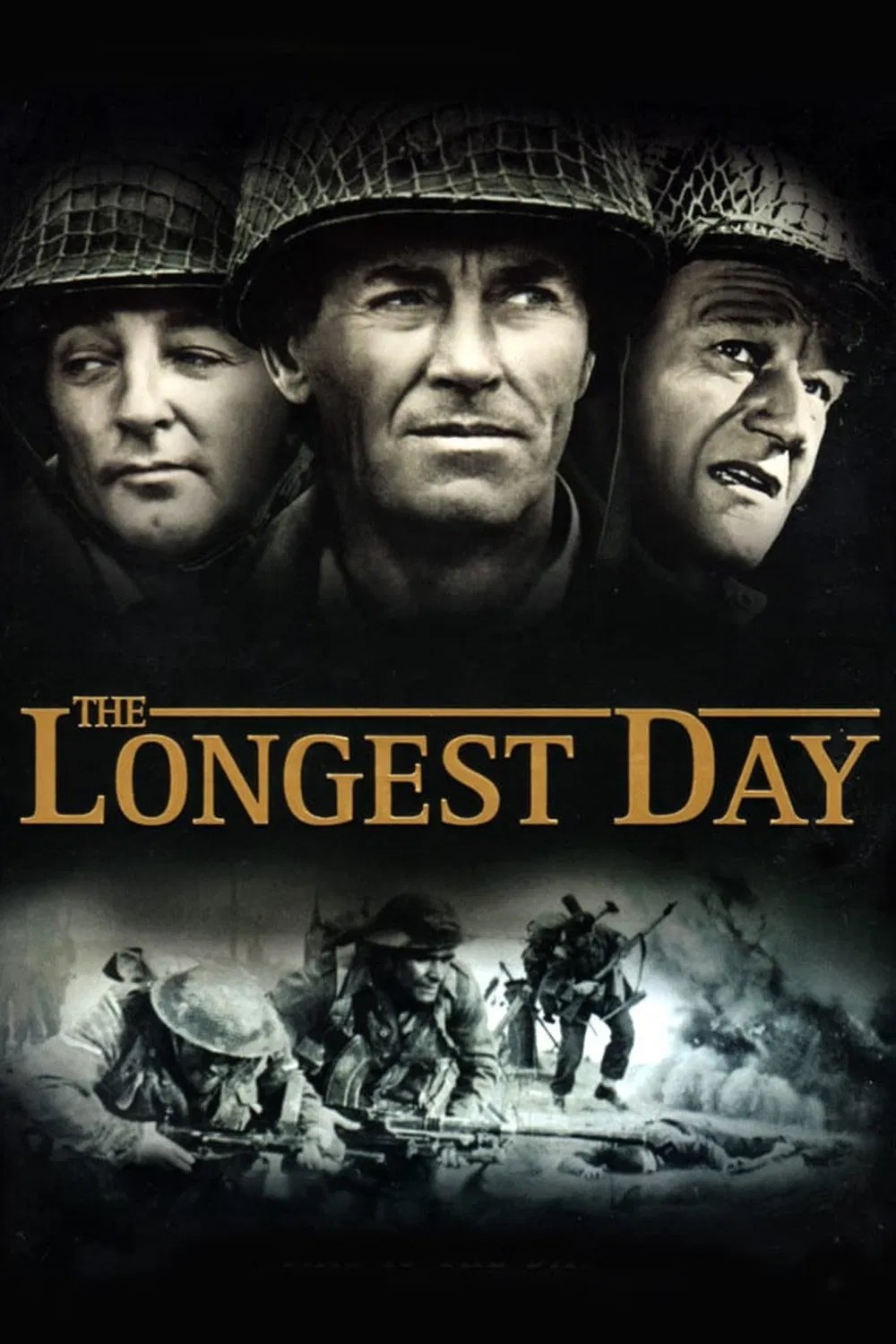
Review: The Longest Day (dir. by Ken Annakin, Andrew Barton & Bernhard Wicki)


“The thing that’s always worried me about being one of the few is the way we keep on getting fewer.” — Flight Officer David Campbell

You could be forgiven for thinking that a three-hour black-and-white war epic from 1962 about the D-Day landings might feel like homework. The Longest Day sounds exactly like the kind of movie your history buff uncle would insist you watch, and you’d brace yourself for stiff acting, dated effects, and a flag-waving tone that hasn’t aged well. But here’s the surprise: this thing still cooks. It’s massive, messy in the best way, and surprisingly modern in its storytelling. Directed by a quartet of filmmakers—Ken Annakin for the British sequences, Andrew Marton for the Americans, Bernhard Wicki for the Germans, and with uncredited help from John Wayne’s own ego (more on that later)—The Longest Day isn’t one movie. It’s five or six movies crammed into a single sprawling canvas, and somehow that chaotic energy works perfectly for a story about the chaos of June 6, 1944.

First, let’s talk about the elephant in the room: the cast. It’s absurd. John Wayne, Robert Mitchum, Henry Fonda, Sean Connery, Richard Burton, Rod Steiger, Robert Wagner, Curt Jürgens, and a young Gert Fröbe (the future Goldfinger) are just the headliners. There are about forty other recognizable faces popping up for two minutes of screen time. You half expect a narrator to say “and that guy from that thing.” But here’s the trick: The Longest Day uses star power not as distraction but as shorthand. When you see John Wayne playing Lt. Col. Benjamin Vandervoort, you don’t need a backstory. You just know he’s the tough, unkillable leader. When you see Henry Fonda as Brig. Gen. Theodore Roosevelt Jr., you read quiet dignity and grit. The movie trusts that you’ll fill in the blanks, which allows it to jump between American, British, French, and German perspectives without pausing for emotional handholding. That’s a bold gamble, and it mostly pays off, though Wayne’s scenes are a prime example of the film’s one real weakness: occasionally, it lets the star overpower the story. His Vandervoort breaks his ankle jumping into Normandy and still leads his men—cool story, historically accurate—but Wayne plays it with that trademark swagger that feels more Rio Bravo than WWII. It doesn’t ruin the film, but it does remind you you’re watching a movie star, not a soldier.

Where The Longest Day truly earns its reputation is in its structure. The film opens with a ground-level view of the German defenders—foggy, tired, complacent. Rommel (Curt Jürgens) is home for his wife’s birthday. Junior officers are skeptical of the “invasion threat.” Then we cut to the Allied side, from Eisenhower’s agonized “go” decision to the paratroopers floating down into French nightmares. The film refuses to pick a hero. It bounces between a German machine-gunner mowing down Americans on Omaha Beach and a French Resistance fighter getting captured and executed. There’s no swelling music to tell you who to root for—the score by Maurice Jarre is often tense, percussive, or eerily quiet. That evenhandedness is shocking for an early-60s war film. The Germans aren’t cackling villains. They’re professionals, some cynical, some naive, all trapped in a bad situation. One scene shows a German officer calmly reporting the invasion to higher command while another weeps because his men have no air support. You don’t sympathize with them exactly, but you understand them. That’s rare for any war movie, let alone one starring John Wayne.

The set pieces remain jaw-dropping. Because this was made before CGI, every paratrooper you see actually jumped (with stuntmen and low altitudes). Every landing craft ramp dropping on Omaha Beach is filled with real extras who had to swim ashore in cold water. The famous shot of a lone French commando running across a bridge under fire? That’s a real explosion, real bullets (blanks, but still). The production employed thousands of military advisors and actual veterans as extras. You can feel that authenticity in the grain of the film. When American soldiers fumble with wet ammunition or a British glider crash-lands through a fence, it’s not slick Hollywood heroism. It’s clumsy, loud, and terrifying. The movie’s most quoted line—“The greatest thing about the greatest generation is they didn’t know they were the greatest”—isn’t in the film, but the spirit is everywhere. These guys aren’t quoting Shakespeare. They’re vomiting from seasickness, losing their gear, and crying for their mothers. Then they get up and climb a cliff. That contrast is what makes The Longest Day so effective: it’s a blockbuster that respects the small, undignified human moments.

If the film has a flaw beyond occasional star vanity, it’s pacing. The first hour is deliberately slow—building tension through radar stations, weather reports, and a French priest’s bicycle ride. That might bore viewers raised on Saving Private Ryan’s opening twenty minutes. But hang with it, because when the invasion starts, the deliberate pace pays off. You’ve been inside the German bunkers, heard their debates, seen their confidence. So when paratroopers land behind their lines with toy clickers (the actual “cricket” device from history), every crack of a twig feels tense. The other flaw is the film’s treatment of the French Resistance and civilians. They get a few noble moments—a girl running through gunfire to deliver a message—but overall, the French are sidelined. The movie is fundamentally Anglo-American, with German scenes as the “other” perspective. That’s honest to the command structure of D-Day, but it does mean the country being liberated mostly watches from the margins.

Still, The Longest Day achieves something that most war epics don’t: it’s a genuine ensemble piece without a single protagonist, and it never loses its moral clarity. There’s a scene where a German colonel (the wonderful Werner Hinz) looks at an American prisoner and says, “We fight for a monster. You fight for your homes.” That’s the whole movie in one line. It doesn’t demonize the Germans as evil—it shows them as humans who made terrible choices and are now paying for them. And it doesn’t sanctify the Allies—it shows them as scared kids with a just cause. The final image of the film is a lingering shot of the beach, littered with bodies and wreckage, as a narrator tells you the exact number of casualties on both sides. No music. No kiss. No flag. Just the silent aftermath. For 1962, that’s audacious. For today, it’s heartbreaking.

So should you watch The Longest Day? Yes, but not as a history lesson. Watch it as a time capsule of how we used to make movies: with real explosions, real extras, and a willingness to let a story breathe across three hours without a superhero or a snappy one-liner. It’s old-fashioned, sure. Some of the acting is stagey, and the black-and-white photography might feel like a relic. But once the landing craft doors drop and the bullets start kicking up water, you’ll forget the runtime. It’s not Saving Private Ryan’s visceral nightmare, and it’s not Band of Brothers’ intimate character study. It’s a reporter’s notebook of a film—raw, sprawling, and full of names you’ll never remember but faces you won’t forget. For a movie that’s over sixty years old, The Longest Day still has legs. And for a story about the longest day, it earns every single minute.
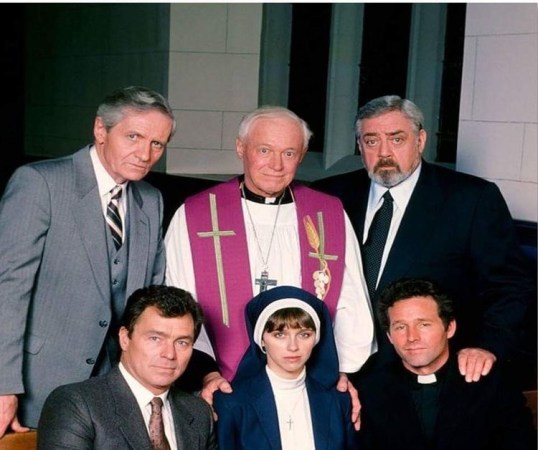
I Watched Perry Mason: The Case of the Notorious Nun (1986, Dir. by Ron Satlof)


In the second Perry Mason movie, Perry (Raymond Burr) defends Sister Margaret (Michele Greene), who has been accused of murdering Father Thomas O’Neil (Timothy Bottoms).  The D.A. (David Ogden Stiers) says that Sister Margaret was having an affair with Father O’Neil and she killed him when he tried to break it off.  However, the movie shows us that, just like in the last movie, Father O’Neil was actually killed by a hitman (Hagan Beggs).  Perry, Della (Barbara Hale), and Paul Drake, Jr. (William Katt) have to figure out who ordered the priest’s murder.

I enjoyed the Case of the Notorious Nun, even if it wasn’t as good as the previous film.  It was still entertaining and I loved watching Perry constantly give Paul a hard time about every little thing but this time, it was really obvious who the actual killer was.  Paul, of course, had romantic feelings for Sister Margaret but nothing came from them, other than a chaste kiss on the cheek.  Sorry, Paul.  You’re charming but you’re not that charming.

Father O’Neil was far more sympathetic than the previous movie’s victim.  Father O’Neil was trying to make the world a better place and his death with was a real tragedy.  That made it all the more satisfying when Perry was able to get his cross-examination confession.  There was an alarming scene early on in the movie where Perry checked into a hospital because he was feeling faint and I get the feeling that they framed the scene to make Raymond Burr look even heavier than he was.  (This movie justified Paul Drake doing all the leg work while Perry stayed at the office.)  But even if he moves a little slower than he used to, Perry Mason is still the best lawyer out there.

It’s No Westworld: Futureworld (1976, directed by Richard T. Heffron)


Two years after the Westworld “incident,” (in which a group of robots malfunctioned and murdered hundreds of humans), Delos Amusement Park has reopened and is accepting guests.  Westworld has been permanently shut down but guests can still go to Romanworld and Medeivalworld (despite the fact that it was in Medievalworld that the whole robot rebellion started in the first place).  Delos has added two new worlds: Spaworld and Futureworld.  Spaworld is a spa for people who want to think young and Futureworld is the world of the future, which looks much like 1976, the year that this film was made.

Two reporters, Chuck Browning (Peter Fonda) and Tracy Ballard (Blythe Danner), have been invited to cover the grand reopening of Delos and to hopefully generate some good publicity.  Chuck, however, has reason to believe that there’s something sinister happening at Delos.  While Tracy is busy fantasizing about Yul Brynner, Chuck discovers that Delos is using Futureworld to clone diplomats.

At the end of Futureworld, Peter Fonda gives everyone the finger and that’s really cool but otherwise, this is a forgettable sequel to Westworld.  The whole point of the original Westworld was that the robots didn’t know they were robots but, in Futureworld, the robots not only know what they are but they’re also superfluous to the plot.  There’s no robot revolution in Futureworld nor is there any of Crichton’s concerns about technology run amok.  Instead, it’s all about clones and a predictable political conspiracy.

The main issue facing the makers of this film was how could they do a sequel to Michael Crichton’s unexpected hit when Westworld‘s main attraction, Yul Brynner’s robot gunslinger, was thoroughly destroyed at the end of the first film.  It would not make any sense for anyone to have reactivated the robot.  Their solution was to bring Brynner in for a cameo in which he appeared in one of Tracy’s dreams.  Sadly, why they thought it was a good idea to have Tracy develop an erotic fixation on a killer robot and then, just as abruptly, abandon the idea is not for us to know.  They would have been better off leaving Brynner out of the film entirely because his presence just reminds us that Futureworld is no Westworld.

Insomnia File #26: Rabbit Run (dir by Jack Smight)


What’s an Insomnia File? You know how some times you just can’t get any sleep and, at about three in the morning, you’ll find yourself watching whatever you can find on cable? This feature is all about those insomnia-inspired discoveries!

If, at one in the morning on Wednesday, you were suffering from insomnia, you could have turned over to TCM and watched the 1970 film, Rabbit Run.  That’s what I did.

Rabbit Run is the epitome of a dumb lug film.  In a dumb lug film, a male character finds himself living an unfulfilling life but he can’t figure out the reason.  Why can’t he figure it out?  Because he’s a dumb lug, with the emphasis on dumb.  Usually, the viewer is supposed to sympathize with the dumb lug because he doesn’t mean to hurt anyone and everyone else in his world is somehow even more annoying than he is.  Typically, the dumb lug will have an emotionally distant wife who refuses to have sex with him and who is usually portrayed as being somehow at fault for everything bad that has happened in the dumb lug’s face.  (Want to see a more recent dumb lug film than Rabbit Run?  American Beauty.)  Ever since the silent era, there have been dumb lug films.  In particular, male filmmakers and critics seem to love dumb lug films because they allow them to pat themselves on the back for admitting to being dumb while, at the same time, assuring them that everything is the fault of the wife or the girlfriend or the mother or the mother-in-law.

In Rabbit Run, the dumb lug is named Harry Angstrom (James Caan), though most people still remember him as Rabbit, the high school basketball star.  Harry’s life peaked in high school.  Now, he’s 28 and he can’t hold down a job.  He’s married to Janice (Carrie Snodgress), who spends all of her time drinking and watching TV.  He has a son and another baby is on the way.  One day, when the pregnant Janice asks him to go out and get her a pack of cigarettes, Harry responds by getting in his car and driving all the way from Pennsylvania to Virginia.

When he returns to Pennsylvania, Rabbit doesn’t go back to his wife.  Instead, he drops in on his former basketball coach (Jack Albertson) and begs for advice on what he should do.  The coach, it turns out, is more than little creepy.  He also has absolutely no practical advise to give.  He does introduce Rabbit to a part-time prostitute named Ruth (Anjanette Comer).  Rabbit quickly decides that he’s in love with Ruth and soon, he’s moved in with her.

Meanwhile, there’s all sorts of little things going on.  Rabbit gets a job working as a gardener.  Rabbit befriends the local Episcopal minister (Arthur Hill), even while the minister’s cynical wife (Melodie Johnson) tries to tempt Rabbit away from both his wife and his mistress.  Rabbit both resents and envies the sexual freedom of the counter culture, as represented by his younger sister.  And, of course, Janice is pregnant…

Rabbit Run is based on a highly acclaimed novel by John Updike.  I haven’t read the novel so I can’t compare it to the film, beyond pointing out that many great works of literature have been turned into mediocre movies, largely because the director never found a way to visually translate whatever it was that made the book so memorable in the first place.  Rabbit Run was directed by Jack Smight, who takes a rather frantic approach to the material.  Since Rabbit Run is primarily a character study, it needed a director who would be willing to get out of the way and let the actors dominate the film.  Instead, Smight overdirects, as if he was desperately trying to prove that he could keep up with all the other trendy filmmakers.  The whole movie is full of extreme close-ups, abrupt jump cuts, intrusive music, and delusions of ennui.  You find yourself wishing that someone had been willing to grab Smight and shout, “Calm down!”

(On the plus side, as far as the films of 1970 are concerned, Smight’s direction of Rabbit Run still isn’t as bad as Richard Rush’s direction of Gettting Straight.)

James Caan actually gives a likable performance as Rabbit, which is good because Rabbit would be totally unbearable if not played by an actor with at least a little genuine charisma.  There’s nothing subtle about Caan’s performance but he makes it work.  You never like Rabbit but, at the same time, you don’t hate him.

Unfortunately, there’s nothing subtle about the rest of the cast either.  Something rather tragic happens about 80 minutes into the film and, as much as I knew I shouldn’t, I still found myself giggling because Carrie Snodgress’s performance was so bad that it was impossible for me to take any of it seriously.  Even worse is Arthur Hill, as the minister who won’t stop trying to help Rabbit out.  I eventually reached the point where, every time that sanctimonious character started to open his mouth, I found myself hoping someone would hit him over the head and knock him out.  Among the major supporting players, only Anjanette Comer is allowed a chance to be something more than just a sterotype.  Like Caan, she does the best that she can but ultimately. this is James Caan’s movie.

It’s a disappointing movie but it did not put me to sleep.  Give credit for that to James Caan, who is the only reason to see Rabbit Run.

Previous Insomnia Files:

  1. Story of Mankind
  2. Stag
  3. Love Is A Gun
  4. Nina Takes A Lover
  5. Black Ice
  6. Frogs For Snakes
  7. Fair Game
  8. From The Hip
  9. Born Killers
  10. Eye For An Eye
  11. Summer Catch
  12. Beyond the Law
  13. Spring Broke
  14. Promise
  15. George Wallace
  16. Kill The Messenger
  17. The Suburbans
  18. Only The Strong
  19. Great Expectations
  20. Casual Sex?
  21. Truth
  22. Insomina
  23. Death Do Us Part
  24. A Star is Born
  25. The Winning Season