When I think of Tuesday Weld, I first think of her character in Sergio Leone’s ONCE UPON A TIME IN AMERICA (1984). It’s not an easy character to play and she nails it. James Woods references Tuesday in his 2024 album Hear the Thunder Crack on the song “Cafe Central,” specifically pointing out how difficult her character was to play.
Weld hasn’t appeared on screen since 2001, but she worked for 45 years prior to her retirement. To celebrate her birthday, here’s a scene from the Leone masterpiece.
A lot of my favorite actors and celebrities were born on June 7th. I picked out a few of them, based on how much I have enjoyed their work over the years. I may have even created my own movie marathon for the day!!
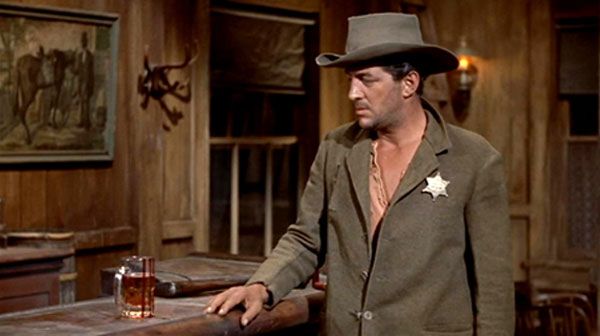
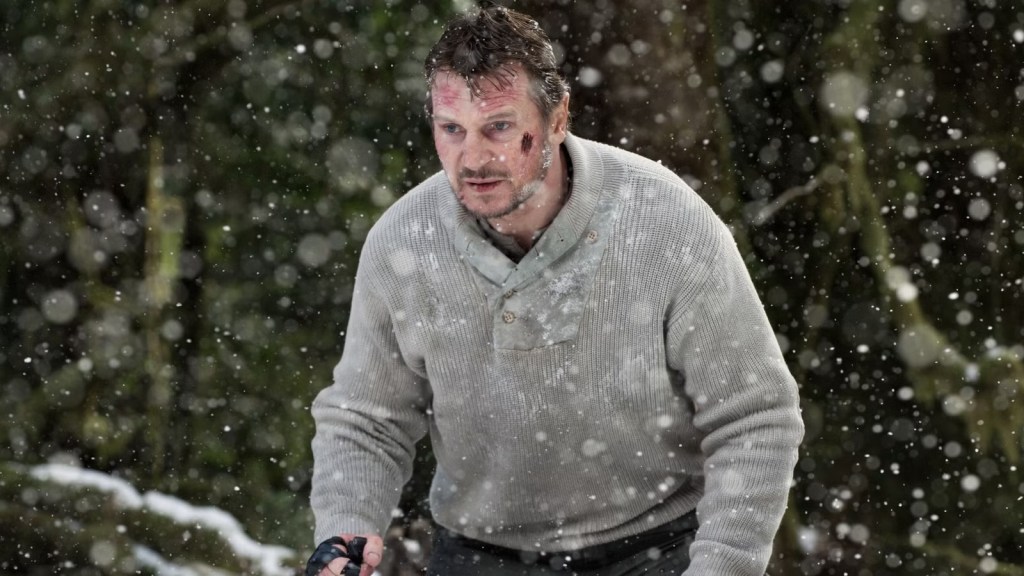
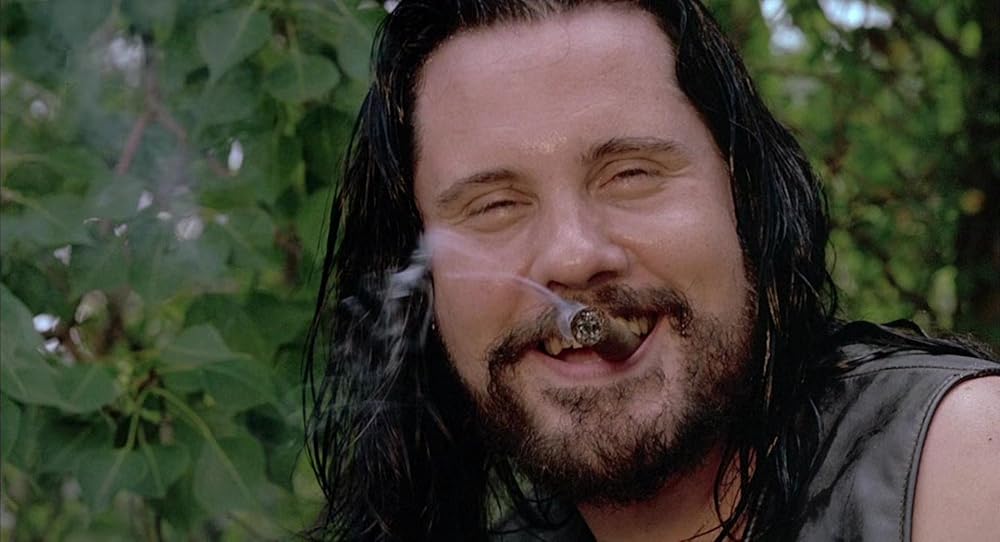
Dean Martin in RIO BRAVO (1959) – Dean would have turned 109 years old today!Liam Neeson in THE GREY (2011) – Liam turns 74 today!William Forsythe in STONE COLD (1991) – William turns 71 today!Prince in PURPLE RAIN (1984) – Prince would have turned 68 years old today.
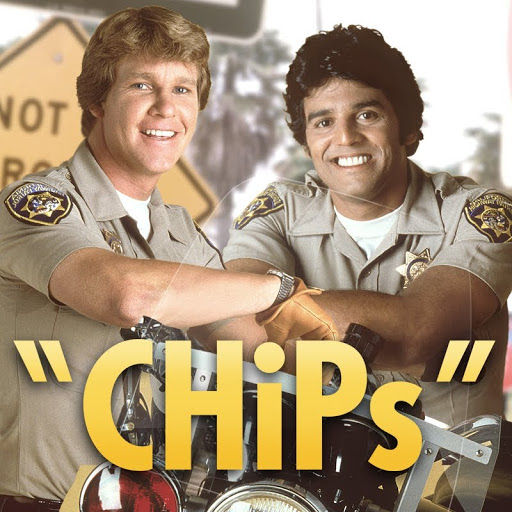
Welcome to Late Night Retro Television Reviews, a feature where we review some of our favorite and least favorite shows of the past! On Mondays, I will be reviewing CHiPs, which ran on NBC from 1977 to 1983. The entire show is currently streaming on Prime!
This week, it’s a musical conflict!
Episode 5.16 “Battle of the Bands”
(Dir by Leslie H. Martinson, originally aired on January 31st, 1982)
Jon Baker cannot understand the appeal of punk rock. He says that the punk rockers all seem to be suburban kids so why are they so angry? They’re not from “the ghetto,” as Baker puts it.
“Suburbs can be a ghetto too, Jon.” Grossie says.
Grossie, who is definitely my favorite member of the Highway Patrol, explains that he likes to keep up with youth culture and, as a result, he understands the difference between Punk and New Wave. Punk rockers have fans who slam dance while New Wave bands have fans who pogo. Grossie demonstrates how to do each dance while the other members of the Highway Patrol watch. When Getraer demands to know why Grossie is slamming himself against the lockers in the locker room, Grossie proceeds to hop out of the room.
This is all important information for Baker to have because there’s a Battle of the Bands coming up. New Waver Snow Pink (Susan Richardson) is eager to win but her guitars were recently stolen out of her band’s van. Unfortunately, Snow Pink has been targeted by Pain, a punk band that is led by Thrasher (William Forsythe). Thrasher doesn’t care about making good music. All he wants to do is cause trouble!
Now, I will say that Thrasher is kind of intimidating. That’s more due to him being played by a young William Forsythe than anything else. He’s a “punk,” which, in the world of CHiPs, means that he has a mohawk and his two bandmates have shaved heads. (If anything, they look more like Neo-Nazis than punk rockers. Johnny Rotten would have kicked them out of a moving car.) That said, when Thrasher flicks his lighter and talks about trashing the club, you believe that there’s a very good chance that he’ll do just that. Fortunately, the Highway Patrol is there to stop him.
Now, as you probably already guessed, there was no way that CHiPs was going to do a Battle of the Bands episode without giving Ponch a band. Ponch competes and he sings Kool & The Gang’s Celebration. It’s disco vs punk vs new wave! Of course, punk doesn’t really get to compete because the band is arrested. And Ponch really can’t win because then his character would have an excuse to leave the show. So, it’s not a shock when Snow Pink wins the Battle of the Bands.
To be absolutely honest, this episode was surprisingly fun. It was definitely an episode of its era, embracing both music and the moral panic of the 80s. The punks were unconvincing. Snow Pink was actually a pretty good singer. Estrada flashed that blinding grin while singing disco. Baker once again comes close to getting a romantic subplot. Grossie gets a monologue about the ideology of punk rock. What’s not to like? Bury this episode in the ground because it’s a time capsule!
One final note: Baker, at one point, says that Ponch might leave the Highway Patrol to pursue his musical career. It’s impossible not to hear the note of hope in Larry Wilcox’s voice.
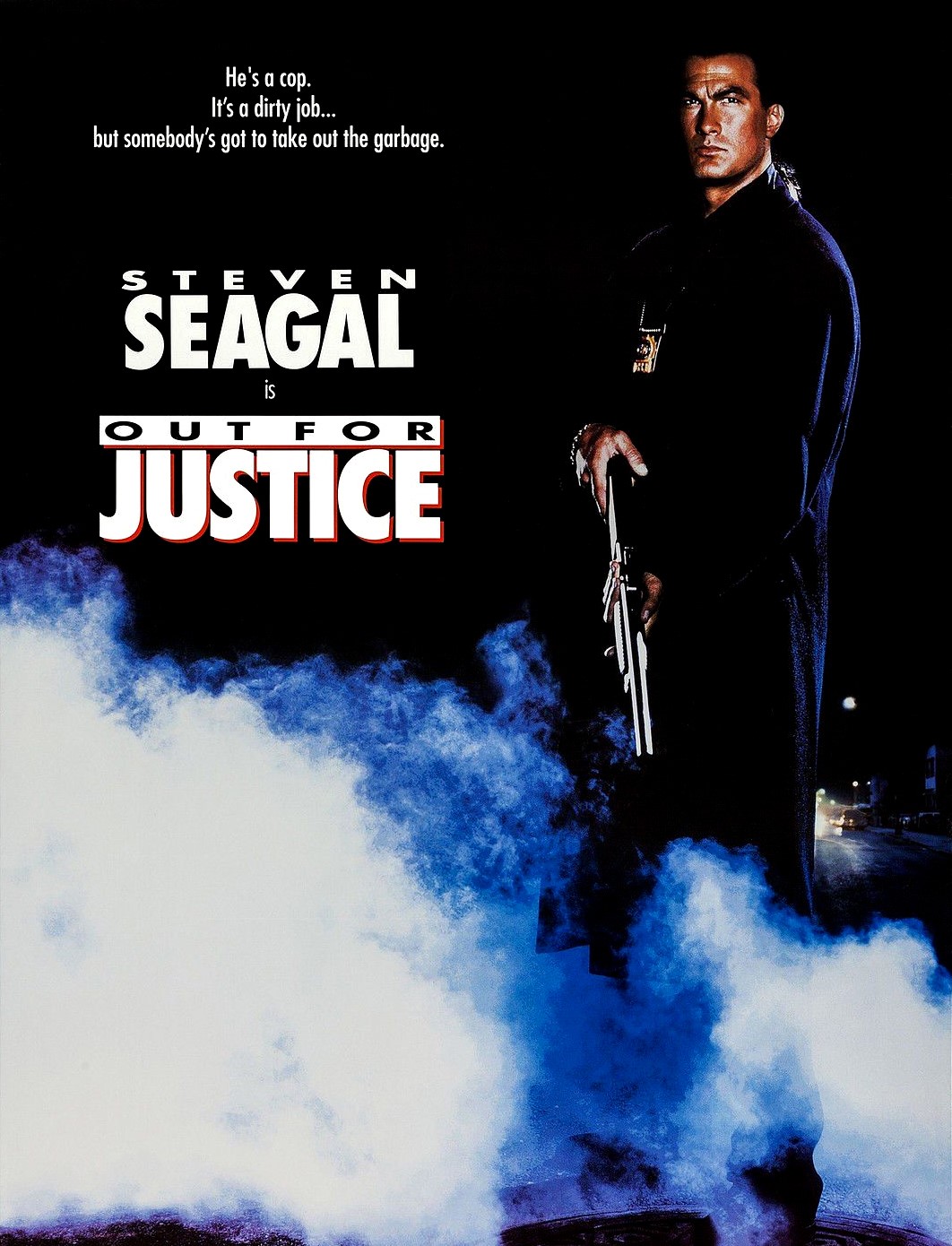
Out for Justice is the kind of movie that leans so heavily on its star’s ridiculous swagger that it stops being merely bad and ridiculous and becomes entertaining in a “can’t‑look‑away from the car‑crash” sort of way. It’s not a polished or especially sophisticated action film, but it has a rough, gleefully over‑the‑top energy that makes it a perfect guilty pleasure, the kind of early ’90s action crime movie that works less because of craft and more because of attitude, bruises, and sheer confidence.
At its core, Out for Justice is a revenge story so simple it barely bothers pretending to be anything else. Steven Seagal plays Gino Felino, a Brooklyn cop chasing the man responsible for his partner’s death, and the plot mostly functions as a chain of excuses to send him from one grimy neighborhood stop to the next, collecting broken noses and wounded pride along the way. That stripped‑down structure is part of the movie’s charm, because there’s no attempt to dress it up with complicated twists or emotional depth; it’s all forward momentum, all hard stares, all macho problem‑solving by fist and elbow.
One of the things that gives Out for Justice its off‑kilter charm is how every actor in the cast seems to have read the script as an invitation to extremes. Performances swing violently between scenery‑chewing over‑the‑top theatrics and barely‑there, almost sleepwalking subtlety, with almost nothing in the middle. Either you’re shouting, staring down suspects inches from their faces, or you’re slouched in the background mugging in silence. It shouldn’t work, but the sheer imbalance in energy somehow makes the film feel like a live wire instead of a flat ’90s programmer.
Nowhere is that more obvious than with William Forsythe’s villain, Richie Madano, who plays the role so far “out there” that it’s hard not to wonder if he was actually on a lot of coke like the character was written to be. He leans into every sneer, every twitch, and every unhinged stare until he starts to look less like a character and more like a walking drug‑induced nightmare. There’s a manic, unpredictable edge to his performance that makes him feel genuinely dangerous, even when the dialogue around him is pure tough‑guy parody. It’s a kind of commitment that could easily tip into self‑parody, but Forsythe owns it so completely that he ends up grounding the film’s madness instead of derailing it.
What really makes Out for Justice memorable is how fully it leans into Seagal’s absurd screen persona. He’s at his best here when he’s acting like a man who believes every room belongs to him, and that attitude gives the movie a weird, shameless energy that a lot of his later work lacked. Even when the dialogue is clunky or the Brooklyn swagger feels more imagined than lived‑in, Seagal’s self‑serious delivery turns the whole thing into a performance art piece of tough‑guy certainty. The film is unintentionally funny at times, but that only adds to the appeal, because it makes the movie feel even more like a relic from a time when action stars could be gloriously excessive without irony.
The action is the main draw, and this is where Out for Justice earns most of its reputation. The fights have that satisfying, bone‑crunching roughness that makes the violence feel tangible instead of slick, and the movie keeps finding excuses to escalate from intimidation to outright brutality. Seagal’s style here is less flashy than some of his contemporaries, but that works in the film’s favor because the choreography has a mean, close‑quarters edge to it. The result is a movie that often feels like it’s trying to win by sheer stubbornness, and honestly, that suits it perfectly.
There’s also a strong sleaze factor running through the whole thing, and that’s another reason it works as a “bad but good” movie. The neighborhoods feel dirty, the criminals are exaggerated to the point of cartoonish menace, and the film’s idea of atmosphere is basically to keep everything sweaty, smoky, and angry. Forsythe’s villain, in particular, leans so extravagantly into that sleaze that he ends up giving the film a properly nasty center. A lot of the supporting characters are basically there to be insulted, questioned, or thrown into a wall, but the movie gets enough mileage out of that rhythm that it never really becomes boring.
Still, there’s no reason to pretend Out for Justice is secretly elegant. The script is thin, the character work is mostly functional, and the movie often feels like it was assembled to move from one confrontation to the next as efficiently as possible. Some of the scenes drag, and the film’s macho posturing can wear thin if you’re not already in the mood for this kind of energy. It also has that peculiar Seagal‑era problem where the movie wants him to be a street‑level man of the people, but the character sometimes comes across more like a self‑mythologizing neighborhood warlord than an actual human being. That disconnect is part of the fun, but it is still a disconnect.
What keeps Out for Justice from becoming a throwaway is the confidence behind the nonsense. It feels like a movie made by people who believed that attitude could substitute for sophistication, and in this case, they were mostly right. The pacing may be uneven, the story may be paper‑thin, and the acting may veer into laughable territory, but the movie never loses its nerve, and that gives it a strange kind of integrity. It doesn’t apologize for being dumb, and that unashamed commitment is exactly why it has aged into cult‑status entertainment instead of disappearing into the pile of generic action forgettables.
That’s why Out for Justice works so well as a guilty pleasure. It’s violent, ridiculous, and very much stuck in its own macho time capsule, but those flaws are inseparable from the appeal. The movie’s “bad but good” vibe comes from the way it accidentally becomes bigger and funnier than it likely intended, while still delivering enough real action‑movie satisfaction to justify the ride. It’s the kind of film that invites eye‑rolling and cheers in almost equal measure, and that balancing act is what makes it such a durable little cult object.
In the end, Out for Justice is not a masterpiece, and it doesn’t need to be. It’s a bruised, swaggering, over‑confident slab of early ’90s action cheese that knows how to sell its own nonsense with just enough force to make it lovable. To borrow from film reactor EOM Reacts (who is hilarious, by the way), “This whole movie screams cocaine.” If you want clean storytelling or nuanced performances, it will probably frustrate you. If you want a hard‑edged, trashy, surprisingly watchable Seagal vehicle that embodies the “bad it’s good” spirit—including a cast that either chews every morsel of the scenery or fades into the wallpaper—Out for Justice hits the mark.
Also, be on the look out for a quick cameo of Kane Hodder (who played Jason Voorhees for many of the franchise’s many sequels) as a gang member and for Dan Inosanto (teacher to Bruce Lee and Chuck Norris) as a character named “Sticks.”
It’s strange to hear Leslie Nielsen drop an F bomb.
That was my main though I watched Camouflage. Leslie Nielsen plays a hard-boiled private detective named Jack Potter who reluctantly takes on an apprentice named Matty McKenzie (Lochlyn Munro). Mostly to get Matty, a failed stage actor, out of his hair, Jack sends him to handle a minor case in the small town of Beaver Ridge. The minor case becomes a major case when it becomes clear that a murder is being planned.
Camouflage starts out like a typical Leslie Nielsen mockbuster, with Nielsen providing a ridiculous, Frank Drebin-style narration. But the film itself develops into a dark comedy where Matty finds himself in a small town where everyone’s got secret. Nielsen gives an almost-serious performance as Potter, playing him as a cynic with a tragic backstory and little patience for his protegee. There’s a tonal imbalance between the moments of broad comedy and the more serious moments and the film doesn’t work as a result but it is interesting to see a post-Airplane! Leslie Nielsen playing things relatively straight.
One interesting thing about Camouflage is that it was written by Billy Bob Thornton and Tom Epperson but, in the final cut, the screenplay is credited to Reginald Perry. (The small town setting is one that Thornton used frequently in his scripts and it’s easy to imagine him playing the role of Jack Potter in alternate version of this film.) Camouflage reportedly sat on the shelf for quite a while before it was finally given a release and Nielsen’s narration often feels like it was something that was added in post-production to try to both bring the disjointed film together and to draw in the Naked Gun fans. I have a feeling the story behind this film is probably more interesting than the film itself.
17 year-old Brad Crain was at the movie theater in April of 1991 to see Steven Seagal’s latest action film, OUT FOR JUSTICE! Seagal’s career had shot out of a cannon with his first three films being the highly successful movies ABOVE THE LAW (1988), HARD TO KILL (1990), and MARKED FOR DEATH (1990). As a guy who loved action movies, Seagal (with his pony tail) was a cool new action star, and I was down for it.
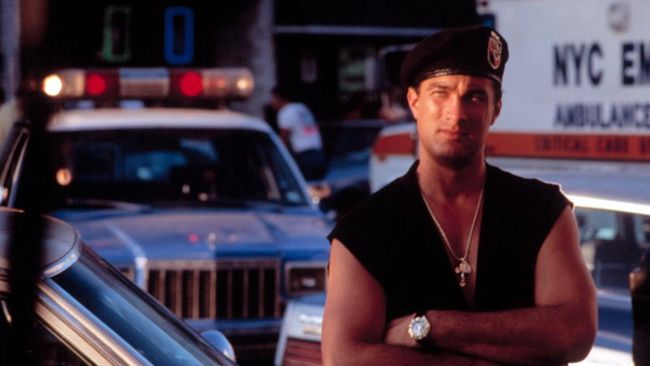
Steven Seagal plays Detective Gino Felino, a Brooklyn cop called into duty when a guy who grew up with him in their neighborhood, mob enforcer Richie Madano (William Forsythe), goes completely off the rails. Hooked on drugs and looking to settle some personal scores, Richie murders Gino’s partner, and begins turning their neighborhood into a war zone, even pulling a woman out of her car and blowing her away in broad daylight over a simple traffic incident. Convinced that Richie will not leave the neighborhood he grew up in, Gino talks Captain Ronnie Danziger (Jerry Orbach) into letting him have an unmarked police car, a shotgun, and his approval to engage in a manhunt for the drugged out psycho. From that point forward, Gino shakes down Richie’s family members and associates to try to find out where he is. As bodies and broken bones pile up, Gino is determined to do whatever it takes to bring Richie to justice!
I’ll just say up front that OUT FOR JUSTICE is my personal favorite Steven Seagal film. It’s not the crowd pleaser or the box office champ that the next year’s UNDER SIEGE (1992) would be, and film critics largely blew it off when it first hit cinemas, but it does feature the star at his most charismatic, something that would all but disappear after the mid-90’s. I love the way Seagal plays Gino. Sure he’s tough, but he talks more, he laughs more, and it feels like he’s actually enjoying himself. His Gino isn’t just a badass cop, he’s a neighborhood guy, a former street punk who grew up and made something positive out of himself. Seagal’s performance here truly works, and he plays the role with so much confidence that it’s a shame that he didn’t remain this engaged in future performances.
OUT FOR JUSTICE is a badass action film. After it opens with Richie’s horrific murders, it then follows Gino’s hunt for the killer into smoky bars filled with wannabe tough guys who know more than they’re letting on. They get their asses handed to them. It follows Gino as Richie’s goons attack him at various places, from meat shops to apartment buildings, and he dispatches them with calm precision, but often in gruesome ways. I still wince when I see the results of meat cleaver fights and close quarter shotgun blasts. OUT FOR JUSTICE is a throwback to an era when action films featured men with integrity who kick ass and take names. While the movie does have some melodrama and humor, at the end of the day, this is tough-guy cinema done right.
I did want to shout out a few other things about OUT FOR JUSTICE that helps put it over the top for me. William Forsythe is incredible as Richie Madano. He’s sweaty, twitchy, cruel, and completely unhinged. He makes you believe that he’s literally capable of doing anything, and it seems like his goons may be following more out of fear than anything else. His Richie is a man who doesn’t expect that he’ll be alive that much longer, so he’s willing to cross every line that may have once mattered in his life. Director John Flynn captures the urgency of the film’s action very well, and we can feel the tension as Gino tries to locate the crazy Richie as quickly as possible before more innocent people are killed. He isn’t afraid to show the brutality of the violence as part of Gino’s quest, either. This shouldn’t be surprising when you recognize that Flynn directed the revenge classic ROLLING THUNDER (1977) about fifteen years earlier. The one last thing I wanted to point out about OUT FOR JUSTICE is that it was written by R. Lance Hill, who wrote the brutal Charles Bronson hitman film THE EVIL THAT MEN DO (1984). These are talented guys who know how to tell tough stories about even tougher men who are willing to do what it takes to get justice when no one else can.
At the end of the day, Steven Seagal would go on to make a lot more movies, but I don’t think he ever quite recaptured the balance of charisma and toughness that he shows here. And OUT FOR JUSTICE is a badass action movie that doesn’t really care what movie critics think, either. Buoyed by Seagal’s performance, the film’s action is angry, focused, unapologetic, and still hits hard over thirty years after it was originally released.
Today is actor William Forsythe’s 70th birthday. Forsythe is a good character actor, and I’ve always had a fondness for a movie he appeared in called STONE COLD, because it was partially filmed in the town of Conway, Arkansas, which is about seven miles from the house I grew up in. I even remember when they had the downtown blocked off so they could film their scenes. STONE COLD starred All-American football player Brian Bosworth, who was making his film debut. As was the norm back in those days, Forsythe played a really bad guy. So happy birthday, Mr. Forsythe! Enjoy!
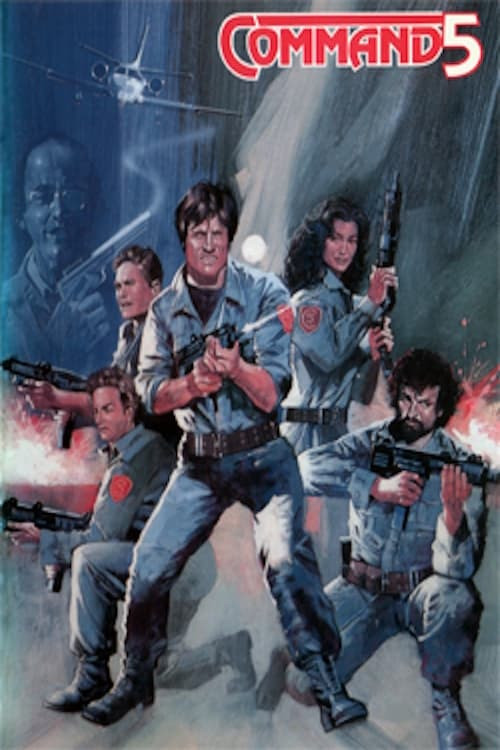
Morgan (Stephen Parr) is a mysterious government operative who puts together a special paramilitary force to take on extreme threats. He says that only misfits are allowed to join his group because they have the edge he needs. Smith (William Russ) is a wild Texan who drives like a maniac. Psychiatrist Winslow (Sonja Smits) can fire an Uzi better than any man. Kowalski (John Matuszak) is a demolitions expert who listens to Beethoven. Jack Coburn (Wings Hauser) is a rebellious detective who is good with a throwing knife.
After a montage of their extensive training and a scene where our heroes take a look at the bullet-proof RV that they’ll be traveling the country in, the movie finally gets down to business. A motorcycle-riding terror cult led by Delgado (Gregory Sierra) has taken an entire town hostage and is threatening to kill everyone unless they’re given a flight out of the country. Our heroes drive their bulletproof van into town and try to defeat the bad guys. There’s one good scene where the RV is driving down the town’s main street and getting hit nonstop with bullets. The scene was obviously ripped off from the end of Clint Eastwood’s The Gauntlet but it’s still exciting to watch. Otherwise, the action in this one is pretty rudimentary.
I guess Command 5 was supposed to be a pilot for television show that never went into production. It is very much a television production. There’s a lot of shooting but no blood. Wings Hauser is less dangerous than usual. The whole thing ends with Command 5 looking forward to adventures that were never to come. Watching the pilot, you can see why it never became a show. The characters were all thinly-written and never seemed to have much of a connection with each other and Hauser and Russ both seemed to be competing to be the loose cannon of the group. This one is for Wings Hauser completists only.
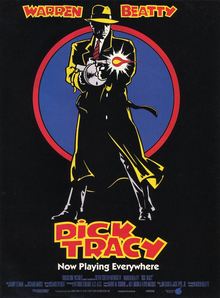
The year is 1937 and “Big Boy” Caprice (Al Pacino) and his gang of flamboyant and often disfigured criminals are trying to take over the rackets. Standing in their way is ace detective Dick Tracy (Warren Beatty), the yellow trench-wearing defender of the law. Tracy is not only looking to take down Caprice but he and Tess Trueheart (Glenne Headly) are currently the guardians of The Kid (Charlie Korsmo), a young street kid who witnessed one of Caprice’s worst crimes. Tracy’s investigation leads him through a rogue’s gallery of criminals and also involves Breathless Mahoney (Madonna), who has witnessed many of Caprice’s crimes but who also wants to steal Tracy’s heart from Tess.
Based on the long-running comic strip, Dick Tracy was a labor of love on the part of Warren Beatty. Not only starring but also directing, Tracy made a film that stayed true to the look and the feel of the original comic strip (the film’s visual palette was limited to just seven colors) while also including an all-star cast the featured Madonna is an attempt to appeal to a younger audience who had probably never even heard of Dick Tracy. When Dick Tracy was released, the majority of the publicity centered around Madonna’s participation in the film and the fact that she was dating Beatty at the time. Madonna is actually probably the weakest element of the film. More of a personality than an actress, Madonna is always Madonna no matter who she is playing and, in a film full of famous actors managing to be convincing as the members of Dick Tracy’s rogue gallery, Madonna feels out of place. Michelle Pfeiffer would have been the ideal Breathless Mahoney.
It doesn’t matter, though, because the rest of the film is great. It’s one of the few comic book films of the 90s to really hold up, mostly due to Beatty’s obvious enthusiasm for the material and the performances of everyone in the supporting cast who was not named Madonna. Al Pacino received an Oscar nomination for playing Big Boy Caprice but equally good are Dustin Hoffman as Mumbles, William Forsythe as Flaptop, R.G. Armstong as Pruneface, and Henry Silva as Influence. These actors all create memorable characters, even while acting under a ton of very convincing makeup. I also liked Dick Van Dyke as the corrupt District Attorney. Beatty knew audience would be shocked to see Van Dyke not playing a hero and both he and Van Dyke play it up for all its worth. Beatty embraces the comic strip’s campiness while still remaining respectful to its style and the combination of Danny Elfman’s music and Stephen Sondheim’s songs provide just the right score for Dick Tracy’s adventures. The film can be surprisingly violent at times but the same was often said about the Dick Tracy comic strip. It wasn’t two-way wrist radios and trips to the Moon. Dick Tracy also dealt with the most ruthless and bloodthirsty gangsters his city had to offer.
Dick Tracy was considered to be a box office disappointment when it was originally released. (Again, you have to wonder if Beatty overestimated how many fans Dick Tracy had in 1990.) But it holds up well and is still more entertaining than several of the more recent comic book movies that have been released.
Sheriff Hugh “Smokey” Turner (Walter Barnes) of Cyco County, Arkansas is determined to capture teenage car thief and prankster, Roscoe Wilton (Jimmy McNichol). Roscoe is determined to disrupt the high school homecoming dance by abducting the homecoming queen, Peggy Sue (Janet Julian). Peggy Sue is, at first, determined to escape from Roscoe but changes her mind as they flee from her father, who just happens to be Sheriff Turner.
From producer Roger Corman, Smokey Bites The Dust is an 88-minute car chase film where the most spectacular getaways and crashes are lifted from other Roger Corman productions. Eagle-eyed viewers will spot footage from Eat My Dust, Grand Theft Auto, and Moving Violations. In order to explain why the cars keep changing from scene to scene, the chase moves from county-to-county where both Roscoe and Sherriff Turner inevitably end up ditching (or crashing) their old car and then stealing a new vehicle to continue the pursuit.
That’s not much of a plot so the run time is padded out with several subplots. A local moonshiner tries to sell his special brew to a group of Arabs. Peggy Sue’s boyfriend, Kenny (William Forsyth, in one of his first films), joins in the chase. Dick Miller flies around in a helicopter and also gets involved in the chase. None of it makes any sense and none of it is particularly amusing but Roger Corman undoubtedly made a lot of money pushing this thing into Southern drive-ins and letting people assume it was some sort of a sequel to Smokey and the Bandit.
Most of the acting is pretty bad. When it comes to being an incompetent sheriff, Walter Barnes is no Jackie Gleason. Jimmy McNichol comes across as being seriously disturbed. Of the main cast, Janet Julian is alone in giving an appealing and naturalistic performance as Peggy Sue. While Julian (who has since retired from acting) never became the star she deserved to be, she is remembered for her later turn as Christopher Walken’s lawyer and girlfriend in 1990’s King of New York.