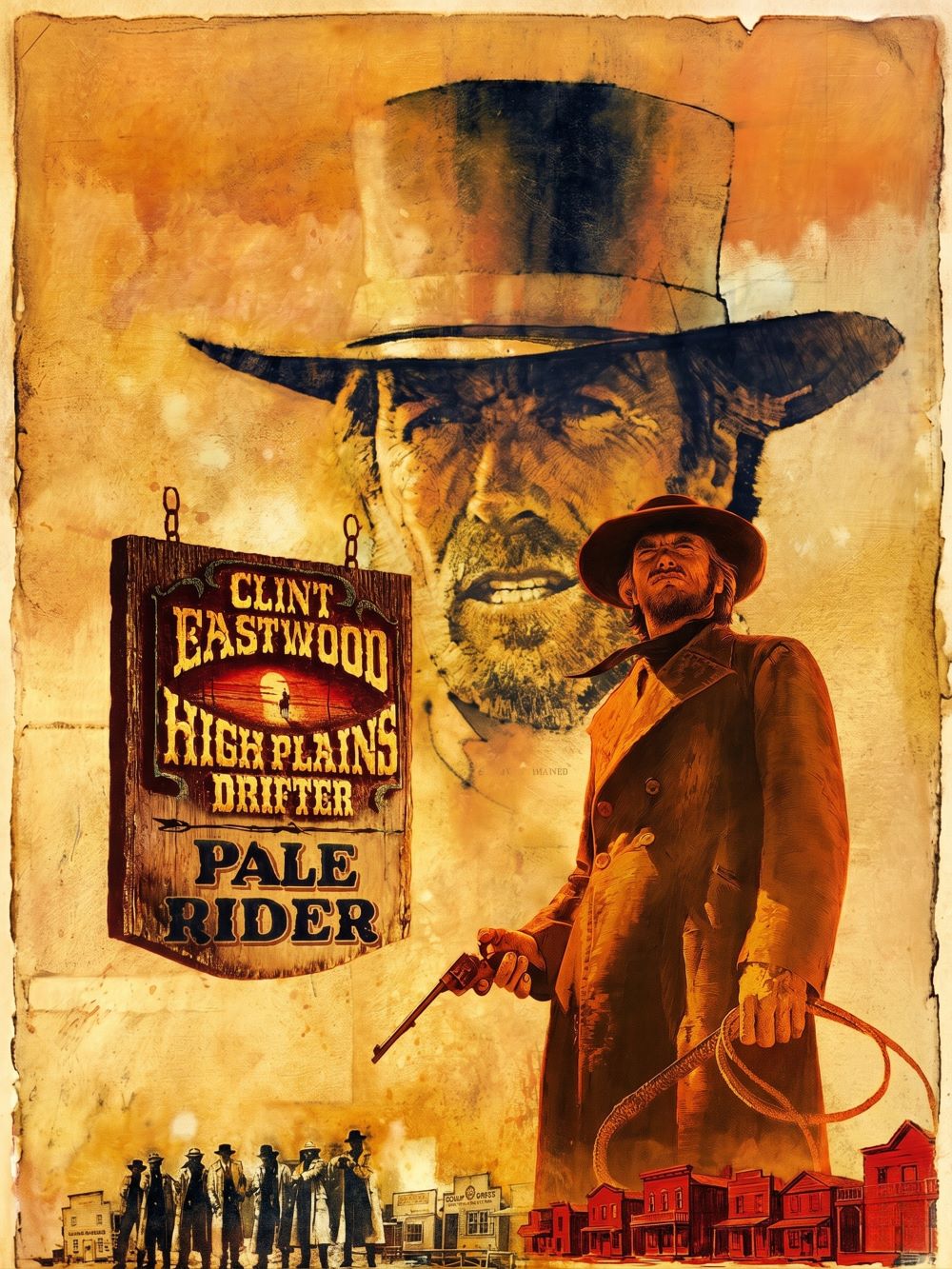
“It’s what people know about themselves inside that makes ’em afraid.” — The Stranger
Mythic Outsiders and the Shape of the Stranger
Clint Eastwood’s High Plains Drifter and Pale Rider both revolve around the arrival of a mysterious outsider whose presence destabilizes and reconfigures a frontier community already burdened by moral pressure, economic vulnerability, or buried violence. In High Plains Drifter, the Stranger arrives with the weight of something closer to metaphysical judgment than human intention. He is introduced not as a conventional protagonist but as an unsettling disruption of reality itself, a figure who seems to exist slightly outside the normal rules governing cause and consequence. His relationship to the town of Lago is immediately adversarial, but not in a personal sense—it is structural, almost cosmic, as though he is less reacting to the town than fulfilling a prewritten moral outcome.
By contrast, Pale Rider preserves the same narrative skeleton but shifts the emotional and moral emphasis toward intervention rather than judgment. The Preacher still carries ambiguity—his scars, his sudden appearance, and his almost supernatural timing all suggest something beyond ordinary human agency—but his role is fundamentally protective. He enters a world defined by industrial pressure and economic coercion rather than buried collective sin, and his presence functions as a counterweight to imbalance rather than an execution of moral sentence. The result is that both films feel like variations of the same mythic story, but one is written as condemnation while the other reads as reluctant guardianship.
Old Testament Retribution vs. Folkloric Myth
One of the most revealing ways to distinguish the two films is through their mythic grammar. High Plains Drifter reads like an Old Testament narrative of retribution, where morality is absolute, guilt is inherited collectively, and punishment is not only justified but structurally inevitable. The Stranger operates like a figure of divine wrath, not because he explicitly claims divine authority, but because the world of the film behaves as though such authority is implicit. Lago is not a community undergoing moral testing; it is a community already judged. Every act the Stranger commits feels like the unfolding of a sentence that predates his arrival. Violence in this framework is not expressive or emotional—it is procedural, almost liturgical, as though the town is being dismantled according to a moral code that does not permit negotiation.
The Old Testament quality of High Plains Drifter is also evident in its treatment of time and consequence. The past is not past—it is active, invasive, and inescapable. The town’s buried crime against its former marshal is not simply a backstory element; it functions as a theological stain that structures everything that follows. The Stranger does not introduce justice into the world; he reveals that justice was already waiting, dormant and inevitable.
Pale Rider, by contrast, operates within a folkloric mode that feels less doctrinal and more narrative in the oral-tradition sense. The Preacher is not a judge delivering sentence but a figure who appears within a story because the story requires balance. Folklore does not insist on moral finality in the same way scripture does; instead, it preserves ambiguity, repetition, and interpretive openness. The Preacher’s identity remains unresolved not because the film withholds information, but because resolution itself is not the point. He resembles figures from frontier legend—wandering spirits, unnamed avengers, or protective ghosts whose purpose is understood only through their effects on a community rather than through explicit explanation.
Where High Plains Drifter insists on inevitability, Pale Rider allows for contingency. The Preacher arrives in response to suffering rather than in fulfillment of punishment. His presence suggests that moral intervention is episodic rather than absolute, something that occurs when imbalance becomes intolerable rather than something decreed in advance. The result is a world that feels open-ended rather than sealed.
Moral Worlds: Guilt Versus Vulnerability
The moral architecture of each film is constructed through the condition of its community. In High Plains Drifter, Lago is defined by collective guilt so pervasive that it erases meaningful individuality. The townspeople are not simply flawed characters; they are components of a shared moral collapse. Their original crime—the betrayal and murder of their marshal—functions as the foundation of their identity. The Stranger’s arrival does not introduce new moral tension; it activates an existing one that has been suppressed but never resolved. The town’s psychology is therefore circular: guilt produces fear, fear produces complicity, and complicity guarantees punishment.
This circularity is what gives High Plains Drifter its claustrophobic quality. There is no outside moral perspective capable of altering the town’s fate. Even resistance or survival strategies feel complicit in the same moral structure. The town is effectively trapped inside its own ethical architecture.
In Pale Rider, however, the mining community is framed through vulnerability rather than guilt. These characters are not haunted by a collective sin but threatened by external forces—specifically Coy LaHood’s industrial expansion, which seeks to displace them through economic pressure and intimidation. The moral stakes are therefore asymmetrical: a powerful industrial entity versus a fragile group of independent miners. This reframing is crucial because it transforms the Preacher’s role from agent of punishment to agent of protection. He does not expose corruption within the miners; he resists corruption directed toward them.
Tone and Philosophical Direction
The tonal difference between the films reflects Eastwood’s evolving relationship with the Western mythos. High Plains Drifter is austere, surreal, and deliberately disorienting. The town of Lago feels less like a historical location than a moral construct, a space designed to contain judgment. The visual and narrative isolation of the town reinforces its status as a closed system, one in which moral consequence operates without interference from broader social or geographic context. The result is a film that feels almost metaphysical in its severity, as though it is staging a moral experiment rather than telling a grounded story.
Violence in this context becomes an instrument of revelation. Each act performed by the Stranger peels back layers of denial and self-deception, leaving only the raw structure of guilt beneath. The tone is not merely dark—it is stripping, reductive, and final.
Pale Rider, while still restrained and often somber, introduces a more grounded emotional texture. The mining settlement feels materially real, shaped by labor, scarcity, and interpersonal bonds. This grounding prevents the film from collapsing into abstraction. Even when supernatural ambiguity is present, it is embedded within a world that feels historically and physically tangible. This creates a tonal tension between myth and realism that softens the absolutism found in High Plains Drifter. Instead of moral vacuum, Pale Rider offers moral friction.
The Outsider as Moral Force
Eastwood’s performances in both films embody the evolution of the outsider archetype. In High Plains Drifter, the Stranger is almost entirely detached from human relatability. His silence is not contemplative but destabilizing, creating unease in every interaction. He functions like a moral solvent, dissolving social bonds and exposing hidden structures of guilt. There is no suggestion that he belongs to the world he enters; instead, he appears to impose a structure upon it.
In Pale Rider, the Preacher retains the same controlled economy of expression, but his presence is tempered by moments of relational meaning. His connection to the miners, particularly the young girl whose prayer summons him, introduces a reciprocal dimension absent from High Plains Drifter. He is not simply an external force acting upon the world; he is a figure whose arrival is framed as response. This responsiveness is what aligns him more closely with folkloric tradition, where characters are defined not by origin but by function within a narrative ecosystem.
Violence as Judgment vs. Necessity
Violence in High Plains Drifter operates as moral inevitability. It is structured, ritualized, and unavoidably recursive. Each act feels like the continuation of a moral sequence already underway, as though the Stranger is simply advancing toward a predetermined conclusion. The emotional effect is one of inevitability without catharsis.
In Pale Rider, violence is repositioned as necessity rather than inevitability. It emerges only when economic exploitation and coercion leave no viable alternatives. This reframing is subtle but significant: violence becomes situational rather than cosmic. The Preacher does not embody judgment; he responds to imbalance. As a result, even the film’s climactic confrontations carry a different emotional charge—they feel like interruptions in injustice rather than fulfillments of destiny.
Supporting Communities and Narrative Focus
Both films maintain a strong central focus on Eastwood’s outsider, which inevitably limits the depth of supporting character development. However, the implications of this limitation differ between them. In High Plains Drifter, the flattening of the townspeople reinforces the idea of collective moral identity. Individual psychology is irrelevant because the town functions as a single ethical organism. The lack of distinction between characters serves the film’s allegorical purpose.
In Pale Rider, the miners are more individualized in performance even if not fully developed in script. Actors such as Michael Moriarty and Carrie Snodgress bring emotional specificity that suggests lives extending beyond the frame. This helps ground the film’s mythic structure in human stakes, preventing it from becoming purely symbolic. Even if the characters are archetypal, they are not abstract.
Visual Mythmaking
Cinematographically, the two films articulate their mythic identities through environment. High Plains Drifter constructs a space that feels artificially isolated, as though removed from ordinary geography and placed into a moral void. The town becomes a sealed chamber in which ethical consequences unfold without external interference. This abstraction reinforces its Old Testament quality: a world governed by decree.
Pale Rider, shot by Bruce Surtees, leans into environmental tactility. The forests, mountains, and mining encampments feel embedded in a larger natural system. This grounding creates a sense of narrative openness. Rather than existing as a moral stage, the landscape feels like a lived world in which myth temporarily emerges before receding again into ordinary life. This is essential to its folkloric tone.
Conclusion: Two Mythic Languages of the Western
Ultimately, High Plains Drifter and Pale Rider function as two distinct mythic languages within Clint Eastwood’s evolving critique of the Western. One articulates itself through Old Testament logic—absolute judgment, collective guilt, and irreversible consequence. The other speaks in folkloric terms—episodic intervention, narrative ambiguity, and moral imbalance temporarily corrected rather than permanently resolved. Together, they form a sustained meditation on the Western outsider as both executioner and legend: one who arrives to complete a sentence already written, and another who arrives like a story that briefly becomes real before fading back into myth.


Terrific analysis!
LikeLike
Pingback: Lisa Marie’s Week In Review: 5/11/26 — 5/17/26 | Through the Shattered Lens