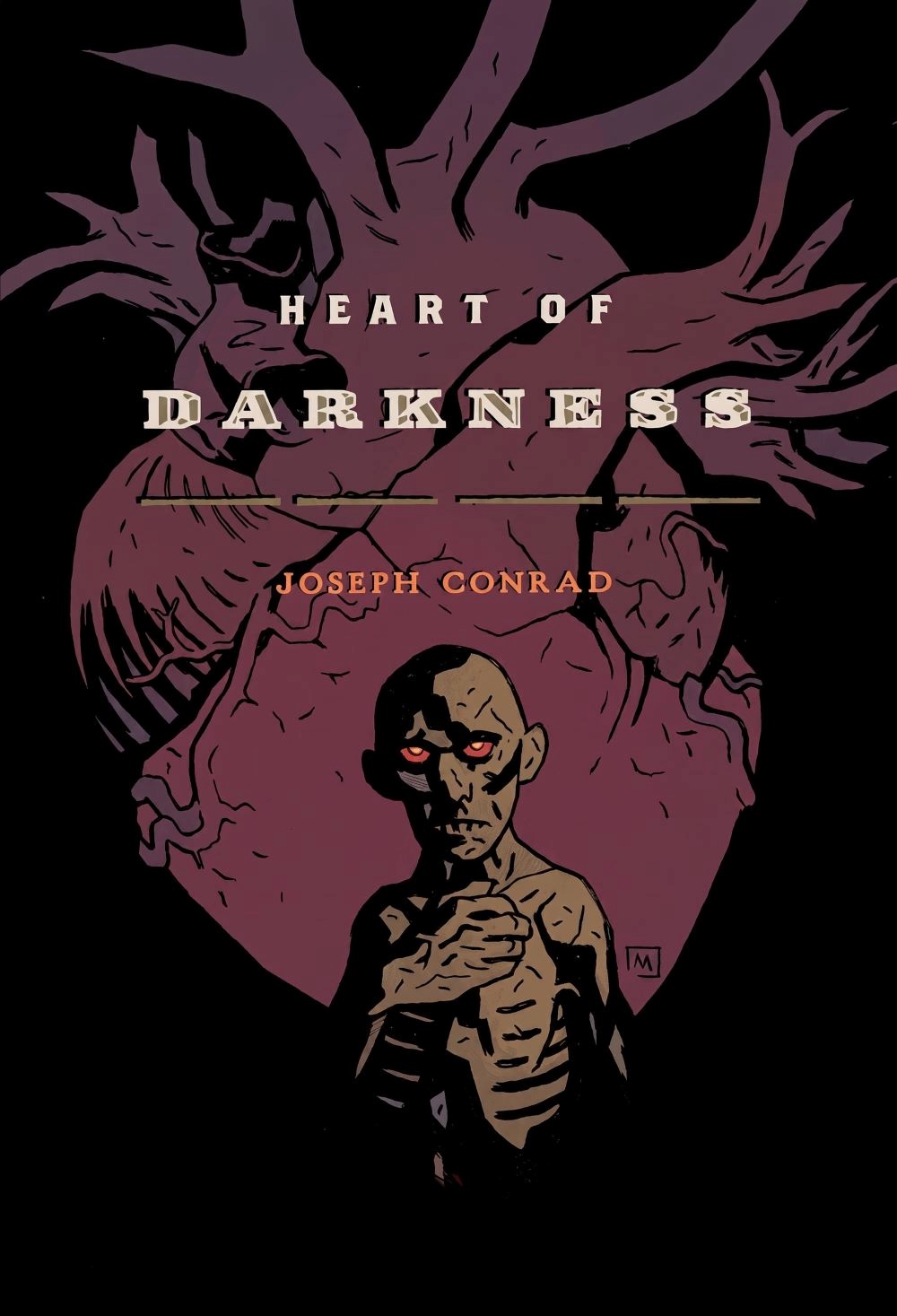
“The mind of man is capable of anything.” — Charles Marlow
There’s a strange, magnetic pull to Joseph Conrad’s Heart of Darkness that keeps readers coming back, even when the book itself seems determined to repel you. Published in 1899, this novella is often taught as a classic of colonial critique, but spending time with it feels less like a lecture and more like a slow, feverish drift up a murky river. The plot is deceptively simple: a British sailor named Marlow takes a job piloting a steamboat for an ivory trading company in the Belgian Congo. His real mission, however, is to find Kurtz, a charismatic, brilliant agent who has supposedly gone mad and set himself up as a god among the natives. What Marlow finds instead is a hollow man whose final whisper—“The horror! The horror!”—becomes one of literature’s most chilling epitaphs.
Conrad’s prose is dense and atmospheric, almost claustrophobic. He writes in long, looping sentences that circle back on themselves, mimicking the tangled jungle and Marlow’s own spiraling psyche. You don’t read this novella so much as wade through it, feeling the heat, the flies, and the creeping sense of moral decay. The frame narrative—Marlow telling his story to a group of sailors on the Thames—adds a layer of ironic distance. London, the heart of empire, is presented as another kind of darkness, a civilized wilderness that has simply learned to hide its savagery behind suits and ledgers. This structural choice is brilliant because it forces you to ask: is the “darkness” really in Africa, or is it something Europe shipped downriver?
That said, any honest review has to address the elephant in the room: the book’s treatment of race. For decades, the Nigerian writer and critic Chinua Achebe has mounted the most devastating case against Heart of Darkness. In his landmark 1975 lecture “An Image of Africa: Racism in Conrad’s Heart of Darkness,” Achebe argues that Conrad, despite ostensibly critiquing Belgian colonialism, produced a work that is fundamentally racist—a piece of literature born directly from the imperial colonial era and its dehumanizing ideologies. Achebe’s point is sharp and uncomfortable: the novella seeks to expose the dangers and horrors of imperialism, yet it simultaneously perpetuates the very racist ideas it should be dismantling. Conrad denies nearly every African character a name, a voice, or an interior life. They appear as limbs, grunts, or “savages” performing ominous rituals on the shore. Africa itself is reduced to “a place of darkness,” “the prehistoric earth,” and a blank space on the map waiting for European meaning. The sole exception is a well-dressed native man who works as a cook—and even he is reduced to a clumsy, almost comic figure. Marlow is more disturbed by the sight of “improper” cannibals restraining themselves than he is by the company’s brutal exploitation.
Achebe’s critique cuts to the bone: Conrad may have hated the cruelty of colonialism, but he couldn’t imagine Africans as fully human. He traded one set of stereotypes for another, offering a critique of empire that remains trapped inside empire’s own racial logic. You can argue that Conrad is exposing racism by showing Marlow’s limited perspective, but the text gives us no alternative viewpoint. The Congolese remain scenery for a white man’s existential crisis. That’s not just dated; it’s a structural flaw that makes the book feel less like a universal tragedy and more like a monologue delivered in a vacuum—and, as Achebe famously wrote, “a book which parades in the most vulgar fashion prejudices and insults from which a section of mankind has suffered untold agonies and atrocities should not be called a great work of art.” So while the novella wants to critique colonial violence, it cannot see the violence of its own representational strategies. The very language Conrad uses to evoke horror—the “savage” drums, the “prehistoric” shores—ends up reinforcing the racist hierarchies he pretends to question. Overt insults mix with subtle, almost unconscious dehumanization, creating a text that is as morally compromised as the ivory traders it condemns.
Where Heart of Darkness still stings is in its psychological precision, even as Achebe’s critique complicates any easy admiration. Kurtz is a masterpiece of ambiguity: a poet, a painter, a journalist who wrote a report on “civilizing” the natives, only to scribble at the bottom, “Exterminate all the brutes!” He represents the lie at the core of imperialism—the idea that Europe brings light to darkness, when in fact it brings greed, violence, and an insatiable hunger for ivory. The novella’s real horror isn’t the jungle or the cannibals; it’s how easily a man with noble ideals can become a skull-decorating tyrant. Conrad, who himself worked in the Congo, understood that the heart of darkness is not a place but a capacity we all carry. Yet Achebe would counter that this “we” is tellingly selective—the capacity for darkness is explored in Kurtz and Marlow, while actual African people are merely the backdrop against which that darkness is measured.
Despite its flaws—or perhaps because of their uncomfortable rawness—Heart of Darkness has proven enormously influential since its publication. Its DNA can be found in everything from T.S. Eliot’s The Waste Land (which originally quoted Kurtz’s “horror” as an epigraph) to Werner Herzog’s Aguirre, the Wrath of God. But the best and most famous example is Francis Ford Coppola’s 1979 film Apocalypse Now, which transplants the story from colonial Congo to the Vietnam War. Captain Willard stands in for Marlow, and the rogue Colonel Kurtz (famously played by Marlon Brando) becomes the ivory trader’s spiritual twin—a decorated American operative who has set up his own brutal kingdom in the Cambodian jungle. Coppola keeps Conrad’s core structure: a river journey into madness, a whispered report on “unsound methods,” and a final, intimate confrontation with a man who has seen too much. What makes Apocalypse Now such a brilliant adaptation is that it doesn’t just copy the plot; it captures the feverish, hallucinatory tone. The film’s famous line—“I love the smell of napalm in the morning”—echoes Kurtz’s seductive, terrifying embrace of violence. By updating the setting, Coppola proved that Heart of Darkness was never really about the Congo. It was about the darkness any empire carries inside itself. Yet even here, Achebe’s shadow lingers: the film, like the novella, largely sidelines the Vietnamese and Cambodian people, turning them into anonymous threats or scenery for an American psychodrama.
So, is this a book you should read? Yes, but with caution and critical awareness. It’s short—under 40,000 words—but it’s not an easy afternoon’s entertainment. Read it alongside Achebe’s essay “An Image of Africa” or a historical account of Leopold II’s atrocities. Treat Marlow as an unreliable narrator, not a prophet, and recognize that Conrad’s attempt to critique empire is fatally compromised by the very racial imagination he never managed to escape. The prose can be maddeningly vague, and the pacing sometimes stalls under the weight of its own symbolism. Yet for all its flaws, Heart of Darkness refuses to fade away, in part because artists from Conrad to Coppola keep finding new horrors to pour into its shape, and in part because critics like Achebe force us to read it honestly—as both a searing study of evil and an uncomfortable document of that same evil’s persistence. It’s a mirror held up to the worst of us, and whether you see a portrait of colonialism, a study of madness, a racist artifact, or all three at once, you won’t forget what stares back.


Pingback: Lisa Marie’s Week In Review: 5/11/26 — 5/17/26 | Through the Shattered Lens