Adam Cooper (Chad Lowe) is a teenager growing up in Colonial Massachusetts. His father, Moses Cooper (Tommy Lee Jones), is a stern man who believes that rights come from men and not God and who, despite believing in negotiating instead of fighting, is willing to take arms against the British if necessary. Adam has a pretty girlfriend (Meredith Salenger) and tries to please both his religious mother (Susan Blakely) and his agnostic father. When Paul Revere makes his famous ride, both Adam and Moses are thrust into the Battle of Lexington and, over the course of one long night, Adam is forced to grow up and become the man of the house.
Based on the classic novel by Howard Fast, April Morning was made for television and first aired in 1988. The novel and the movie provide a look at the American Revolution through the eyes of the people who actually fought in the battles. The movie emphasizes the coming-of-age aspect of Fast’s novel and downplays the political subtext. The novel presented a much more complex view of both war and religion while the film definitely simplifies things. Chad Lowe comes across as being too contemporary to be totally believable as someone growing up in the 1700s but Tommy Lee Jones is the perfect choice for Moses Cooper and, even though her role is small, Meredith Salenger once again demonstrates that she was one of the best young actresses of the era. In the film, Rip Torn plays the man who fires the first shot of the battle and it’s hard to think of a better actor for the role.
At its best, the movie recreates the confusion of being in battle. Even though the Battle of Lexington was the start of the American Revolution and April 19th, 1776 was one of the most important dates in American history, Adam Cooper just wants to survive the night so that he can return home. War may sometimes be necessary but it’s never easy.
“Once you are able to kill mentally, the physical part will be easy. The difficult part… is learning how to turn it off.” — L.T. Bonham
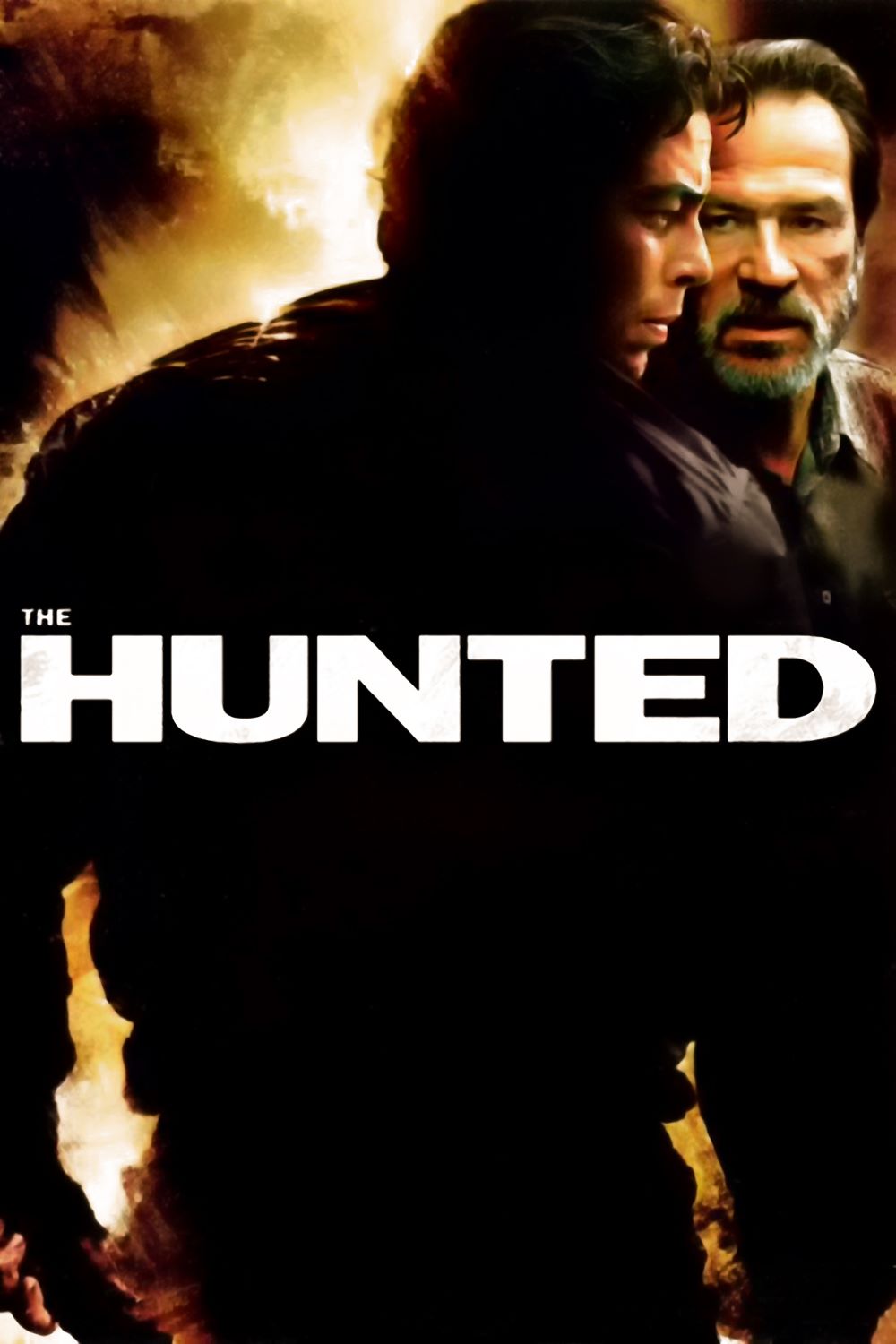
The Hunted (2003) is one of those films that feels like it slipped through the cracks of early 2000s cinema—a gritty, atmospheric thriller directed by William Friedkin, a filmmaker whose name alone should’ve guaranteed more attention. Friedkin, the man behind The French Connection and The Exorcist, has always had a knack for tension and raw, almost documentary-like realism, and The Hunted carries that same DNA. It’s not a perfect movie, but it’s a fascinating one, a slow-burn chase film that trades explosive set pieces for mood, character, and a kind of existential dread that lingers long after the credits roll.
The story follows L.T. Bonham, a former survival instructor played by Tommy Lee Jones, who’s called back to help the authorities when a series of brutal murders points to a former student of his, Aaron Hallam, played by Benicio del Toro. Hallam, a highly trained assassin, has gone rogue, and Bonham is the only one who can track him down. The premise is simple, almost minimalist: two men, one hunting the other, with the wilderness of the Pacific Northwest serving as their battleground. There’s no grand conspiracy, no world-ending stakes—just a personal, almost primal duel between mentor and protégé. The film’s strength lies in its refusal to overcomplicate things. It’s a character study disguised as a thriller, and it’s all the better for it.
What’s immediately striking about The Hunted is its pacing. Friedkin doesn’t rush. The film takes its time establishing Bonham’s world—a quiet, isolated life in the woods, where he trains soldiers in the art of survival and combat. There’s a sense of routine, of discipline, and when Hallam re-enters his life, it’s not with a bang but with a whisper. The first act is deliberate, almost meditative, as Bonham pieces together the clues and realizes the man he’s after isn’t just any killer, but someone he once shaped. This isn’t a film about action for action’s sake. It’s about the weight of violence, the cost of skill, and the thin line between hunter and hunted.
Benicio del Toro is the standout here. Hallam is a role that could’ve easily been reduced to a one-dimensional villain, but del Toro imbues him with a quiet, unsettling intensity. There’s a scene early on where Hallam, having just committed a particularly gruesome murder, calmly walks away from the crime scene, his face a mask of detached focus. It’s chilling not because he’s raging or unhinged, but because he’s so controlled. Hallam isn’t a monster in the traditional sense; he’s a man who’s been trained to kill and has embraced that role with terrifying efficiency. Del Toro plays him with a stillness that’s unnerving, his eyes always calculating, always three steps ahead. It’s a performance that relies more on presence than dialogue, and it’s one of his most underrated.
Tommy Lee Jones, on the other hand, is a different kind of compelling. Bonham is a man of few words, a hardened veteran who’s seen too much to be rattled by much. Jones, with his gravelly voice and weathered demeanor, sells the role of a man who’s spent a lifetime in the shadows. There’s a weariness to him, a sense that he’s not just chasing Hallam to stop the killings, but to confront his own past. The dynamic between the two is electric, even when they’re not in the same scene. Their eventual face-to-face encounters crackle with tension, not because of what they say, but because of what they don’t. These are two men who understand each other on a level that most people never will, and that mutual recognition makes their conflict all the more tragic.
Friedkin’s direction is, as always, masterful in its restraint. He’s never been one for flashy camerawork or overly stylized shots, and The Hunted is no exception. The cinematography is stark and functional, emphasizing the cold, unforgiving landscape of the Pacific Northwest. The forests, rivers, and small towns feel like characters in their own right, vast and indifferent to the human drama unfolding within them. There’s a scene where Bonham and a local sheriff, played by Connie Nielsen, track Hallam through the woods. The camera lingers on the trees, the mud, the rain—details that ground the film in a tangible, almost tactile reality. It’s not just a chase; it’s a test of endurance, both physical and psychological.
The film shares some striking thematic ground with First Blood, another story about soldiers haunted by what they’ve seen and done in war. Both films explore men who are not just racked with guilt but suffering from PTSD, their minds fractured by the horrors of combat. But where First Blood ultimately offered a glimmer of hope—that understanding and redemption might be possible—The Hunted takes a far bleaker view. Bonham and Hallam aren’t just damaged; they’re broken in ways that can’t be fixed. Hallam, in particular, represents the idea that some soldiers simply cannot come back from the brink of their experiences. There’s no catharsis for him, no moment of clarity or salvation. The film suggests that for some, the training and the trauma run too deep, and the only way out is through violence. It’s a brutal, unflinching perspective that sets The Hunted apart from more sentimental takes on the same themes.
The film’s action sequences, when they do arrive, are brutal and concise. There’s no shaky cam or rapid editing here—Friedkin lets the violence unfold in long, unflinching takes. A knife fight in a motel room is particularly memorable, not for its choreography, but for its rawness. It’s messy, desperate, and over in seconds. There’s no glorification, no slow-motion heroics. Just two men trying to kill each other in the most efficient way possible. It’s a far cry from the hyper-stylized action of the era, and it’s all the more effective for it.
Unfortunately, the film’s strengths are bogged down by its weaknesses, particularly in how it handles its secondary characters. The supporting cast, including Connie Nielsen as the sheriff, often feel thinly written, existing primarily as obstacles to delay the inevitable showdown between Bonham and Hallam. Their motivations and personalities are barely sketched out, making them feel more like narrative speed bumps than fully realized people. It’s frustrating because the film’s core dynamic is so compelling that these underdeveloped side characters only serve to slow down the momentum. And despite its brisk 90-plus minute runtime, The Hunted still manages to drag at times. The deliberate pacing that works so well in establishing atmosphere starts to feel indulgent when the story isn’t moving forward, leaving the audience waiting for the next meaningful interaction between its two leads.
If The Hunted has other weaknesses, it’s that it might be a little too restrained for some viewers. The slow burn won’t be for everyone, especially in an era where audiences have come to expect constant stimulation. The film demands patience, and those who aren’t willing to meet it on its terms might find it dull. There are also moments where the plot feels a bit thin, as if Friedkin and screenwriter Art Monterastelli were more interested in atmosphere than narrative complexity. But that’s also part of its charm. The Hunted isn’t trying to be a puzzle-box thriller or a high-octane spectacle. It’s a mood piece, a meditation on violence and the men who wield it.
The ending, without spoiling too much, is ambiguous in a way that feels true to the film’s themes. There’s no neat resolution, no easy answers. It’s a conclusion that lingers, forcing the audience to sit with the uncomfortable questions it raises. Is justice served? Is Hallam truly defeated, or is he just the first of many? The film doesn’t provide answers, and that’s to its credit. It’s more interested in the journey than the destination, in the hunt rather than the catch. While First Blood left room for healing, The Hunted closes the door on that possibility for some, reinforcing its bleak worldview.
In the grand scheme of Friedkin’s filmography, The Hunted might not rank alongside his most iconic works, but it’s a fascinating entry in his body of work. It’s a film that feels out of time, both in its style and its themes. Released in 2003, it arrived in a cinematic landscape dominated by CGI spectacle and franchise filmmaking, and it’s easy to see why it didn’t make a bigger splash at the time. But for those willing to seek it out, The Hunted is a hidden gem—a tense, thought-provoking thriller that rewards patience and close attention. It’s a film about the cost of violence, the weight of the past, and the thin line between the hunter and the hunted. And in an era where action movies often prioritize style over substance, its grounded, no-nonsense approach feels like a breath of fresh air.
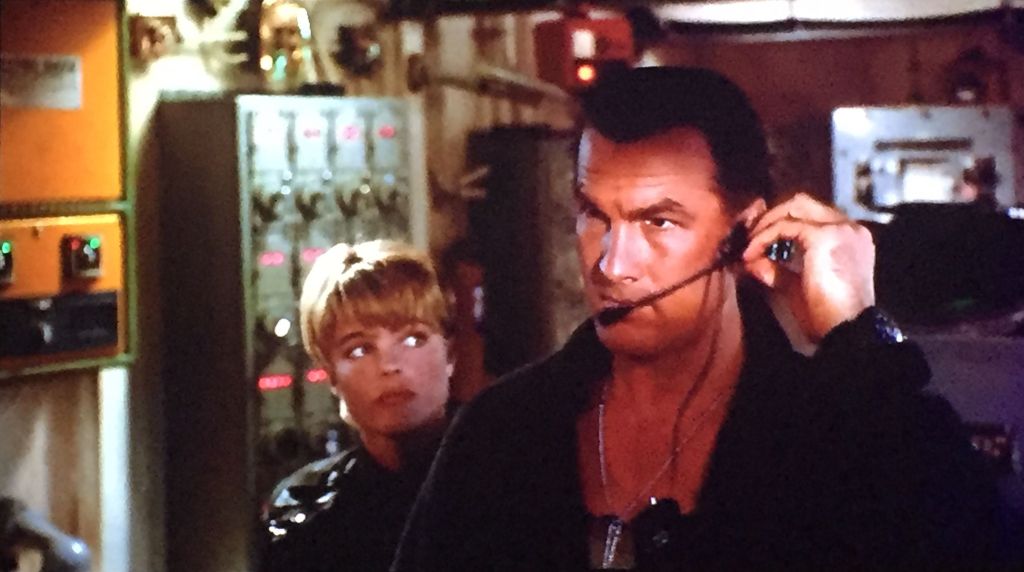
I’ve always liked UNDER SIEGE. After his sudden emergence with a series of brutal action films in the late 80’s and early 90’s, like ABOVE THE LAW and OUT FOR JUSTICE, Steven Seagal entered the world of high concept action filmmaking when he starred in this “Die Hard on a Battleship.” Seagal would not be the underdog cop taking on drug dealers, coked up mafia hitmen, or crooked cops here. Rather, he emerges as a full blown movie star in a big budget studio action film. Directed by Andrew Davis, whose credits include Chuck Norris’ best movie CODE OF SILENCE (1985), Seagal’s debut ABOVE THE LAW (1988) and the next year’s global smash THE FUGITIVE (1993), this is the movie where everything came together for Seagal. I watched UNDER SIEGE at the movie theater myself in 1992 and had a great time with it. I didn’t realize at the time that this would be his career peak, with a global box office of over $156 million. No other film would really even come close.
Casey Ryback (Seagal) is a “cook” aboard the USS Missouri, a battleship that is scheduled to be decommissioned. He’s also a former badass Navy SEAL who was demoted after punching out his commanding officer when a mission in Panama had gone wrong. When a group of mercenaries led by ex–CIA operative William Strannix (Tommy Lee Jones) seize control of the ship under the guise of a birthday celebration, they overlook Ryback. In classic John McClane style, Ryback goes on to become a fly in their ointment, a monkey in their wrench, and a big-time pain in their asses! Moving through the narrow corridors of the ship, and with the assistance of Playboy Playmate Jordan Tate (Erika Eleniak), Ryback begins taking out mercenaries one by one. But will he be able to stop Strannix and his partner Krill (Gary Busey) from stealing the ship’s nuclear Tomahawks and preserve the safety and security of the world? I’ll give you one guess!
First and foremost, UNDER SIEGE is a damn good action movie. It definitely helps that a director as talented as Andrew Davis is calling the shots. His film delivers on the entertainment front, with lots of well staged shootouts, violent scenes of close quarter, hand-to-hand combat, and a cake emergence sequence that still makes my head spin! I think the battleship makes for a great “movie” setting for this type of action. With its concoction of narrow hallways, engine rooms, and mess halls, there’s all kinds of interesting places for fighting and killing. Back in 2007, I was lucky enough to take a tour of the USS Alabama battleship, the primary filming location for UNDER SIEGE, which only enhances my appreciation for the work done here. On the heels of his confident and charismatic performance in the prior year’s OUT FOR JUSTICE, this is Steven Seagal at his most watchable. He’s in peak physical condition, so he can believably kick all the ass that’s necessary for this kind of film, and he’s also likable in his role as the underestimated “cook.” He will never be mistaken for Bruce Willis, but Seagal is good here.
Great action movies will usually have great villains, and UNDER SIEGE is especially blessed in this area. Tommy Lee Jones goes way over-the-top, chewing on scenery like he’s at a Golden Corral buffet, turning Strannix into the type of irrational lunatic that I love in my early 90’s action movies. And looking back now, Gary Busey seems to do what he does best. His traitorous Commander Krill comes off as goofy, disgusting, and unstable. In other words, he’s perfect. Even though Seagal does smile more in this film, Jones and Busey do bring an energy to the movie that balances out Seagal’s more stoic character, providing the type of spark not often found in the star’s movies.
At the end of the day, I rank UNDER SIEGE as my second favorite Steven Seagal film, slightly below my preference for the more down and dirty OUT FOR JUSTICE. What it lacks in grit is more than made up with entertainment value, strong performances, and action on a scale that the star’s future films would never rise to again. If I were put in a position where I could only recommend one Steven Seagal film to a person who’d never seen one of his movies before, I’d probably go with this one. It’s an excellent, mainstream 90’s action movie.
In celebration of William Devane’s 86th birthday, I’m sharing a scene from one of my favorite revenge films, ROLLING THUNDER (1977). In my opinion, this is the high water mark in Devane’s 60 year career. And we all need a friend like Tommy Lee Jones’ character here… someone who’s always ready to go at the drop of a hat. Things are about to get violent right after they leave, but the calmness of the two men as they get ready to unleash violent hell on a group of murderous bastards makes this scene a standout.
Welcome to Retro Television Reviews, a feature where we review some of our favorite and least favorite shows of the past! On Saturdays, Lisa will be reviewing The American Short Story, which ran semi-regularly on PBS in 1974 to 1981. The entire show can be purchased on Prime and found on YouTube and Tubi.
This week, we have an adaptation of a William Faulkner short story.
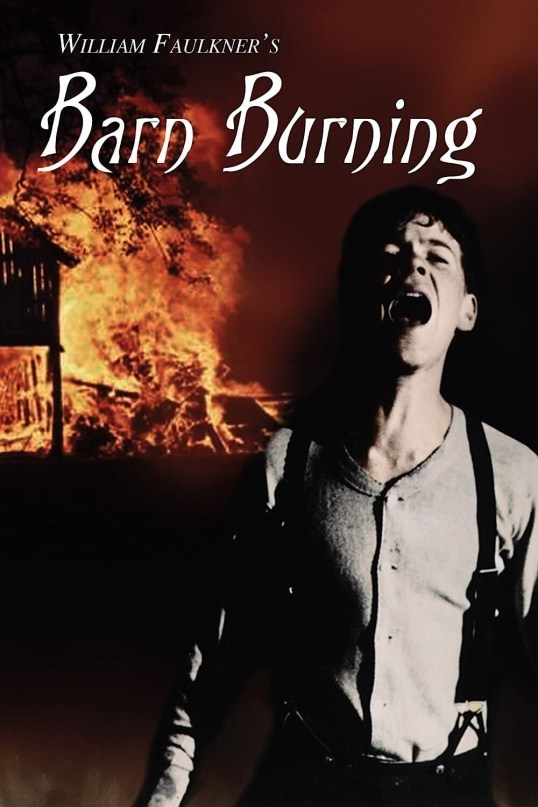
Episode #13: Barn Burning
(Dir by Peter Werner, originally aired in 1980)
The year is 1895 and everyone in Yoknapatawpha County, Mississippi knows that Abner Snopes (Tommy Lee Jones) is no good. The taciturn and bitter Abner is notorious for burning down the barns of those who he feels have mistreated him. When Abner is dragged into the Justice of the Peace’s courtroom (which also happens to be a general store), he’s only acquitted because the judge and the prosecutor realize it would be unfair to force Abner’s young son, Sartoris “Sarty” Snopes (Shawn Whittington), to testify against him. Abner and his family are ordered to move to another town but Abner avoids any legal punishment. Despite that, Abner still accuses Sarty of thinking about betraying him.
This episode follows Sarty as he tries to understand his abusive father, a man who is offended over being told to wash a rug that he intentionally damaged that he plots to burn down another barn. (The owner of the rug is played by Jimmy Faulkner, the grandson of William Faulkner.) Sarty wants his father’s love but it soon becomes clear that Abner is too angry and resentful to love anyone. The story ends with a fire and an ambiguous tragedy, leaving both the fate of Abner and the future of Sarty unclear.
With his shifting viewpoints and his internalized style of narration, William Faulkner is not an easy writer to adapt to the screen. With Barn Burning, director Peter Werner takes a straight-forward approach to Faulkner’s short story. While Werner’s film might lack the nuance that was brought to the tale by Faulkner’s stream-of-consciousness style, it does work as a portrait of living with an angry man who is determined to let the world know that he’s not going to be pushed around anymore. Tommy Lee Jones gives a strong, intimidating, and ultimately charismatic performance as Abner, a tyrant who only shows emotion when he feels that he’s been treated disrespectfully. The story takes place in the ruins of the Old South and capture the struggle between the forced gentility of the old aristocracy and the crassness of the future, represented by Abner and his family.
This was a strong episode that truly did justice to William Faulkner’s short story.
4 Shots From 4 Films is just what it says it is, 4 shots from 4 of our favorite films. As opposed to the reviews and recaps that we usually post, 4 Shots From 4 Films lets the visuals do the talking.
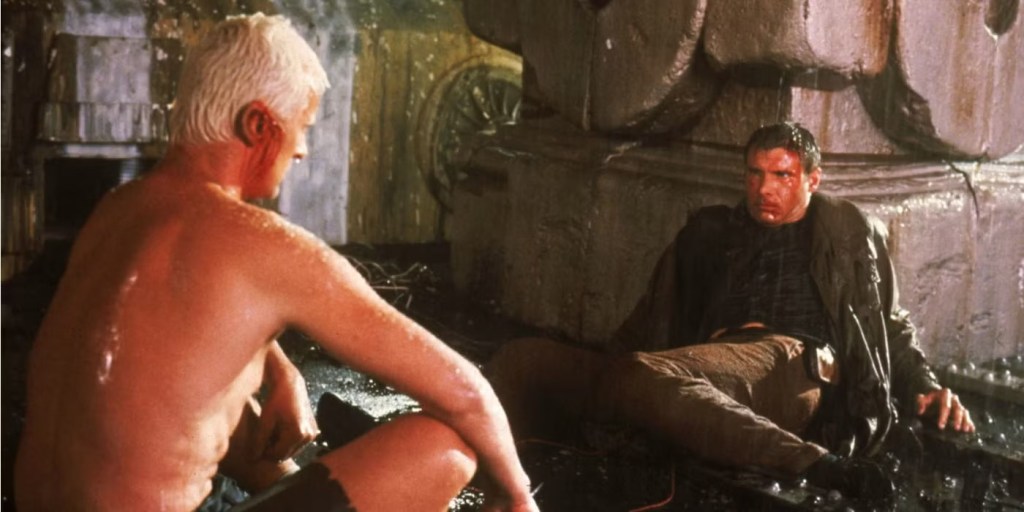
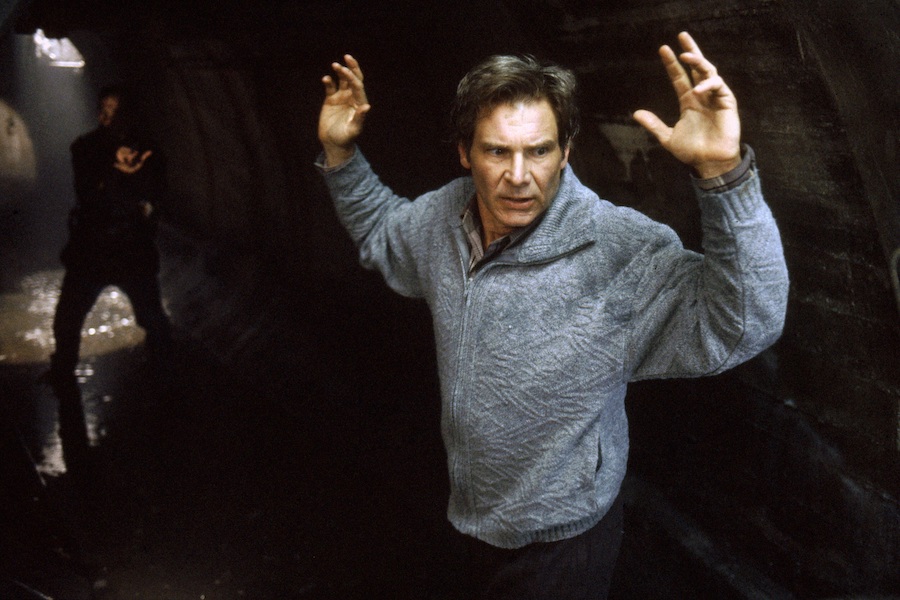
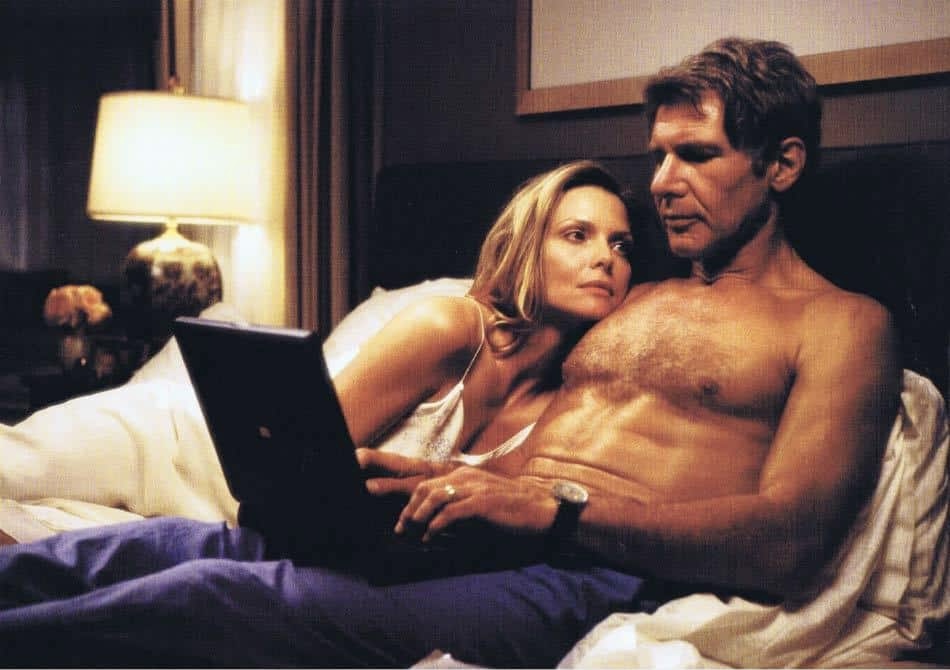
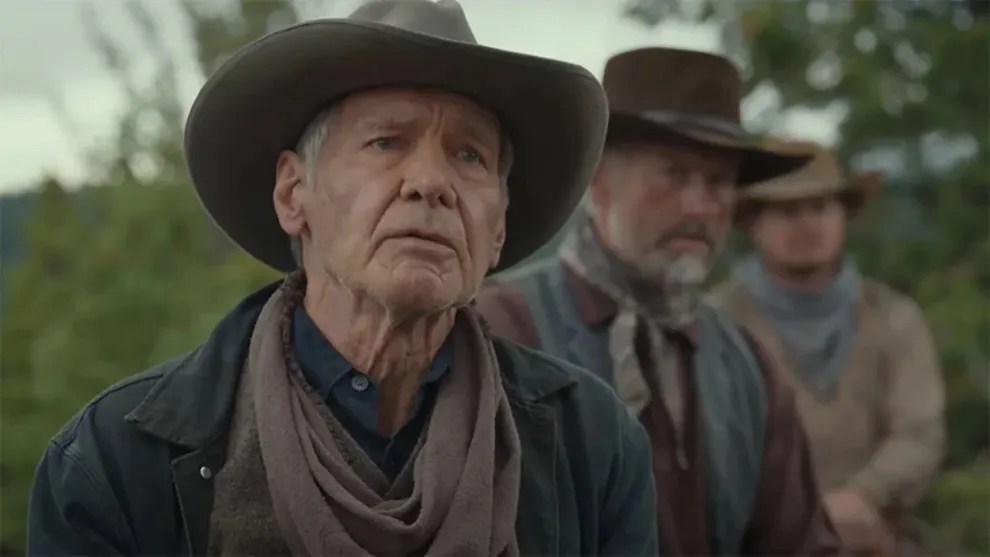
Today is Harrison Ford’s 83rd birthday. There’s not much I can say about Ford other than my movie going life pretty much started as a 4 year old with the STAR WARS movies. As I was growing up, he was one of the biggest stars on the planet, and his movies were almost always really good. He’s quite simply one of the best.
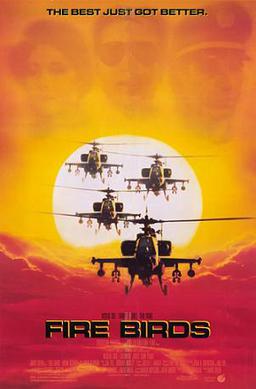
The South American drug cartels have been getting too aggressive so the American government decides to take them out with Apache helicopters. Missions leaders Tommy Lee Jones and Dale Dye know that these helicopters are the ultimate weapons of death and that things could go terribly wrong if they recruit the wrong pilots.
So, of course, they get Nicholas Cage and Sean Young to fly them.
FireBirds was an attempt to redo TopGun with helicopters. It does actually improve on Top Gun in that it gives the pilots an actual villain to fight. The drug cartels and the German mercenary (Bert Rhine) that they hire are good B-movie villains and an improvement on the faceless and apparently nationless bad guys who showed up at the end of TopGun. What FireBirds cannot improve on are the flying sequences because fighter planes are just more exciting than to watch than helicopters.
The best thing about the movie is that it brought Nicolas Cage and Tommy Lee Jones together and their acting styles mesh far better than I think anyone would expect. Sean Young is about as believable as a helicopter pilot as you would expect her to be, which is to say not at all. There’s a reason why Young’s best performance was as a robot.
“I. Am. The. Greatest!” Nicolas Cage says in the movie and he sounds convinced. Fire Birds makes the case that Cage is the greatest when it comes to making something bad watchable. This movie would be thoroughly forgettable if not for his presence and the same can be said about a lot of other movies as well. But, Tommy Lee Jones can lay claim to the “Greatest” title as well. Five years after FireBirds, Tommy Lee Jones would tell Jim Carrey, “I cannot sanction your buffoonery,” and the passage of time has shown that Jones knew what he was talking about. Nicolas Cage and Tommy Lee Jones should make more movies together.
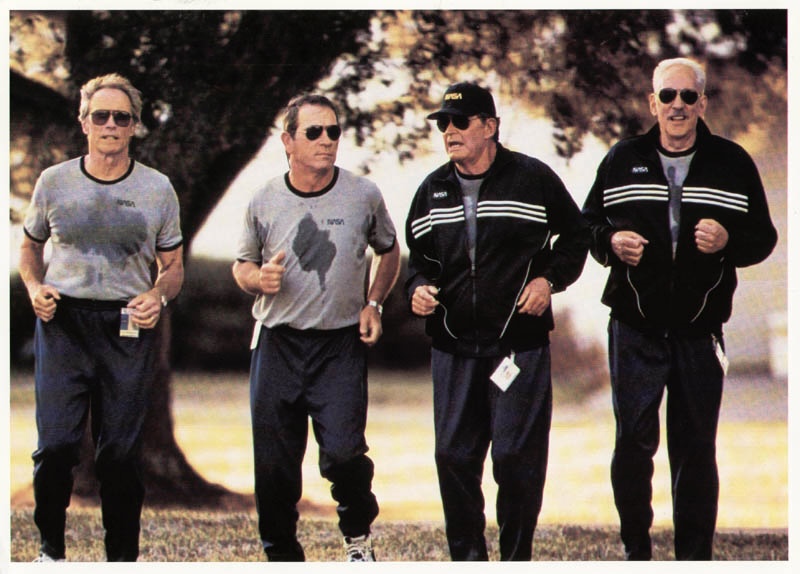
One of the funniest scenes in SPACE COWBOYS (2000) takes place when Jay Leno interviews the characters of Frank Corvin (Clint Eastwood), Hawk Hawkins (Tommy Lee Jones), Jerry O’Neill (Donald Sutherland) and Tank Sullivan (James Garner). The scene I’m referring to involves a question asked of “babe magnet” Jerry O’Neill. Only a few moments of Jay Leno’s material made it into the completed film, but the interview was filmed in front of a real Tonight Show audience. Leno made monologue jokes about Viagra, Matlock (1986), and prostate problems. Leno ad-libbed with the actors like he would in a real interview. I’ve included the additional scenes here!
Here at The Shattered Lens, we’re definitely celebrating Clint Eastwood’s May 31st birthday. As part of that celebration, I decided to revisit his 2000 film, SPACE COWBOYS.
SPACE COWBOYS opens in 1958 on the day that Air Force Test Pilot Frank Corvin (Clint Eastwood) and his team of Hawk Hawkins (Tommy Lee Jones), Jerry O’Neill (Donald Sutherland), and Tank Sullivan (James Garner) find out that their test program is being shutdown due to the formation of NASA. Their dreams of someday making it to space are crushed, and to make it worse, they were stabbed in the back by their leader Bob Gerson (James Cromwell) and not invited to be part of NASA’s new testing program. Fast forward to the present time, where a Soviet communications satellite seems to be unresponsive and NASA is working with Russian General Vostov (Rade Serbedzija) to figure out how to keep it from crashing back to Earth. The satellite is a relic of the Cold War that somehow ended up with a guidance system on board that’s so old that it was designed by Frank, and the young folks don’t know how to work with it. And to complicate things even further, the guidance system can only be fixed on site, which means in space. So it seems that NASA finally needs Frank after all this time, and he’ll only agree to help if he’s able to bring his old team on board. Their old nemesis Bob, the project’s manager at NASA, reluctantly agrees. We see that he’s still the same bastard he’s always been as he and General Vostov are holding back critical information about the cargo of the satellite. So let the training and preparation for the mission begin!
The premise of SPACE COWBOYS may not be very realistic, but I think it’s one hell of a fun movie, especially during its first half. I really enjoy watching this amazing cast of veteran actors do their thing. Of course they get the cool walk into NASA headquarters wearing sunglasses and leather jackets, while N’ Sync’s “Space Cowboy” plays over the soundtrack. Clint Eastwood plays the character he has perfected over his career, that of the tough, grizzled leader with a dry sense of humor. Tommy Lee Jones is the fearless hotshot who has never been good at following orders, but has the kind of talent that everyone wishes they had. Jones is actually by far the youngest of the primary cast, a full 16 years younger than Eastwood. Donald Sutherland gets some of the best laughs as the ladies man of the team. The scene where he answers Jay Leno’s question about his reputation as a lothario made me laugh out loud! James Garner’s character became a Baptist minister after his days with the Air Force and prays often for the group. He’s good here, but his character is the least memorable. With their mission labeled “The Ripe Stuff” by the media, watching these great older actors go through their training, and deal with their much younger counterparts and the NASA brass, is a joy. I also want to shout out William Devane as the NASA flight director for the mission. He has a couple of really strong scenes.
The legendary cast of this film can’t help but give a seasoned moviegoer like me a warm sense of nostalgia based on their amazing body of work. I remember introducing KELLY’S HEROES to my son when he was a boy. He watched my DVD over and over again. Seeing Eastwood and Sutherland together here brought those memories back. One of my very favorite revenge films is ROLLING THUNDER with William Devane and Tommy Lee Jones. Seeing them together here helps me remember just how great they are in that badass classic. Heck, Garner’s character name of “Tank” Sullivan takes me back to one of the very first movies our family rented when we got our VCR in the mid-80’s! Do y’all remember Garner’s film TANK from 1984? I certainly do!
I will admit that once the crew takes off and begins the actual mission, which comprises about the last 45 minutes of the film, the entertainment level goes down a couple of notches for me. The technical aspects of completing the mission are not as interesting to me as the character interplay in the earlier portions of the film. With that said, there are still some exciting moments to be had, including the nailbiter of a landing at the end.
I enjoyed revisiting SPACE COWBOYS after quite a few years. This movie is ultimately a crowd pleaser, and for me, it does its job well. Enjoy the trailer below:
Normally, the trailer for The Burial is not the type of trailer that would really catch my attention but, with all of the recent concerns about Jamie Foxx’s health, it’s a little bit heartwarming to watch just how energetic Foxx is in this trailer. (Of course, The Burial was filmed before Foxx’s recent struggles.) Personally, I think Foxx’s high energy and Tommy Lee Jones’s more subdued (some might say “grouchy”) approach could be an interesting combination.
The Burial is set to be released in theaters on October 6th and on Prime on October 13th.
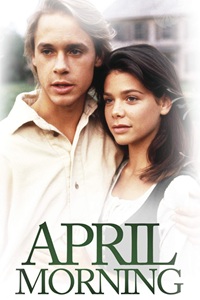 Adam Cooper (Chad Lowe) is a teenager growing up in Colonial Massachusetts. His father, Moses Cooper (Tommy Lee Jones), is a stern man who believes that rights come from men and not God and who, despite believing in negotiating instead of fighting, is willing to take arms against the British if necessary. Adam has a pretty girlfriend (Meredith Salenger) and tries to please both his religious mother (Susan Blakely) and his agnostic father. When Paul Revere makes his famous ride, both Adam and Moses are thrust into the Battle of Lexington and, over the course of one long night, Adam is forced to grow up and become the man of the house.