Lisa’s Early Oscar Nominations for July


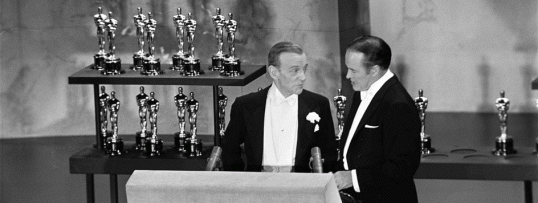
With each passing month, the Oscar race becomes just a little bit clearer.  We are still a few months away from the true Oscar season but a few contenders have emerged.

My predictions are below.  Previously, my predictions were all based on wishful thinking and instinct.  Well, there’s still a lot of wishful thinking to be found below but, at the same time, the festival season is providing a guide and there are some early reviews that have started to come in.  I’ve never been a 100% correct in my predictions and I doubt this year is going to be any different.  (For one thing, I always predict 10 best picture nominees, even though that’s close to being a mathematical impossibility under the current Academy rules.)

One final note: Some day, the Academy will get over their resistance to Netflix and streaming.  I don’t think that’s going to happen this year, though.  I kept that in mind while considering the chances of such heavily hyped (and, for that matter, less heavily hyped) contenders as Mudbound and The Meyerowitz Stories.

Anyway, here are my predictions for July!  Be sure to check out my predictions for January, February, March, April, May, and June as well!

Best Picture

Call Me By Your Name

Darkest Hour

Detroit

The Disaster Artist

Dunkirk

The Florida Project

Goodbye Christopher Robin

The Greatest Showman

Logan

Wonderstruck

Best Director

Sean Baker for The Florida Project

Kathryn Bigelow for Detroit

Michael Gracey for The Greatest Showman

Christopher Nolan for Dunkirk

Joe Wright for Darkest Hour

Best Actor

Chadwick Boseman in Marshall

Willem DaFoe in The Florida Project

Hugh Jackman in The Greatest Showman

Gary Oldman in Darkest Hour

Donald Sutherland in The Leisure Seeker

Best Actress

Judi Dench in Victoria and Abdul

Kirsten Dunst in Woodshock

Frances McDormand in Three Billboards Outside of Ebbing Missouri

Emma Stone in Battle of the Sexes

Meryl Streep in The Papers

Best Supporting Actor

Steve Carell in Battle of the Sexes

James Franco in The Disaster Artist

Armie Hammer in Call Me By Your Name

Will Poulter in Detroit

Patrick Stewart in Logan

Best Supporting Actress

Penelope Cruz in Murder on the Orient Express

Holly Hunter in The Big Sick

Melissa Leo in The Novitiate

Julianne Moore in Wonderstuck

Margot Robbie in Goodbye Christopher Robin


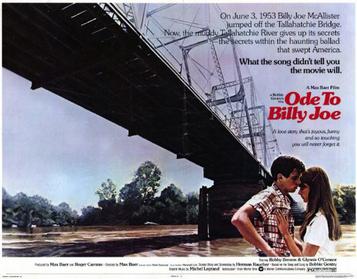
Film Review: Ode to Billy Joe (dir by Max Baer, Jr.)


Why, on June 3rd, did Billie Joe McAllister jump off of the Tallahatchie Bridge in Mississippi?

That was the question that was asked in Ode to Billie Joe, a 1967 country song by Bobbie Gentry.  In the song, the details were deliberately left inconclusive.  Why did Billie Joe commit suicide?  No one knows.  All they know is that he was a good worker at the sawmill and, the weekend before jumping, he was seen standing on the bridge with a teenage girl and apparently, they dropped something down into the river below.  The song suggests that the girl and the narrator are one in the same but even that is left somewhat vague.

Ode to Billie Joe was a hit when it was first released, largely because it’s story could be interpreted in so many different ways.  Why did Billie Joe kill himself?  Maybe it was because he didn’t want to be drafted.  Maybe it was because he and his girlfriend had killed their baby and tossed it off the bridge.  Maybe it was because he was hooked on Dexedrine and his doctor wasn’t available to renew his prescription.  It could be any reason that you wanted it to be.

However, in 1976, when Ode to Billie Joe was turned into a movie, ambiguity would not do.  As opposed to the song, Ode To Billy Joe had to answer the question as to why Billy Joe jumped into that river.  In the movie, 18 year-old Billy Joe (Robby Benson) works at the sawmill and spends his time courting 15 year-old Bobbie Lee Hartley (Glynnis O’Connor).  Bobbie Lee’s father (Sandy McPeak) says that she’s too young to have a “gentleman caller,” even though Bobbie Lee insists that she’s “15 going on 34 … B cup!”  Bobbie Lee warns Billy Joe that her father is liable to shoot his ears off but Billy Joe insists that he doesn’t need ears because he’s in love with her.  That’s kind of a sweet sentiment, even though I don’t think Billy Joe would look that good without ears.

(Whenever I complain about how Southerners in the movies always seem to have two first names, my sister Erin replies, “Yeah, that’s really annoying, Lisa Marie.”  So, I won’t make a big deal about it this time…)

One night, Billy Joe and his friends go out and Billy Joe ends up getting drunk.  He disappears for several days and when he shows up again, something has definitely changed.  After unsuccessfully trying to make love to Bobbie Lee, Billy Joe tells her what happened that night he got drunk.  Billy Joe had sex with a man, something that he has been raised to view as being the ultimate sin.  When Billy Joe is later pulled out of the river, the entire town wonders why he jumped off the bridge and how Bobbie Lee was involved…

Ode to Billy Joe, which aired last Tuesday on TCM, is a better-than-average film, one that I was surprised to have never come across in the past.  That doesn’t mean that it’s a perfect movie. Robby Benson, in the role of Billy Joe, gives an absolutely terrible performance.  You can tell that Benson was trying really hard to do a good job but, often, he goes totally overboard, making scenes that should be poignant feel melodramatic.  Though it probably has more to do with when the film was made than anything else, the film is also vague about Billy Joe’s sexuality.  Is Billy Joe in denial about his identity?  Is he deeply closeted or was he in such a drunken stupor that he was taken advantage of?  Ode to Billy Joe does not seem to be sure.  By committing suicide, Billy Joe joins the ranks of gay movie characters who would rather die than accept their sexuality.  Obviously, he had to jump off that bridge because that’s what the song said he did but there’s a part of me that wishes the movie had featured someone commenting that they never actually found Billy Joe’s body and then the final scene could have taken place 16 years later, with Bobbie Lee living as a hippie in San Francisco and just happening to spot Billy Joe walking down the street, hand-in-hand with his boyfriend.

Here’s what does work about the movie.  Glynnis O’Connor gives a great and empathetic performance as Bobbie Lee.  The scenes with her father and her mother (played by Joan Hotchkis) have a very poignant and wonderful realness to them.  Though I’ll always be a city girl at heart (well, okay — a suburb girl), I spent some time in the country when I was growing up.  And while I was never quite as isolated as Bobbie Lee (who lives in a house with no electricity or plumbing) and the film took place in the past, I could still relate to many of Bobbie Lee’s experiences.  The film may have been made in 1976 and set in 1952 but life in the country hasn’t changed that much.

For instance, there’s this great scene where Bobbie Lee’s father is trying to drive across the bridge.  The only problem is that there’s a bunch of drunk shitkickers on the bridge, sitting in their pickup truck and blocking his way.  It’s a very tense scene, one that I found difficult to watch because, when I was growing up in Arkansas, Oklahoma, Louisiana, and South Texas, I saw the exact same thing happen more times than I care to admit.  In the country, no one backs down.  Scenes like that elevated Ode To Billy Joe to being something more than just another movie based on a song.

Finally, there’s a beautiful scene towards the end of the film, between Bobbie Lee and a character played by an actor named James Best.  I won’t spoil the scene but it’s a master class in great acting.  (Best also played one of the sadistic villains in Rolling Thunder, another good 70s film about life and death in the country.)

Though I wasn’t expecting much from it, Ode to Billy Joe was a pleasant surprise.  It’s not perfect but it’s still worth watching.

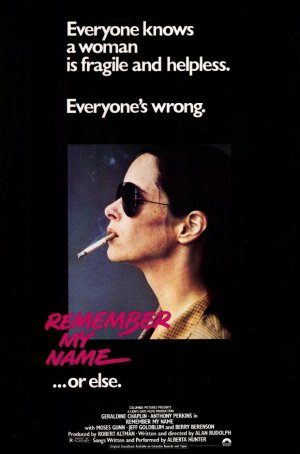
Insomnia File #27: Remember My Name (dir by Alan Rudolph)


What’s an Insomnia File? You know how some times you just can’t get any sleep and, at about three in the morning, you’ll find yourself watching whatever you can find on cable? This feature is all about those insomnia-inspired discoveries!

If you were having trouble sleeping last Tuesday, around one in the morning, you could have turned over to TCM and watched Remember My Name, an odd and sometimes frustrating little thriller from 1978.

Remember My Name opens with Emily (Geraldine Chaplin) showing up in a small town in California.  From the minute we first see and hear Emily, something seems to be off about her.  She views the world through suspicious eyes.  Whenever anyone talks to her, you’re never quite sure whether she’s going be friendly or if she’s going to lash out.  When she speaks, there’s something weird about her vocal inflection, as if she’s always struggling to figure out what she’s supposed to say.  She seems to be separated from the world, almost as if she’s walking through a living dream and only talking to figments of her imagination.  There’s nothing about her that feels at all authentic.

She moves into a small apartment and enters into a relationship with her handyman (Moses Gunn), a relationship that seems to be largely defined by her refusal to open up about herself.  She gets a job at a grocery story that’s managed by a Mr. Nudd (Jeff Goldblum).  Mr. Nudd mentions something about Emily knowing his mother.  Apparently, they met in prison.

Soon, Emily is stalking a construction worker named Neil Curry (Anthony Perkins).  When Neil spots her, he calls out her name and Emily runs away.  And yet, Neil doesn’t bother to tell his wife, Barbara (Berry Berenson), about Emily.  Soon, Emily is even breaking into the Curry home, silently shadowing Barbara as she walks through the house.

I described Remember My Name as being a thriller and I guess that, technically it is.  There are a few moments of tension, especially when Emily is stalking Barbara.  However, the film itself is directed in a detached manner by Alan Rudolph.  Rudolph was a protegé of director Robert Altman (who also produced Remember My Name) and Rudolph’s approach is very Altmanesque, often to the detriment of the film.  (Chaplin and Jeff Goldblum had both appeared in several Altman films, most famously in Nashville.)  Though the film is dominated by Chaplin and Perkins, it’s still very much an ensemble film and the action plays out in a deceptively casual, almost random manner.  It tries so hard to be Altmanesque that Remember My Name gets a bit frustrating, to be honest.  Chaplin gives such a good and memorable performance and she works very hard to make Emily a character who is both frightening and, at times, surprisingly sympathetic but, for the most part, Rudolph’s technique makes it difficult to get emotionally involved in any of the action unfolding on-screen.  Rudolph observes the action but refuses to comment on it.  As a result, Remember My Name is occasionally intriguing but, just as often, it’s rather boring.  Just like real life, I suppose.  And, just like real life, it’s not for everyone.

That said, it was interesting to see Anthony Perkins playing a role other than a knife-wielding inn manager.  Without resorting to any of the familiar tics or the neurotic speech patterns that typecast him forever as Norman Bates, Perkins plays Neil as just being a regular, blue collar guy and he actually does a pretty good job.  Watching the film, I got the feeling that this was perhaps Perkins’s attempt to change his image.  (Whenever Neil appears shirtless, both the film and Perkins seem to be saying, Check out this physique!  Would someone only capable of playing a psycho have abs like this?)  Neil’s wife, Barbara, was played Perkins’s wife, Berry Berenson.  Neither one of them is with us any longer.  Perkins died of AIDS in 1990 while Berry Berenson was on one of the planes that flew into the World Trade Center on 9-11.  They both did good work in this film, as did Chaplin and Goldblum and, really, the entire cast.  It’s just a pity that the film itself isn’t as good as the performances. 

Previous Insomnia Files:

  1. Story of Mankind
  2. Stag
  3. Love Is A Gun
  4. Nina Takes A Lover
  5. Black Ice
  6. Frogs For Snakes
  7. Fair Game
  8. From The Hip
  9. Born Killers
  10. Eye For An Eye
  11. Summer Catch
  12. Beyond the Law
  13. Spring Broke
  14. Promise
  15. George Wallace
  16. Kill The Messenger
  17. The Suburbans
  18. Only The Strong
  19. Great Expectations
  20. Casual Sex?
  21. Truth
  22. Insomina
  23. Death Do Us Part
  24. A Star is Born
  25. The Winning Season
  26. Rabbit Run

Short Film Review: Girl and a Scar (dir by David Cave)


I always enjoy watching and reviewing short films.

The short film format challenges both the filmmaker and the viewer.  For the filmmaker, the challenge is to take the audience on a full cinematic journey in a limited amount of time.  It’s one thing when you have two hours to tell a story, it’s something entirely different when you’ve only got 15 minutes.  As a result, the visuals and the acting become even more important.  You can’t have one wasted shot or one performance that feels out-of-place.  For the viewer (and the reviewer, for that matter), the challenge is to relearn how to watch a movie.  Short films force you to pay attention to every single detail because, often times, it’s only through catching those details that you’ll be able to understand what you’ve just seen.  In short films, there’s no time for the director or screenwriter to come back, take you by the hand, and say, “This is what it all means.”  Instead, it’s up to you to figure it out.  I love a challenge and that’s why I always appreciate and enjoy the chance to watch and review a short film.

For instance, I recently had a chance to watch Girl and a Scar, a 15-minute film from moviemaker David Cave.  It’s a challenging film, one that is full of surreal imagery and haunting atmosphere.  While the ever-present wind howls on the soundtrack, we find ourselves looking at an isolated house, one that would not be out-of-place in a Jean Rollin vampire film.  Inside the house, the Girl (Ileana Cardy) cuts herself with a razor blade.  Throughout the movie, the wound grows, almost as if it has a mind of its own.  We see the Girl outside, standing in front of what appears to be an industrial park and watching as a young man walks away from her and then as a man in a … well, I’m not going to spoil the details.  Let’s just say that she’s approached by a man in a very memorable costume.  In between the scenes of the Girl walking along the beach and stumbling through her isolated home, there are snippets of animation.  We see the girl in the forest, a cartoon that is occasionally eating and occasionally throwing up.  Connecting it all is the sound of that howling wind and that ever-growing wound on the Girl’s stomach.

The imagery is frequently shocking and disturbing and yet, because Cave does such a good job framing his images and maintaining the film’s atmosphere, the film is always watchable.  It helps that Ileana Cardy, though having no dialogue, gives a good and empathetic performance as the Girl.  You may not always understand what is happening to here but you want to understand and that’s the important thing.  From the minute it opens, Girl and a Scar invites you to investigate and try to solve its mysteries.  With the mix of body horror and animation, Girl and a Scar at times feels like a fairy tale told by David Cronenberg.

Short films are not necessarily easy to track down but I do recommend making the effort.  Hopefully, this one will soon start making the festival circuit.


TV Review: Twin Peaks: The Return Part 10 (dir by David Lynch)


I’m getting a late start on this recap and I imagine that, by the time I’m finished rewatching the latest episode of Twin Peaks and typing all this up, I’ll probably barely be able to keep my eyes open.  Dexedrine is a wonderful and helpful tool but it can only do so much.

(Don’t freak out, I take it for my ADD.  It helps me focus.  The endless energy is just a nice side benefit.)

So, I better not waste any time!  Let’s talk about Part 10 of Twin Peaks!
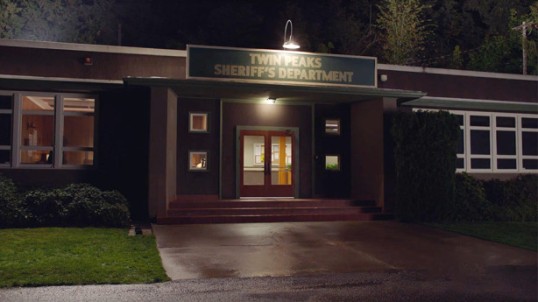
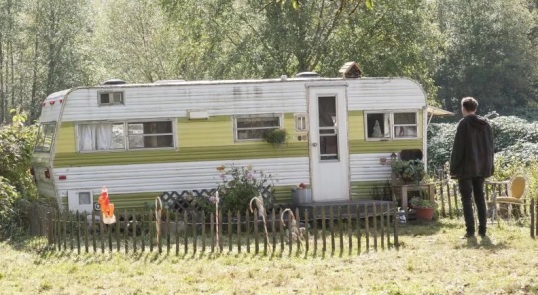
We open in Twin Peaks, at the trailer park to be exact.  Richard Horne (Eamon Farren) pulls up outside the trailer of Miriam (Sarah Jean Long), the poor woman who was unlucky enough to see him running down that little boy a few episodes ago.  As this episode will demonstrate, Richard is perhaps the most loathsome character to ever appear in a David Lynch film.  Even Blue Velvet‘s Frank Booth never ran down a child while driving around Lumberton.

From inside her trailer, Miriam yells at Richard that not only has she gone to the police but that she also wrote Sheriff Truman a letter, telling him that, if anything happens to her, Richard is the one responsible.  Richard responds by rushing into the trailer and beating Miriam to death.

As Richard walks away from the trailer, he calls his Deputy Chad (John Pirruccello) and orders him to intercept the letter and keep Truman from reading it.

Elsewhere in the trailer park. Carl (Harry Dean Stanton) sits in front of the manager’s office, plays his guitar, and sings.  The gentleness of Carl’s voice provides a stark contrast to the rest of the episode.
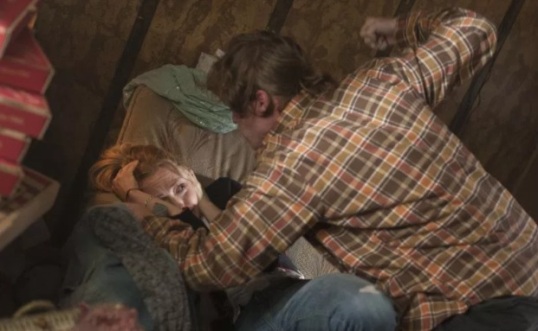
Carl’s song is interrupted by the sound of Steve (Caleb Landry Jones), in another trailer, yelling at Becky (Amanda Seyfried) and throwing stuff out the window.  Becky is not only Shelley’s daughter but apparently, she’s found herself married to a modern-day Leo Johnson as well.  Just like Leo, Steve is upset because he feels Becky isn’t keeping their home clean enough.

(Whatever happened to Leo?  I assume all those tarantulas eventually fell on his face and killed him.)

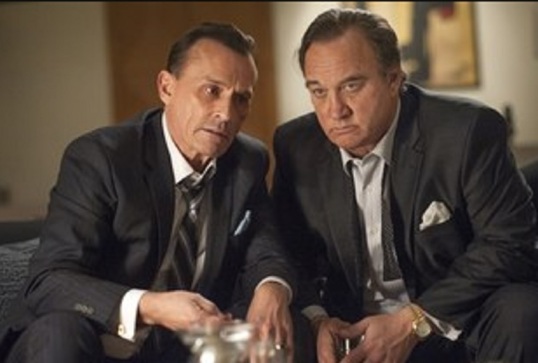
In Las Vegas, Candie (Amy Shiels) — wearing her iconic pink dress — attempts to kill a fly by hitting it with a remote.  Unfortunately, the fly happens to be on the face of Rodney Mitchum (Robert Knepper), which leads to him getting smacked.  Bradley (James Belushi) rushes into the room the make sure that Rodney is okay, while Candie screams and sobs. The fly, I believe, escaped unharmed.

Janey-E (Naomi Watts) and Dougie (Kyle MacLachlan) visit with Dr. Ben (John Billingsley).  While Dougie continues to stare blankly forward, Janey-E explains that he’s been acting strangely for a few days.  Janey-E explains that Dougie has a drinking and gambling problem.  Dr. Ben is bemused by Dougie’s weight loss.  Janey-E agrees that Dougie has lost a lot of weight … “in a good way.”  Dr. Ben announces that Dougie appears to be in perfect health.  “Remarkable,” Janey-E says while looking at the shirtless Dougie.

Back the Mitchum place, Candie is still crying while Rodney assures her that he’s fine.  On the TV, Bradley and Rodney watch a news story about both Dougie and the arrest of Ike the Spike.

“Brad,” Rodney says, “remind me to call off that hit on Ike.”

“Saved us a wad of dough!” Bradley agrees, “Niiiiiiiice!”

Bradley recognizes Dougie from the news.  “That’s our Mr. Jackpots,” Bradley says.

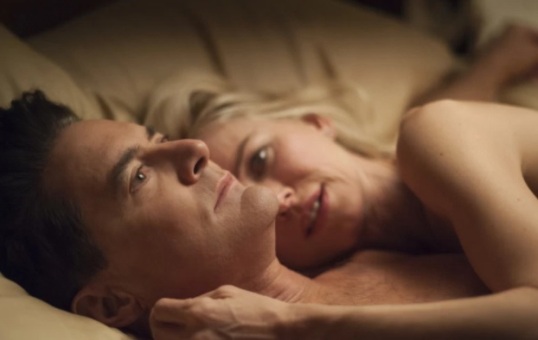
At the Jones house, Janey-E watches Dougie eat cake.  She asks if he finds her attractive.  Dougie says nothing, entranced by the cake.  Janey-E tells him that she finds him attractive.  Dougie stares at her blankly.  Janey-E takes Dougie upstairs, where she rides him while he lays underneath her in a state of stunned euphoria.  (Dougie/Cooper, of course, is experiencing all of this for the first time.)  Afterward, she tells Dougie, “I love you.”  “Love you,” Dougie blankly repeats.
In Twin Peaks, Dr. Jacoby (Russ Tamblyn) rants on his podcast about pharmaceutical companies.  Nadine (Wendy Robie) listens approvingly.  We see that she’s sitting in her own store, Run Silent Run Drapes.  Yay!  Nadine finally perfected her drape runners!

It’s morning in Vegas.  As Sonny Jim (Pierce Gagnon), fresh from being traumatized by all the noise his parents made while he was trying to get some sleep, waits in the car, Janey-E tells Dougie that she can’t stop thinking about last night.  Dougie blankly nods.

In the wilderness outside Twin Peaks, Jerry (David Patrick Kelly) is still lost.  “You can’t fool me!” he yells, “I’ve been here before!”

At the Sheriff’s office, Lucy (Kimmy Robertson) wonders why Deputy Chad is hanging out in the lobby.  Of course, we know that Chad is waiting for the mail so that he can intercept Miriam’s letter.  Chad, however, just says that he’s appreciating the beauty of the day.  Chad sees the mailman pulling up so he runs outside to meet him.  Lucy is rightly suspicious, especially when Chad rather obviously stuffs Miriam’s letter under his shirt.

This is followed by a scene that literally left me queasy.  At the Horne House, a bruised and battered Johnny Horne (Eric Rondell) stares at a creepy toy that has the body of teddy bear and a head of glass.  Throughout the entire violent and brutal scene that will follow, the toy continues to ask — in a vaguely British accent — “Hello, Johnny.  How are you today?”
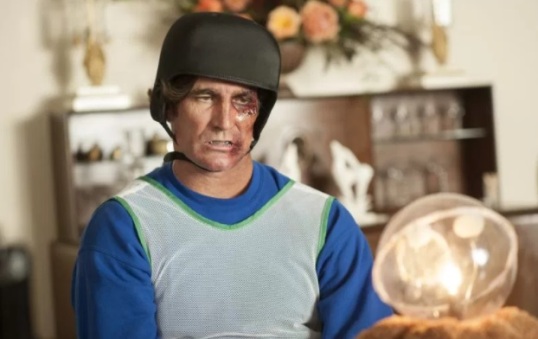
Johnny Horne (Richard’s uncle)

Richard bursts into the house and demands that Sylvia (Jan D’Arcy) give him money.  When she tells him to ask his grandfather, Richard grabs her by throat.  As Richard attacks her (and Farren is absolutely terrifying in this scene), Johnny falls out of the chair and groans on the floor.  It gets even worse when Johnny calls Sylvia “grandma.”
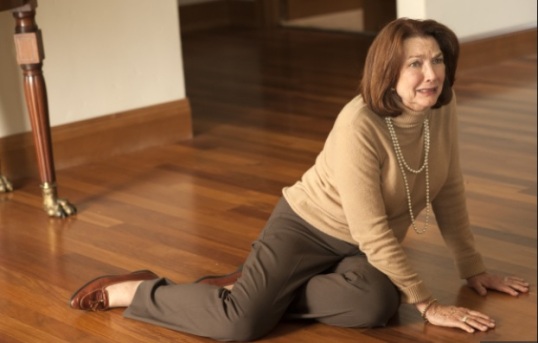
Sylvia, Richard’s grandmother

In other words, tonight, my greatest fear was confirmed.  Richard is Audrey’s son.  And judging from both his sociopathic personality and their shared affinity for leather jackets, it appears that Richard’s father is the Doppelganger.  A few episodes ago, Dr. Hayward revealed the, when Cooper last saw Audrey, she was still in a coma.
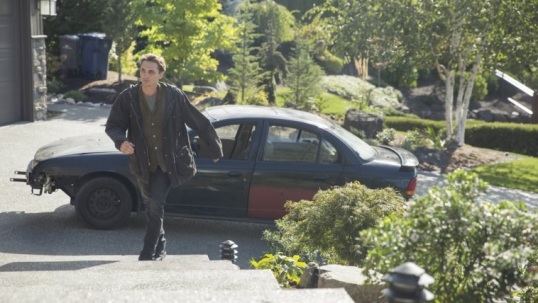
Richard Horne (son of Audrey and Cooper’s Doppelganger)

Richard gets the money.  He also calls his grandmother the C-word and steals her jewelry.  “Why do you have to make something so simple so fucking difficult!?” Richard snaps before leaving.

Seriously, this scene — more than anything else that we’ve seen so far in this series — left me truly shaken.  The performances of Farren and D’Arcy were so intense that, even though I knew it was coming and what would happen, I still had to take a break after rewatching this scene.

After that disturbing scene, we cut back to Las Vegas.  Roger (Joe Adler) tells Duncan Todd (Patrick Fischler) that it’s true that Ike has been captured by the police.  After Roger leaves, we see that Anthony Sinclair (Tom Sizemore) is in Duncan’s office.  Duncan tells Anthony that he’s to go to the Mitchum Brothers and that he’s to claim that Dougie cheated them out of an insurance claim.  Duncan believes that the Mitchums will respond by killing Dougie.  If the Mitchums don’t kill Dougie, Anthony will have to do it himself.

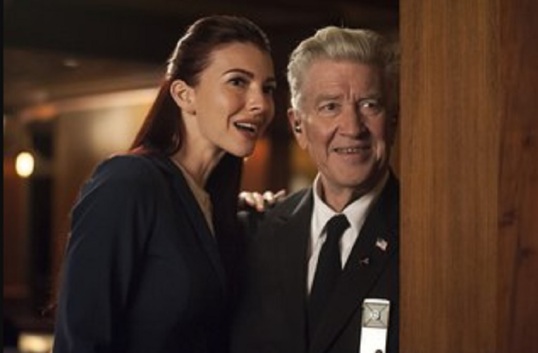
In South Dakota, love is in the air.  Albert (Miguel Ferrer) is on a date with coroner Constance Talbot (Jane Adams).  A bemused Gordon (David Lynch) watches them, with Tammy (Chrysta Bell) at his side.  But Gordon — you belong with Shelley!

Back in Vegas, Anthony goes to the casino and is spotted by the Mitchum brothers.  They tell Candie — who, like the other ladies in pink, is hanging out in their office — to bring Anthony to see them.  “You want me to bring him here?” Candie asks, somewhat vaguely, before heading to the casino floor.

As they watch Candie and Anthony on the surveillance footage, the Mitchum brothers realize that they may have made a mistake sending Candie.  Candie and Anthony start to have a long conversation.  Bradley is finally forced to tell the pit boss, Warrick (David Dastmalchian) to bring both Candie and Anthony back to the main office.

Before Rodney can complain, Bradley says, “If we fire her, she’s got no place to go.”  So, in case you were wondering which brother was the nice brother, apparently it’s Jim Belushi.
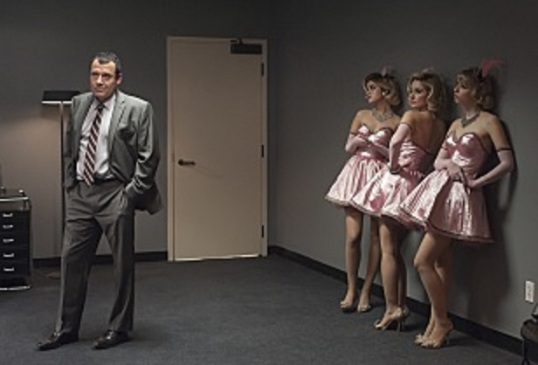
Anyway, Candie and Anthony finally arrive at the office.  The Mitchums demand to know what Candie and Anthony were talking about.  Candie thinks for a minute and then remembers that they were talking about how it was going to be hot and smoggy the next day.

Anthony finally gets his chance to tell the Mitchum brothers that Dougie handled their denied claim and that he has a personal vendetta against them.  Anthony is not exactly the best liar and the Mitchums tell Candie to show Anthony out of their office.

“You have an enemy in Douglas Jones!” Anthony shouts.

Later, Bradley and Rodney have a drink in their living room.  Despite Anthony not being the most convincing of storytellers, the Mitchum brothers appear to believe him and they both agree that Dougie has to die.  Rodney announces, “Now I know how Brando felt.”

(Wally Brando, maybe?)
Back in South Dakota, Gordon sits in his hotel room and draws a picture — one that resembles the cave drawings from the 2nd season of Twin Peaks — on a piece of paper.  Someone knocks on his door.  When Gordon answers it, he has a vision of Laura crying while hearing Sarah Palmer (Grace Zabriksie) calling Laura’s name.

As the vision fades, Gordon sees that Albert is standing out in the hallway.  Albert enters the hotel room and reveals that, while they were in the morgue, Diane received a text on her phone: “Around the dinner table, the conversation is lively.”  Albert says that he and Tammy tracked the text as coming from Mexico.  Diane responded with a heavily encrypted message: “They have Hastings.  He’s going to take them to the site.”

“What should we do?” Albert asks.

“Keep her close,” Gordon replies.

Tammy then shows up at the room, revealing that she has new information concerning “the penthouse murders” in New York City.  (That would be the murder of poor Sam and Tracy in Part 1.)  She shows Gordon a picture of the Doppelganger in the penthouse, standing in front of the glass case.

At the Great Northern, Ben (Richard Beymer) takes a call from his now ex-wife, Sylvia.  Sylvia demands that Ben repay her all of the money that Richard stole from her.  Ben refuses.  Sadly, when Ben asks if Johnny’s okay, Sylvia snaps back, “No concern about me!”

Hanging up on his former wife, a frustrated Ben calls out, “Beverly, do you want to have dinner with me?”
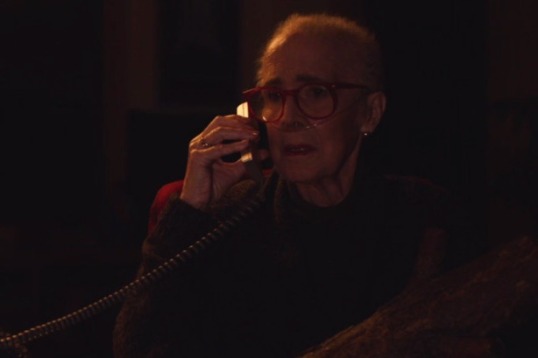
At her lonely house, the Log Lady (Catherine Coulson) calls Hawks (Michael Horse) and tell him that “Electricity is humming.  You can hear it in the mountains and rivers…in these days, the glow is dying?  What will be in the darkness that remains?”

(This scene is even more poignant when you consider it was probably the final thing that Coulson ever filmed before passing away last year.)

The Log Lady tells Hawk that the Truman brothers are “true men … they are your brothers … watch and lesson to the dream of time and space…Hawk…Laura is the one…”

At the Road House, Rebekah Del Rio performs, providing both this episode and the series as a whole with yet another link to Mulholland Drive.  (That’s not as crazy as it sounds.  Mulholland Drive was originally envisioned as being a spin-off of Twin Peaks, with Audrey moving to Hollywood.)
What to say about this episode?  It was, in many ways, deceptively simple.  All of the disparate elements of the show are finally coming together.  The appearances by Sizemore, Belushi, and Knepper served to remind us — just as Jennifer Jason Leigh did last week — that Twin Peaks is not just random David Lynch quirkiness.  Everything is connected.  A story is being told.  You just have to have the patience to look for the clues.

And finally, to those reviewers complaining that Twin Peaks: The Return is misogynistic, open your eyes.  Yes, many of the characters are misogynists.  Not a single one of them is, in anyway, portrayed sympathetically.  He may be a surrealist but David Lynch is one of the most humanistic filmmakers of all time.  If the world of Twin Peaks is sometimes ugly, so is the world outside your front door.

Twin Peaks on TSL:

  1. Twin Peaks: In the Beginning by Jedadiah Leland
  2. TV Review: Twin Peaks 1.1 — The Pilot (dir by David Lynch) by Lisa Marie Bowman
  3. TV Review: Twin Peaks 1.2 — Traces To Nowhere (directed by Duwayne Dunham) by Jedadiah Leland
  4. TV Review: Twin Peaks 1.3 — Zen, or the Skill To Catch A Killer (dir by David Lynch) by Lisa Marie Bowman
  5. TV Review: Twin Peaks 1.4 “Rest in Pain” (dir by Tina Rathbone) by Leonard Wilson
  6. TV Review: Twin Peaks 1.5 “The One-Armed Man” (directed by Tim Hunter) by Jedadiah Leland
  7. TV Review: Twin Peaks 1.6 “Cooper’s Dreams” (directed by Lesli Linka Glatter) by Lisa Marie Bowman
  8. TV Review: Twin Peaks 1.7 “Realization Time” (directed by Caleb Deschanel) by Lisa Marie Bowman
  9. TV Review: Twin Peaks 1.8 “The Last Evening” (directed by Mark Frost) by Leonard Wilson
  10. TV Review: Twin Peaks 2.1 “May the Giant Be With You” (dir by David Lynch) by Leonard Wilson
  11. TV Review: Twin Peaks 2.2 “Coma” (directed by David Lynch) by Jedadiah Leland
  12. TV Review: Twin Peaks 2.3 “The Man Behind The Glass” (directed by Lesli Linka Glatter) by Jedadiah Leland
  13. TV Review: Twin Peaks 2.4 “Laura’s Secret Diary” (dir by Todd Holland) by Lisa Marie Bowman
  14. TV Review: Twin Peaks 2.5 “The Orchid’s Curse” (dir by Graeme Clifford) by Lisa Marie Bowman
  15. TV Review: Twin Peaks 2.6 “Demons” (dir by Lesli Linka Glatter) by Leonard Wilson
  16. TV Review: Twin Peaks 2.7 “Lonely Souls” (directed by David Lynch) by Jedadiah Leland
  17. TV Review: Twin Peaks 2.8 “Drive With A Dead Girl” (dir by Caleb Deschanel) by Lisa Marie Bowman
  18. TV Review: Twin Peaks 2.9 “Arbitrary Law” (dir by Tim Hunter) by Lisa Marie Bowman
  19. TV Review: Twin Peaks 2.10 “Dispute Between Brothers” (directed by Tina Rathbone) by Jedadiah Leland
  20. TV Review: Twin Peaks 2.11 “Masked Ball” (directed by Duwayne Dunham) by Leonard Wilson
  21. TV Review: Twin Peaks 2.12 “The Black Widow” (directed by Caleb Deschanel) by Leonard Wilson
  22. TV Review: Twin Peaks 2.13 “Checkmate” (directed by Todd Holland) by Jedadiah Leland
  23. TV Review: Twin Peaks 2.14 “Double Play” (directed by Uli Edel) by Jedadiah Leland
  24. TV Review: Twin Peaks 2.15 “Slaves and Masters” (directed by Diane Keaton) by Lisa Marie Bowman
  25. TV Review: Twin Peaks 2.16 “The Condemned Woman” (directed by Lesli Linka Glatter) by Leonard Wilson
  26. TV Review: Twin Peaks 2.17 “Wounds and Scars” (directed by James Foley) by Lisa Marie Bowman
  27. TV Review: Twin Peaks 2.18 “On The Wings of Love” (directed by Duwayne Dunham) by Jedadiah Leland
  28. TV Review: Twin Peaks 2.19 “Variations on Relations” (directed by Jonathan Sanger) by Lisa Marie Bowman
  29. TV Review: Twin Peaks 2.20 “The Path to the Black Lodge” (directed by Stephen Gyllenhaal) by Lisa Marie Bowman
  30. TV Review: Twin Peaks 2.21 “Miss Twin Peaks” (directed by Tim Hunter) by Leonard Wilson
  31. TV Review: Twin Peaks 22.2 “Beyond Life and Death” (directed by David Lynch) by Lisa Marie Bowman
  32. Film Review: Twin Peaks: Fire Walk With Me (dir by David Lynch) by Lisa Marie Bowman
  33. Here’s The Latest Teaser for Showtime’s Twin Peaks by Lisa Marie Bowman
  34. Here’s The Newest Teaser for Showtime’s Twin Peaks by Lisa Marie Bowman
  35. 12 Initial Thoughts About Twin Peaks: The Return Parts One and Two by Lisa Marie Bowman
  36. This Week’s Peaks: Parts One and Two by Ryan C. (trashfilm guru)
  37. TV Review: Twin Peaks: The Return Parts One and Two (dir by David Lynch) by Lisa Marie Bowman
  38. 4 Shots From 4 Films: Special Twin Peaks Edition by Lisa Marie Bowman
  39. This Week’s Peaks: Parts Three and Four by Ryan C. (trashfilm guru)
  40. 14 Initial Thoughts About Twin Peaks: The Return Part Three by Lisa Marie Bowman (dir by David Lynch)
  41. 10 Initial Thoughts About Twin Peaks: The Return Part Four by Lisa Marie Bowman (dir by David Lynch)
  42. TV Review: Twin Peaks: The Return Parts Three and Four (dir by David Lynch) by Lisa Marie Bowman 
  43. 18 Initial Thoughts About Twin Peaks: The Return Part 5 (dir by David Lynch) by Lisa Marie Bowman
  44. This Week’s Peaks: Part Five by Ryan C. (trashfilm guru)
  45. TV Review: Twin Peaks: The Return: Part 5 (dir by David Lynch) by Lisa Marie Bowman
  46. 14 Initial Thoughts On Twin Peaks Part 6 (dir by David Lynch) by Lisa Marie Bowman
  47. This Week’s Peaks: Part Six by Ryan C. (trashfilm guru)
  48. TV Review: Twin Peaks: The Return Part 6 (dir by David Lynch) by Lisa Marie Bowman
  49. 12 Initial Thoughts on Twin Peaks: The Return Part 7 (dir by David Lynch) by Lisa Marie Bowman
  50. This Week’s Peaks: Part Seven by Ryan C. (trashfilm guru)
  51. TV Review: Twin Peaks: The Return Part 7 (dir by David Lynch) by Lisa Marie Bowman
  52. Ten Initial Thoughts on Twin Peaks: The Return Part 8 (dir by David Lynch) by Lisa Marie Bowman
  53. This Week’s Peaks: Part Eight by Ryan C (trashfilm guru)
  54. TV Review: Twin Peaks: The Return Part 8 (dir by David Lynch) by Lisa Marie Bowman
  55. 16 Initial Thoughts on Twin Peaks: The Return Part 9 (dir by David Lynch) by Lisa Marie Bowman
  56. This Week’s Peaks: Part Nine by Ryan C (trashfilm guru)
  57. TV Review: Twin Peaks: The Return Part 9 (dir by David Lynch) by Lisa Marie Bowman
  58. 20 Initial Thoughts On Twin Peaks: The Return Part 10 (dir by David Lynch) by Lisa Marie Bowman
  59. This Week’s Peaks: Part 10 by Ryan C (trashfilm guru)
20 Initial Thoughts on Twins Peaks: The Return Part 10 (dir by David Lynch)


As always, these are just my initial thoughts.  A full recap will appear on this site either tonight or tomorrow.  It’s been crazy day/

  1. I’m DVRing Game of Thrones, I’ll get around to it tomorrow probably.  Believe it or not, I’ll probably have an easier time following the plot of Twin Peaks than I will Game of Thrones.
  2. Damn!  As if you didn’t already need a reason to loathe Richard Horne…
  3. Eamon Farren does a good job playing Richard but seriously, the character is just so loathsome.  I hope he’s not Audrey’s son.
  4. I would love a chance to sit down and interview Harry Dean Stanton.  I can’t wait to see Lucky, an upcoming film in which he co-stars with none other than David Lynch.
  5. We lived in some scary places when I was growing up but we managed to avoid the trailer park.  This episode is making me happy that was the case.
  6. Jerry’s never going to get out of the woods.
  7. Does Chad actually do anything or does he just hang out at the sheriff’s station all day?
  8. Uh-oh, did Richard just call Mrs. Horne grandma?  Oh my God, he is Audrey’s son…
  9. If Richard is dead by the end of this episode, I will not complain.
  10. Oh my God — what if the Doppelganger and Audrey had a son named Richard?
  11. Richard just called his own grandmother the C-word.  Okay, he needs to die.
  12. On a sad note, Richard’s behavior is perhaps the most realistic thing about Twin Peaks.  There are way too many Richard Hornes in the world.
  13. To be honest, I’m always a little relieved with a character or an actor, like Jim Belushi or Tom Sizemore, from a previous episode shows up.  It’s a reminder that this isn’t just random Lynch quirkiness.  A story actually is being told here.
  14. If I was on Twin Peaks, I would totally want to wear a pink dress and spent my time leaning against a wall with an unimpressed look on my face.  Actually, that’s pretty much what I do all day anyway but still…
  15. Laura!
  16. I guess Ben and Sylvia are divorced now.
  17. The Log Lady!  (RIP, Catherine Coulson)
  18. Is anyone else starting to get the feeling that Dougie/Cooper is never going to get back to normal?
  19. Tonight’s music guest was Rebekkah del Rio.  Her performance in Mulholland Drive is still one of the most haunting things ever.
  20. If I seem distracted, it’s because — while I was watching Twin Peaks — a friend of mine found herself being so harassed by online trolls that she shut down her twitter account.  Shit like that needs to stop.  I don’t care what you worship, I don’t care how you vote, I don’t care what you watch, and I don’t care what you listen to — if you’re a bully, you’ve got to go.  The bullies have got to go.

Twin Peaks on TSL:

  1. Twin Peaks: In the Beginning by Jedadiah Leland
  2. TV Review: Twin Peaks 1.1 — The Pilot (dir by David Lynch) by Lisa Marie Bowman
  3. TV Review: Twin Peaks 1.2 — Traces To Nowhere (directed by Duwayne Dunham) by Jedadiah Leland
  4. TV Review: Twin Peaks 1.3 — Zen, or the Skill To Catch A Killer (dir by David Lynch) by Lisa Marie Bowman
  5. TV Review: Twin Peaks 1.4 “Rest in Pain” (dir by Tina Rathbone) by Leonard Wilson
  6. TV Review: Twin Peaks 1.5 “The One-Armed Man” (directed by Tim Hunter) by Jedadiah Leland
  7. TV Review: Twin Peaks 1.6 “Cooper’s Dreams” (directed by Lesli Linka Glatter) by Lisa Marie Bowman
  8. TV Review: Twin Peaks 1.7 “Realization Time” (directed by Caleb Deschanel) by Lisa Marie Bowman
  9. TV Review: Twin Peaks 1.8 “The Last Evening” (directed by Mark Frost) by Leonard Wilson
  10. TV Review: Twin Peaks 2.1 “May the Giant Be With You” (dir by David Lynch) by Leonard Wilson
  11. TV Review: Twin Peaks 2.2 “Coma” (directed by David Lynch) by Jedadiah Leland
  12. TV Review: Twin Peaks 2.3 “The Man Behind The Glass” (directed by Lesli Linka Glatter) by Jedadiah Leland
  13. TV Review: Twin Peaks 2.4 “Laura’s Secret Diary” (dir by Todd Holland) by Lisa Marie Bowman
  14. TV Review: Twin Peaks 2.5 “The Orchid’s Curse” (dir by Graeme Clifford) by Lisa Marie Bowman
  15. TV Review: Twin Peaks 2.6 “Demons” (dir by Lesli Linka Glatter) by Leonard Wilson
  16. TV Review: Twin Peaks 2.7 “Lonely Souls” (directed by David Lynch) by Jedadiah Leland
  17. TV Review: Twin Peaks 2.8 “Drive With A Dead Girl” (dir by Caleb Deschanel) by Lisa Marie Bowman
  18. TV Review: Twin Peaks 2.9 “Arbitrary Law” (dir by Tim Hunter) by Lisa Marie Bowman
  19. TV Review: Twin Peaks 2.10 “Dispute Between Brothers” (directed by Tina Rathbone) by Jedadiah Leland
  20. TV Review: Twin Peaks 2.11 “Masked Ball” (directed by Duwayne Dunham) by Leonard Wilson
  21. TV Review: Twin Peaks 2.12 “The Black Widow” (directed by Caleb Deschanel) by Leonard Wilson
  22. TV Review: Twin Peaks 2.13 “Checkmate” (directed by Todd Holland) by Jedadiah Leland
  23. TV Review: Twin Peaks 2.14 “Double Play” (directed by Uli Edel) by Jedadiah Leland
  24. TV Review: Twin Peaks 2.15 “Slaves and Masters” (directed by Diane Keaton) by Lisa Marie Bowman
  25. TV Review: Twin Peaks 2.16 “The Condemned Woman” (directed by Lesli Linka Glatter) by Leonard Wilson
  26. TV Review: Twin Peaks 2.17 “Wounds and Scars” (directed by James Foley) by Lisa Marie Bowman
  27. TV Review: Twin Peaks 2.18 “On The Wings of Love” (directed by Duwayne Dunham) by Jedadiah Leland
  28. TV Review: Twin Peaks 2.19 “Variations on Relations” (directed by Jonathan Sanger) by Lisa Marie Bowman
  29. TV Review: Twin Peaks 2.20 “The Path to the Black Lodge” (directed by Stephen Gyllenhaal) by Lisa Marie Bowman
  30. TV Review: Twin Peaks 2.21 “Miss Twin Peaks” (directed by Tim Hunter) by Leonard Wilson
  31. TV Review: Twin Peaks 22.2 “Beyond Life and Death” (directed by David Lynch) by Lisa Marie Bowman
  32. Film Review: Twin Peaks: Fire Walk With Me (dir by David Lynch) by Lisa Marie Bowman
  33. Here’s The Latest Teaser for Showtime’s Twin Peaks by Lisa Marie Bowman
  34. Here’s The Newest Teaser for Showtime’s Twin Peaks by Lisa Marie Bowman
  35. 12 Initial Thoughts About Twin Peaks: The Return Parts One and Two by Lisa Marie Bowman
  36. This Week’s Peaks: Parts One and Two by Ryan C. (trashfilm guru)
  37. TV Review: Twin Peaks: The Return Parts One and Two (dir by David Lynch) by Lisa Marie Bowman
  38. 4 Shots From 4 Films: Special Twin Peaks Edition by Lisa Marie Bowman
  39. This Week’s Peaks: Parts Three and Four by Ryan C. (trashfilm guru)
  40. 14 Initial Thoughts About Twin Peaks: The Return Part Three by Lisa Marie Bowman (dir by David Lynch)
  41. 10 Initial Thoughts About Twin Peaks: The Return Part Four by Lisa Marie Bowman (dir by David Lynch)
  42. TV Review: Twin Peaks: The Return Parts Three and Four (dir by David Lynch) by Lisa Marie Bowman 
  43. 18 Initial Thoughts About Twin Peaks: The Return Part 5 (dir by David Lynch) by Lisa Marie Bowman
  44. This Week’s Peaks: Part Five by Ryan C. (trashfilm guru)
  45. TV Review: Twin Peaks: The Return: Part 5 (dir by David Lynch) by Lisa Marie Bowman
  46. 14 Initial Thoughts On Twin Peaks Part 6 (dir by David Lynch) by Lisa Marie Bowman
  47. This Week’s Peaks: Part Six by Ryan C. (trashfilm guru)
  48. TV Review: Twin Peaks: The Return Part 6 (dir by David Lynch) by Lisa Marie Bowman
  49. 12 Initial Thoughts on Twin Peaks: The Return Part 7 (dir by David Lynch) by Lisa Marie Bowman
  50. This Week’s Peaks: Part Seven by Ryan C. (trashfilm guru)
  51. TV Review: Twin Peaks: The Return Part 7 (dir by David Lynch) by Lisa Marie Bowman
  52. Ten Initial Thoughts on Twin Peaks: The Return Part 8 (dir by David Lynch) by Lisa Marie Bowman
  53. This Week’s Peaks: Part Eight by Ryan C (trashfilm guru)
  54. TV Review: Twin Peaks: The Return Part 8 (dir by David Lynch) by Lisa Marie Bowman
  55. 16 Initial Thoughts on Twin Peaks: The Return Part 9 (dir by David Lynch) by Lisa Marie Bowman
  56. This Week’s Peaks: Part Nine by Ryan C (trashfilm guru)
  57. TV Review: Twin Peaks: The Return Part 9 (dir by David Lynch) by Lisa Marie Bowman

Rest in Peace, George Romero


George Romero has died, at the age of 77.

I wrote this in 2015:

When I say “George Romero,” you probably immediately think of zombies.  And why not?  Night of the Living Dead is perhaps the best known zombie film ever made and Dawn of the Dead is perhaps the second best known.  Day of the Dead and Land of the Dead both have their fervent admirers.  Without the work of George Romero, there would be no Walking Dead.  Without the zombie films of George Romero, countless children would have never grown up to become horror filmmakers.  Without George Romero, there would have been no Italian zombie films, which means that I would never have fallen in love with Italian horror and I wouldn’t have been tweeting about it that day in 2010 when Arleigh asked me if I wanted to be a contributor to this website.

Though he had directed commercials and a few industrial films, 1968’s Night of the Living Dead was George Romero’s first feature film.  His first!  I cannot even imagine what it must feel like to totally change the face and history of cinema with your very first feature film.  All modern horror films owe a debt not only to Night of the Living Dead but to all of Romero’s subsequent films as well.

Romero, himself, didn’t necessarily set out to be a horror film director.  As he himself often said, the main reason that he and his associates made Night of the Living Dead was because they knew there was a market for cheap horror films.  He followed up Night of the Living Dead with Touch of Vanilla, a hippie love story that few people saw.  And while Romero eventually did accept that he would be forever known as a horror filmmaker, his films were always concerned with more than just scaring people.  Whether intentional or not, Night of the Living Dead is a powerful allegory about prejudice and mankind’s inability to work together.  (For all the zombies, the film’s scariest scene comes at the end when the African-American Ben is shot by a redneck deputy and casually tossed onto a pile of bodies.)  The Dario Argento-produced Dawn of the Dead was a satire of consumerism while The Crazies suggested that people were already so crazy that it was hardly necessary for a chemical spill to bring out the worst in us.  In Martin, Romero cast a weary eye on organized religion while Land of the Dead was perhaps Romero’s angriest film, taking on the state of post-911 America.  With films like Creepshow and The Dark Half, Romero showed that he was one of the few directors who could successfully adapt the sometimes unwieldy prose of Stephen King to the screen.  It’s a shame that his long-rumored adaptations of The Stand and The Dark Tower turned out to be just that, rumors.

Yes, George Romero was a great horror filmmaker but more than that, he was a great director period.  He never sacrificed his independence, choosing to make some of his best-regarded movies in Philadelphia.  He never compromised his message, offering up visions of the world that continued to grow bleaker and bleaker.  Though he never received the awards that he deserved or, to be honest, the critical acclaim that he was owed, George Romero will be remembered as one of the most important American filmmakers of all time.

George Romero died, of lung cancer, surrounded by his loved ones.  Reportedly, he died listening to The Quiet Man soundtrack.

Rest in peace, George.

Music Video Of The Day: Instant Crush by Daft Punk featuring Julian Casablancas (2013, dir by Warren Fu)


Hi, everyone!  Lisa here with today’s music video of the day!

July 14th is Bastille Day in France so it only seems appropriate to share a video from my two favorite French musical artistes, Daft Punk.  That’s right — the robots are French!

Instant Crush was the fourth single to be released off of Daft Punk’s Grammy-winning fourth album, Random Access Memories.  It’s a collaboration between the robots and Julian Casablancas.  The video was directed by veteran music video director Warren Fu and it brings tears to my eyes every time.

Enjoy!

Playing Catch-Up With The Films of 2017: Life (dir by Daniel Espinosa)


I don’t care what Neil deGrasse Tyson says.  Space is dangerous.

Just judging by what I’ve seen in the movies, it might be a good idea for humanity to stay earthbound.  Seriously, it seems like every time a group of astronauts and scientists spend an extended period of time off of our planet, bad shit happens.  They either end up leaving behind someone on Mars or sometimes they crash land on a planet inhabited by vampires.  Occasionally, they end up with evil creatures bursting out of their chest and, if they’re not careful, they might even end up accidentally traveling all the way to Hell and back.

For that matter, it might be a good idea to also stop listening to Bill Nye.  I’ve seen enough movies to know better than to trust science.  Did you know that every time a revived corpse has gone on a killing spree, a scientist has been to blame?  In the movies, science always says it’s going to make the world a better place but ultimately, it just seems to make things worse.

Consider Life, for instance.

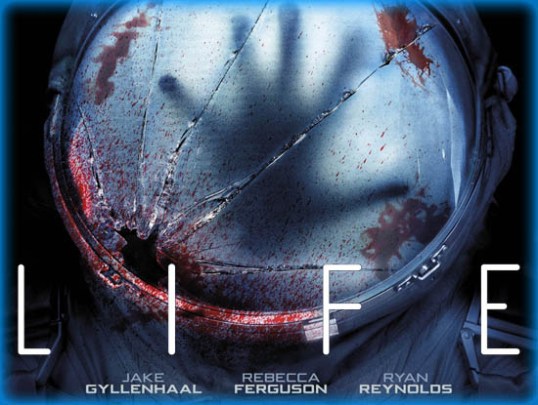
This science fiction film, which came out earlier this year and didn’t stick around in theaters for very long, opens with the crew of the International Space Station taking questions from a group of school children on Earth.  Everyone is really excited because a probe has been picked up evidence that there was once extraterrestrial life on Mars.  Starting from one cell, the scientists have managed to clone an alien organism.  (Or something like that.  Wisely, the movie doesn’t waste too much time on how all of this actually works.)  The school kids name the organism Calvin.

Isn’t that cute?

But here’s the thing.  Life is a science fiction/horror movie hybrid and, as a result, we already know that it was a mistake to bring that alien to life.  We know that almost everyone in that space station is going to die a terrible death.  It doesn’t matter that the scientists are played by people like Jake Gyllenhaal, Ryan Reynolds, and Rebecca Ferguson  We know what is going to happen because we’ve all seen at least one movie in the Alien franchise.  We know what’s going to happen and, when things start to fall apart, the entire audience nods and says, “I told you so.”

That’s not to say that Life doesn’t work.   Life may be predictable but that’s actually a part of the film’s charm.  This is the type of film that you need to watch with a group of your loudest and snarkiest friends.  (I watched it with my sisters during the 4th of July weekend.  We all love Jake.  We all love Ryan.  Things got a bit out of hand.)  You don’t watch Life because you’re looking for an upbeat portrait of space exploration.  You watch Life so that you can yell, “No, don’t bring Calvin to life!  No, you idiot!  Don’t go into space!  Don’t lock yourself in the lab!  HAVEN’T ANY OF YOU SCIENTISTS EVER SEEN A HORROR MOVIE BEFORE!?”

(Indeed, one of the unexpected pleasures of Life was seeing that even brilliant people will do stupid things when confronted by the unknown.)

That said, Life occasionally caught me off guard.  It’s not that I was shocked to see the members of the cast being picked off one by one by Calvin.  Instead, I was shocked by the film’s relentlessly dark and bleak vision.  For a film called Life, it’s ultimately all about death.  Just because a character is being played by a big star, that doesn’t mean they won’t end up with Calvin entering their body and graphically devouring them from the inside out.  Calvin was a truly frightening creation and director Daniel Espinosa does a good job of capturing the claustrophobia and clutter of the space station.  Even if they didn’t exactly break any new ground, Espinosa and screenwriters Rhett Reese and Paul Wernick deserve a lot of credit for pursuing the film to its dark conclusion.  In space, they seem to suggest, there is no hope.

In conclusion, the main lesson of Life seems to be this: outer space is a terrible place and the worst thing that humanity can do is leave the planet.  Science is going to be the death of us.  Neil deGrasse Tyson has a lot to answer for.