Guilty Pleasure No. 114: Death Race (dir. by Paul W.S. Anderson)


Death Race (2008) is the kind of movie that feels like it was engineered in a lab specifically to test how much nonsense an audience will tolerate as long as things explode every ten minutes. Directed by Paul W.S. Anderson, a filmmaker whose entire career seems built on the philosophy of “style over literally anything else,” the film doesn’t so much tell a story as it barrels through one at full speed, flipping off logic, subtlety, and occasionally even coherence along the way. And yet—this is the annoying part—it works. Not in a “this is a good film” sense, but in that grimy, late-night cable, “I probably shouldn’t be enjoying this as much as I am” way.

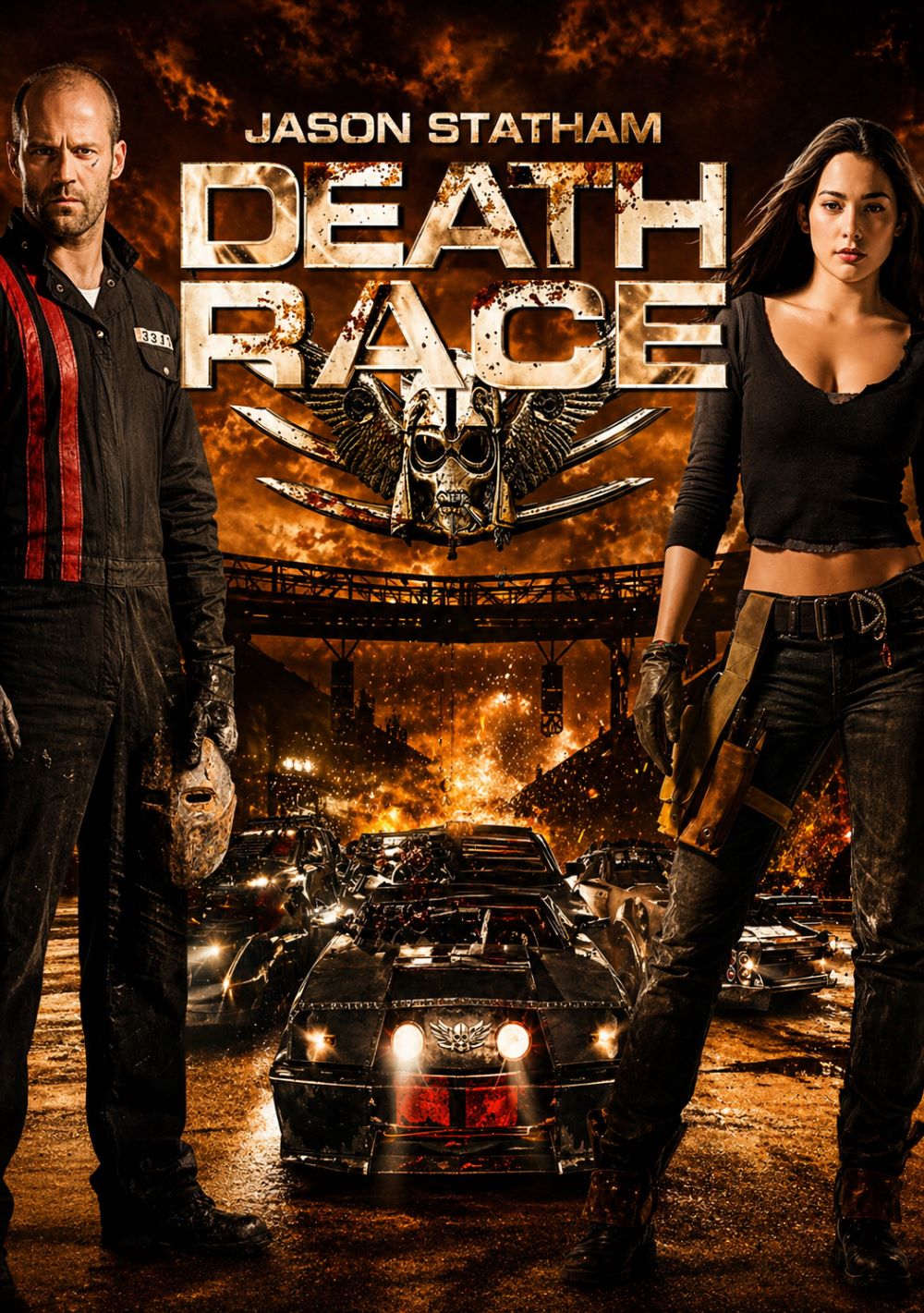
The premise is pure pulp: in a dystopian future where the economy has collapsed (because of course it has), prisons have turned into profit-generating entertainment hubs. The main attraction is the Death Race, a gladiatorial car battle where inmates drive weaponized vehicles and murder each other for the amusement of a bloodthirsty audience. Jason Statham plays Jensen Ames, a wrongfully convicted ex-racer forced to step into the role of a masked legend named Frankenstein. It’s as blunt and ridiculous as it sounds, and the movie never once tries to elevate it beyond that. There’s no pretense of social commentary that isn’t immediately undercut by another machine gun turret popping out of a car hood.

Anderson directs the whole thing like he’s permanently hopped up on energy drinks and early 2000s music video aesthetics. The camera is constantly moving, cutting, shaking, and occasionally losing track of what’s happening entirely. Action scenes are edited within an inch of their life, creating a sense of chaotic momentum that’s exciting in the moment but completely disposable five seconds later. It’s visual junk food—greasy, loud, and weirdly satisfying even when you know it’s terrible for you.

A huge part of why Death Race remains watchable—arguably the biggest reason—is the decision to cast Jason Statham in the lead. This is exactly the kind of role his entire screen persona was built for, and the film leans on that heavily. Statham doesn’t bring depth or complexity, but he brings something more valuable here: credibility. You believe he can survive this world. You believe he can drive, fight, and endure the endless barrage of chaos being thrown at him. In a movie this dumb, that kind of grounding goes a long way. Swap him out for a less naturally commanding actor, and the whole thing probably collapses under its own stupidity.

That’s not to say he’s delivering some kind of nuanced performance. He isn’t. He operates in that familiar Statham mode—minimal dialogue, maximum scowl, and a constant sense that he’s two seconds away from breaking someone’s arm. But that simplicity works in the film’s favor. He becomes the one stable element in an otherwise unhinged movie, a human anchor that keeps the madness from drifting into outright parody. The choice to center the film around him is one of the few decisions here that feels genuinely smart, even if everything surrounding it is chaos.

Then you’ve got Joan Allen, who plays the prison warden with a level of icy commitment that almost tricks you into thinking the movie has something deeper going on. She treats the Death Race like high art, which is both hilarious and oddly effective. There’s a strange tension between her seriousness and the film’s inherent stupidity that gives Death Race a bit more texture than it probably deserves. She’s acting in a better movie that doesn’t exist, and somehow that makes this one more watchable.

But let’s not kid ourselves—this is not a good film. The characters are paper-thin, the dialogue is aggressively functional, and the plot moves forward with the grace of a sledgehammer. Emotional beats land with a dull thud, and any attempt at stakes is drowned out by the next explosion or metal-on-metal collision. It’s the kind of movie where you can predict every major turn five minutes in advance and still not care because you’re too busy watching a car fire a missile at another car.

What makes Death Race oddly compelling, though, is how completely it commits to its own stupidity. There’s no wink to the audience, no self-aware humor trying to soften the edges. It plays everything straight, which paradoxically makes it feel more honest than a lot of “so bad it’s good” movies. It’s not trying to be clever or subversive—it just wants to show you armored cars smashing into each other while people scream and things explode. And on that level, it absolutely delivers.

There’s also something weirdly nostalgic about it. It feels like a relic of a very specific era of action filmmaking, where grit meant desaturated colors, shaky cameras, and protagonists who communicated exclusively through clenched jaws and short sentences. It’s pre-Mad Max: Fury Road, pre-the current wave of more thoughtfully constructed action cinema. Death Race exists in that awkward middle ground where filmmakers had access to bigger budgets and better effects but hadn’t quite figured out how to use them with any real finesse.

And yet, despite all its flaws—or maybe because of them—it’s entertaining. Not in a “this is a masterpiece” way, but in that guilty pleasure sense where you’re fully aware of how dumb it is and still having a good time. It’s a film that succeeds almost accidentally, powered by sheer momentum and a refusal to slow down long enough for you to think too hard about what you’re watching.

In the end, Death Race is a mess. A loud, clunky, overedited mess with delusions of intensity and a complete disregard for nuance. But it’s also a perfect example of a movie that’s entertaining despite itself. It shouldn’t work, and on paper, it really doesn’t. But between the explosions, the ridiculous premise, and—crucially—Statham’s perfectly calibrated presence, it finds a groove and sticks to it. You don’t respect it, you don’t admire it—but you kind of enjoy the hell out of it anyway.

Previous Guilty Pleasures

  1. Half-Baked
  2. Save The Last Dance
  3. Every Rose Has Its Thorns
  4. The Jeremy Kyle Show
  5. Invasion USA
  6. The Golden Child
  7. Final Destination 2
  8. Paparazzi
  9. The Principal
  10. The Substitute
  11. Terror In The Family
  12. Pandorum
  13. Lambada
  14. Fear
  15. Cocktail
  16. Keep Off The Grass
  17. Girls, Girls, Girls
  18. Class
  19. Tart
  20. King Kong vs. Godzilla
  21. Hawk the Slayer
  22. Battle Beyond the Stars
  23. Meridian
  24. Walk of Shame
  25. From Justin To Kelly
  26. Project Greenlight
  27. Sex Decoy: Love Stings
  28. Swimfan
  29. On the Line
  30. Wolfen
  31. Hail Caesar!
  32. It’s So Cold In The D
  33. In the Mix
  34. Healed By Grace
  35. Valley of the Dolls
  36. The Legend of Billie Jean
  37. Death Wish
  38. Shipping Wars
  39. Ghost Whisperer
  40. Parking Wars
  41. The Dead Are After Me
  42. Harper’s Island
  43. The Resurrection of Gavin Stone
  44. Paranormal State
  45. Utopia
  46. Bar Rescue
  47. The Powers of Matthew Star
  48. Spiker
  49. Heavenly Bodies
  50. Maid in Manhattan
  51. Rage and Honor
  52. Saved By The Bell 3. 21 “No Hope With Dope”
  53. Happy Gilmore
  54. Solarbabies
  55. The Dawn of Correction
  56. Once You Understand
  57. The Voyeurs 
  58. Robot Jox
  59. Teen Wolf
  60. The Running Man
  61. Double Dragon
  62. Backtrack
  63. Julie and Jack
  64. Karate Warrior
  65. Invaders From Mars
  66. Cloverfield
  67. Aerobicide 
  68. Blood Harvest
  69. Shocking Dark
  70. Face The Truth
  71. Submerged
  72. The Canyons
  73. Days of Thunder
  74. Van Helsing
  75. The Night Comes for Us
  76. Code of Silence
  77. Captain Ron
  78. Armageddon
  79. Kate’s Secret
  80. Point Break
  81. The Replacements
  82. The Shadow
  83. Meteor
  84. Last Action Hero
  85. Attack of the Killer Tomatoes
  86. The Horror at 37,000 Feet
  87. The ‘Burbs
  88. Lifeforce
  89. Highschool of the Dead
  90. Ice Station Zebra
  91. No One Lives
  92. Brewster’s Millions
  93. Porky’s
  94. Revenge of the Nerds
  95. The Delta Force
  96. The Hidden
  97. Roller Boogie
  98. Raw Deal
  99. Death Merchant Series
  100. Ski Patrol
  101. The Executioner Series
  102. The Destroyer Series
  103. Private Teacher
  104. The Parker Series
  105. Ramba
  106. The Troubles of Janice
  107. Ironwood
  108. Interspecies Reviewers
  109. SST — Death Flight
  110. Undercover Brother
  111. Out for Justice
  112. Food Wars!
  113. Cherry

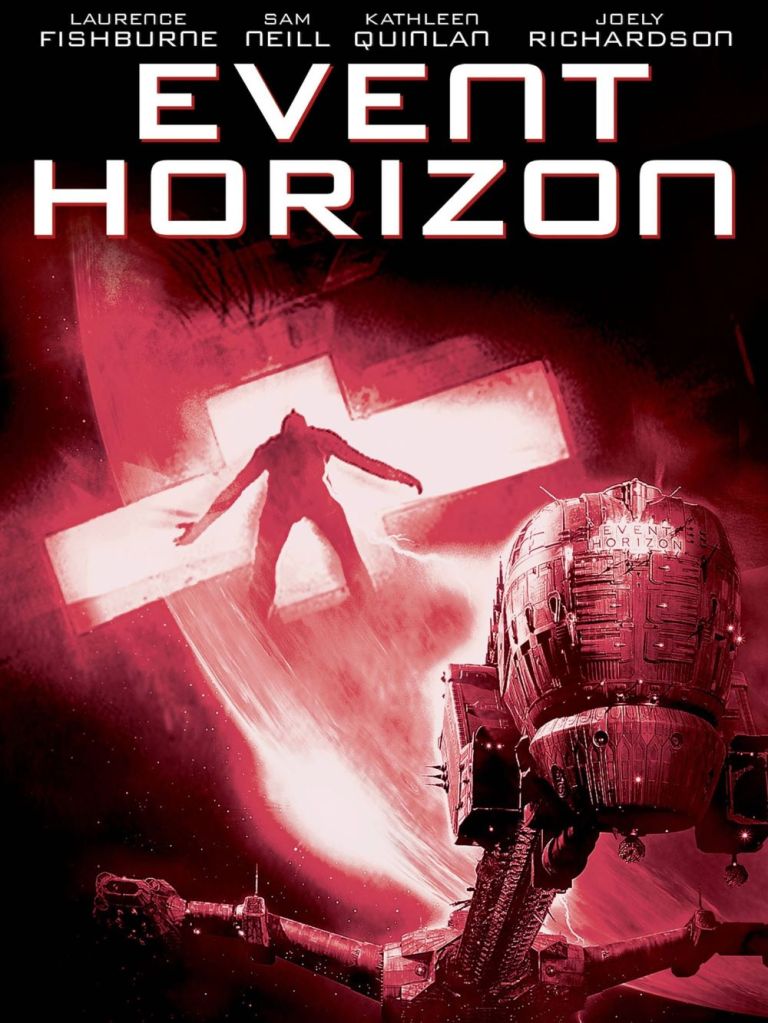
Horror Review: Event Horizon (dir. by Paul W. S. Anderson)


“You know nothing. Hell is only a word. The reality is much, much worse.” — Dr. Weir

Paul W.S. Anderson’s 1997 film Event Horizon stands out as a memorable mix of science fiction and horror, remembered for its gripping atmosphere and disturbing visuals. The story is set in 2047: a rescue crew aboard the Lewis and Clark is sent out to recover the long-missing spaceship Event Horizon, a vessel built to test a new kind of faster-than-light travel. Onboard with them is Dr. William Weir, the Event Horizon’s creator, who explains that the ship vanished after first activating its “gravity drive,” which can fold space to allow for instant travel across vast cosmic distances.

Soon after reaching the drifting Event Horizon, the crew discovers signs of mass violence and horror. They recover a disturbing audio message and realize something traumatic happened to the original crew. As they search for survivors, they experience intense and personal hallucinations—memories and fears brought to life by the ship. It becomes clear that the Event Horizon didn’t just jump through space; it traveled to a place outside reality, a nightmarish interdimensional realm resembling hell.

What makes Event Horizon particularly unique is its concept of hell as an alternate dimension that can infect and corrupt whatever or whoever crosses into it. The ship’s gravity drive doesn’t simply facilitate faster travel—it accidentally opens a gateway to this chaotic, malevolent place. This portrayal of hell as a dangerous interdimensional reality that preys on minds and bodies echoes the idea found in the massive gaming property Warhammer 40K, where hell is depicted as the Warp, a dimension of chaos that corrupts and drives people insane. Like the Warp, the film’s hell is an unpredictable, hostile realm where sanity and physical form break down, infecting and warping everything that comes into contact.

Visually, the film relies on claustrophobic corridors, flickering lights, and unsettling sounds to keep the audience off-balance. The design of the ship itself—part gothic cathedral, part industrial nightmare—adds to the sense of unease and dread throughout. The use of practical effects and detailed sets grounds the sci-fi terror in something tangible, making it all feel more immediate and believable.

Event Horizon also hints at bigger philosophical questions: how far should science go, and what happens when the drive for knowledge is unchecked by ethics or humility? The gravity drive is a technological wonder, but it’s treated with little caution by its inventor, and the catastrophic results suggest that some discoveries may be better left unexplored. The ship becomes both a literal and figurative vehicle for exploring the limits of human ambition and the dangers of pushing beyond them.

As the movie builds toward its climax, the rescue crew faces increasingly desperate odds. The possessed Dr. Weir, now an outright villain, sees the hellish dimension the gravity drive visited as the next step for humanity—a place of chaos and suffering. Multiple characters die in gruesome ways, and the survivors have to fight their own fears and the haunted ship itself. The ending is chilling and ambiguous, leaving open the possibility that the ship’s evil has not been fully contained.

At release, Event Horizon divided critics and audiences. Some found the violence and nightmare imagery too intense or the story too messy to follow. Others praised its ambition and the way it blends psychological horror with cosmic sci-fi. Over the years, the film has developed a cult reputation, frequently cited as one of the more effective and original space horror movies. Its legacy can be seen in later media, especially in video games that tackle similar haunted spaceship scenarios.

However, the film is not without flaws. Many viewers and critics point out uneven pacing, especially in the second half where tension sometimes drains away. The characters often act inconsistently or make choices that feel unrealistic for trained astronauts, which undermines the suspense. The script’s tonal shifts—from serious psychological drama to moments that unintentionally verge on camp—can jolt the viewer out of the experience. The use of jump scares is sometimes predictable, and the film’s heavy reliance on loud, chaotic sequences instead of quiet suspense can feel overwhelming. Some CGI effects haven’t aged well, contrasting with the otherwise impressive practical effects and set design. Acting performances are mixed too; while Sam Neill and Laurence Fishburne are strong, some supporting cast members lack conviction, making emotional engagement uneven.

Importantly, Event Horizon represents Paul W.S. Anderson at his most subtle and effective in directing. Compared to many of his later films, where his style often becomes frenetic and unchecked—possibly due to a lack of producer control—Event Horizon is more controlled, atmospheric, and haunting. This balance between style and substance makes it one of Anderson’s better directorial works, if not his best to date. The film showcases his interest in spatial geography, the use of negative space, and claustrophobic production design, all elements he would expand on in his later work but never as effectively deployed as here. The haunting visual touches, combined with his ability to direct actors and maintain tension, set Event Horizon apart from his more bombastic, less focused later entries.

Despite its flaws, Event Horizon remains gripping and memorable. Its strengths lie in combining deeply personal psychological horror with the vast, terrifying unknown of space and alternate realities. The film explores not just external threats, but also how guilt, fear, and trauma can be weaponized by forces beyond human understanding. For viewers seeking more than a standard haunted spaceship story, Event Horizon offers a disturbing, thought-provoking glimpse into the dark frontier of science, faith, and madness. It stands as a cult classic of sci-fi horror that continues to inspire discussion about the dangers of pushing too far into the unknown.

Guilty Pleasure No. 12: Pandorum (dir. Christian Alvart)


pandorum_posterSometimes a really bad film just does enough to push my buttons to actually make me like it. One such film was 2009’s scifi=thriller Pandorum.

The film was one of those that had some hype behind it prior to the film’s release. It had a nice marketing angle which included some very disturbing biomechanical imagery that harkened back to classic H.R. Giger artwork from both Alien and Dune. The film even had an interesting premise which was about a mental affliction caused by long exposure to space travel called “Pandorum”.

When the film finally came out to say that it bombed would be quite an understatement. While the ideas behind the film were interesting enough the overall execution of said ideas were haphazard at best and unimaginative at it’s worst. There’s nothing worst than a B-movie trying to stand out from the dregs and failing because it’s dull and boring. Yet, despite all that I’ve been fascinated by Pandorum ever since I’ve caught it on video.

German director Christian Alvart might be lacking some style in his direction of the film, but the cast itself manages to work their damnedest to make the film work. Ben Foster does his usual twitching performance where we don’t know if he’s about to go psycho on everyone around him or just curl up in the corner and start sobbing like a newborn. Dennis Quaid chews the scenery so much in every scene he’s in that his work in the film almost comes off as performance art.

Even the idea that people who were gentically-enhanced to adapt and evolve to their surroundings was a new one. The film even goes further by making the foundation of rapid evolution come from the ship itself. All the cannibalism involved just added that grindhouse touch to the proceedings.

The one thing that really brings me back to watching this film as one of my many guilty pleasure’s was this was the first film that introduced the world to Antje Traue. She’s better known as one of the few good things to come out of Man of Steel. Even in this first feature film for Antje Traue we already see examples of how much a badass she can be. It’s a shame that the film around her wasn’t better.

Pandorum never improves with each repeat viewing, but it doesn’t get worst either. It just straddles that fine line where one or two things changed for the better would’ve made it a good film. But for the life of me I have no idea why I like it and continue to watch it. Sometimes even bad films will push enough of the requisite buttons for people to like it and this film certainly pushed the right ones from me.

Trailer: Resident Evil: Retribution


The Resident Evil film franchise seems to be the franchise that just keeps on going and going. Like the undead which forms the bulk of the danger to the characters in the film, this film series just won’t die. It’s success has both confounded critics and audiences alike. It’s turned Milla Jovovich into an action star whether we like it or not. It’s also a series that despite some major flaws continues because it makes it’s studios money.

We now have the first teaser trailer for the 5th film in the series, Resident Evil: Retribution, and just like the 4th film in the series it will be in 3D. It will also have several characters from past films who we saw die make appearances in the film. Whether they come back as themselves in the film’s present storyline or in flashbacks has yet to be determined. The trailer itself looks like a major advert for Sony smartphones, PS Vita and tablet products. In fact, I’d say that almost 40% of this teaser is all about pushing Sony products.

If that’s the case then this trailer does teach me one thing: Sony products will lead to a global zombie apocalypse. I think this event would never happen if people bought iPhones and iPads.

Resident Evil: Retribution is set for a September 14, 2012 release date.