Could Black Panther be the first comic book movie to receive an Oscar nomination?
Last year, around this time, we were asking the exact same question about Logan. Logan didn’t pick up a Best Picture nomination but it was nominated for Best Adapted Screenplay, which would seem to suggest that the Academy is slowly coming around to accepting that so-called “Super Hero Films” can also be legitimate Oscar contenders.
As for Black Panther, it is currently the most critically acclaimed and financially successful film of 2018. For those who say that there’s no way the Academy will ever nominate a comic book film for best picture, it should be remembered that there was a time when people said that Academy would never nominate a horror comedy for Best Picture. Much like Get Out, Black Panther could prove the naysayers wrong.
Anyway, here are my Oscar predictions for February. As always, it ‘s really way too early to be making these predictions. Usually, Sundance provides at least a little bit of a guide but this year, Sundance was pretty low-key. The most obvious Sundance Oscar contender — Burden — doesn’t even have a release date yet.
Also, the uncertain status of The Weinstein Company has thrown a lot of films into limbo. Some of the unreleased TWC films might find homes with other studios. Others will probably be left in limbo. Then again, even if those films do get a release, I doubt the Academy is going to nominate any films stained with the noxious fingerprints of the Weinsteins.
Even more than usual, the guesses below are random. At this time next year, we’ll probably look at this list and laugh. Some of you might laugh today.
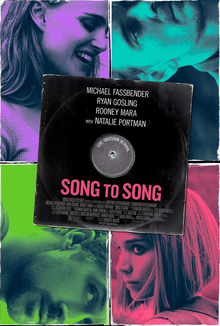
You’re watching a movie called Song to Song. It’s about beautiful people in a beautiful city.
In this case, the city is Austin, Texas. The people are all involved in the Austin music scene and they’re played by actors like Ryan Gosling, Rooney Mara, Natalie Portman, Michael Fassbender, and Cate Blanchett. A good deal of Song to Song was filmed at the Austin City Limits festival and several real-life musicians appear as themselves, though only Patti Smith is on screen long enough to make much of an impression. To be honest, both the music and Austin are almost incidental to the film. Though the movie was sold as an Austin film and it premiered at SXSW, it could have just as easily taken place in Ft. Worth.
The film is made up of short, deliberately obscure shots. The camera never stops moving, floating over images of sunsets, sunrises, and oddly empty streets. Because the film was shot with a wide-angle lens, you’re never not aware of the expanse around the characters. At times, all of those beautiful film stars run the risk of become specks on the landscape, as if the film itself is taunting the characters for thinking that they are more important than nature.
Who are the characters? It’s not always easy to say. There are plenty of voice overs but it’s rare that anyone directly states what they’re thinking or who they are. When the characters speak to each other, they mumble. The dialogue is a mix of the banal and the portentous, a sure sign of a film that was largely shot without a script. Eventually, you turn on the captioning so that you can at least understand what everyone’s muttering.
Michael Fassbender plays Cook. Cook appears to be a music producer but he could just as easily be a businessman who enjoys hanging out with and manipulating aspiring stars. People seem to know him but nobody seems to be particularly impressed by him. Cook spends a lot of time standing in front of a pool. Is it his pool? Is it his house? It’s hard to say. Cook is obsessed with control or maybe he isn’t. Halfway through the film, Fassbender appears to turn into his character from Shame.
Ryan Gosling is BV. BV appears to be a lyricist, though it’s never made clear what type of songs that he writes. At one point, you think someone said that he had written a country song but you may have misheard. BV appears to have an estranged relationship with his dying father. BV may be a romantic or he may not. He seems to fall in love easily but he spends just as much time staring at the sky soulfully and suggesting that he has a hard time with commitment. BV appears to be Cook’s best friend but sometimes, he isn’t. There’s a random scene where BV accuses Cook of cheating him. It’s never brought up again.
Rooney Mara is Faye. Faye contributes most of the voice overs and yet, oddly, you’re never sure who exactly she is. She appears to be BV’s girlfriend and sometimes, she appears to be Cook’s girlfriend. Sometimes, she’s in love and then, just as abruptly, she’s not. She may be a singer or she may be a songwriter. At one point, she appears to be interviewing Patty Smith so maybe she’s a music journalist. The film is centered around her but it never makes clear who she is.
Natalie Portman is Rhonda. Rhonda was a teacher but now she’s a waitress. She might be religious or she might not. She might be married to Cook or she might not. Her mother (Holly Hunter) might be dying or she might not.
And there are other beautful people as well. Cate Blanchett plays a character named Amanda. Amanda has a relationship with one of the characters and then vanishes after four scenes. There’s an intriguing sadness to Blanchett’s performance. Since the first cut of Song to Song was 8 hours long, you can assume her backstory was left on the cutting room floor. (And yet strangely, it works that we never know much about who Amanda is.) Lykke Li shows up, presumably playing herself but maybe not. Berenice Marlohe and Val Kilmer also have small roles, wandering in and out of the character’s lives.
There’s a lot of wandering in this movie. The characters wander through their life, stopping only to kiss each other, caress each other, and occasionally stare soulfully into the distance. The camera seems to wander from scene to scene, stopping to occasionally focus on random details. Even the film’s timeline seems to wander, as you find yourself looking at Rooney Mara’s forever changing hair and using it as a roadmap in your attempt to understand the film’s story.
“I went through a period when I thought sex had to be violent,” Rooney Mara’s voice over breathlessly explains, “We thought we could just roll and tumble, live from song to song, kiss to kiss.”
As you watch Song to Song, you find yourself both intrigued and annoyed. This is a Terrence Malick film, after all. You love movies so, of course, you love Malick. Even if his recent films have been flawed and self-indulgent, he is a true original. You want to support him because he’s an artist but, as you watch Song to Song, the emphasis really does seem to be on self-indulgence. The images are beautiful but the characters are so empty and the voice overs are so incredibly pretentious. Should you be mad or should you be thankful that, in this time of cinematic blandness, there’s a director still willing to follow his own vision?
At times, Song to Song is brilliant. There are images in Song to Song that are as beautiful as any that Malick has ever captured. Sometimes, both the images and the characters are almost too beautiful. The music business is tough and dirty but all of the images in Song to Song are clean and vibrant.
At times, Song to Song is incredibly annoying. It’s hard not to suspect that the film would have worked better if Natalie Portman and Rooney Mara had switched roles. Mara can be an outstanding actress with the right director (just check out her performance in Carol) but, in Song to Song, her natural blandness makes it difficult to take her seriously as whoever she’s supposed to be. Portman has much less screen time and yet creates an unforgettable character. Mara is in 75% of the film and yet never seems like an active participant.
At times, the film is annoyingly brilliant. Malick’s self-indulgence can drive you mad while still leaving you impressed by his commitment to his vision.
And then, other times, the film is brilliantly annoying. Many directors have mixed overly pretty images with pretentious voice overs but few do so with the panache of Terrence Malick.
Even fans of Terrence Malick, of which I certainly am one, will probably find Song to Song to be his weakest film. Even compared to films like To The Wonder and Knight of Cups, Song to Song is a slow movie and there are moments that come dangerously close to self-parody. Unlike Tree of Life, where everything eventually came together in enigmatic poignance, Song to Song often feels like less than the sum of its parts. And yet, I can’t totally dismiss anything made by Terrence Malick. Song to Song may be empty but it’s oh so pretty.
Okay, so I’ll admit that I’m really excited about the trailer for Lady Bloodfight.
But, just from glancing at twitter, it appears that most of y’all are more excited about two other trailers that dropped today!
It’s kind of a tradition to complain that the Thor movies are the weakest part of the MCU. Of course, I would never say that because … well, you know. Chris Hemsworth and Tom Hiddleston. I mean, c’mon!
But anyway, there always has been kind of an inherent silliness to Thor and that silliness certainly seems to be present in the first trailer for Thor: Ragnarok.
Silliness, thy name is Jeff Goldblum.
Also, it appears that only Cate Blanchett can destroy Thor’s hammer. Well, that kinda makes sense. Cate Blanchett can do anything.
(I just like the music. Hey, Arleigh, is that Led Zeppelin?)
And then there’s this fun new teaser for Guardians of the Galaxy Vol. 2! Have I mentioned how much I’m looking forward to this movie?
(Hmmm….Chris Evans, Chris Pratt, Chris Hemsworth, there’s a lot of Chris in the MCU. But where’s Christopher Walken?)
What’s an Insomnia File? You know how some times you just can’t get any sleep and, at about three in the morning, you’ll find yourself watching whatever you can find on cable? This feature is all about those insomnia-inspired discoveries!
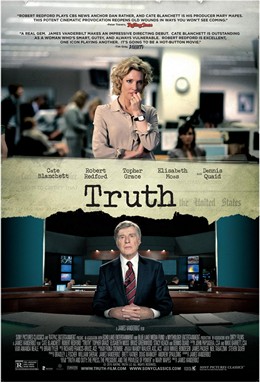
If, last night, you found yourself awake at three in the morning, you could have turned over to Starz and watched the 2015 film, Truth.
I can’t say for sure whether or not Truth would have put you to sleep. It kept me awake, largely because I was in a state of shock that any movie could be as bad as what I was watching. Without running the risk of hyperbole, I can say that Truth is one of the worst fucking movies that I’ve ever seen in my entire life. It’s not just that the film is poorly scripted, inconsistently acted, and directed in the most heavy-handed way possible. No, the problems with Truth went far beyond mere execution. Truth is a film with an agenda, one that I kind of agree with, but it’s such a total misfire that it ends up doing more damage to its cause than good. Truth is meant to be a defense of the much maligned mainstream media but it’s so poorly put together that it’s easy to imagine it being one of Donald Trump’s guilty pleasures. Remember how all of us musical theater nerds used to hatewatch Smash? I imagine that the White House staff does the same thing with Truth.
Truth is ostensibly based on a true story. In 2004, veteran anchorman Dan Rather (played by Robert Redford) reported a story that then-President George W. Bush got preferential treatment while he was serving in the Air National Guard. This story was considered to be especially big because 1) the Iraq War was deeply unpopular, 2) Bush was in a tight race for reelection, 3) his opponent, John F. Kerry, didn’t have much to offer beyond having served in Vietnam, and 4) questions were being raised about what Kerry actually did in Vietnam.
One of the most important pieces of evidence in Rather’s story were four memos that had been provided by a retired Lieutenant Colonel from the Air National Guard, a veteran Bush-hater named Bill Burkett (played, in the film, by Stacy Keach). Shortly after the story aired, conservative bloggers claimed that the memos were obvious forgeries. After spending weeks defending the story and haughtily dismissing anyone who didn’t collect an eight-figure paycheck from CBS, Rather admitted on air that the authenticity of the memos could not be verified. In the wake of the scandal, Rather’s longtime producer, Mary Mapes (Cate Blanchett), was fired. Rather retired a year earlier than expected and went on to become one of those reliably dull commentators who occasionally emerges to complain about how the world hasn’t been the same since Adlai Stevenson died. Mapes later wrote a book, which argued that 1) the memos were authentic and 2) it didn’t actually matter whether they were authentic, even though they like so totally were.
With all the current talk about fake news and whether both the media and Hollywood exist in a bubble, Truth is a film that should be especially relevant but, as previously stated, it’s so clumsy and heavy-handed that it actually does more harm than good. About halfway through the film, there’s a hilarious scene in which literally the entire country is shown watching 60 Minutes with awe-struck expression on their face. Children are watching. Customers in a bar are watching. The cooking staff in the kitchen pauses in their work to watch the report. Heroic music rises on the soundtrack. This scene, with all of its self-important grandeur, pretty much sums up everything that’s wrong with Truth. It’s one thing to argue that the news media does, should, and must play an important role in American life. It’s another thing to make your argument by constructing a fantasy world where the entire country plots their lives around watching 60 Minutes. But that’s the way Vanderbilt directs the entire film. He’s so high on the fumes of his good intentions that he doesn’t realize his film basically comes across like a parody of those intentions.
Especially in the second half of the film, there’s a lot of speeches about why journalism is important. And those speeches may actually make a great point but the problem is that none of them convince us that Mary Mapes and Dan Rather didn’t get fooled by some painfully obvious forgeries. In its laudable effort to defend journalism, Truth makes the mistake of excusing shoddy journalism. When, towards the end of the film, Mapes exclaims that the memos were only a minor part of the overall story and not necessary to prove that Bush got preferential treatment, you want someone to ask her, “If you could prove the story without them, then why did you include these unverifiable documents in the first place, especially considering that they were received from a questionable source?” But nobody does because none of the film’s saintly characters have been written or portrayed with the nuance necessary to be able to survive a question like that. Truth‘s problem is that it wants to have it both ways. “It doesn’t matter that this story was based on obviously fake documents,” Truth says, “And, because Mary Mapes and Dan Rather were sent by God to tell the truth, the obviously fake documents were completely real.”
And then there’s the film’s performers. Stacy Keach is great as Burkitt and his eccentric performance suggests the film that Truth could have been if it wasn’t so concerned with trying to portray its lead characters as saints. But then there’s Robert Redford, whose portrayal of Dan Rather has all the nuance and personality of a wax figure. (Redford wears suspenders. That’s the extent of his performance.) As Mary Mapes, Cate Blanchett is totally wasted. She doesn’t really have a character to play, beyond her male director’s conception of what a professional woman is supposed to be like. (She also has a traumatic back story of abuse, which the film trots out in such a klutzy manner that it’s actually incredibly insulting to real-life abuse victims.) Dennis Quaid, Topher Grace, and Elisabeth Moss all show up as members of Mapes’s team. Quaid is playing a military man so he gets to salute in slow motion. Grace is playing a hipster with a beard so he gets this embarrassing scene where he rants about how he’s being targeted not because of sloppy reporting but because of a corporate conspiracy. (This was obviously meant to be a huge applause moment but, like a lot of the movie, it doesn’t explain how the progressive cause is helped by shoddy journalism.) Moss doesn’t get to do anything, other than sit in the background. To waste a cast of this quality is a crime.
So why did this mostly terrible film get respectful reviews? Why did Sasha Stone and Jeff Wells insist that Truth was destined to be an Oscar contender? Call it confirmation bias. Truth plays to mainstream liberals (which includes the majority of film reviewers) in much the same way that God’s Not Dead 2 plays to Christians. But just because you agree with a film’s ideology, that doesn’t make it an example of good filmmaking. While artistic films are often political, it’s rare that political films are ever art. If every anti-Bush film was an artistic masterpiece, we would be living in a cinematic golden age.
Here’s the thing. We live in a time when the media is under attack and being used a convenient scapegoat for every bad thing in America. Donald Trump largely won in 2016 by portraying the media as being biased and that’s a charge that will undoubtedly be repeated many times over the next four years. A heavy-handed mess like Truth doesn’t help anything.
I am so happy that Mad Max, Brooklyn, and Room were nominated but considering how many great films were released in 2015, it’s hard not to be disappointed with the nominees for Best Picture. No Carol. No Ex Machina. No Sicarioor Inside Out. No Straight Out Of Compton, Creed, or Beasts of No Nation. Is The Martian the only best picture winner to even have more than one African-American prominently featured in the cast? 10 years from now, when people can see past the politics and concentrate on the filmmaking, The Big Short will be recognized as one of the worst best picture nominees of all time.
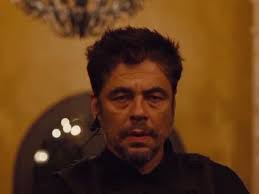
As for other snubs, I am so sad to see that Kristen Stewart and Benicio Del Toro were not nominated in the supporting races. For that matter, Rooney was the lead in Carol and that’s where she should have been nominated. It’s also interesting to note that Mark Ruffalo was nominated for giving the worst performance in Spotlight.
I know that Spotlight is the official front runner but, looking at the nominations, I wouldn’t be surprised to see The Revenant win. Or maybe even (bleh!) The Big Short.
Best Actor
Bryan Cranston, “Trumbo”
Matt Damon, “The Martian”
Leonardo DiCaprio, “The Revenant”
Michael Fassbender, “Steve Jobs”
Eddie Redmayne, “The Danish Girl”
Best Actress
Cate Blanchett, “Carol”
Brie Larson, “Room”
Jennifer Lawrence, “Joy”
Charlotte Rampling, “45 Years”
Saoirse Ronan, “Brooklyn”
Best Song “Fifty Shades of Grey” – “Earned It”
“The Hunting Ground” – “Til it Happens to You”
“Racing Extinction” – “Manta Ray” “Spectre” – “Writing’s on the Wall”
“Youth” – “Simple Song #3”
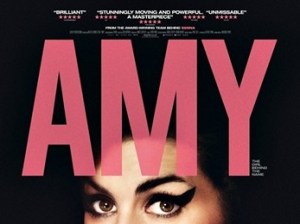
Best Documentary Feature “Amy”
“Cartel Land”
“The Look of Silence”
“What Happened, Miss Simone?”
“Winter on Fire: Ukraine’s Fight for Freedom”
Best Foreign Language Film
“Embrace of the Serpent”
“Mustang”
“Son of Saul”
“Theeb”
“A War”
Best Animated Short
“Bear Story”
“Prologue”
“Sanjay’s Super Team”
“We Can’t Live without Cosmos”
“World of Tomorrow”
Best Documentary Short
“Body Team 12”
“Chau, Beyond the Lines”
“Claude Lanzmann: Spectres of the Shoah”
“A Girl in the River: The Price of Forgiveness”
“Last Day of Freedom”
Best Live Action Short
“Ave Maria”
“Day One”
“Everything Will Be Okay (Alles Wird Gut)”
“Shok”
“Stutterer”
With the Oscar nominations due to be announced tomorrow, now is the time that the Shattered Lens indulges in a little something called, “What if Lisa had all the power.” Listed below are my personal Oscar nominations. Please note that these are not the films that I necessarily think will be nominated. The fact of the matter is that the many of them will not. Instead, these are the films that would be nominated if I was solely responsible for deciding the nominees this year. Winners are starred and listed in bold.
(You’ll also note that I’ve added four categories, all of which I believe the Academy should adopt — Best Voice-Over Performance, Best Casting, Best Stunt Work, and Best Overall Use Of Music In A Film.)
(Click on the links to see my nominations for 2014, 2013, 2012, 2011, and 2010!)
Best Actress
Katharine Isabelle in 88
Brie Larson in Room
Rooney Mara in Carol
Saoirse Ronan in Brooklyn
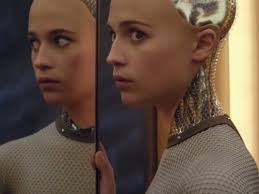
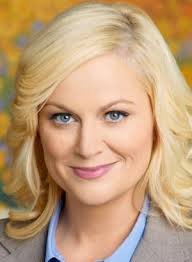
Amy Schumer in Trainwreck *Alicia Vikander in Ex Machina*
The Dorian Awards are handed out by the Gay and Lesbian Entertainment Film Critics Association. Here are their film nominations for 2015.
FILM OF THE YEAR
The Big Short / Paramount, Regency Brooklyn / Fox Searchlight Carol / The Weinstein Company Mad Max: Fury Road / Warner Bros., Village Road Show Spotlight / Open Road, Participant, First Look
DIRECTOR OF THE YEAR
(Film or Television)
Sean Baker, Tangerine / Magnolia Pictures
Todd Haynes, Carol / The Weinstein Company
Alejandro Gonzalez Iñárritu, The Revenant / Fox
Tom McCarthy, Spotlight / Open Road, Participant, First Look
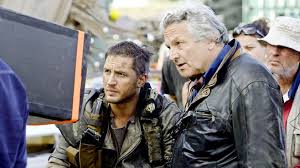
George Miller, Mad Max: Fury Road / Warner Bros., Village Road Show
PERFORMANCE OF THE YEAR — ACTRESS
Cate Blanchett, Carol / The Weinstein Company
Brie Larson, Room / A24
Rooney Mara, Carol / The Weinstein Company
Charlotte Rampling, 45 Years / Sundance Selects
Saoirse Ronan, Brooklyn / Fox Searchlight
PERFORMANCE OF THE YEAR — ACTOR
Matt Damon, The Martian / Fox
Leonardo DiCaprio, The Revenant / Fox
Michael Fassbender, Steve Jobs / Universal
Tom Hardy, Legend / Universal, Cross Creek
Eddie Redmayne, The Danish Girl / Focus, Working Title
LGBTQ FILM OF THE YEAR Carol / The Weinstein Company
The Danish Girl / Focus, Working Title
Freeheld / Summit
Grandma / Sony Pictures Classics
Tangerine / Magnolia Pictures
FOREIGN LANGUAGE FILM OF THE YEAR
The Assassin / Central Motion Pictures, Well Go USA
Mustang / Cohen Media Group
Phoenix / Sundance Selects
Son of Saul / Sony Pictures Classics
Viva / Magnolia Pictures
SCREENPLAY OF THE YEAR
Emma Donoghue, Room / A24
Phyllis Nagy, Carol / The Weinstein Company
Charles Randolph and Adam McKay, The Big Short / Paramount, Regency
Josh Singer & Tom McCarthy, Spotlight / Open Road, Participant, First Look
Aaron Sorkin, Steve Jobs / Universal
DOCUMENTARY OF THE YEAR
(theatrical release, TV airing or DVD release) Amy / A24
Best of Enemies / Magnolia Pictures, Magnet Going Clear: Scientology and the Prison of Belief / HBO
Making a Murderer / Netflix
What Happened, Miss Simone? / Netflix
VISUALLY STRIKING FILM OF THE YEAR
(honoring a production of stunning beauty, from art direction to cinematography) Carol / The Weinstein Company
The Danish Girl / Focus, Working Title Mad Max: Fury Road / Warner Bros., Village Road Show The Martian / Fox The Revenant / Fox
UNSUNG FILM OF THE YEAR
The Diary of a Teenage Girl / Sony Pictures Classics Ex Machina / A24
Grandma / Sony Pictures Classics
Me and Earl and the Dying Girl / Fox Searchlight
Tangerine (Magnolia)
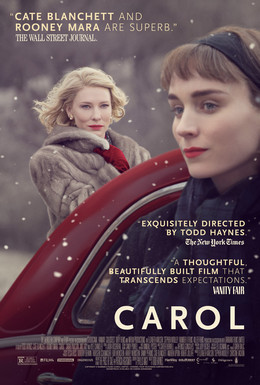
I say that without a hint of hesitation or doubt. 2015 was a wonderful year for movies and I would say that there were at least 20 film released that I would call great. And, out of those 20, Carol is the best.
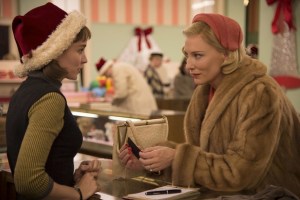
Carol opens in 1952. Therese Belivet (Rooney Mara) is young, lonely, and living in New York City. She’s an aspiring photographer who can’t afford a decent camera, a secret bohemian living in a world where morality and culture are defined by the bourgeoisie. She has a boyfriend named Richard (Jake Lacey) and he’s eager to marry her and move to France but, try as she might, Therese simply cannot bring herself to feel the same way about him that he feels about her. Though she lives with him, she refuses to have sex with him. At one point, she asks him if he’s ever heard of men being attracted to other men and she asks if he thinks the same can be true of women. Richard says sure, before adding that it’s always the result of “something wrong” psychologically.
It’s Christmas. Therese gets a temporary job, working at a department store in Manhattan. From the moment we see Therese surrounded by the Christmas crowds, we realize that she feels totally out-of-place among the rest of the world. She is withdrawn and quiet and rarely looks anyone in the eye. That is until she meets Carol (Cate Blanchett).
Carol is searching for a gift for her daughter and accidentally leaves her gloves behind at the store. When Therese arranges for the gloves to be returned to Carol, Carol thanks her by taking her out to lunch. Soon, Carol is inviting Therese to spend Christmas at her house in New Jersey and a jealous Richard is complaining that Therese has a “crush” on the older woman.
Carol is going through a difficult divorce. Her alcoholic husband, Harge (Kyle Chandler), is demanding full custody of their children. Harge knows that years ago, Carol had a brief affair with her best friend, Abby (Sarah Paulson), and he can’t handle it. When he stops by, drunk and belligerent, on Christmas, he discovers Therese visiting Carol and he freaks out even more.
(With all the attention being paid to the exquisite performances of Blanchett and Mara, now would be good place to mention that Kyle Chandler does a great job playing a loathsome character. With his performance here and his role in The Spectacular Now, Chandler has cornered the market on playing abusive alcoholics.)
For New Year’s, Carol and Therese go on a trip and they finally consummate their relationship (in Iowa, of all places). But what they don’t know is that Harge has hired men to follow them and to get proof of their relationship. If Carol wants to see her daughter again, she knows that it means seeing a psychotherapist for help with her “problem” and never seeing Therese again…
Carol is an amazing and beautiful film, a portrait of both forbidden love and the struggle to survive in a society that demands total and complete conformity. In many scenes, director Todd Haynes pays homage to the masters of 50s melodrama, filmmakers like Mark Robson, Douglas Sirk and Nicholas Ray. The film’s lushly vibrant colors and attention to detail feels reminiscent of the films that Sirk made for MGM, with Cate Blanchett often made up to resemble Lana Turner. Meanwhile, Rooney Mara often resembles Natalie Wood from Rebel Without A Cause. One shot in particular, with the shadows of a window bar falling across Blanchett’s face like the bars of a prison cell, immediately brought to mind the end of Ray’s Bigger Than Life.
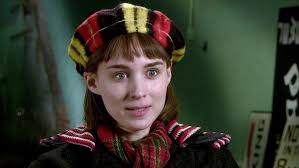
For the longest time, I have complained about Rooney Mara’s performance in David Fincher’s rehash of The Girl With The Dragon Tattoo. Well, I’m prepared to stop complaining because Mara is brilliant in Carol. Her blossoming as an actress mirrors Therese’s blossoming as a woman. Rooney Mara is being promoted for best supporting actress but make no mistake. There’s nothing “supporting” about Rooney Mara’s performance. Carol is all about Therese and it works because of Mara’s wonderful performance.
Regardless of what may or may not happen with the Oscar nominations on Thursday, Carol is the best film of 2015. It’s a film that we will still be talking about decades from now.
The Seattle Film Critics Survey announced their nominees for the best of 2015 earlier today and I have to say, their nominations are pretty interesting! (Also interesting to note is that they did not nominate Oscar front runner Spotlight.) Way to go, Seattle!

















 Through the Shattered Lens