Embracing the Melodrama Part II #93: Boogie Nights (dir by Paul Thomas Anderson)


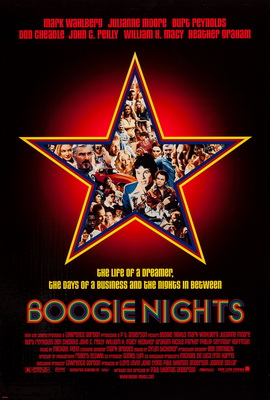
Boogie_nights_ver1The 1997 film Boogie Nights (which, amazingly enough, was not nominated for best picture) is a bit of an overwhelming film to review.  It’s a great film and, if you’re reading this review, you’ve probably seen Boogie Nights and you probably already know that it’s a great film.  And if you haven’t seen Boogie Nights, you really should because it’s a great film.  So, this review, in short, amounts to: Great film.

Boogie Nights takes place in the late 70s and the early 80s.  Eddie Adams (Mark Wahlberg) is a high school dropout who works as a busboy, lives with his parents, and has a really big cock.  (Indeed, one of the film’s most famous lines is, “This is a giant cock.”)  When we first meet Eddie, he’s likable and cute in a dumb sort of way.  Then he meets adult film director Jack Horner (Burt Reynolds) and becomes a star.  At first, everything is great.  Eddie changes his name to Dirk Diggler and no longer has to deal with his abusive mother (a chilling Joanna Gleason).  Jack and Amber Waves (Julianne Moore) become his new parents.  He gets a cool older brother in the form of actor Reed Rothschild (John C. Reilly, totally nailing the “People tell me that I look like Han Solo,” line).  He makes friends with other adult film actors, like the desperately unhip Buck (Don Cheadle), the free-spirited (and secretly very angry) Rollergirl (Heather Graham), and the poignantly insecure Jessie St. Vincent (Melora Walters).  He gets new admirers, like Scotty J. (Philip Seymour Hoffman).  He also gets addicted to cocaine.  And while Dirk falls from stardom, the adult film industry is taken over by gangsters like Floyd Gondolli (Philip Baker Hall) and self-styled artists like Jack Horner find themselves pushed to the side.

And you may have noticed that I mentioned a lot of actors in the paragraph above.  That’s because Boogie Nights is a true ensemble piece.  It’s full of great performances and memorable characters.  Along with everyone that I mentioned above, the cast also includes William H. Macy as cinematographer “Little Bill” Daggett.  From the minutes we first meet Little Bill, we get the feeling that he might be a little bit too uptight for pornography.  Maybe that’s because his wife — played by the inspiring sex positive feminist and veteran adult film star Nina Hartley — is constantly and publicly cheating on him.  Macy and Hartley do not have as much screen time as the rest of the cast but, ultimately, their characters are two of the most important in the film.

And then there’s Robert Ridgely, who is marvelously sleazy as the paternal but ultimately icky Col. James.  When we first meet the Colonel, he’s almost a humorous character.  But then, suddenly, there’s one chilling scene where he opens up to Jack Horner and we are forced to reconsider everything that we had previously assumed about both the Colonel and his business.

And how can we forget Luis Guzman, as a club owner who desperately wants to appear in one of Jack’s films?  Or Ricky Jay as a plain-spoken cameraman?  Or how about Thomas Jane, playing one of those tightly wound characters who you know is going to be trouble as soon as you see him?  And finally, nobody who has seen Boogie Nights will ever forget Alfred Molina, singing along to Sister Christian and running down the street, clad only in black bikini briefs and firing a shotgun.

But it’s not just the actors who make Boogie Nights a great film.  This was Paul Thomas Anderson’s second film and, under his direction, we feel as if we’ve been thrown straight into Dirk’s exciting and ultimately dangerous world.  When the film begins, the camera almost seems to glide, capturing the excitement of having everything that you could possibly want.  But, as things go downhill for Dirk, the camerawork gets more jittery and nervous.   A sequence where Anderson cuts back and forth between Jack trying to shoot a movie on video (as opposed to his beloved film) and Dirk nearly being beaten to death in a parking lot remains one of the best sequences that Anderson has ever directed.

And then there’s the music!  Oh my God!  The music!

And the dancing!

And the singing!

I’ll be the first admit that I have no idea whether or not Boogie Nights is a realistic portrait of the adult film industry in the 70s and 80s.  But ultimately, Boogie Nights is not about porn.  It’s about a group of outsiders who form their own little family.  At the end of the film, you’re happy that they all found each other.  You know that Dirk will probably continue to have problems in the future but you’re happy for him because, no matter what happened in the past or what’s going to happen in the future, you know that he’s found a family that will always love him.

As I mentioned at the start of this appreciation, Boogie Nights was not nominated for best picture.  Titanic was named the best picture of 1997.  As I’ve said before, I loved Titanic when I was 12.  But, nearly 18 years later, Boogie Nights is definitely the better picture.

It has stood the test of time.
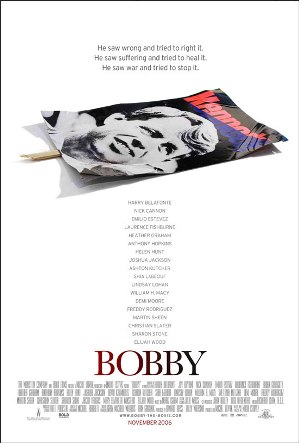
 

Shattered Politics #80: Bobby (dir by Emilio Estevez)


Bobby_poster

A few years ago, I was on twitter when I came across someone who had just watched The Breakfast Club.  

“Whatever happened to Emilio Estevez?” she asked.

Being the know-it-all, obsessive film fan that I am, I tweeted back, “He’s a director.”

Of course, I could not leave well enough along.  I had to send another tweet, “He directed a movie called Bobby that got nominated for bunch of Golden Globes.”

“Was it any good?” she wrote back.

“Never seen it,” I wrote back, suddenly feeling very embarrassed because, if there’s anything I hate, it’s admitting that there’s a film that I haven’t seen.

However, Shattered Politics gave me an excuse to finally sit down and watch Bobby.  So now, I can now say that I have watched this 2006 film and … eh.

Listen, I have to admit that I really hate giving a film like Bobby a lukewarm review because it’s not like Bobby is a bad film.  It really isn’t.  As a director, Emilio Estevez is a bit heavy-handed but he’s not without talent.  He’s good with actors.  Bobby actually features good performances from both Lindsay Lohan and Shia LaBeouf!  So, give Estevez that.

And Bobby is a film that Estevez spent seven years making.  It’s a film that he largely made with his own money.  Bobby is obviously a passion project for Estevez and that passion does come through.  (That’s actually one of the reasons why the film often feels so heavy-handed.)

But, with all that in mind, Bobby never really develops a strong enough narrative to make Estevez’s passion dramatically compelling.  The film takes place on the day of the 1968 Democratic California Presidential Primary.  That’s the day that Robert F. Kennedy won the primary and was then shot by Sirhan Sirhan in the kitchen of the Ambassador Hotel.  However, it never seems to know what it wants to say about Kennedy or his death, beyond the fact that Estevez seems to like him.

(Incidentally, it’s always interesting, to me, that Dallas is still expected to apologize every day for the death of JFK but Los Angeles has never had to apologize for the death of his brother.)

Estevez follows an ensemble of 22 characters as they go about their day at and around the Ambassador Hotel.  As often happens with ensemble pieces, some of these characters are more interesting than others.

For instance, Anthony Hopkins plays a courtly and retired doorman who sits in the lobby and plays chess with his friend Nelson (Harry Belafonte).  It adds little to the film’s story but both Hopkins and Belafonte appear to enjoy acting opposite each other and so, they’re fun to watch.

Lindsay Lohan plays a woman who marries a recently enlisted soldier (Elijah Wood), the hope being that his marital status will keep him out of Vietnam.  The problem with this story is that it’s so compelling that it feels unfair that it has to share space with all the other stories.

Christian Slater plays Darrell, who runs the kitchen and who spends most of the movie talking down to the kitchen staff, the majority of whom are Hispanic.  Darrell is disliked by the hotel’s manager (William H. Macy) who is cheating on his wife (Sharon Stone).

And then, you’ve got two campaign aides (Shia LaBeouf and Brian Geraghty) who end up dropping acid with a drug dealer played by Ashton Kutcher.  Unfortunately, Estevez tries to visualize their trip and it brings the film’s action to a halt.

Estevez himself shows up, playing the husband of an alcoholic singer (Demi Moore).  And Estevez’s father, Martin Sheen, gets to play a wealthy supporter of Kennedy’s.  Sheen’s wife is played by Helen Hunt.  She gets to ask her husband whether she reminds him more of Jackie or of Ethel.

(Actually, Martin Sheen and Helen Hunt are cute together.  Much as with Lohan and Wood, you wish that more time had been devoted to them and their relationship.)

And there are other stories as well.  In fact, there’s far too many stories going on in Bobby.  It may seem strange for a girl who is trying to review 94 films in three weeks to say this but Emilio Estevez really tries to cram too much into Bobby.

At the same time, too much ambition is better none.  Bobby may have been a misfire but at least it’s a respectable misfire.

Shattered Politics #77: Thank You For Smoking (dir by Jason Reitman)


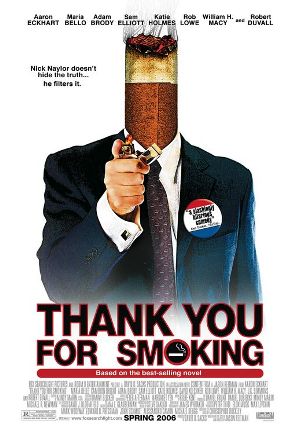
Thank_you_for_smoking_PosterI have always hated those Truth.com commercials.  Truth.com is an organization that claims to be dedicated to eradicating smoking.  Their smug commercials are essentially the height of hipster douchebaggery, a bunch of self-consciously cool people wandering around and harassing random people about whether or not they smoke.  And then, of course, there was the commercial where they all gathered outside a tobacco company and pretended to be dead.  Of course, the truth about Truth.com is that they are essentially the same people who, in high school, would get offended whenever anyone wore a short skirt.  I really can not stand people like that.  (And don’t even get me started on those assholes who appear in the Above The Influence commercials.)  Myself, I don’t smoke because I have asthma.  But, seriously, whenever I see a Truth.com commercial, I’m tempted to run down to 711 and start.

And so maybe that’s why I like the 2005 comedy Thank You For Smoking.

The hero of Thank You For Smoking is Nick Naylor (Aaron Eckhart), a lobbyist for the tobacco industry, who is first seen appearing on a talk show and winning over a hostile audience by announcing that the tobacco industry is going to be investing millions in researching way to keep young people from smoking and shaking the hand of a teenage honor student who is dying from lung cancer.  Over the course of the film, Nick shows us how he does business, everything from defending tobacco companies on talk shows to convincing a former Marlboro Man-turned-cancer-patient to drop his law suit.  When Nick isn’t working, he’s hanging out with his best friends (who are lobbyists for both the liquor and the gun industries), trying to bond with his son (Cameron Bright), or having sex with a reporter (Katie Holmes).

Now, in most movies, Nick Naylor would be the villain.  However, in Thank You For Smoking, Nick becomes a hero by default, if just because everyone who disagrees with him is even worse than he is.  Add to that, Nick has the benefit of being played by Aaron Eckhart while all of his opponents are played by balding actors with ugly beards.

Another reason that I liked Thank You For Smoking was because the main villain was a senator from Vermont and it’s about time somebody stood up to the tyranny of Vermont.  Ortolan Finistirre (William H. Macy) has built a career out of campaigning against the tobacco industries and why shouldn’t he?  Who, other than Nick Naylor, is willing to defend them?  Finistirre’s latest plan is to change the law so that every pack of cigarettes has to be branded with a skull and crossbones warning.

When Nick and Finistirre finally face off, it’s a battle between those who believe in allowing people the freedom to make their own choices and those who hide their totalitarian impulse behind claims that they’re working for the greater good.

Thank You For Smoking was Jason Reitman’s first film.  And while it may be a bit too episodic and it frequently struggles to maintain a consistent tone, it’s still a lot better than both Labor Day and Men, Women, & Children.

6 Late Film Reviews: 300: Rise of Empire, About Last Night, Adult World, Jersey Boys, Ride Along, and Trust Me


Well, the year is coming to a close and I’ve got close to 50 films that I still need to review before I get around to making out my “Best of 2014” list.  (That’s not even counting the films that I still have left to see.  December is going to be a busy month.)  With that in mind, here are late reviews of 6 films that I saw earlier this year and had yet to get around to reviewing.

300_Rise_of_an_Empire

1) 300: Rise of an Empire (dir by Noam Munro)

Last night, I watched 300: Rise of an Empire for the second time and I still couldn’t figure out what exactly is going on for most of the film.  I know that there’s a lot of fighting and a lot of bare-chested men yelling and, whenever anyone swings a sword, they suddenly start moving in slow motion and dark blood spurts across the screen like Jackson Pollock decorating a previously blank canvas.  The style of 300 has been co-opted by so many other films that 300: Rise of an Empire feels more like an imitation than a continuation.

At the same time, I’m resisting the temptation to be too critical of 300: Rise of the Empire for two reasons.  First off, this movie wasn’t really made to appeal to me.  Instead, this is a total guy film and, much as I have every right to love Winter’s Tale, guys have every right to love their 300 movies.  Secondly, 300: Rise of an Empire features Eva Green as a warrior and she totally kicks ass.

About_Last_Night_One_Sheet

2) About Last Night (dir by Steve Pink)

Obviously, I made a big mistake this Valentine’s Day by insisting that my boyfriend take me to see Endless Love.  (I still stand by my desire to see Winter’s Tale.)  I say this because I recently watched this year’s other big Valentine’s Day release, About Last Night, and I discovered that it’s a funny and, in its way, rather sweet romantic comedy.

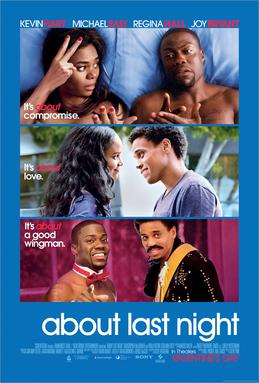
About Last Night tells the story of two couples, Danny (Michael Ealy) and Debbie (Joy Bryant) and Bernie (Kevin Hart) and Joan (Regina Hall).  All four of the actors have a very real chemistry, with Hart and Hall bringing the laughs and Ealy and Bryant bringing the tears.  The film itself is ultimately predictable but very likable.

Adult_World

3) Adult World (dir by Scott Coffey)

In Adult World, Emma Roberts plays Amy Anderson, an aspiring author and recent college graduate.  Despite her own overwhelming faith in her own abilities, Amy struggles to find a job outside of college.  She is finally reduced to working at Adult World, a small adult bookstore.  Working at the store, she befriends the far more down-to-earth Alex (Evan Peters) and eventually discovers that one of her customers is also her idol, poet Rat Billings (John Cusack).  Amy proceeds to force her way into Rat’s life, volunteering to work as his assistant and declaring herself to be his protegé.  However, it turns out that Rat is far less altruistic than Amy originally thought (and with a name like Rat, are you surprised?).

Adult World is a flawed film but I still really enjoyed it.  The story has a few problems and the film never really takes full narrative advantage of Adult World as a setting but the entire film is so well-acted that you’re willing to forgive its flaws.  Cusack gives a surprisingly playful performance while Evan Peters is adorable in a Jesse Eisenberg-type of way.  Emma Roberts shows a lot of courage, playing a character who is both infuriating and relatable.

Jersey_Boys_Poster

4) Jersey Boys (dir by Clint Eastwood)

Clint Eastwood’s upcoming American Sniper has been getting so much attention as a potential Oscar contender that it’s easy to forget that, at the beginning of the year, everyone was expecting Jersey Boys to be Eastwood’s Oscar contender.  In fact, it’s easy to forget about Jersey Boys all together.  It’s just one of those films that, despite its best efforts, fails to make much of an impression.

Jersey Boys is based on one of the Broadway musicals that tourists always brag about seeing.  It tells the true story of how four kids from the “neighborhood” became the Four Seasons and recorded songs that have since gone on to appear on thousands of film soundtracks.  The period detail is a lot of fun, Christopher Walken, who has a small role as a local gangster, is always entertaining to watch, and the music sounds great but Eastwood’s direction is so old-fashioned and dramatically inert that you don’t really take much away from it.

Hopefully, American Sniper will be the work of the Eastwood who made Mystic River and not the Eastwood who did Jersey Boys.

Ride_Along_poster

5) Ride Along (dir by Tim Story)

School security guard Ben Barber (Kevin Hart) wants to marry Angela (Tiki Sumpter) but Angela’s tough cop brother James (Ice Cube) doesn’t approve.  In order to prove himself worth, Ben goes on a ride along with James and the results are just as generic as you might expect.  Probably the only really funny part of the film was the way that Hart delivered the line, “You’re white!  You don’t fight!” but we all saw that in the commercial so who cares?

On the plus side, Ice Cube has a lot of screen presence and is well-cast as James.  As for Kevin Hart — well, he should probably be thankful that About Last Night came out a month after Ride Along.

Trust Me

6) Trust Me (dir by Clark Gregg)

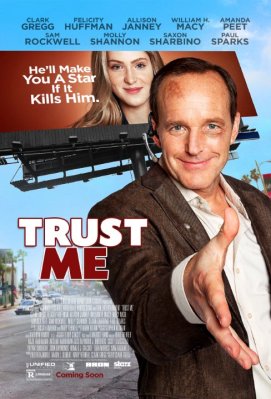
In Trust Me, Clark Gregg both directs and stars.  He plays Howard, a fast-talking but ultimately kind-hearted talent agent who mostly represents children.  After losing some of his most popular clients to rival agent Aldo (a hilariously sleazy Sam Rockwell), Howard meets Lydia (Saxon Sharbino), a 13 year-old actress.  Soon, Howard is representing Lydia and trying to land her a starring role in a major production.  Howard also finds the time to tentatively date his next door neighbor (Amanda Peet).  However, there’s more to Howard than meets the eye.  He is haunted by the death of one of his previous clients and his guilt leads him to become especially protective of Lydia.  When Howard concludes that Lydia is being sexually abused by her crude father (Paul Sparks), he attempts to protect her from both him and the Hollywood system that’s threatening to corrupt her.  It all leads to an oddly tragic conclusion…

I say “oddly tragic” because Trust Me is, in many ways, an odd film.  As a director, Gregg gets good performances from his cast but he never manages to find a consistent tone.  The film starts as a Hollywood satire and then it becomes a romantic comedy and then it turns into a legal drama before then becoming an all-0ut attack on the way the entertainment industry treats child actors and then finally, it settles on being a tragedy.  As a result, Trust Me is undeniably a bit of a mess.

And yet, it’s a compelling mess and the film itself is so heart-felt that you can’t help but forgive its flaws.  If nothing else, it proves that Clark Gregg is capable of more than just being Marvel’s Agent Coulson.

44 Days of Paranoia #16: Wag the Dog (dir by Barry Levinson)


For today’s entry in the 44 Days of Paranoia, we’re taking a look at Barry Levinson’s 1997 political satire, Wag The Dog.

Wag the Dog opens with a White House in crisis.  With two weeks to go until the Presidential election, it’s been discovered that the incumbent President has had a brief dalliance with a girl scout.  Up until the scandal became public, the President was enjoying at 17 point lead in the polls.  Now, that lead is about to evaporate unless something can be done to keep the American public from thinking about the President’s personal life.

Significantly, the President himself never appears on-screen.  We never learn his position on the issues.  We never hear about anything he’s done during his first term.  We don’t even know what political party he belongs to.  (However, his opponent is played by Craig T. Nelson so I’m going to assume that the President is a Democrat.  Because, seriously, it’s hard for me to imagine Nelson being anything other than a Republican…)  The President remains a shadowy and insubstantial figure who, in the end, represents nothing.

Instead of getting to know the President, we instead spend the film with the aides who have to clean up after his mess.  One of those aides, Winifred Ames (Anne Heche), calls in a legendary (and rather sinister) political PR man, Conrad Bean (Robert De Niro).  Conrad announces that the only way to save the campaign is to distract the American public with a quick and totally fake war with Albania.  Why Albania?  According to Conrad, Albania has a sinister name and nobody knows anything about it.

To help create this fake war, Conrad recruits Hollywood film producer, Stanley Motts (a hilariously manic Dustin Hoffman).  Much as Conrad is a legend in politics, Stanley is a legend in Hollywood.  Stanley enthusiastically jumps into the project of creating a fake war of Albania, manufacturing everything from fake war footage to patriotic songs to anything else necessary to rally the American public.  Denis Leary shows up as a mysterious figure known as the Fad King and schemes how to make war with Albania the latest trend.  Willie Nelson sings a song to stir the spirit of every patriotic American.  A very young Kirsten Dunst is recruited to play a terrified orphan in staged Albanian atrocity footage.  A shell-shocked vet (Woody Harrelson) is cast as the Albanian War’s first hero.  Stanley greets every problem with an enthusiastic exclamation of, “This is nothing!”

Along the way, a rather odd friendship develops between the secretive Conrad and the overly verbose Stanley.  However, when Stanley, who often laments that he’s never won an Oscar, starts to complain about the fact that he’s never going to get any recognition for his “greatest production,” Conrad finds himself forced to reconsider their relationship.

Wag the Dog was first released in 1997 and, thanks to David Mamet’s darkly comedic script and Barry Levinson’s brisk direction, the film feels incredibly prophetic.  Indeed, all the film needs is for someone to mention making the war a trending topic and it would be impossible to tell that it was made 16 years ago.  Wag the Dog accomplishes the best thing that any political satire can hope to accomplish: it makes you question everything.  Whenever one watches a news report triumphantly bragging about the latest done strike, it’s hard not to feel that Stanley Motts would approve.

Other entries in the 44 Days Of Paranoia:

  1. Clonus
  2. Executive Action
  3. Winter Kills
  4. Interview With The Assassin
  5. The Trial of Lee Harvey Oswald
  6. JFK
  7. Beyond The Doors
  8. Three Days of the Condor
  9. They Saved Hitler’s Brain
  10. The Intruder
  11. Police, Adjective
  12. Burn After Reading
  13. Quiz Show
  14. Flying Blind
  15. God Told Me To

2 Trailers: The Sessions and Alex Cross


A frequently asked question: When is John Hawkes going to win an Oscar?

Ever since I first saw Winter’s Bone back in 2010, I’ve wondered just when exactly John Hawkes is going to finally win an Oscar.  Unfortunately, he did not win for Winter’s Bone and his chilling work in Martha Marcy May Marlene was ignored.  This year, however, he’s back with The Sessions.  In this film, Hawkes plays a 38 year-old man who is confined to an iron lung and who is attempting to lose his virginity with the help of William H. Macy and Helen Hunt.

The Sessions has been getting a lot of buzz since it premiered on Sundance.  That, quite frankly, makes me wary because I’ve come to learn that you have to take Sundance acclaim with a grain of salt.  If Cannes is where people go to be insanely critical, Sundance has a deserved reputation for going overboard when it comes to praise.  However, I will take a chance on anything featuring John Hawkes and, just judging from the trailer, it looks like both The Sessions and John Hawkes could be contenders when it comes time to hand out Oscar nominations.

A less frequently asked question: When is Tyler Perry going to win an Oscar?

Most people would probably answer that question by replying, “Never,” and they could very well be correct.  I have to admit that I’ve never actually sat through any of Tyler’s Perry’s films and, to be honest, I’ve never really had any desire to.  That said, I’ve always been fascinated by Perry’s success and I can’t help but admire the fact that he’s not shy when it comes to self-promotion.

In the upcoming Alex Cross, Tyler Perry will step into a role that was previously played by Morgan Freeman and, if nothing else, it’ll add fuel to the debate as to whether or not Perry is a legitimate acting talent or just a smart businessman.  To be honest, the trailer for Alex Cross plays less like a movie trailer and more like a commercial for a movie on Chiller.  I think that’s largely because of the presence of TV-movie mainstays like Matthew Fox and John C. McGinley.  Still, chances are, Alex Cross will be the first exposure that I (and a lot of other people) get to Tyler Perry as an actor as opposed to just a personality. 

Lisa Marie Gets On Top of The Lincoln Lawyer (dir. by Brad Furman)


When I’m not writing about movies or reality television, I work for a lawyer.  Some people would describe me as being a receptionist but personally, I prefer the term office administrator.  (Actually, what I’d really prefer would be to have people refer to me as “Dr. Bowman,” but that’s in the future.)  As a result of my job, I’ve become jaded as far as “legal thrillers” are concerned.  The fact of the matter is that most lawyers aren’t slick, most trials aren’t exciting, and most surprise witnesses will probably have their testimony ruled inadmissable.  (Assuming, of course, that the testimony is allowed in the first place.  It won’t be.)  Add to that, attorney-client privilege is always presented as being some sort of grave and somber power like the one ring to unite them all.*

All of the usual legal thriller elements show up in Brad Furman’s new film, The Lincoln Lawyer.  Slick attorneys, melodramatic courtroom theatrics, and a lot of discussion about attorney-client privilege, The Lincoln Lawyer has them all but, fortunately, director Furman presents these cliches with so much energy and such a fine attention to detail that you don’t really mind the fact that you’ve seen this movie a hundred times in the past.

In the Lincoln Lawyer, Matthew McConaughey plays a lawyer who operates from the backseat of his car and who finds himself hired to defend a spoiled rich kid (Ryan Phillippe) who has been accused of raping a prostitute.  After McConaughey takes the case, it quickly becomes apparent to both him and his lead investigator (a nicely eccentric turn from William H. Macy) that not only is Phillippe guilty but he’s a serial murderer as well.  Phillippe, however, quickly reveals that he doesn’t care if McConaughey knows that he’s guilty.  After all, since McConaughey is Phillippe’s lawyer now, McConaughey can’t go to the police. 

Ryan Phillippe makes for an imposing villain and Margarita Leviera (she played Lisa P. in Adventureland) also gives a sympathetic performance as his latest victim.  However, the film is really a showcase for Matthew McConaughey who is at his full McConaugheyness here.  Not only do you believe him as the type of lawyer who would operate out of the backseat of a car but you also totally buy it when he has to deliver potentially awkward lines like, “I’m trying to set things right!”  This is probably his best performance to date, one in which all the bad acting habits of the past are totally appropriate for the character.  If nothing else, The Lincoln Lawyer is worth seeing if just for Matthew McConaughey.

——

*Seriously, if you call up your lawyer and tell him that you’re planning on trying to blow up California in three weeks, attorney-client privilege isn’t going to protect you.  So, don’t do it.