Icarus File No. 29: 1776 (dir by Peter R. Hunt)


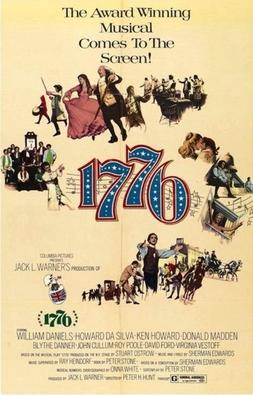
The year is 1776.  The British have landed in Canada and are now marching towards New York with the intention of putting down a revolultion that has sprung up over issues like unfair taxation.  In Philadelphia, John Adams (William Daniels) is frustrated by the refusal the second Continental Congress to take up debate on whether or not the 13 North American colonies should announce their official independence from Britian.  Every day, Adams steps into the chamber and demands that the Congress take some action.  And, every day, his fellow deletates sing, “Sit down, John!”

Yes, you read that correctly.  They sing it.

Based on a 1969 Broadway musical, 1776 features a lot of singing, a lot talking, and not much else.  This is a film about the debate surrounding the writing of the Declaraiton of Independence that sometimes feels as if it’s telling its story in real time.  It’s no shock when Benjaming Franklin (Howard Da Silva) continually falls asleep at his desk or when Thomas Jefferson (Ken Howard) sings that he’d rather be home.  This is a nearly 3-hour film that feels like 3 months.  Some films about the Revolutionary War emphasize the brilliance of the Founding Fathers.  Some films emphazie the struggle to be free.  Other films emphasize the daily violence of serving in the army.  1776 captures the monotony of being trapped in a room full of cranky middle-aged men who will not stop talking.  The film dutifully captures every debate and controversy.  When John Adams shouts at everyone to get on with it, it’s hard not to sympathize until you realize that Adams himself is a huge reason why nothing ever seems to get done.  There’s only so many hours in the day that can be devoted to singing songs.

Perhaps the most shocking thing about 1776 is that it was realsed in 1972.  Nothing about 1776 suggests that it’s a product of the same era in which Bob Fosse was redefining the musical with Caberet and Francis Ford Coppola was refefining the historial epic with The Godfather and John Boorman was risking the lives of Burt Reynolds and Jon Voight to capture a weekend rafting trip.  There’s nothing about Peter R. Hunt’s direction to suggest that this film was made in the same era that saw Robert Altman playfully reinventing genres ranging from the service comedy to the detective film to the ensemble musical.  At a time when American directors were rebelling against convention and experimenting with new ways to tell stories, 1776 is a lengthy, dramatically inert and stagebound Broadway adaptation.  In style and look, it feels like a cinematic product of the 1950s or the early 60s, a film that was made when Hollywood’s only competition was from television.  Even Thomas Jefferson’s longing for his wife (Blythe Danner) is played discreetly.  When she finally does show up in Philadelphia, Jefferson closes the shudders.  When John Adams and Benjamin Franklin notice that the shudders are still closed hours later, it’s treated as a moment for everyone in the audience to turn red as they try not to giggle.  They’re having sex, the audience is meant to think, Good thing they’re married!  It’s a moment that feels as natural and human as Sandra Dee looking over her shoulder and winking as she goes off with Troy Donahue.

The key to understanding 1776 is to be found in the opening credits.  “Produced by Jack Warner.”  By the time 1776 went into production, Warner had been a Hollywood mogul for 54 years.  He started his career in the silent era and he built Warner Brothers into one of Hollywood’s most successful studios.  When he was younger, he was the one breaking the rules, making gangster movies and turning actor like James Cagney, Humphrey Bogart, and Edward G. Robinson into stars.  However, by the time he made 1776, Warner was the last of a dying breed.  Despite having greenlit Bonnie and Clyde, one of the seminal “Now Hollywood” productions, the older Jack Warner had little use for the Hollywood counterculture.  1776 was reportedly a pet project for Jack Warner, a film that he took a strong hand in producting and which he expected would sweep the box office and the Oscars.  Warner recruited the majority of the show’s Broadway cast to appear in the film.  Warner personally ordered the remove of a musical number that seemed to discreetly critcize the Vietnam War.  Warner even went on TV to promote the film.  During an interview on the Merv Griffin Show, Warner launched into a triade about “pinko commies.”  I imagine Warner had a point about the communists but it still was probably not the right way to promote the film in the 1970s.  While other films invited the counterculture into Hollywood, 1776 was essentially Jack Warner shouting, “Stay off my lawn!” with the voice of William Daniels.

1776 was a last attempt to hold onto the old way of making movies.  It was a film about a revolution that was desgined to thwart another revolution.  The Continental Congress was menaced by the British.  Jack Warner was menaced by the shadows of Coppola, Scorsese, and Friedkin.  It would be Jack Warner’s final film as a producer.  He died in 1974, still one of the towering figures in the history of Hollywood.  Of the old time moguls, only Adolph Zuker and Darryl F. Zanuck outlasted Jack Warner.

When Hamilon first came out in 2025, it was often described as being the antidote to 1776Hamilton was entertaining where 1776 was stodgy.  Well, maybe.  1776 may lack great songs but it doesn’t really have any truly bad ones either.  Instead, it’s just a very middle-of-the-road show, inoffensive and designed to keep the tourits happy.  Hamilton was viewed as being revolutionary when it was released but now it feels a bit gimmicky, with both the show and the almost religious initial enthusiasm for it feeling like somewhat embarassing artifacts from a different era.  (From the coverage during the Hamilton’s heyday, you would think no one but Lin-Manuel Miranda had ever written about Alexander Hamilton or Aaron Burr before.)  There is a great film to be made about the Continental Congress but it probably doesn’t invovle any singing.

As for 1776, William Daniels is amusing when he gets frusrated and Blythe Danner is far prettier than the real Martha Jefferson and the film itself is a forgettable tribute to the great men who foudned a great country.
Previous Icarus Files:

  1. Cloud Atlas
  2. Maximum Overdrive
  3. Glass
  4. Captive State
  5. Mother!
  6. The Man Who Killed Don Quixote
  7. Last Days
  8. Plan 9 From Outer Space
  9. The Last Movie
  10. 88
  11. The Bonfire of the Vanities
  12. Birdemic
  13. Birdemic 2: The Resurrection 
  14. Last Exit To Brooklyn
  15. Glen or Glenda
  16. The Assassination of Trotsky
  17. Che!
  18. Brewster McCloud
  19. American Traitor: The Trial of Axis Sally
  20. Tough Guys Don’t Dance
  21. Reach Me
  22. Revolution
  23. The Last Tycoon
  24. Express to Terror 
  25. 1941
  26. The Teheran Incident
  27. Con Man
  28. Looker

On-Stage On The Lens: Hamlet From The Lunt-Fontaine Theater (dir by Bill Colleran and John Gielgud)


That Richard Burton is today best-remembered for his tumultuous marriages to Elizabeth Taylor and for his performances in several less-than-worthy films is unfortunate as Burton was also one of the most highly regarded staged actors of his generation.  In fact, late in his life, Burton often expressed regret that he had ever left the stage for films to begin with.

In 1964, Burton played Hamlet on Broadway, in a production that was directed by John Gielgud.  (Gielgud also provided the voice of the Ghost.)  This is a video-recording of both that production and Burton’s acclaimed performance.  Burton brings an intense and almost divine madness to the role.  Watching, one can see why Burton would have preferred to have been remembered for this instead of for playing Mark Antony.


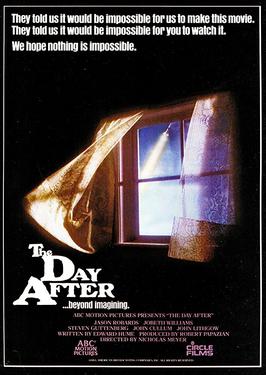
Film Review: The Day After (dir by Nicholas Meyer)


“This is Lawrence. This is Lawrence, Kansas. Is anybody there? Anybody at all?”

The words of Joe Huxley (John Lithgow) hang over the ending of The Day After, a 1983 film that imagines what the aftermath of a nuclear war would be like not on the East or the West Coasts but instead in the rural heartland of America.  Huxley is a professor at the University of Kansas and, as he explains early on in the film, Kansas would be an automatic target in any nuclear war because it houses a number of missile silos.  When he explains that, it’s in an almost joking tone, largely because the missiles haven’t been launched yet.  Instead, the only thing we’ve heard are a few barely noticed news stories about growing tensions between America and Russia.  About halfway through The Day After, the bombs go off and there are suddenly no more jokes to be made.

When the bombs drop over Kansas, we watch as cities and field and people burst into flames.  In a matter of minutes, several thousands are killed.  I’m almost ashamed to admit that I was probably more upset by the image of a horse being vaporized than I was by the death of poor Bruce Gallatin (Jeff East), the college student who was planning on marrying Denise Dahlberg (Lori Lethin).  I guess it’s because horses — really, all animals — have nothing to do with the conflicts between nations.  Humans are the ones who take the time to build bigger and better weapons and The Day After is one of the few films about war that’s willing to acknowledge that, when humans fight, it’s not just humans that die.

The bombing sequence is lengthy and I have to admit that I was a bit distracted by the fact that I recognized some of the footage from other movies.  A scene of panicked people running through a building was taken from Two-Minute Warning.  A scene of a building exploding and a construction worker being consumed by flames was lifted from Meteor.  As well, there’s some stock footage which should be familiar to anyone who has ever seen a documentary about the early days of the Cold War.  Still, despite that, it’s an effective sequence simply because it’s so relentless.  Some of the film’s most likable characters are vaporized before our eyes.  Steve Guttenberg, of all people, is seen ducking into a store.

Guttenberg plays Stephen Klein, a pre-med student who manages to survive the initial attack and takes shelter with the Dahlberg family at their ranch.  At first, it’s a bit distracting to see Steve Guttenberg in a very serious and very grim film about the nuclear apocalypse but he does a good job.  The sight of him losing both his teeth and his hair carries a punch precisely because he is reliably goofy Steve Guttenberg.

If the film has a star, it’s probably Jason Robards, the doctor who witnesses the initial blast from the safety of his car and then treats the dying in Lawrence, Kansas.  He does so, despite the fact that he doesn’t know if his wife, son, and daughter are even still alive.  He continues to do so until he also falls ill with radiation poisoning.  Knowing that he’s dying, he heads home just to discover that there is no home to return to.

Home is reccuring theme throughout The Day After.  Everyone wants to return to their home but everyone’s home has been wiped out.  “This is my home,” Jim Dahlberg (John Cullum) tries to explain before he’s attacked by a group of feral nomads.  Home no longer exists and trying to pretend like life can go back to the way it once was is an often fatal mistake.

Real happy film, right?  Yeah, this isn’t exactly a film that you watch for fun.  I have to admit that I made a joke about how I wouldn’t want to die while wearing the unfortunate blue jumpsuit that Jason Robards’s daughter chooses to wear on the day of the nuclear attack and I felt guilty immediately.  (Well, not that guilty.  Seriously, it was a terrible fashion choice.)  The Day After is a film that gives audiences zero hope by design.  It was made at a time when it was generally assumed that nuclear was inevitable and it was designed to scare the Hell out of everyone watching.  And while I can’t attest to how audience may have reacted in 1983, I can say that, in 2020, it’s still a powerful and disturbing film.

“Is anybody there? Anybody at all?” Joe Huxley asks and by the end of the film, the answer doesn’t matter.  The damage has already been done.

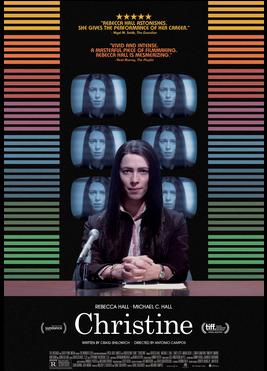
The Things You Find on Netflix: Christine (dir by Antonio Campos)


I really regret that I didn’t get a chance to see Christine when it played here last year.  I wanted to but the movie was only in theaters for a week and then it vanished.

I guess I shouldn’t be too surprised that Christine didn’t become a blockbuster.  I imagine that most potential viewers were turned off by the fact that 1) it wasn’t a remake of the movie about the killer car and 2) it was based on the true story of a reporter who, in 1974, committed suicide on live television.  I imagine that, to many people, the film sounded like it would be indescribably sad.  It certainly sounded that way to me.  That’s why, when the movie opened at the Dallas Angelika, I said, “I’ll see it next week.”  Of course, by the time “next week” rolled around, the movie was gone.

And that’s a shame.  I just watched Christine on Netflix and I discovered that it was one of the best films of 2016.  Yes, it is a sad film but it’s also a frequently fascinating one.  The movie may tell the story of a tragedy but it’s anchored and enlivened by a brilliant performance from Rebecca Hall.  People who love movies, of course, already know that Rebecca Hall is a brilliant actress but, unfortunately, she rarely gets the roles in the films that she deserves.  As of this writing, her most financially successful film was probably The Town and, in that film, she was pretty much wasted in a nothing role.  She is perfectly cast in Christine, perhaps as perfectly cast as any performer could ever hope to be.

Rebecca Hall plays Christine Chubbuck, a reporter who was based in Sarasota, Florida.  In 1974, she started a newscast by announcing, “”In keeping with Channel 40’s policy of bringing you the latest in ‘blood and guts’, and in living color, you are going to see another first—attempted suicide.”  She then drew a gun from a shopping bag that was sitting behind the anchor desk.  As thousands watched, she shot herself in the back of the head.

Along with the gun, the shopping bag had contained the homemade puppets that Christine used whenever she volunteered at the local children’s hospital.  On the anchor desk, among her papers, was a news report that she had written the previous night, announcing that “Local news personality Christine Chubbuck” had shot herself on live television and had been taken to the hospital in critical condition.  Christine, who was reportedly frustrated both personally and professionally, was briefly the number one story in the nation.

One of the more interesting things about the suicide of Christine Chubbuck is that it happened in 1974, long before YouTube, Facebook Live, or Twitter.  Chubbuck’s suicide was only aired once and the footage has subsequently vanished.  If Christine Chubbuck, or anyone else, committed suicide on television today, it would immediately be all over the internet.  We would end up seeing, at the very least, clips of it on an almost daily basis.  Sadly, we would see it so much that we would probably become desensitized to it.  Since Christine Chubbuck’s death was recorded but remains unseen, both she and her suicide have achieved an almost mythical quality.  One can look at the details of Christine Chubbuck’s death and see almost anything that they want.

Christine follows the last few months of Chubbuck’s life.  As played by Rebecca Hall, Christine is confident enough that she can imagine interviewing Richard Nixon but insecure enough to obsess over whether she was nodding too much while the imaginary President gave his imaginary answer.  She lives with her mother (J. Smith-Cameron), a self-described hippie who keeps making references to a breakdown that Christine had in Boston.  When she complains about the pressure that she’s under to sensationalize the news, her boss dismisses her with “You’re a feminist!”  (He says it like an accusation.)  When she gives in and purchases a police scanner so that she can find the stories that the boss is demanding, she ends up spending most of her night listening to two cops brag about “how far” they got with their girlfriends the night before. When she goes to the doctor to complain about chronic stomach pain, she’s told that she has to have an ovary removed and she’ll probably never be able to conceive.  When she thinks that she finally has a date with the man who she’s been crushing on, she is instead dragged to an empty-headed encounter group.  Her group partner has a slick answer for every problem that Christine has until Christine says that she’s thirty and she’s still a virgin.

“Oh,” her partner replies, flummoxed.

In the film, Christine struggles with both depression and, in my opinion, bipolar disorder as well.  Unfortunately, for her mental well-being, she’s a woman in 1974.  The only thing that the world has to offer her are vapid self-affirmation (“I’m okay, you’re okay!  I’m okay, you’re okay!” one co-worker chants at a particularly dramatic moment) and sexist bosses who dismiss what is clearly a manic episode as either “being moody” or “being difficult.”  Speaking as someone who is very sensitive as to how mental health issues are portrayed onscreen, all I can say is that Christine gets it right.

I’m probably making this film sound like the most depressing movie ever made and it’s definitely not a happy film.  I had tears in my eyes by the end of it.  At the same time, it’s also a compulsively watchable character study.  Rebecca Hall gives such a good and brave performance as Christine that you can’t look away, even when you feel like you should.  Rebecca Hall is also ably supported by Michael C. Hall, Tracy Letts, Morgan Spector, Timothy Simons, and Maria Dizzia, who all play her sometimes sympathetic, sometimes annoyed co-workers.

Now, I do think that I should warn anyone from thinking that Christine is a 100% accurate look at Christine Chubbuck’s life and death.  The film left me so moved that I actually did some research and I came across this article from the Washington Post — Christine Chubbuck: 29, Good-Looking, Educated, A Television Personality. Dead. Live and in Color.  After reading the profile, it was easy to see that the film did take some dramatic license.  However, it was also easy to see that Christine gets the essence of the story right.

If, like me, you missed Christine in the theaters, you can now see it on Netflix.  And you should!

6 Late Film Reviews: 300: Rise of Empire, About Last Night, Adult World, Jersey Boys, Ride Along, and Trust Me


Well, the year is coming to a close and I’ve got close to 50 films that I still need to review before I get around to making out my “Best of 2014” list.  (That’s not even counting the films that I still have left to see.  December is going to be a busy month.)  With that in mind, here are late reviews of 6 films that I saw earlier this year and had yet to get around to reviewing.

300_Rise_of_an_Empire

1) 300: Rise of an Empire (dir by Noam Munro)

Last night, I watched 300: Rise of an Empire for the second time and I still couldn’t figure out what exactly is going on for most of the film.  I know that there’s a lot of fighting and a lot of bare-chested men yelling and, whenever anyone swings a sword, they suddenly start moving in slow motion and dark blood spurts across the screen like Jackson Pollock decorating a previously blank canvas.  The style of 300 has been co-opted by so many other films that 300: Rise of an Empire feels more like an imitation than a continuation.

At the same time, I’m resisting the temptation to be too critical of 300: Rise of the Empire for two reasons.  First off, this movie wasn’t really made to appeal to me.  Instead, this is a total guy film and, much as I have every right to love Winter’s Tale, guys have every right to love their 300 movies.  Secondly, 300: Rise of an Empire features Eva Green as a warrior and she totally kicks ass.

About_Last_Night_One_Sheet

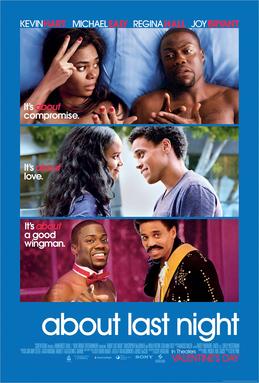
2) About Last Night (dir by Steve Pink)

Obviously, I made a big mistake this Valentine’s Day by insisting that my boyfriend take me to see Endless Love.  (I still stand by my desire to see Winter’s Tale.)  I say this because I recently watched this year’s other big Valentine’s Day release, About Last Night, and I discovered that it’s a funny and, in its way, rather sweet romantic comedy.

About Last Night tells the story of two couples, Danny (Michael Ealy) and Debbie (Joy Bryant) and Bernie (Kevin Hart) and Joan (Regina Hall).  All four of the actors have a very real chemistry, with Hart and Hall bringing the laughs and Ealy and Bryant bringing the tears.  The film itself is ultimately predictable but very likable.

Adult_World

3) Adult World (dir by Scott Coffey)

In Adult World, Emma Roberts plays Amy Anderson, an aspiring author and recent college graduate.  Despite her own overwhelming faith in her own abilities, Amy struggles to find a job outside of college.  She is finally reduced to working at Adult World, a small adult bookstore.  Working at the store, she befriends the far more down-to-earth Alex (Evan Peters) and eventually discovers that one of her customers is also her idol, poet Rat Billings (John Cusack).  Amy proceeds to force her way into Rat’s life, volunteering to work as his assistant and declaring herself to be his protegé.  However, it turns out that Rat is far less altruistic than Amy originally thought (and with a name like Rat, are you surprised?).

Adult World is a flawed film but I still really enjoyed it.  The story has a few problems and the film never really takes full narrative advantage of Adult World as a setting but the entire film is so well-acted that you’re willing to forgive its flaws.  Cusack gives a surprisingly playful performance while Evan Peters is adorable in a Jesse Eisenberg-type of way.  Emma Roberts shows a lot of courage, playing a character who is both infuriating and relatable.

Jersey_Boys_Poster

4) Jersey Boys (dir by Clint Eastwood)

Clint Eastwood’s upcoming American Sniper has been getting so much attention as a potential Oscar contender that it’s easy to forget that, at the beginning of the year, everyone was expecting Jersey Boys to be Eastwood’s Oscar contender.  In fact, it’s easy to forget about Jersey Boys all together.  It’s just one of those films that, despite its best efforts, fails to make much of an impression.

Jersey Boys is based on one of the Broadway musicals that tourists always brag about seeing.  It tells the true story of how four kids from the “neighborhood” became the Four Seasons and recorded songs that have since gone on to appear on thousands of film soundtracks.  The period detail is a lot of fun, Christopher Walken, who has a small role as a local gangster, is always entertaining to watch, and the music sounds great but Eastwood’s direction is so old-fashioned and dramatically inert that you don’t really take much away from it.

Hopefully, American Sniper will be the work of the Eastwood who made Mystic River and not the Eastwood who did Jersey Boys.

Ride_Along_poster

5) Ride Along (dir by Tim Story)

School security guard Ben Barber (Kevin Hart) wants to marry Angela (Tiki Sumpter) but Angela’s tough cop brother James (Ice Cube) doesn’t approve.  In order to prove himself worth, Ben goes on a ride along with James and the results are just as generic as you might expect.  Probably the only really funny part of the film was the way that Hart delivered the line, “You’re white!  You don’t fight!” but we all saw that in the commercial so who cares?

On the plus side, Ice Cube has a lot of screen presence and is well-cast as James.  As for Kevin Hart — well, he should probably be thankful that About Last Night came out a month after Ride Along.

Trust Me

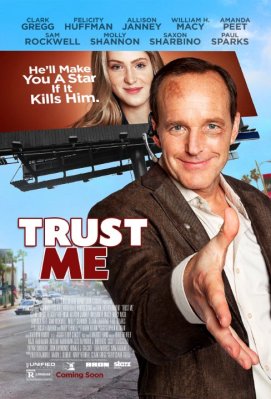
6) Trust Me (dir by Clark Gregg)

In Trust Me, Clark Gregg both directs and stars.  He plays Howard, a fast-talking but ultimately kind-hearted talent agent who mostly represents children.  After losing some of his most popular clients to rival agent Aldo (a hilariously sleazy Sam Rockwell), Howard meets Lydia (Saxon Sharbino), a 13 year-old actress.  Soon, Howard is representing Lydia and trying to land her a starring role in a major production.  Howard also finds the time to tentatively date his next door neighbor (Amanda Peet).  However, there’s more to Howard than meets the eye.  He is haunted by the death of one of his previous clients and his guilt leads him to become especially protective of Lydia.  When Howard concludes that Lydia is being sexually abused by her crude father (Paul Sparks), he attempts to protect her from both him and the Hollywood system that’s threatening to corrupt her.  It all leads to an oddly tragic conclusion…

I say “oddly tragic” because Trust Me is, in many ways, an odd film.  As a director, Gregg gets good performances from his cast but he never manages to find a consistent tone.  The film starts as a Hollywood satire and then it becomes a romantic comedy and then it turns into a legal drama before then becoming an all-0ut attack on the way the entertainment industry treats child actors and then finally, it settles on being a tragedy.  As a result, Trust Me is undeniably a bit of a mess.

And yet, it’s a compelling mess and the film itself is so heart-felt that you can’t help but forgive its flaws.  If nothing else, it proves that Clark Gregg is capable of more than just being Marvel’s Agent Coulson.