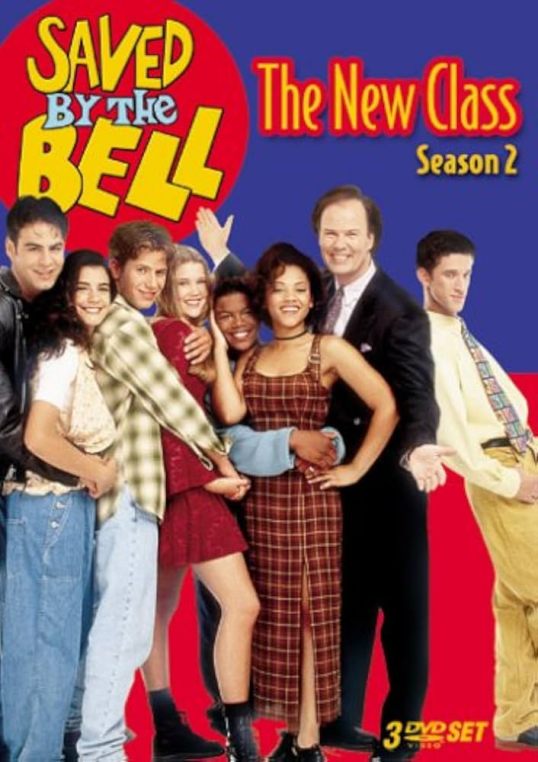
Retro Television Review: Saved By The Bell: The New Class 2.4 “Blood Money”


Welcome to Retro Television Reviews, a feature where we review some of our favorite and least favorite shows of the past!  On Tuesdays, I will be reviewing Saved By The Bell: The New Class, which ran on NBC from 1993 to 2o00.  The show is currently on Prime.

This week, it’s time to learn a lesson about giving blood.

Episode 2.4 “Blood Money”

(Dir by Don Barnhart, originally aired on September 17th, 1994)

Megan is running the school blood drive but no one wants to give blood.  Mr. Belding tries to teach everyone a lesson by volunteering but he’s informed by nurse Penny Brady (Emma Caulfield) that he has high cholesterol.  Not only does Belding need to start an exercise regimen but he’s apparently too fat to chaperone the school’s hiking trip.

Not wanting the school’s butch gym teacher to chaperone the trip, Brian decides that Screech should be the chaperone.  However, Screech is depressed because he has a crush on Penny but he can’t work up the courage to ask her out.  Brian tells Penny that he’ll get everyone in the school to donate blood if she agrees to go out with Screech….

Ugh.  This is another Screech-is-in-love episode.  Dustin Diamond was nowhere near as bad during season 2 as he would be in later seasons but still, watching the previously asexual Screech date someone is not a pleasant experience.  Penny discovers that she actually likes Screech (why?) but then Screech hears that she was bribed to go out with him and he gets his feelings hurt.

BUT WHAT ABOUT THE HIKING TRIP?

Seriously, screw the hiking trip.  Why is this school always sponsoring a trip somewhere?  Just give people their diplomas and stay out of their lives….

Oh no, Tommy D’s previously unseen best friend was in a motorcycle accident!  And he has a very rare blood type!  Only Screech can save him!  Screech gives blood, everyone apologizes for setting him up, and Screech agrees to chaperone the trip and to continue dating Penny.  I’m going to guess that didn’t last since Screech ended up dating Allison while working at the country club over the summer.

Meanwhile, some poor biker has gallons of Screech inside of him.

What an episode.  The whole problem with the first season is that the students were not very likable.  Now, the show actually has likable students but all of the attention is on Screech.  It’s like this show just wanted to fail!

Hero Of The Day: Leo Kessler (Ten To Midnight)


“Jerry, I’m not a nice person. I’m a mean, selfish son-of-a-bitch. I know you want a story, but I want a killer and what I want comes first!”

— Detective Leo Kessler (Charles Bronson) in Ten To Midnight (1983)

At first, Detective Leo Kessler seems like exactly the type of cop that you would expect to find in a film about a serial killer who knows how to manipulate the system to his advantage.  Kessler is tough, plain-spoken, a blue collar warrior who is trying to keep the streets of Los Angeles safe for citizens of every age.

“I remember when the legal meant lawful,” Kessler says, “Now, it means loophole.”

Kessler isn’t thrilled that his new partner, Paul McAnn (Andrew Stevens), is a graduate of Berkley and that he’s got a degree in sociology.  Kessler’s doubts are actually justified.  One of the first things that McAnn does is drop a wad of chewing gum on the ground at a crime scene.  Kessler also knows that Warren Stacy (Gene Davis) is the psycho who has been targeting young women and making obscene phone calls to his daughter, Laurie (Lisa Eilbacher).  When McAnn discovers that Kessler has planted blood evidence on Warren’s clothes, McAnn is torn about what to do.  “Forget what’s legal,” Kessler says, “and do what’s right.”

But here’s the thing with Kessler.  He may say that he’s a mean son of a bitch but he’s not.  He’s actually a pretty nice guy.  He even discovers that he likes and becomes a mentor to McAnn.  Kessler just doesn’t think that someone like Warren Stacy should be wandering around, free to kill.  Charles Bronson never gets nearly enough credit for his acting.  Leo Kessler isn’t just a touch cop.  He’s an old-fashioned guy in a changing world.  He’s someone who doesn’t understand why the system is suddenly more worried about the Warrn Stacys of the world than the victims.

He’s also a father.

Leo: “I hate quiche.”

Laurie: “Why did you get it?”

Leo: “I thought it was pie.”

As violent and exploitive as From 10 To Midnight is, I have to admit that I have a sentimental attachment to the film.  The difficult-but-loving relationship between Leo and Laurie Kessler reminds me of my own relationship with my Dad.  I see a lot of my Dad in Leo and I also see a lot of myself in Laurie.  There’s a scene early on where McAnn mentions to Laurie that she’s a lot like her father.

“You think so?” Laurie replies, “I don’t.”

That scene gets me every time because I’ve had people say the same thing to me about my Dad and I used to have the same response.  Everyone else picked up on it long before I realized it.  For all of Laurie complaints about Leo having always been too busy for her, she’s there to comfort him after he gets kicked off the force.  “I’m getting drunk with my old man,” Laurie says.  Leo replies that she’s not.

It’s rare to see Charles Bronson cast as a family man.  Usually, he played loners, the type of solitary warriors who seemed to have nothing in their lives beyond doing accomplishing whatever their mission happened to be.  The Death Wish films did give Bronson a family but they were all dead by the end of the second film.  10 To Midnight features Bronson as not just a tough cop but also Bronson as a father with an independent and intelligent daughter.  I think that’s the main reason why 10 to Midnight is my favorite Bronson films.

“No, we won’t.”

— Detective Leo Kessler

Bronson only fires his gun once in 10 To Midnight but he definitely makes a statement with that shot.  And after spending 101 minutes watching Kessler trying to stop Warren Stacy, there’s definitely something very cathartic about the simple brutality of the film’s ending.  Trying to analyze or understand evil, the film tells us, is pointless.

Sometimes, you just need someone who is willing to say, “No, we won’t.”

Hero of the Day

Late Night Retro Television Review: CHiPs 5.21 “The Game of War”


Welcome to Late Night Retro Television Reviews, a feature where we review some of our favorite and least favorite shows of the past!  On Mondays, I will be reviewing CHiPs, which ran on NBC from 1977 to 1983.  The entire show is currently streaming on Prime!

This week …. it’s jet pack time!

Episode 5.21 “The Game of War”

(Dir by Gordon Hessler, originally aired on March 14th, 1982)

While the members of the Highway Patrol try and fail to beat Harlan at chess, Peter J. Stoler (Clu Gulager) plots a prison break.  Stoler is one of the leading members of a group of former soldiers.  On the weekends, they engage in war games.  During the week, they plot to spring their former leader, Rascoe (Johnny Seven), from prison.  Peter has just received a jet pack.  Unless the Highway Patrol can stop them, Rascoe is going to fly to freedom.

Meanwhile, a process server named Darla Mason (Sandra Kerns) goes to ludicrous lengths to serve her targets.  She pretends to have car trouble.  She wears old person makeup.  She does whatever she needs to do to get her target to lower their defenses so that she can hand them their court papers and say, “You’ve been served.”  Process servers are a necessary part of our legal system but I’ve never cared much for any of the ones that I’ve known.  It takes a certain amount of cruelty to get close to someone just so you can give them a summons.  Darla is a fairly annoying character and I certainly wasn’t upset when Rascoe’s militia abducted her.  And when the episode ended with her getting served, it felt like poetic justice.

This episode was nothing special but it held my attention.  I mean, how can you not enjoy a little jet pack action?  Clu Gulager was actually somewhat sympathetic as the main bad guy.  Personally, I think Ponch and Baker should have let him go.  Just give him his jet pack and let him fly away.  He didn’t mean any harm!

Seriously, they should have given Clu his own show.


Retro Television Review: Crime Story 1.5 “The War”


Welcome to Retro Television Reviews, a feature where we review some of our favorite and least favorite shows of the past!  On Mondays, I will be reviewing Crime Story, which ran on NBC from 1986 to 1988.  The entire show can be found on Tubi!

This week, Luca has to prove himself.

Episode 1.5 “The War”

(Dir by Leon Ichaso, originally aired on October 7th, 1986)

Luca is in trouble.

Last week’s episode ended with Max Goldman on the receiving end of a beating from Noah Ganz’s goons.  Goldman survives and returns with a message.  Ganz is not happy that Luca tried to steal his book.  Bartoli, Weisbord, and Fosse all inform Luca will have to resolve the Ganz situation on his own.

Luca tries to get public defender David Abrams (Stephen Lang) to act as a negotiator for him but David doesn’t want to get involved in the mobster lifestyle that made his father rich.  David just wants to defend the poor and play sax in a jazz club.  When Luca is attacked while driving in Chicago, he realizes that negotiating with Ganz is a dead end.

Instead, he just kills Ganz.  In a bravura sequence, Luca shows up at a hotel and, with the help of sniper, takes down Ganz’s bodyguards.  Then he uses a bomb to take out Ganz while the latter is holding court in an elevator.  A plume of white smoke puffs out of the hotel’s exhaust vent.

Having taken care of the issue, Luca is welcomed back into the family.  Weisbord says, “Call me Mac.”  Fosse (played by Michael Madsen) nods and slowly smokes a cigarette.

Meanwhile, Torello’s wife miscarries.  This is the episode that features the clip of Torello walking down a lonely Chicago street on a rainy night.  (The clip is prominently featured during the show’s opening credits.)  In fact, both Torello and Luca end up spending a good deal of time walking around at night while David Abrams plays his saxophone.  It’s a scene that is so overstylized that it shouldn’t work but somehow, it does.  If nothing else, it reminds us that Crime Story of two dangerously obsessed men on a collision course.

This was a good episode, if just because it showed that Luca can be a clever criminal when he needs to be.  Before this episode, Luca seemed to be clearly outmatched by Torello.  With this episode, Luca proved himself to be Torello’s equal.

Villain of the Day: Emilio Barzini (The Godfather)


Emilio Barzini.

As played by Richard Conte in The Godfather, Barzini is far different from many of the other mob bosses that we meet over the course of Mario Puzo’s and Francis Ford Coppola’s Mafia epic.  He doesn’t yell.  He doesn’t threaten.  If anything, Barzini comes across as almost being a statesman.  When it’s time to broker a peace between the Tattaglia and the Corleone families, Barzini is the one who sits at the head of the table.  When it’s time to determine how the drug trade will be divided, Barzini is the one who offers up the “sensible” solution.  Barzini keeps calm.  He knows how to deal with volatile people.  He just wants to make sure that peace is restored and everyone gets a fair cut of the profit.  “We are not communists,” he says.

It’s after that meeting that Vito Corleone finally realizes that everything that has happened, from the nearly successful attempt on his life to the exile of Michael to the death of Santino, was Barzini’s doing.  Barzini perhaps a got a bit too clever for his own good.  By so coolly and efficiently brokering the peace, Barzini revealed that was far more clever than the “pimp” Philip Tattaglia.  Whereas Tattaglia was too crude to put together a coalition against the Corleones, Barzini was just the type of pitiless manipulator who could convince a group of otherwise powerful people to sign away their own futures.  Perhaps he was a communist after all.

Of course, most viewers (and readers) will have figured out that Barzini is the main bad guy long before Vito does.  From the first minute that we see Barzini at the wedding reception at the Corleone Compound, we know that he’s a sinister figure.  While everyone else at the wedding is being emotional, sentimental, and delightfully Italian, Barzini watches without a hint of emotion.  Indeed, the only time we see any real emotion from Barzini is when he smirks at Vito’s funeral.

After his goons unsuccessfully attempt to assassinate Don Vito, Sollozzo famously tells Tom Hagen that “the Don was slipping.”  And it’s hard not to feel that Sollozzo had a point.  Consider Vito Corleone’s track record in The Godfather.  He failed to teach Sonny the basics of being a good Don.  He promoted Tom Hagen to consiglieri despite the fact that Tom was viewed as being an outsider by the other Families.  When it came time to send someone undercover to investigate the Tattaglias, he gave the job to Luca Brasi despite the fact that everyone knew there was no way that Brasi would actually betray Vito.  He stopped to buy fruit, despite not being accompanied by his bodyguards.  Worst of all, Vito somehow missed that it was Barzini all along.  Vito was slipping.  He got complacent.  He failed to see how the world was changing and how the old honor system was being discarded.  That allowed him to be victimized by Barzini.

Fortunately, Michael was there to take charge.  Unfortunately, for Barzini, Al Neri was also there to put on his policeman’s uniform and wait for Barzini to exit from his latest meeting.  Barzini took several bullets to the back.  Barzini’s driver was caught in the cross-fire.  I’ve always felt bad about that.  I mean, the driver was just asking why he had been given a parking ticket and Neri shot him.  If nothing else, we can see why Neri didn’t make it as a cop.

Barzini and Vito had a lot in common.  They were both diplomats who could use violence when necessary.  It’s perhaps not a surprise to learn that, before he was cast as Barzini, Richard Conte was one of the many actors considered for the role of Vito Corleone.  How different would the film have been with the sinister Conte — as opposed to the likable Brando — in the lead role?

Luckily, Coppola made the right decision. Just as Brando was the perfect Vito, Richard Conte was the perfect Barzini.

Villain of the Day

Film Review: Brainstorm (dir by Douglas Trumbull)


It’s hard to imagine that someone could overact while playing a corpse but Louise Fletcher somehow manages to do just that in 1983’s Brainstorm and I think we owe her some respect for that.  The underrated Fletched won an Oscar for playing Nurse Ratched in One Flew Over The Cuckoo’s Nest and she appeared in a handful of other films that I’ve liked (Strange Behavior, the 2012 restoration of Once Upon A Time In America) but, now that I’ve watched Brainstorm, I will always think of her playing a dead character with the biggest, hammiest facial expression ever on her otherwise lifeless face.

In Brainstorm, Fletcher plays Dr. Lillian Reynolds, a chain-smoking scientist who is always upset about something.  When Lillian isn’t lighting a cigarette or yelling, “You sold me out!,” she’s clutching her chest and taking her heart pills.  Working with her partner, Dr. Michael Brace (Christopher Walken), Lillian has developed a brain-computer interface that allows people’s brain waves to be recorded on tape so that others can then experience what they experienced.  In practice, this looks like putting on a helmet and then seeing what appears to be a home movie.  What fun!  Lillian thinks that the interface can be used to change and save the world.  Dr. Brace thinks he can use the interface to discover why his marriage to Karen (Natalie Wood) fell apart.  Their associate, Hal (Joe Dorsey), thinks he can use it to experience his friend screwing the babysitter over and over and over again.  Meanwhile, Alex Taber (Cliff Robertson) thinks that it can be used as a military weapon.

(Hal is probably the one who comes the closest to what people would actually use this technology for.)

Lillian is not happy about her technology being turned over to the military.  She gets upset about it over and over again.  Eventually, she suffers one of the most overdramatic heart attacks ever recorded on film.  Before she dies, she hooks herself up to the machine and records her dying vision.  Michael becomes obsessed with seeing what Lillian saw as she entered the afterlife.  Unfortunately, the mean military folks have the tape so it looks like Michael is going to have to unleash some chaos.  I can’t think of any other film that mixes Christopher Walken having a beatific vision with a bunch of slapstick humor featuring an out-of-control robot and a bunch of soap bubbles.

Today, if Brainstorm is known for anything, it’s as the film that Natalie Wood was shooting when she died.  One popular theory about the circumstances surrounding Wood’s death is that she was having an affair with Christopher Walken.  Watching the two of them in this film should disabuse anyone of that notion as the two of them have absolutely zero chemistry as a couple.  (For the record, I think Wood’s death was an accident and that a lot of self-styled Internet sleuths owe Robert Wagner an apology.)  If there’s anything that this film should be known for, it should be that it features a large number of Oscar nominees and winners and they all end up giving absolutely lousy performances.  Even the usually wonderful Christopher Walken seems to be playing someone imitating himself.  Watching this film, I was never quite sure why anyone was actually doing anything.

Director Douglas Trumbull was best known for designing the Stargate sequence in 2001: A Space Odyssey and, not surprisingly, Brainstorm’s vision of the afterlife is actually pretty effective.  One gets the feeling that Trumbull was more comfortable with the special effects than he was with the human actors.

I have to admit that I always smile a little at films where scientists are shocked — shocked, I tell ya! — to discover that their technology is going to be used for military purposes.  Why did they think the government was funding them in the first place?  Lillian seems to believe that her technology will be used to allow people to experience what it’s like to ride a roller coaster.  That’s what IMAX is for.

Late Night Retro Television Review: Degrassi: The Next Generation 2.18 “Dressed in Black”


Welcome to Late Night Retro Television Reviews, a feature where we review some of our favorite and least favorite shows of the past!  On Sunday, I will be reviewing the Canadian series, Degrassi: The Next Generation, which aired from 2001 to 2015!  The series can be streamed on YouTube and Tubi.

This week, Ashley is back with Jimmy.  But for how long?

Episode 2.18 “Dressed in Black”

(Dir by Gavin Smith, originally aired on January 19th, 2003)

This episode of Degrassi features one of my favorite opening scenes.  Ashley, in full goth mode, sings a depressing and rather overwrought song to Jimmy, who she is finally dating again.  Jimmy listens and is obviously struggling to appear interested.  After Ashley finishes, Jimmy tells her that it was a great song.  Ashley asks him if he really understood it.  Jimmy nods.  Ashley says that she’s going to sing another one.  Jimmy gets a panicked look on his face….

While Ellie has always been the character to whom I’ve related (we’re both reheads!), I have to admit that I was probably more like Ashley in high school.  I wrote my share of emo poetry and I always made sure to ask my friends whether or not they got what I was truly trying to say.  One reason why I would ask was that I really wasn’t sure what I was trying to say.

Anyway, this episode features Ashley and Jimmy back together for a short time.  Unfortunately, Jimmy wants to bring back the old Ashley while Ashley wants to be the new Ashley.  Ashley also has a pretty obvious crush on Craig, who captures her attention by discussing how Shakespeare was actually a misogynistic creep.  For their English class, Jimmy and Hazel and Craig and Ashley are instructed to reinterpret Taming of the Shrew for a modern audience.  Jimmy and Hazel come up with a silly love story, complete with Hazel doing a cheer.  Craig and Ashley interpret the play as a harrowing portrait of domestic abuse.

At the end of the episode, Ashley gives Jimmy a poem and breaks up with him.  I once did the same thing in high school.  I still feel kind of bad about it.  I worked way too hard to make it rhyme.

Meanwhile, after sitting through a sex ed class, Toby and JT buy condoms.  Spinner finds out and, seeing as how Toby is dating Spinner’s adopted sister, he is not amused.  Spinner tells Toby that there’s already too much pressure on young women to be sexually active.  Wow, that’s a good message but also totally out-of-character for Spinner!

This storyline …. eh.  Toby’s storylines were always kind of boring, largely because Toby never got to do much other than try to hide in the hallways.  I’m glad he’s no longer pining over Emma but still, he’s not a particularly interesting character and the writers never seemed to really know what to do with either him or Kendra.

This episode is a lot more interesting if you know that Ashley and Craig are eventually going to become a couple and that Craig’s going to end up on the streets after trying to kill Joey during a manic episode.  And let’s not even talk about the fact that Ashley is going to eventually steal Jimmy’s music and use it to launch her own career.  As a stand-alone episode, it’s a bit blah but it definitely foreshadows the show that Degrassi is going to become.

Retro Television Review: Homicide: Life On The Street 5.11 “The Documentary”


Welcome to Retro Television Reviews, a feature where we review some of our favorite and least favorite shows of the past!  On Sundays, I will be reviewing Homicide: Life On The Street, which aired from 1993 to 1999, on NBC!  It  can be viewed on Peacock.

This week, Brodie reveals his film!

Episode 5.11 “The Documentary”

(Dir by Barbara Kopple, originally aired on January 3rd, 1997)

On December 31st, the detectives are gathered in the squad room and waiting for the big ball to drop in New York.  The phones have not rung all night but, as Munch keeps reminding everyone, that is soon going to change.  Brodie comes in with a VHS tape and shows the detectives the documentary that he’s filmed about them.  Finally, we learn why Brodie has been filming random corners of the station for the past few episodes.

I have to admit that I was expecting this to be a clip show and there is one lengthy montage that is made up of scenes taken from previous episodes.  But, for the most part, the documentary is all new footage.  We watch as Bayliss and Pembleton investigate a murder committed by a mortician who didn’t want people to learn that he was dressing up the dead and posing with them.  (Yikes!)  All of the detectives take a turn explaining how the Miranda rights work, with their dialogue lifted pretty much intact from the David Simon book that inspired the show.  In a parody of Homicide’s signature visual style, the same clip of Lewis and Kellerman walking into a bar is shown three times in a row.  At one point, Lewis, Kellerman, and Brodie chase a suspect and run into a Barry Levinson-led film crew that is filming a show called Homicide.  “Real cops don’t yell ‘freeze,'” Brodie tells Levinson.

It’s a clever episode, made all the more so by the reactions of the detectives watching themselves on screen.  Pembleton confesses to Bayliss that it’s hard for him to watch footage of himself before his stroke because Pembleton doesn’t recognize the young and angry detective that he used to be.  All of the detectives object to footage of them joking about their job.  As the documentary ends, Giardello asks for the original copy for “safe keeping.”  Brodie reveals that he already sold the documentary to PBS.  “You can’t show us joking about dead people!” Munch says.  “It’s an invasion of privacy!” Bayliss says.  Brodie starts to defend himself but then the ball drops, the new year begins, and the phones start ringing.

This was a good ensemble episode.  If, for some reason, you only wanted to watch the later episodes of Homicide, this would be a good one to start with because the documentary re-introduces us to everyone.  Funny, dramatic, and eventually quite emotional, this episode was Homicide at its best.

Song of the Day: Take California by The Propellerheads


“Take California.”

Today’s song of the day is a classic.  Released in 1996, the Propellerheads’s Take California is one of the essential big beat songs.  It was used to good effect in Any Given Sunday.  Was it the song playing when that football player lost his eye?  I really don’t remember.  It should have been, though.

The voices in this song belong to Richard Nixon and comedian (and Lyndon Johnson imitator) Earle Doud.